• Fri frakt över 249 kr
  • •
  • Snabba leveranser
  • •
  • Billiga böcker
Kundservice

Du är på sajten för privatpersoner.

Företag, bibliotek eller offentlig verksamhet?

Du handlar på classic.bokus.com, där alla dina funktioner finns intakta.
Till classic.bokus.com
Bokus logotyp. Gå till startsidan.
  • Erbjudanden
  • Nyheter
  • Student
  • Topplistor
  • Barn & ungdom
  • Bokus Play
  • E-böcker
  • Pocketböcker
  • Spel & pussel

10% rabatt på allt med kod NYSTART10 →

Sidfot

Mina sidor

    Hjälp

    • Kundservice
    • Vanliga frågor och svar
    • Frakt och leverans
    • Retur vid ångerrätt
    • Reklamera vara
    • Betalning
    • Köpvillkor
    • Allmänna villkor
    • Information om webbplatsens tillgänglighet

    Om Bokus

    • Om oss
    • Pressrum
    • För studenter
    • För företag
    • För bibliotek och offentlig verksamhet
    • För leverantörer
    • Hållbarhet

    Populärt

    • Aktuella erbjudanden
    • Presentkort
    • Studentlitteratur
    • Nya böcker
    • Topplistor
    • Signerade böcker
    • Engelska böcker

    Inspiration

    • Boktips
    • BookTok
    • Populära bokserier
    • Barnbokskaraktärer
    • Populära författare
    Logotyp för Bokus
    Följ oss på Facebook (extern länk)Följ oss på Instagram (extern länk)Följ oss på YouTube (extern länk)Följ oss på TikTok (extern länk)
    bokus @ CookiesAnpassa cookiesIntegritetspolicyKöpvillkor
    Till Citymail hemsida (extern länk)Till Budbee hemsida (extern länk)Till Postnord hemsida (extern länk)Till Schenker hemsida (extern länk)Till Early Bird hemsida (extern länk)Till Walleys hemsida (extern länk)
    1. Samhälle och politik
    2. Samhälle och kultur
    3. Sociala grupper och identitet

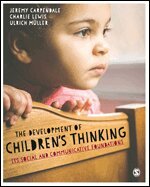
    The Development of Children’s Thinking

    Its Social and Communicative Foundations

    AvJeremy Carpendale,Charlie Lewis

    Häftad, Engelska, 2017

    1 678 kr

    Beställningsvara. Skickas inom 3-6 vardagar. Fri frakt över 249 kr.

    Fler format och utgåvor

    Inbunden

    Tillf. slut

    Beskrivning

    The Development of Children’s Thinking offers undergraduate and graduate students in psychology and other disciplines an introduction to several core areas of developmental psychology. It examines recent empirical research within the context of longstanding theoretical debates. In particular, it shows how a grasp of classic theories within developmental psychology is vital for a grasp of new areas of research such as cognitive neuroscience that have impacted on our understanding of how children develop.

    The focus of this book will be on infancy and childhood, and it looks at:

    • Theories and context of development
    • How developmental psychology attempts to reconcile influences of nature and nurture
    • Communication in infancy as a precursor to later thinking
    • Language development in primates and young children
    • Cognitive and social development, including the child’s understanding of the mind
    • How studies of moral reasoning reflect upon our understanding of development 

    Produktinformation

    • Utgivningsdatum:2017-12-28
    • Mått:186 x 232 x 23 mm
    • Vikt:740 g
    • Format:Häftad
    • Språk:Engelska
    • Antal sidor:416
    • Upplaga:1
    • Förlag:SAGE Publications
    • ISBN:9781446295649

    Utforska kategorier

    • Sociala grupper och identitet inom Samhälle och politik
    • Barnpsykologi och utvecklingspsykologi inom Psykologi och pedagogik

    Mer om författaren

    Jeremy CarpendaleJeremy I. M. Carpendale is Professor of Developmental Psychology at Simon Fraser University, Canada. He has published in the areas of cognitive, social cognitive, and moral development. His work focuses on the nature and development of thinking about social and moral matters and the role of language and social interaction in such development. He is author of How Children Develop Social Understanding (2006 with C. Lewis). He is an editor of several books, including Social Life and Social Knowledge: Toward a Process Account of Development (2008 with U. Müller, N. Budwig, & B. Sokol), The Cambridge Companion to Piaget (2009 with U. Müller & L. Smith), and Self- and Social-Regulation: Social interaction and the development of social understanding and executive functions (2010 with B. Sokol, U. Müller, A. Young, & G. Iarocci).Charlie Lewis is Professor of Family and Developmental Psychology at Lancaster University, United Kingdom. His research focuses on both preschoolers’ social cognitive skills and the influence of family factors on that the nature and development of these skills. He has written or edited sixteen books and several research papers not only on cognitive, social cognitive, and social development in typical children, but also in atypical populations, particularly children with autism. His current research includes studies on the development of executive function skills in preschoolers and children with developmental difficulties. Ulrich MüllerUlrich Müller is a professor of life-span development in the Dept. of Psychology at the University of Victoria. He currently serves as Dept. Chair. Dr. Müller’s research focuses on the development of self-regulation, the contribution of self-regulation to psychological adjustment and academic achievement, and the impact of parent-child interaction on the development of self-regulation. Dr. Müller was awarded the Early Scientific Achievement Award from the Society of Research in Child Development in 2005. He has published widely in journals such as Child Development, Developmental Psychology, and Journal of Experimental Child Psychology. He is co-editor of 7 several books, including the Cambridge Companion to Piaget (2009), Self-Regulation and Autonomy (2013), Social Life and Social Knowledge (2008), and the prestigious Handbook of Child Psychology and Developmental Sciences, Vol. 2: Cognitive processes (7th edition, 2015). ?

    Recensioner i media

    With minimal jargon, clear language, and plenty of examples, the authors offer both a tour of social and communicative development, as well as a comprehensive argument regarding how development should be conceptualized. Drawing from relational views of development tracing back from George Herbert Mead, Jean Piaget, and Lev Vygotsky, to more modern thinkers and theories, this book argues convincingly for placing the developing child within a developmental system.Students and other readers will also relish in the organization of the book, which traces development from the first moments infancy to the social complexities of childhood.This text does an excellent job uncovering the assumptions that underlie theories in development psychology, such as those regarding knowledge, meaning, language, and morality. This feature is particularly valuable for students as it provides the tools for evaluating future theories in light of their philosophical assumptions, not just by what empirical evidence there happens to be.

    Innehållsförteckning

    • Chapter 1: Introduction: What is Human Thinking and How Does it Develop?Chapter 2: The Role of Biology in Psychological DevelopmentChapter 3: Constructivist Approaches to Children′s ThinkingChapter 4: Sociocultural Approaches to Children′s ThinkingChapter 5: The Development of Communication and Social Understanding in InfancyChapter 6: Theories of Communication and Social Understanding in InfancyChapter 7: Animal Communication and Human LanguageChapter 8: Language in Human Communication and ThinkingChapter 9: How Children Learn the Meaning of WordsChapter 10: How Children Come to Control Their BehaviourChapter 11: Understanding the Social WorldChapter 12: Social Interaction, Language and Social UnderstandingChapter 13: Moral Reasoning and ActionChapter 14: Recent Issues in Moral Development