• Fri frakt över 249 kr
  • •
  • Snabba leveranser
  • •
  • Billiga böcker
Kundservice

Du är på sajten för privatpersoner.

Företag, bibliotek eller offentlig verksamhet?

Du handlar på classic.bokus.com, där alla dina funktioner finns intakta.
Till classic.bokus.com
Bokus logotyp. Gå till startsidan.
  • Erbjudanden
  • Nyheter
  • Student
  • Topplistor
  • Barn & ungdom
  • Bokus Play
  • E-böcker
  • Pocketböcker
  • Spel & pussel

10% rabatt på allt med kod: NYSTART10 →

Sidfot

Mina sidor

    Hjälp

    • Kundservice
    • Vanliga frågor och svar
    • Frakt och leverans
    • Retur vid ångerrätt
    • Reklamera vara
    • Betalning
    • Köpvillkor
    • Allmänna villkor
    • Information om webbplatsens tillgänglighet

    Om Bokus

    • Om oss
    • Pressrum
    • För studenter
    • För företag
    • För bibliotek och offentlig verksamhet
    • För leverantörer
    • Hållbarhet

    Populärt

    • Aktuella erbjudanden
    • Presentkort
    • Studentlitteratur
    • Nya böcker
    • Topplistor
    • Signerade böcker
    • Engelska böcker

    Inspiration

    • Boktips
    • BookTok
    • Populära bokserier
    • Barnbokskaraktärer
    • Populära författare
    Logotyp för Bokus
    Följ oss på Facebook (extern länk)Följ oss på Instagram (extern länk)Följ oss på YouTube (extern länk)Följ oss på TikTok (extern länk)
    bokus @ CookiesAnpassa cookiesIntegritetspolicyKöpvillkor
    Till Citymail hemsida (extern länk)Till Budbee hemsida (extern länk)Till Postnord hemsida (extern länk)Till Schenker hemsida (extern länk)Till Early Bird hemsida (extern länk)Till Walleys hemsida (extern länk)
    1. Psykologi och pedagogik
    2. Psykologi
    3. Psykologi: jaget, identitet och personlighet

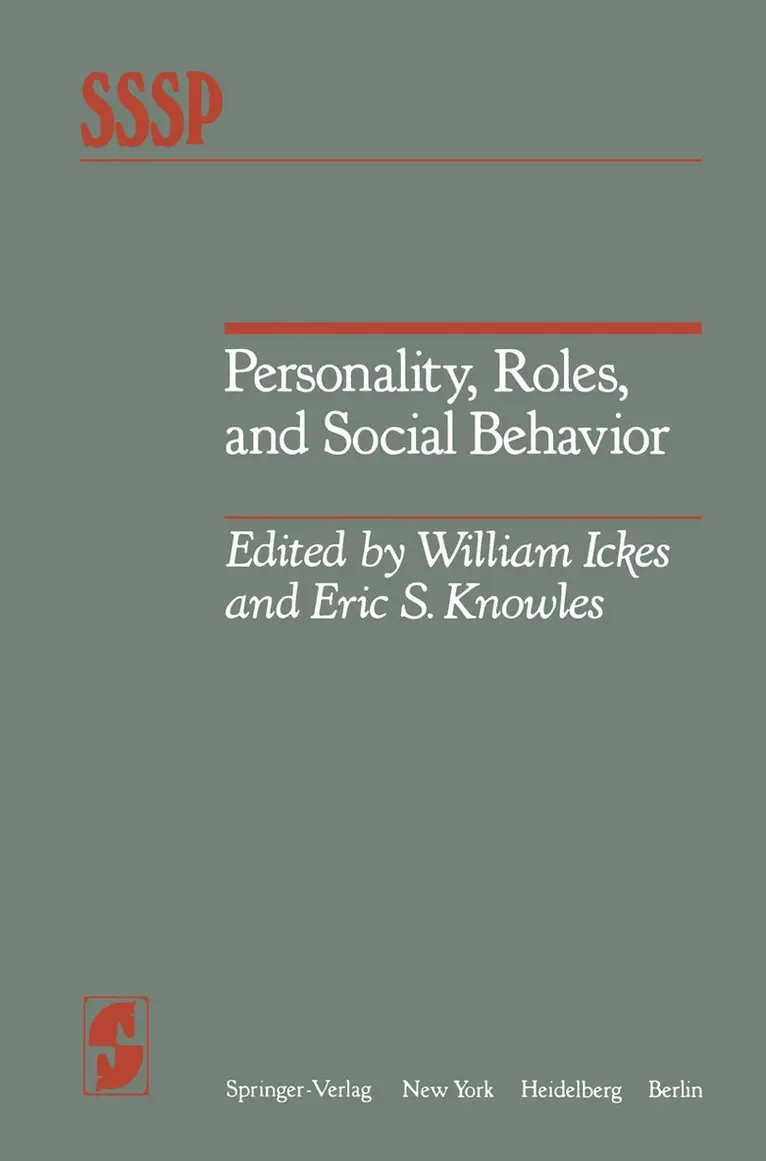
    Personality, Roles, and Social Behavior

    AvW. Ickes,E.S. Knowles

    Häftad, Engelska, 2011

    Del i serien Springer Series in Social Psychology

    531 kr

    Beställningsvara. Skickas inom 10-15 vardagar. Fri frakt över 249 kr.

    Beskrivning

    Personality and Roles: Sources of Regularities in Social Behavior For behavioral scientists, whether they identify primarily with the science of psychology or with that of sociology, there may be no challenge greater than that of discovering regularities and consistencies in social behavior. After all, it is such regularities and consistencies that lend predictability to the behavior of individuals in social contexts-in particular, to those events that constitute dyadic interactions and group processes. In the search for behavioral consistencies, two theoretical constructs have emerged as guiding principles: personality and roles. The theoretical construct of personality seeks to understand regularities and consistencies in social behavior in terms of relatively stable traits, enduring dispositions, and other propensities (for example, needs, motives, and attitudes) that are thought to reside within individuals. Because it focuses primarily on the features of individuals, the construct of personality is fundamentally psychological in nature. By contrast, the theoretical construct of roles seeks to understand regularities and consistencies in social behavior in terms of the directive influence of coherent sets of rules and prescriptions that are provided by the interpersonal, occupational, and societal categories of which individuals are continuing members. Because it focuses primarily on features of social structures, the construct of roles is fundamentally sociological in nature.

    Produktinformation

    • Utgivningsdatum:2011-12-14
    • Mått:155 x 235 x 21 mm
    • Vikt:581 g
    • Format:Häftad
    • Språk:Engelska
    • Serie:Springer Series in Social Psychology
    • Antal sidor:362
    • Förlag:Springer-Verlag New York Inc.
    • ISBN:9781461394716

    Utforska kategorier

    • Psykologi: jaget, identitet och personlighet inom Psykologi och pedagogik
    • Freudiansk psykologi inom Psykologi och pedagogik
    • Sociologi inom Samhälle och politik

    Innehållsförteckning

    • 1. From Individuals to Group Members: A Dialectic for the Social Sciences.- Gemeinschaft and Gesellschaft.- Dialectical Trends in Role Theory.- Dialectical Trends in Personality.- Dialectical Trends in Group Theory.- Conclusions.- 2. The Origin and Maintenance of Social Roles: The Case of Sex Roles.- Social Structures and Intentional Action.- The Case of Sex Roles.- Conclusions.- 3. Social Roles as Interaction Competencies.- Social Action as a Process of Commodity Exchange.- Structural Frames as Conditions of the Possibility of Face-To-Face Interaction.- Social Roles as Sets of Interaction Competencies.- 4. Determinants of Responsiveness in Dyadic Interaction.- The Nature of Responsiveness.- Consequences of Responsiveness.- Personality and Situational Determinants of the Reactions to Unresponsiveness.- Determinants of Responsiveness.- Attention.- Communication Accuracy.- Response Repertoire.- Motivation.- Conclusions.- 5. Personality and Nonverbal Involvement: A Functional Analysis.- Functions of Nonverbal Behavior.- Nonverbal Involvement and Functional Classification.- Personality Correlates of Nonverbal Involvement.- Functional Analysis of Normal Personality Differences.- Summary.- 6. The Forms of Social Awareness.- Awareness of the Social World.- The Representation of Persons in Thought.- The Instigation of Awareness Forms.- The Social Consequences of Awareness Forms.- Conclusion.- 7. Commitment, Identity Salience, and Role Behavior: Theory and Research Example.- Symbolic Interaction and Identity Theory.- Conclusion.- 8. Loss and Human Connection: An Exploration into the Nature of the Social Bond.- Attachment, Grief, and Loss.- Threads of Human Connectedness.- Patterns of Connectedness and Directions for Research.- 9. Changing Roles, Goals, and Self-Conceptions: Process and Results in a Program for Women’s Employment.- Nature and Scope of the Problem.- Nature of the Career Options Program at Houston Community College.- Characteristics of the Program Participants.- Results: Changes in Self-Conceptions and Development of Occupational Plans During the Program.- Antecedents of Change in the Self-Conception Dimensions.- Summary, Conclusions, and Implications.- 10. Discretionary Justice: Influences of Social Role, Personality, and Social Situation.- The Phenomenon of Discretionary Justice.- A Framework for Understanding Discretionary Justice.- Research Paradigms for Explaining Discretionary Justice.- Studies of Discretionary Justice.- Concluding Thoughts on Analyzing Discretionary Justice.- 11. A Basic Paradigm for the Study of Personality, Roles, and Social Behavior.- Birth of a Paradigm.- Description of the Paradigm.- Specific Applications.- A Preliminary Evaluation.- Additional Applications and Extensions.- Author Index.