E-bok, Engelska, 2012
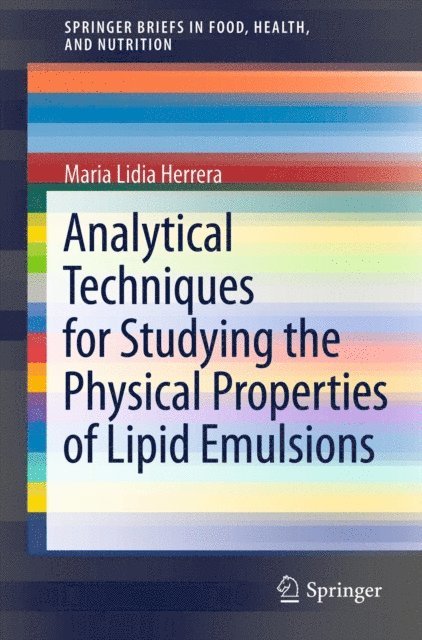
Analytical Techniques for Studying the Physical Properties of Lipid Emulsions
734 kr
Läs direkt i Bokus Reader – eller ladda ned till din enhet (PDF kräver ofta zoom och scroll på små skärmar).
Beskrivning
This book will review old and new methods to study emulsion stability and structure. Examples of emulsion-based foods include ice cream, yoghurt, and mayonnaise. The physicochemical properties of emulsions play an important role in food systems, as they directly contribute to the texture, sensory and nutritional properties of foods. One of the main properties is stability, which refers to the ability of an emulsion to resist physical changes over time. The development of an effective strategy to prevent undesirable changes in the properties of a particular food emulsion depends on the dominant physicochemical mechanism(s) responsible for the changes. In practice, two or more of these mechanisms may operate in concert. It is therefore important for food scientists to identify the relative importance of each mechanism, the relationship between them, and the factors that influence them, so that effective means of controlling the stability and physicochemical properties of emulsions can be established. Several techniques are used to study the physical behavior and structure of emulsions. Each technique has its advantages and disadvantages and provides different insights into the destabilization mechanisms. Among the oldest methods used to study emulsion stability is visual observation and small deformation rheometry. More recently, other techniques, such as ultrasound profiling, microscopy, droplet size distribution, and measurement of surface concentration to characterize adsorbed protein at the interface, have also been employed. Some of these techniques, such as droplet size distribution, involve some form of dilution. However, dilution disrupts some structures that play an important role in stability. The ability to study the stability of food emulsions in their undiluted form may reveal subtle nuances about their stability. Diffusing wave spectroscopy (DWS), laser scanning confocal microscopy (LSCM), nuclear magnetic resonance (NMR), and Turbiscan are among the more powerful, non-perturbing techniques used to characterized emulsions.
Produktinformation
- Utgivningsdatum: 2012-03-05
- Språk: Engelska
- Filformat: PDF
- Kopieringsskydd: LCP
- ISBN: 9781461432562
- Förlag: Springer US
Utforska kategorier
Betyg & recensioner
0 recensioner
Inga recensioner tillgängliga.