• Fri frakt över 249 kr
  • •
  • Snabba leveranser
  • •
  • Billiga böcker
Kundservice

Du är på sajten för privatpersoner.

Företag, bibliotek eller offentlig verksamhet?

Du handlar på classic.bokus.com, där alla dina funktioner finns intakta.
Till classic.bokus.com
Bokus logotyp. Gå till startsidan.
  • Erbjudanden
  • Nyheter
  • Student
  • Topplistor
  • Barn & ungdom
  • Bokus Play
  • E-böcker
  • Pocketböcker
  • Spel & pussel

10% rabatt på allt med kod: NYSTART10 →

Sidfot

Mina sidor

    Hjälp

    • Kundservice
    • Vanliga frågor och svar
    • Frakt och leverans
    • Retur vid ångerrätt
    • Reklamera vara
    • Betalning
    • Köpvillkor
    • Allmänna villkor
    • Information om webbplatsens tillgänglighet

    Om Bokus

    • Om oss
    • Pressrum
    • För studenter
    • För företag
    • För bibliotek och offentlig verksamhet
    • För leverantörer
    • Hållbarhet

    Populärt

    • Aktuella erbjudanden
    • Presentkort
    • Studentlitteratur
    • Nya böcker
    • Topplistor
    • Signerade böcker
    • Engelska böcker

    Inspiration

    • Boktips
    • BookTok
    • Populära bokserier
    • Barnbokskaraktärer
    • Populära författare
    Logotyp för Bokus
    Följ oss på Facebook (extern länk)Följ oss på Instagram (extern länk)Följ oss på YouTube (extern länk)Följ oss på TikTok (extern länk)
    bokus @ CookiesAnpassa cookiesIntegritetspolicyKöpvillkor
    Till Citymail hemsida (extern länk)Till Budbee hemsida (extern länk)Till Postnord hemsida (extern länk)Till Schenker hemsida (extern länk)Till Early Bird hemsida (extern länk)Till Walleys hemsida (extern länk)
    1. Samhälle och politik
    2. Sociologi och antropologi
    3. Sociologi
    • Nyhet

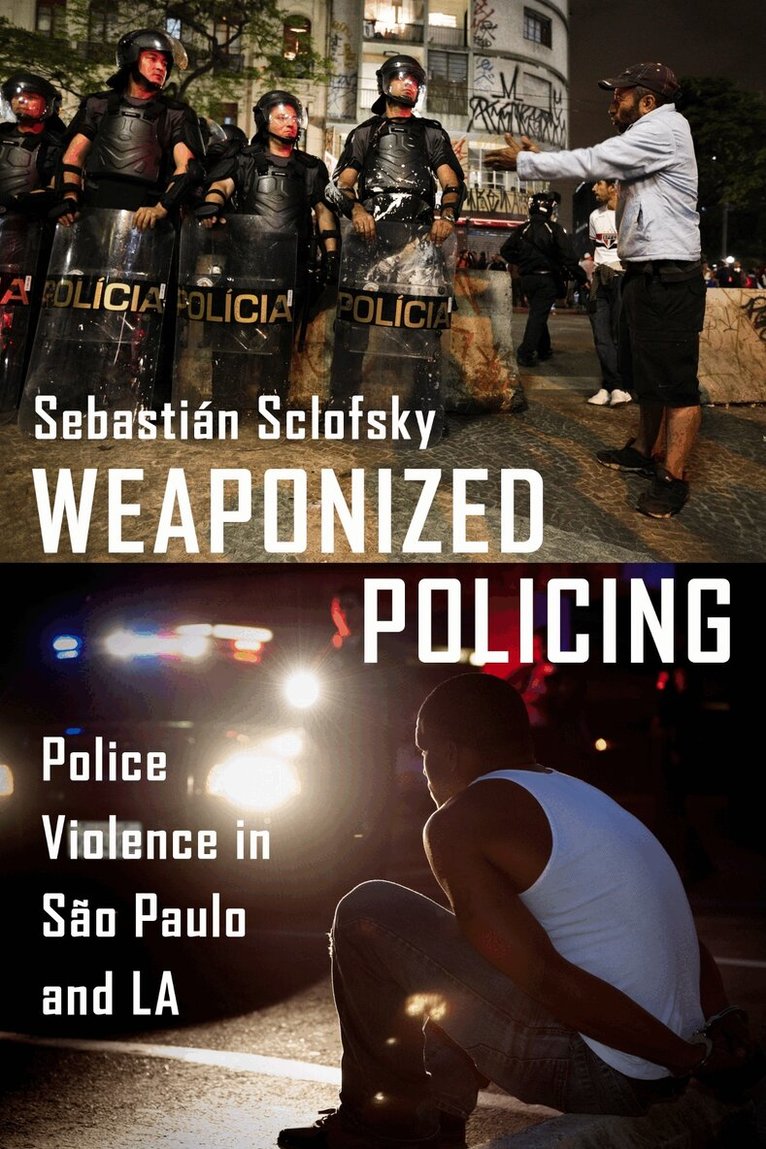
    Weaponized Policing

    Police Violence in São Paulo and LA

    AvSebastián Sclofsky

    Häftad, Engelska, 2026

    302 kr

    Skickas . Fri frakt över 249 kr.

    Fler format och utgåvor

    Inbunden

    1 088 kr

    Beskrivning

    How police reproduce social, spatial, and racial inequalities in two global citiesFrom Donald Trump to Brazil's Jair Bolsonaro, political leaders endorsing "law and order" – specifically through aggressive policing strategies – have supported the formation of carceral states in self-proclaimed democracies. In Weaponized Policing, Sebastián Sclofsky provides a comparative lens on this dynamic, taking a look at police-civilian violence in the United States and Brazil, and its impact on people's understanding of race, space, and citizenship.The book argues that the socio-economic transformations of the last half-century, marked by the rise of neoliberal capitalism, have produced extreme levels of inequality, and created new forms of vulnerability that are managed and reproduced by police. The pacifying processes conducted by the police in their production and reproduction of social order produce the categories of black, poor, and periphery, transforming these subjects into the ultimate "other" against whom police intervention and violence is deemed necessary and justified for the sake of the city's well-being.Drawing on hundreds of interviews with politicians, police officers, community activists, and low-income residents of São Paulo's periphery and neighborhoods in South L.A., Sclofsky follows the stories of individuals who live, and are policed, on the "peripheries." He argues that, in both countries, aggressive policing creates authoritarian enclaves within faulty democracies. As a result, residents of color are criminalized, individual rights are systematically violated, and a sense of second-class citizenship is developed—even when people live in a country where political rights are supposedly guaranteed, and free and fair elections do take place.

    Produktinformation

    • Utgivningsdatum:2026-09-01
    • Mått:152 x 229 x 13 mm
    • Vikt:318 g
    • Format:Häftad
    • Språk:Engelska
    • Antal sidor:232
    • Förlag:New York University Press
    • ISBN:9781479807468

    Utforska kategorier

    • Sociologi inom Samhälle och politik
    • Brottslighet och kriminologi inom Samhälle och politik
    • Politiskt förtryck inom Samhälle och politik

    Mer om författaren

    Sebastián Sclofsky is Associate Professor of Criminal Justice at California State University, Stanislaus.

    Recensioner i media

    "Sebastián Sclofsky prioritizes the voices and experiences of those on the receiving end of police power to demonstrate the transnational reality that policing actively produces racialized inequality through violence, humiliation, and regulation." – Alex S. Vitale, author of The End of Policing "The lives of residents in South L.A. and São Paulo's periphery are marked by terrifying and often dangerous encounters with the police. Based on extensive ethnographic research and hundreds of interviews in Brazil and the United States, Sclofsky's book takes us to neighborhoods turned into authoritarian enclaves, where heavily armed officers routinely use force against poor, Black, and Latino residents, where human rights are shoved aside in the name of security, and where security is understood as protection of the deeply unequal social order. A rare combination of theoretical verve, compassion, and commitment to justice, Weaponized Policing explains why and how police violence persists in democratic societies. It is also a decisive call for change." – Ieva Jusionyte, author of Exit Wounds: How America's Guns Fuel Violence Across the Border "In an extensive analysis ranging from the local to the global, Sclofsky's focus on weaponized policing reveals the many ways in which the police power functions as a war power. The outcome is a major contribution to our understanding of the centrality of state violence in the reproduction of capitalist order." – Mark Neocleous, author of Pacification: Social War and the Power of Police. "Drawing on ethnographic research in São Paulo and South Los Angeles, this book shows how everyday police practices produce distinctions between black and poor subjects considered governable and those framed as persistent threats. Rather than opposing police violence to preventive or community-based strategies, Sclofsky demonstrates how these forms of policing operate together, structuring urban inequality and revealing how state power ultimately determines who is protected, who is controlled, and who is left to die under neoliberal democracy. Through these processes, policing produces populations treated as outsiders to the planned city, reproducing the association of blackness with threat and danger." - Ludmila Ribeiro, author of O "Feijão com Arroz" Do Sistema de Justiça Criminal