• Fri frakt över 249 kr
  • •
  • Snabba leveranser
  • •
  • Billiga böcker
Kundservice

Du är på sajten för privatpersoner.

Företag, bibliotek eller offentlig verksamhet?

Du handlar på classic.bokus.com, där alla dina funktioner finns intakta.
Till classic.bokus.com
Bokus logotyp. Gå till startsidan.
  • Erbjudanden
  • Nyheter
  • Student
  • Topplistor
  • Barn & ungdom
  • Bokus Play
  • E-böcker
  • Pocketböcker
  • Spel & pussel

10% rabatt på allt med kod: NYSTART10 →

Sidfot

Mina sidor

    Hjälp

    • Kundservice
    • Vanliga frågor och svar
    • Frakt och leverans
    • Retur vid ångerrätt
    • Reklamera vara
    • Betalning
    • Köpvillkor
    • Allmänna villkor
    • Information om webbplatsens tillgänglighet

    Om Bokus

    • Om oss
    • Pressrum
    • För studenter
    • För företag
    • För bibliotek och offentlig verksamhet
    • För leverantörer
    • Hållbarhet

    Populärt

    • Aktuella erbjudanden
    • Presentkort
    • Studentlitteratur
    • Nya böcker
    • Topplistor
    • Signerade böcker
    • Engelska böcker

    Inspiration

    • Boktips
    • BookTok
    • Populära bokserier
    • Barnbokskaraktärer
    • Populära författare
    Logotyp för Bokus
    Följ oss på Facebook (extern länk)Följ oss på Instagram (extern länk)Följ oss på YouTube (extern länk)Följ oss på TikTok (extern länk)
    bokus @ CookiesAnpassa cookiesIntegritetspolicyKöpvillkor
    Till Citymail hemsida (extern länk)Till Budbee hemsida (extern länk)Till Postnord hemsida (extern länk)Till Schenker hemsida (extern länk)Till Early Bird hemsida (extern länk)Till Walleys hemsida (extern länk)
    1. Skönlitteratur
    2. Essäer

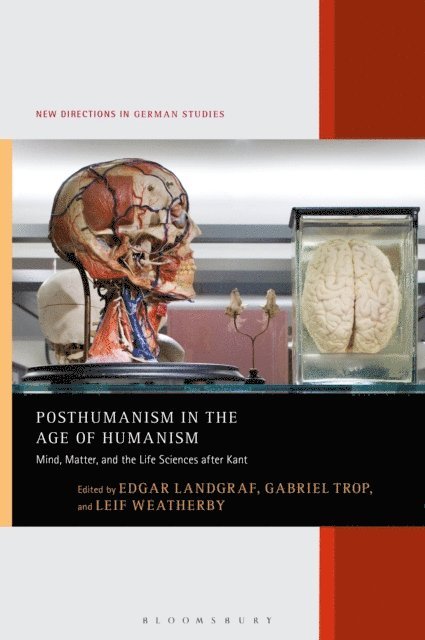
    Posthumanism in the Age of Humanism

    Mind, Matter, and the Life Sciences After Kant

    AvEdgar Landgraf,Gabriel Trop

    E-bok
    Engelska, 2018

    Del i serien New Directions in German Studies

    590 kr

    Läs direkt i Bokus Reader – eller ladda ned till din enhet

    Beskrivning

    The literary and scientific renaissance that struck Germany around 1800 is usually taken to be the cradle of contemporary humanism. Posthumanism in the Age of Humanism shows how figures like Immanuel Kant and Johann Wolfgang Goethe as well as scientists specializing in the emerging modern life and cognitive sciences not only established but also transgressed the boundaries of the “human.” This period so broadly painted as humanist by proponents and detractors alike also grappled with ways of challenging some of humanism's most cherished assumptions: the dualisms, for example, between freedom and nature, science and art, matter and spirit, mind and body, and thereby also between the human and the nonhuman. Posthumanism is older than we think, and the so-called “humanists” of the late Enlightenment have much to offer our contemporary re-thinking of the human.

    Produktinformation

    • Utgivningsdatum:2018-10-04
    • Språk:Engelska
    • Antal sidor:352
    • Filformat:EPUB
    • Kopieringsskydd:LCP
    • ISBN:9781501335686
    • Förlag:Bloomsbury Publishing PLC (Digital)
    • Serie:New Directions in German Studies

    Utforska kategorier

    • Essäer inom Skönlitteratur
    • Litteraturteori inom Skönlitteratur
    • Filosofiska discipliner inom Filosofi och religion

    Mer om författaren

    Edgar Landgraf is Professor of German at Bowling Green State University, USA. He is the author of Improvisation as Art: Conceptual Challenges, Historical Perspectives (Bloomsbury, 2011).Gabriel Trop is Associate Professor in the Department of Germanic and Slavic Languages and Literatures at the University of North Carolina at Chapel Hill, USA. He is the author of Poetry as a Way of Life: Aesthetics and Askesis in the German Eighteenth Century (2015).Leif Weatherby is Assistant Professor of German at New York University, USA. He is the author of Transplanting the Metaphysical Organ: German Romanticism between Leibniz and Marx (2016).

    Recensioner i media

    It is very reassuring to see that the emerging paradigm of posthumanism and the posthuman is beginning to receive some solid critical, historical and genealogical contextualisation. Posthumanism in the Age of Humanism: Mind, Matter, and Life Sciences after Kant is a very welcome extension of the idea of posthumanist prefiguration into the Enlightenment, German Idealism and Romanticism. The contributions to this important collection make an excellent case for locating the beginnings of a critique of anthropocentrism, human exceptionalism, mind-body dualism, unified self and free will within 18th- and 19th-century humanist thought. In doing so, they succeed in painting a more complex, less fashionable, more nuanced and thus more powerful picture of the posthumanist paradigm, while also providing an overdue critical reassessment of German Enlightenment and Romantic thought and their continued influence. The individual contributions take their readers on a fascinating journey through the beginnings of modern life and cognitive sciences, the aesthetic and politics of Romanticism and show how figures like Kant, Herder, Hegel, Humboldt, Kleist, Fichte, Goethe and many others already prepare the terrain for current revisions of materialism, the redefinition of the boundaries between human and nonhuman, the questioning of the role of agency and technology, as well as the rethinking of ecology.

    Innehållsförteckning

    • 1. Introduction: Posthumanism after KantEdgar Landgraf, Gabriel Trop, and Leif WeatherbyI) DISSECTING THE HUMAN BODY: EMBODIMENT, COGNITION, AND THE EARLY LIFE SCIENCES 2. Vertiginous Systems of the SoulJeffrey West Kirkwood, Binghamton University, USA3. Brain Matters in the German Enlightenment: Animal Cognition and Species Difference in Herder, Soemmerring, and GallPatrick Fortmann, University of Illinois at Chicago, USA4. Agency without Humans: Normativity and Path Dependence in the 19th-Century Life Sciences Christian J. Emden, Rice University, USA5. Embodied Phantasy: Johannes Müller and the 19th-Century Neurophysiological Foundations of Critical PosthumanismEdgar Landgraf, Bowling Green State University, USAII) WHO'S AFRAID OF IDEALISM? MATERIALISM, POSTHUMANISM, AND THE POST-KANTIAN LEGACY 6. Kant and PosthumanismCarsten Strathausen, University of Missouri, USA7. Intimations of the Posthuman: Kant's Natural BeautyPeter Gilgen, Cornell University, USA8. Farewell to Ontology: Hegel after HumanismLeif Weatherby, New York University, USA9. Steps to an Ecology of Geist: Hegel, Bateson, and the Spirit of PosthumanismJohn H. Smith, UC Irvine, USA10. Protecting Natural Beauty from Humanism's Violence: The Healing Effects of Alexander von Humboldt's NaturgemäldeElizabeth Millán, DePaul University, USAIII) CYBORG ENLIGHTENMENT: BOUNDARIES OF THE (POST)HUMAN AROUND 1800 11. Posthumanist Thinking in the Work of Heinrich von KleistTim Mehigan, University of Queensland, Australia12. Positing the Robotic Self: From Fichte to Ex MachinaAlex Hogue, Coastal Carolina University, USA13. In Defense of Humanism: Envisioning a Posthuman Future and Its Critique in Goethe's FaustChristian P. Weber, Florida State University, USA13. Beyond Death: Posthuman Perspectives in Christoph Wilhelm Hufeland's Macrobiotics Jocelyn Holland, California Institute of Technology, USA15. The Indifference of the InorganicGabriel Trop, University of North Carolina, USABibliographyNotes on ContributorsIndex