• Fri frakt över 249 kr
  • •
  • Snabba leveranser
  • •
  • Billiga böcker
Kundservice

Du är på sajten för privatpersoner.

Företag, bibliotek eller offentlig verksamhet?

Du handlar på classic.bokus.com, där alla dina funktioner finns intakta.
Till classic.bokus.com
Bokus logotyp. Gå till startsidan.
  • Erbjudanden
  • Student
  • Topplistor
  • Barn & ungdom
  • Bokus Play
  • E-böcker
  • Ljudböcker
  • Pocketböcker
  • Spel och pussel

Pocketfynda! Hundratals böcker för 49 kr/st →

Sidfot

Mina sidor

    Hjälp

    • Kundservice
    • Vanliga frågor och svar
    • Frakt och leverans
    • Retur vid ångerrätt
    • Reklamera vara
    • Betalning
    • Köpvillkor
    • Allmänna villkor
    • Information om webbplatsens tillgänglighet

    Om Bokus

    • Om oss
    • Pressrum
    • För studenter
    • För företag
    • För bibliotek och offentlig verksamhet
    • För leverantörer
    • Hållbarhet

    Populärt

    • Aktuella erbjudanden
    • Presentkort
    • Studentlitteratur
    • Nya böcker
    • Topplistor
    • Signerade böcker
    • Engelska böcker

    Inspiration

    • Boktips
    • BookTok
    • Barnbokskaraktärer
    • Populära författare
    Logotyp för Bokus
    Följ oss på Facebook (extern länk)Följ oss på Instagram (extern länk)Följ oss på YouTube (extern länk)Följ oss på TikTok (extern länk)
    bokus @ CookiesAnpassa cookiesIntegritetspolicyKöpvillkor
    Till Citymail hemsida (extern länk)Till Budbee hemsida (extern länk)Till Postnord hemsida (extern länk)Till Schenker hemsida (extern länk)Till Early Bird hemsida (extern länk)Till Walleys hemsida (extern länk)
    1. Samhälle och politik
    2. Samhälle och kultur
    3. Kultur och medier
    4. Medievetenskap

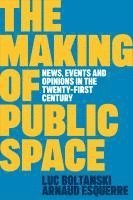
    Making of Public Space

    News, Events and Opinions in the Twenty-First Century

    AvLuc Boltanski,Arnaud Esquerre

    Häftad, Engelska, 2024

    266 kr

    Beställningsvara. Skickas inom 5-8 vardagar. Fri frakt över 249 kr.

    Fler format och utgåvor

    Inbunden

    712 kr

    Beskrivning

    This new book by Luc Boltanski and Arnaud Esquerre is a highly original analysis of the two key processes that shape the contemporary public sphere. On the one hand, there are the processes of news provision which select out a range of facts and events and bring them to the attention of a large number of people who have not, for the most part, experienced them directly.  On the other hand, there are processes of politicization which problematize the facts made known by news provision and treat them as issues that concern citizens and the state. Politicization is typically characterized by a diversity of interpretations which, in turn, gives rise to a proliferation of commentary, discussion, polemic and division.In order to study these processes and their interaction, Boltanski and Esquerre draw on a vast repository of user comments left on the site of a major daily newspaper, as well as the thousands of comments posted on an online video site. They uncover what is sayable by comparing published comments with those deleted by moderators. They capture opinions in the course of their formation, rather than describing views which have long become cemented; these are often reflexive and wise, deriving from responses to interviews or opinion polls. They map out the parameters of politicization today, touching on various hot topics such as feminism, the environment, immigration, religion, nationalism and Europe.This is not just a book about the news and the press, but a major new work which shows how political opinion comes into being and the way in which it affects our daily lives. It will be of great value to students and scholars in media studies, sociology and politics, as well as to anyone interested in the state of politics and the media in our contemporary digital age.

    Produktinformation

    • Utgivningsdatum:2024-12-06
    • Mått:150 x 226 x 23 mm
    • Vikt:454 g
    • Format:Häftad
    • Språk:Engelska
    • Antal sidor:304
    • Förlag:John Wiley and Sons Ltd
    • ISBN:9781509562787

    Utforska kategorier

    • Medievetenskap inom Samhälle och politik
    • Sociologi inom Samhälle och politik

    Mer om författaren

    Luc Boltanski is Professor of Sociology at EHESS, Paris, and the author of many books including The New Spirit of Capitalism (with Eve Chiapello) and Enrichment (with Arnaud Esquerre).Arnaud Esquerre is a sociologist and Director of Research at the CNRS, France. He is the co-author of Enrichment.

    Recensioner i media

    "The Making of Public Space is about nothing less than how humans produce a shared sense of what they have in common and how they elevate issues to politics. Once again, Boltanski and Esquerre deliver their magic: deeply steeped in pragmatism, their strikingly original book combines convincing theoretical arguments about world-making with richly informed empirical insights. The result is a path-breaking analysis that should inform frontier thinking across the social sciences."Michèle Lamont, Harvard University"The Making of Public Space offers a theoretically informed and empirically grounded account of the two broad processes through which public opinion is formed."Richard Foster, Oxford Political Review"Given the abundance of news and news coverage of the world today, the relevance of this work is especially timely."American Association of Geographers Review of Books

    Innehållsförteckning

    • AcknowledgmentsIntroductionNews as a global cultureThe corpuses of data on which this work has focused The empirical analysis of the politicization and formation of ‘opinions’Crowds, masses, networksDemocracy as it isI Being immersed in the newsChapter 1. The presence and periodization of the inaccessibleThe consistency of the NowKnowing by experience or by hearsayThe accessible and the inaccessibleWhat news in which history?Time’s arrowSome problems of historical periodizationThe formation of planes of news itemsThe news in the eyes of its critics (1): inauthenticityThe news in the eyes of its critics (2): fake democracyChapter 2. The process of the eventNews, History and the need to select  Selection and censorshipThe truth of facts, the adequacy of interpretationsTrouble with eventsThe coalescence of facts in the plane of news items   The de-composition and deconstruction of eventsPrecedentsPrimary facts and derived facts: the worth and force of an eventPolitical facts as a seriesDocument 1. History (with a capital H) and historyChapter 3. Political events and the formation of generationsThe salience of eventsBreak or continuity: a question of scaleAt what scale does Le Monde view the world (le monde)? The obituary testBreaks in institutional continuityThe role of major political events in the formation of generationsStructural collectives and generational collectives‘Our generation!’   IIPoliticizationDocument 2. PlotChapter 4. Political discussionConversation or discussionThe risks of political discussionDocument 3. MediasChapter 5. Le Monde and its readers: between news and HistoryLe Monde as a news organ and quasi-institutionLe Monde and HistoryJournalists and their readersDocument 4. CensuredChapter 6. The structure of comments on the newsPre-texts and commentsThe constraints on utteranceContesting the truth of the facts: the 11 September 2001 attacks, with comments made on INA SociétéDiscussion, moderation and commercial censorship Commenting is not denouncingThe irony of the commentatorsDocument 5. What are their names?Chapter 7. The work of ‘one’The intense pleasure of commentStates of mindAnonymity and mishmashThe ‘one’ of the newsDocument 6. Readers’ repliesChapter 8. Politicizing the newsWhat are they thinking of?What is a political problem?The process of politicizationMedically assisted procreation, from the non-political to politicsPolitical shiftsTalking about IslamDifferent shifts in the notion of environmentalismWhen politics proves to be ‘inextricable’ Document 7. ‘Generations’Chapter 9. The dynamics of politicizationShifting positions and generation conflictsPolitical problems and ideologiesThreats and remediesFeeding into politicizationDocument 8. ‘Democracy’Conclusion. The meaning of HistoryInterpretation: between adequacy and violence‘On the right’ or ‘on the left’: the political description of interpretationsTowards the extremePolitics and desolationThe digitalization of strugglesAppendicesConceptual lexiconBibliographyNotesIndex