• Fri frakt över 249 kr
  • •
  • Snabba leveranser
  • •
  • Billiga böcker
Kundservice

Du är på sajten för privatpersoner.

Företag, bibliotek eller offentlig verksamhet?

Du handlar på classic.bokus.com, där alla dina funktioner finns intakta.
Till classic.bokus.com
Bokus logotyp. Gå till startsidan.
  • Erbjudanden
  • Student
  • Topplistor
  • Barn & ungdom
  • Bokus Play
  • E-böcker
  • Ljudböcker
  • Pocketböcker
  • Spel och pussel

5% studentrabatt – använd koden KURSBOK27 →

Sidfot

Mina sidor

    Hjälp

    • Kundservice
    • Vanliga frågor och svar
    • Frakt och leverans
    • Retur vid ångerrätt
    • Reklamera vara
    • Betalning
    • Köpvillkor
    • Allmänna villkor
    • Information om webbplatsens tillgänglighet

    Om Bokus

    • Om oss
    • Pressrum
    • För studenter
    • För företag
    • För bibliotek och offentlig verksamhet
    • För leverantörer
    • Hållbarhet

    Populärt

    • Aktuella erbjudanden
    • Presentkort
    • Studentlitteratur
    • Nya böcker
    • Topplistor
    • Signerade böcker
    • Engelska böcker

    Inspiration

    • Boktips
    • BookTok
    • Barnbokskaraktärer
    • Populära författare
    Logotyp för Bokus
    Följ oss på Facebook (extern länk)Följ oss på Instagram (extern länk)Följ oss på YouTube (extern länk)Följ oss på TikTok (extern länk)
    bokus @ CookiesAnpassa cookiesIntegritetspolicyKöpvillkor
    Till Citymail hemsida (extern länk)Till Budbee hemsida (extern länk)Till Postnord hemsida (extern länk)Till Schenker hemsida (extern länk)Till Early Bird hemsida (extern länk)Till Walleys hemsida (extern länk)
    1. Psykologi och pedagogik
    2. Pedagogik
    3. Utbildningsstrategier och utbildningspolitik

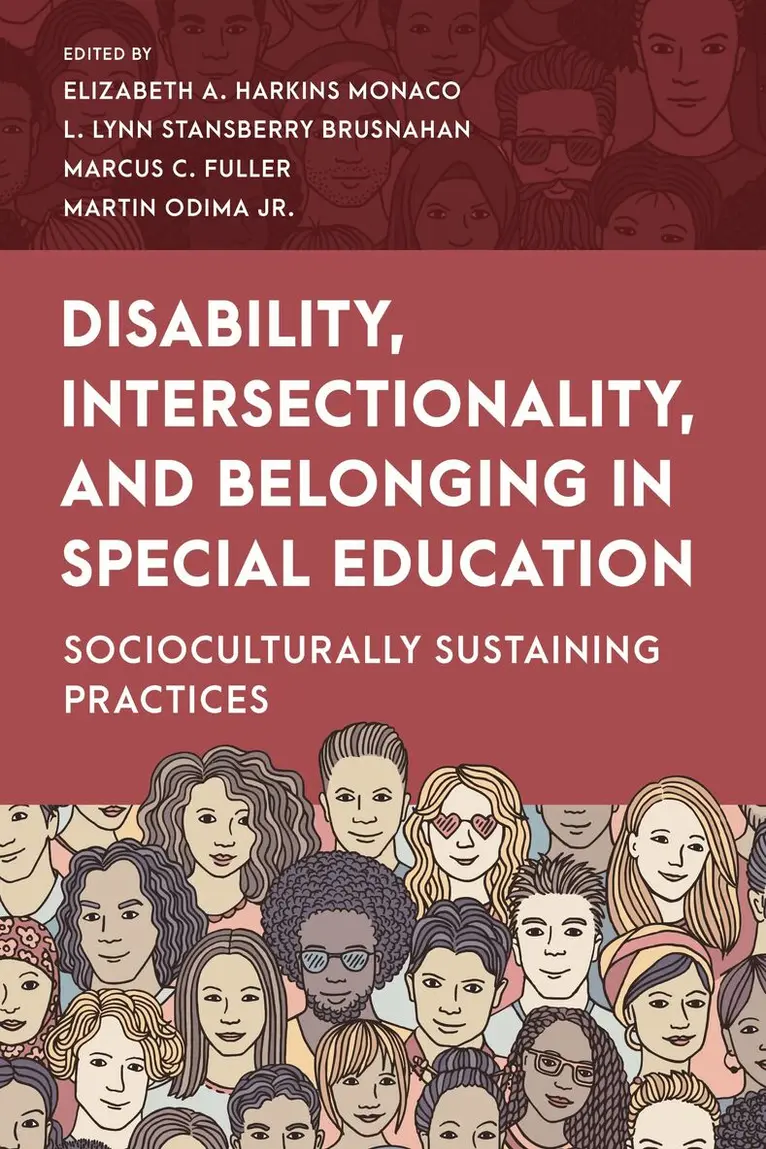
    Disability, Intersectionality, and Belonging in Special Education

    Socioculturally Sustaining Practices

    AvElizabeth A. Harkins Monaco,L. Lynn Stansberry Brusnahan

    Häftad, Engelska, 2024

    Del i serien Special Education Law, Policy, and Practice

    436 kr

    Beställningsvara. Skickas inom 10-15 vardagar. Fri frakt över 249 kr.

    Fler format och utgåvor

    Inbunden

    1 148 kr

    E-bok

    471 kr

    Beskrivning

    Disability, Intersectionality, and Belonging in Special Education focuses on preparing educators who use socioculturally sustaining practices, curricula, and instruction through an intersectional lens.This book empowers preservice students and special education practitioners and administrators to meet the needs of disabled individuals. Understanding the full range of requirements relating to socioculturally sustaining practices is imperative to working with individuals with disabilities as well as with their families and caregivers. Being able to understand and explain this complex issue to others is important and often necessary.Social injustices in special education are historical and systemic. Special education practitioners are typically unaware of the importance of intersectional differences because they have been prepared to address cultural perspectives only during awareness days or through specific units in curricula. At other times they discuss the topic diagnostically—for example, as part of an educational plan or when teaching English as a second language.Other issues stem from the value system of the special education practitioners themselves; some are not willing to engage in these concepts, while others prioritize treating all students the same by using the terms “fairness,” “equity,” and “colorblindness” to justify this treatment. Even when special educator practitioners attempt to address injustices on behalf of their students, they tend to center on only the student’s disability, which means they are ignoring or erasing other aspects of their students’ identities.These concerns highlight the importance of building the sociocultural competence of our teaching force. This book will help practitioners build this competence in their own spheres of influence.

    Produktinformation

    • Utgivningsdatum:2024-02-21
    • Mått:152 x 229 x 30 mm
    • Vikt:599 g
    • Format:Häftad
    • Språk:Engelska
    • Serie:Special Education Law, Policy, and Practice
    • Antal sidor:450
    • Förlag:Bloomsbury Publishing Plc
    • ISBN:9781538175828

    Utforska kategorier

    • Utbildningsstrategier och utbildningspolitik inom Psykologi och pedagogik
    • Specialundervisning inom Psykologi och pedagogik
    • Etnicitet inom Samhälle och politik

    Mer om författaren

    Elizabeth A. Harkins (Monaco), EdD, is an assistant professor in the Department of Special Education, Professional Counseling, and Disability Studies at William Paterson University. She is the current Director of the Autism Spectrum Disorder and Developmental Disabilities Advanced Masters Program. Dr. Harkins has extensive experience serving students with autism spectrum disorder (ASD) and intellectual and developmental disabilities (I/DD) in a variety of settings. Prior to entering academia, she worked for over a decade as a special education administrator, classroom teacher, and family advocate. Dr. Harkins’ scholarly interests focus on the critical importance of social justice pedagogy alongside educational excellence for all students. Some of her recent publications include manuscripts that examine the multiple, overlapping social identities for students with ASD and I/DD; the impacts of social injustices for individuals with disabilities; culturally sustaining practices; and intersectional pedagogy.L. Lynn Stansberry Brusnahan, PhD, is a professor in and Chair of the Department of Special Education in the School of Education at the University of St. Thomas in Minnesota. She coordinates the autism and developmental disabilities master’s programs. She is a private educational consultant and parent of an adult son with autism. She earned her doctorate at the University of Wisconsin-Milwaukee, where she studied contemporary educational issues within urban settings. She has served on the board of directors for the Autism Society of America and Council for Exceptional Children’s (CEC) Division on Autism and Developmental Disabilities (DADD). She co-authored Do-Watch-Listen-Say: Social and communication skills for autism spectrum disorder. Dr. Stansberry Brusnahan’s scholarly interests focus on autism and teacher preparation. In 2012, she was the Autism Society of America’s Professional of the Year. Marcus C. Fuller, PhD, is a visiting lecturer in the Department of Education at The University of Vermont. He earned his doctorate in special education at Texas A&M University. He has served teachers and parents from various ethnic backgrounds, socio-economic status, and age groups within urban and rural areas. Dr. Fuller's scholarly interests focus on empowering families, educators, and researchers by helping them increase their implementation skills during interventions with children with behavior disorders, autism, and/or complex communication needs through the use of educational coaching and performance feedback. Dr. Fuller has served as a reviewer for multiple journals and conference proposals as an active member of the Council for Exceptional Children’s (CEC), Division on Autism and Developmental Disabilities (DADD), and the Council for Children with Behavioral Disorders (CCBD).Martin Odima Jr., M.A., is a Black, cisgender, male from St. Paul, Minnesota. Martin is a Special Education Teacher Coach in the Saint Paul Public School (SPPS) District in Minnesota. Also, Martin is an adjunct faculty in the Department of Special Education at the University of St. Thomas where he teaches undergraduate and graduate students the history, policies, and practices of Special Education. He studied psychology at the University of Minnesota and completed his master’s in special education at the University of St. Thomas. His scholarly interests focus on educational equity, inclusive practices for students with disabilities, and retention of teachers of color. His publications include a focus on teaching strategies for special education teachers to thrive and persist in the field. Martin is currently pursuing a Ph.D. in special education at the University of Minnesota.

    Recensioner i media

    Disability, Intersectionality, and Belonging in Special Education offers preservice educators to practicing professionals in the field of education critical theories, frameworks, and strategies to rally improvements in the lives of students with disabilities. The textbook is divided into four parts with 12 chapters illustrating the concepts of disability with intersectional belonging in special education. By applying research to actual experiences, this volume helps practitioners understand that students are more than disabled and have sociocultural identities that impact their needs. Each chapter also provides vignettes with pause-and-reflect questions. Preservice teachers need to pay close attention to chapters 4–6, which present an overview of various models for describing disability and how society thinks about it. Part 3 provides school and classroom strategies for incorporating students with diverse sociocultural identities. The final section reminds readers to be mindful of their own biases when they communicate with students. In sum, practitioners need to create a sense of belonging for all students. It is refreshing to examine a textbook that finally promotes a more comprehensive environment for all students with disabilities. Highly recommended. Undergraduates through faculty; professionals.

    Innehållsförteckning

    • Table of ContentsSection I: From the Culture of Disability-to-Disability CultureChapter 1: Historical and Modern Contexts of Culture and the Impact on BelongingAuthor BiographiesAbstractGuiding QuestionsCultureA Modern View of CultureCultural Expressions in SchoolsCultural Expressions in SchoolsReferencesChapter 2: Intersectionality in the Context of DisabilityAuthor BiographiesAbstractGuiding QuestionsThe Impact of Intersectional Sociocultural IdentitiesIntersectional Competence in Special EducationSummaryReferencesChapter 3: Disability Culture in the Deaf and Autistic CommunitiesAuthor BiographiesAbstractGuiding QuestionsDisability as a Sociocultural IdentityDisability Culture in Educational ContextsInequities in EducationSummary ReferencesSection II: Critical Theories that Influence our Views of Disability and Race Chapter 4: Critical Race Theory: The Dos, the Don’ts, the Already Dones, & the Stop DoingsAuthor Biographies AbstractGuiding QuestionsThe History of CRTThe Do’s: What is CRT?The Don’ts: What CRT is NotThe Already Dones: Critical Race Theory in EducationSummaryReferencesChapter 5: The Journey of Disability Studies: Contemplating Disability CriticallyAuthor BiographiesAbstractDisability StudiesDiscovering the Need for Critical Disability StudiesSeeking Racial JusticeLooking ForwardSummary ReferencesChapter 6: The History of Disability, Disability Models, and a View for the Future: The Past is PrologueAuthor BiographiesAbstractGuiding Questions Introduction to the History of Disability Rights in the United StatesModels of DisabilityThe Language of DisabilityDisability in the MediaModels of Disability in EducationSummary ReferencesSection III: Educational Frameworks that Champion Equity Chapter 7: Intersectional Sociocultural Competency and Educational EquityAuthor BiographiesAbstractGuiding Questions EquitySummaryReferencesChapter 8: Culturally and Linguistically Sustaining Practices: The What, the Why, and the HowAuthor BiographiesAbstractGuiding Questions What and Why Culturally and Linguistically Sustaining Pedagogy?Embedding Practices into Special Education Teaching FrameworksFrom Culturally and Linguistically Sustaining Practices to Socioculturally Sustaining PracticesSummaryReferencesChapter 9: Educational Practices to Acknowledge and Incorporate Students’ Sociocultural Identities and ExperiencesAuthor BiographiesAbstractGuiding Questions Special EducationNow What: Remixed EducationSummaryReferencesSection IV: Social and Cultural Rights Movements that Impact Special Education Chapter 10: Disability Rights: The Impact of Social and Cultural Movements on Special Education Author BiographiesAbstractGuiding Questions AbleismSocial and Cultural Rights Movements in the 20th CenturyDisability as a Cultural PhenomenonEffective Interventions for Increasing a Sense of BelongingSummaryReferencesChapter 11: The Push and Pull of the Litigation-Legislation-Litigation Cycle Author BiographiesAbstractGuiding Questions United States Special Education LawImpact of Activism on LanguageInclusion and Least Restrictive Environment (LRE)DisproportionalityEducational FrameworksSummaryReferencesChapter 12: Intersectional Belonging in Special EducationAuthor BiographiesAbstractGuiding Questions Factors that Impact Special EducationSpecial Education’s ImpactCreating a Sense of BelongingSummaryReferencesEditor BiographiesGlossary