• Fri frakt över 249 kr
  • •
  • Snabba leveranser
  • •
  • Billiga böcker
Kundservice

Du är på sajten för privatpersoner.

Företag, bibliotek eller offentlig verksamhet?

Du handlar på classic.bokus.com, där alla dina funktioner finns intakta.
Till classic.bokus.com
Bokus logotyp. Gå till startsidan.
  • Erbjudanden
  • Nyheter
  • Student
  • Topplistor
  • Barn & ungdom
  • Bokus Play
  • E-böcker
  • Pocketböcker
  • Spel & pussel

Må bättre, för mindre! Upp till 50% rabatt på hälsoböcker

Sidfot

Mina sidor

    Hjälp

    • Kundservice
    • Vanliga frågor och svar
    • Frakt och leverans
    • Retur vid ångerrätt
    • Reklamera vara
    • Betalning
    • Köpvillkor
    • Allmänna villkor
    • Information om webbplatsens tillgänglighet

    Om Bokus

    • Om oss
    • Pressrum
    • För studenter
    • För företag
    • För bibliotek och offentlig verksamhet
    • För leverantörer
    • Hållbarhet

    Populärt

    • Aktuella erbjudanden
    • Presentkort
    • Studentlitteratur
    • Nya böcker
    • Topplistor
    • Signerade böcker
    • Engelska böcker

    Inspiration

    • Boktips
    • BookTok
    • Populära bokserier
    • Barnbokskaraktärer
    • Populära författare
    Logotyp för Bokus
    Följ oss på Facebook (extern länk)Följ oss på Instagram (extern länk)Följ oss på YouTube (extern länk)Följ oss på TikTok (extern länk)
    bokus @ CookiesAnpassa cookiesIntegritetspolicyKöpvillkor
    Till Citymail hemsida (extern länk)Till Budbee hemsida (extern länk)Till Postnord hemsida (extern länk)Till Schenker hemsida (extern länk)Till Early Bird hemsida (extern länk)Till Walleys hemsida (extern länk)
    1. Samhälle och politik
    2. Samhälle och kultur
    3. Sociala grupper och identitet
    4. Genusvetenskap

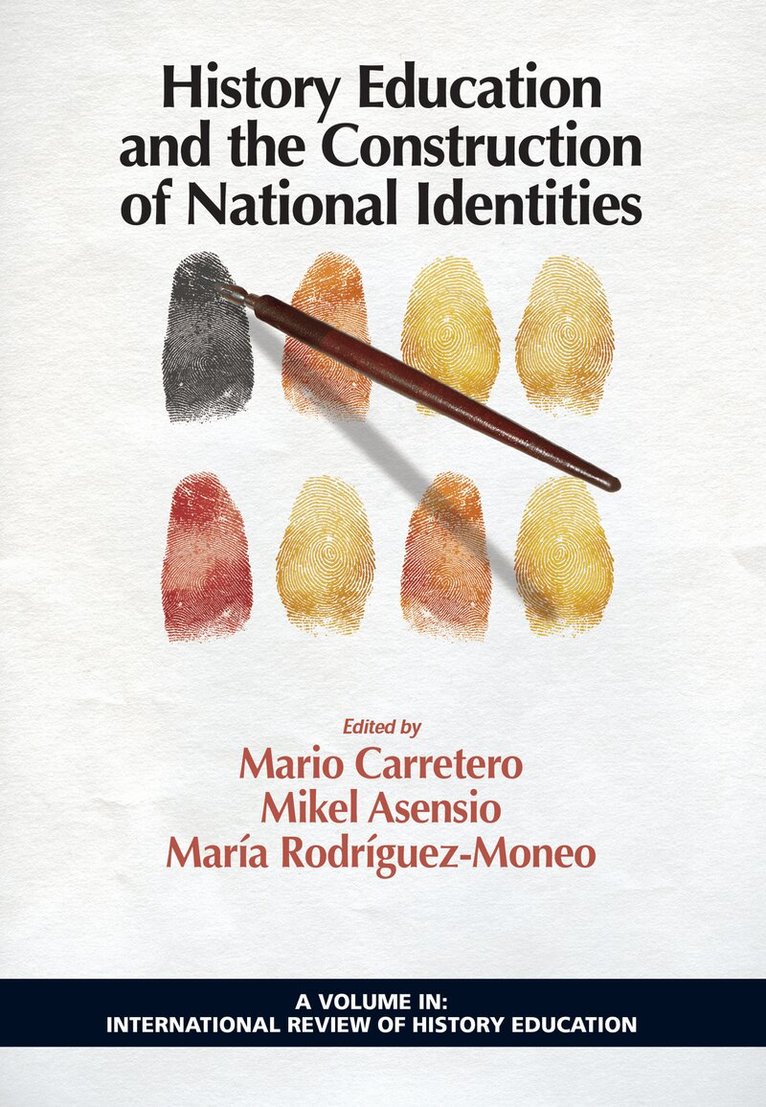
    History Education and the Construction of National Identities

    AvMario Carretero,Mikel Asensio

    Inbunden, Engelska, 2012

    Del i serien International Review of History Education

    1 170 kr

    Beställningsvara. Skickas inom 5-8 vardagar. Fri frakt över 249 kr.

    Beskrivning

    How is history represented? As just a record of the past, as a part of a present identity or as future goals? This book explores how historical contents and narratives are presented in school textbooks and other cultural productions (museums, monuments, etc) and also how they are understood by students, in the context of increasing globalization. In these contemporary conditions, the relation between history learning processes, in and out of school, and the construction of national identities presents an ever more important topic. It is being studied by looking at the appropriation of historical narratives, which are frequently based on the official history of a nation state. Most of the chapters in this volume are educational studies about how the learning of history takes place in school settings of different countries such as Canada, France, Germany, Latin America, Spain, the Netherlands, the United Kingdom and the United States. Covering such a broad sample of cultural and national contexts, they provide a rich reflection on history as a subject related to patriotism, cosmopolitanism, both or neither.

    Produktinformation

    • Utgivningsdatum:2012-09-28
    • Mått:156 x 234 x 22 mm
    • Vikt:704 g
    • Format:Inbunden
    • Språk:Engelska
    • Serie:International Review of History Education
    • Antal sidor:376
    • Förlag:Emerald Publishing Inc
    • ISBN:9781617359361

    Utforska kategorier

    • Genusvetenskap inom Samhälle och politik

    Mer om författaren

    Mario Carretero, Universidad Autónoma de Madrid, SpainMikel Asensio, Universidad Autónoma de Madrid, SpainMaría Rodríguez-Moneo, Universidad Autónoma de Madrid, Spain

    Innehållsförteckning

    • Series Introduction, Peter Lee.Acknowledgements.Chapter 1. History Education and the Construction of a National Identity, Mario Carretero, Maria Rodriguez-Moneo, and Mikel Asensio.Section I. Theoretical Issues.Chapter 2. De-Nationalize History and What Have We Done? Ontology, Essentialism, and the Search for a Cosmopolitan Alternative, Jonathan M. Hansen.Chapter 3. De-Nationalizing History Teaching and Nationalizing It Differently! Some Reflections On How to Defuse the Negative Potential of National(ist) History Teaching, Stefan Berger.Chapter 4. Re-Thinking History Textbooks in a Globalised World, Stuart Foster.Chapter 5. Commentary: What History to Teach? Whose History? Alberto Rosa.Section II. Purposes of History Education.Chapter 6. Dilemmas of Common and Plural History: Reflections on History Education and Heritage in a Globalizing World, Maria Grever.Chapter 7. School History as a Resource for Constructing Identities: Implications of Research from the United States, Northern Ireland, and New Zealand, Keith C. Barton.Chapter 8. A Traditional Frame for Global History: The Narrative of Modernity in French Secondary School, Nicole Tutiaux-Guillon.Chapter 9. Indigenous Historical Consciousness: An Oxymoron or a Dialogue? Peter Seixas.Chapter 10. Commentary: Identity Construction and the Goals of History Education, Cesar Lopez and Mario Carretero.Section III. Students' Ideas and Identities.Chapter 11. Students' Historical Narratives and Concepts About the Nation, Mario Carretero, Cesar Lopez, Maria Fernanda Gonzalez, and Maria Rodriguez-Moneo.Chapter 12. Ways of Knowing and the History Classroom: Supporting Disciplinary Discussion and Reasoning About Texts, Avishag Reisman and Sam Wineburg.Chapter 13. The Intersection of Historical Understanding and Ethical Reflection During Early Adolescence: A Place Where Time is Squared, Michelle J. Bellino and Robert L. Selman.Chapter 14. The Discursive Negotiation of Narratives and Identities in Learning History, Angela Bermúdez.Chapter 15. Commentary: Student Identities in the Present and Their Historical Understanding of the Past: Complications and Implications for Future Research, Alan Stoskopf.Section IV. Museums and Identities.Chapter 16. Historical Narratives in the Colonial, National and Ethnic Museums of Argentina, Paraguay and Spain, Marisa González de Oleaga.Chapter 17. From Identity Museums to Mentality Museums: Theoretical Basis for History Museums, Mikel Asensio.Chapter 18. Commentary: What is the Purpose of a History Museum in the Early 21st Century? Veronica Boix Mansilla.Section V. Collective Memories and Representations of Past and Future.Chapter 19. Are Family Recollections an Obstacle to History Education? How German Students Make Sense of the East German Dictatorship, Sabine Moller.Chapter 20. History as a Dynamic Process: Reanalysing a Case of Anglo-Japanese Reconciliation, Kyoko Murakami.Chapter 21. The Future Shapes the Present: Scenarios, Metaphors and Civic Action, Helen Haste and Amy Hogan.Chapter 22. Monuments in Our Minds: Historical Symbols as Cultural Tools, Jaan Valsiner.Chapter 23. Commentary: The Complex Construction of Identity Representations and the Future of History Education, Floor van Alphen and Mikel Asensio.