• Fri frakt över 249 kr
  • •
  • Snabba leveranser
  • •
  • Billiga böcker
Kundservice

Du är på sajten för privatpersoner.

Företag, bibliotek eller offentlig verksamhet?

Du handlar på classic.bokus.com, där alla dina funktioner finns intakta.
Till classic.bokus.com
Bokus logotyp. Gå till startsidan.
  • Erbjudanden
  • Nyheter
  • Student
  • Topplistor
  • Barn & ungdom
  • Bokus Play
  • E-böcker
  • Pocketböcker
  • Spel & pussel

10% rabatt på allt med kod: NYSTART10 →

Sidfot

Mina sidor

    Hjälp

    • Kundservice
    • Vanliga frågor och svar
    • Frakt och leverans
    • Retur vid ångerrätt
    • Reklamera vara
    • Betalning
    • Köpvillkor
    • Allmänna villkor
    • Information om webbplatsens tillgänglighet

    Om Bokus

    • Om oss
    • Pressrum
    • För studenter
    • För företag
    • För bibliotek och offentlig verksamhet
    • För leverantörer
    • Hållbarhet

    Populärt

    • Aktuella erbjudanden
    • Presentkort
    • Studentlitteratur
    • Nya böcker
    • Topplistor
    • Signerade böcker
    • Engelska böcker

    Inspiration

    • Boktips
    • BookTok
    • Populära bokserier
    • Barnbokskaraktärer
    • Populära författare
    Logotyp för Bokus
    Följ oss på Facebook (extern länk)Följ oss på Instagram (extern länk)Följ oss på YouTube (extern länk)Följ oss på TikTok (extern länk)
    bokus @ CookiesAnpassa cookiesIntegritetspolicyKöpvillkor
    Till Citymail hemsida (extern länk)Till Budbee hemsida (extern länk)Till Postnord hemsida (extern länk)Till Schenker hemsida (extern länk)Till Early Bird hemsida (extern länk)Till Walleys hemsida (extern länk)
    1. Samhälle och politik
    2. Samhälle och kultur
    3. Kultur och medier
    4. Kulturvetenskap

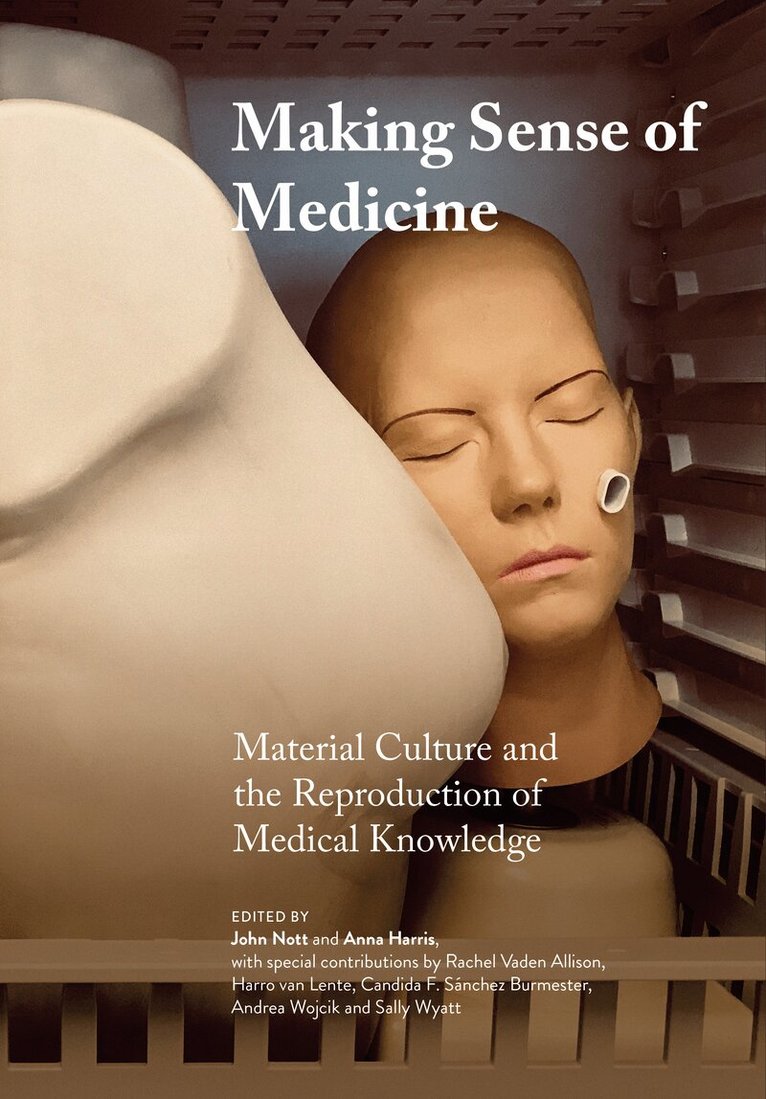
    Making Sense of Medicine

    Material Culture and the Reproduction of Medical Knowledge

    AvJohn Nott,Anna Harris

    Häftad, Engelska, 2022

    Del i serien Global Health Humanities

    575 kr

    Beställningsvara. Skickas inom 5-8 vardagar. Fri frakt över 249 kr.

    Beskrivning

    Medical knowledge manifests in materials, and materials are integral to the reproduction of medical knowledge. From the novice student to the expert practitioner, those who study and work in and around medicine rely on material guidance in their everyday practice and as they seek to further their craft.Students, just as experts, pore over textbooks, photographs and films. They put up and copy down chalkboard illustrations, manipulate plastic models and inspect organic specimens fixed in formalin. They pass through grand university libraries and try not to contaminate anything in cramped surgical theatres. Students, just as experts, learn within an expansive material culture of medicine, they learn from explicitly educative materials, from the workaday tools used for diagnosis and in treatment, they learn in everyday spaces and as part of sprawling infrastructures. While the specific constellation of material varies across time and space, many materials have remained constant, key actors in the spread of medical practices and in the steady, global expansion of biomedical frameworks of health and disease. This collection focuses on the materials, objects, tools and technologies which facilitate the reproduction of medical knowledge and often reify understandings of medical science.The training of doctors is changing rapidly in response to technological development as well to the evolving needs and expectations of patients. Medical schools are beginning to respond to these challenges through curricula redesign and the purchase or endorsement of new teaching aids, simulations and pedagogies. Often, this means that medical schools are embracing the digital at the expense of older teaching materials. Medical education is at a critical juncture and there is momentum to radically rethink its approaches.This collection offers a reflection on these challenges by presenting an innovative and expansive overview of the role of materiality in the training of doctors and in the social reproduction of medicine in general. Experimental in form, and with ethnographic, museological and historical cases, and traces from around the world, this edited volume is the first to fully explore the matter of medical education in the modern world. Supported by the European Research Council under the European Union’s Horizon 2020 research and innovation programme.An academic text, it will be most relevant to academics and graduate students in the fields of health and material culture, but will also have a wider readership with those working on medical education and knowledge and medical history

    Produktinformation

    • Utgivningsdatum:2022-11-07
    • Mått:170 x 244 x 36 mm
    • Vikt:828 g
    • Format:Häftad
    • Språk:Engelska
    • Serie:Global Health Humanities
    • Antal sidor:464
    • Förlag:Intellect
    • ISBN:9781789385779

    Utforska kategorier

    • Kulturvetenskap inom Samhälle och politik
    • Antropologi inom Samhälle och politik
    • Medicinhistoria inom Medicin

    Mer om författaren

    John Nott is an economic and medical historian and a research fellow at the University of Edinburgh. He previously worked as part of the ‘Making Clinical Sense’ project at Maastricht University, the Netherlands.Anna Harris is associate professor of anthropology and science and technology studies at Maastricht University in the Netherlands. Her work concerns issues of learning, sensing (and other bodily practices) and the contemporary/historical role of technologies in medicine. She leads the European Research Council funded project ‘Making Clinical Sense.’

    Recensioner i media

    'A commendable feature of the collection’s exploration is the bringing together of contributions from historians, anthropologists, artists and curators, educators, surgeons and pathologists. In doing so, the collection offers interdisciplinary investigations and equips the reader with a thoughtful and critical understanding of educative technologies. [...] Overall, the collection is meticulously researched and well-written. It is a rewarding book as it is creative and experimental in its approach, and engages with new and familiar topics from interdisciplinary perspectives. The collection will certainly be a key text in inviting and guiding researchers to study the material culture of medicine’s objects of teaching.'

    Innehållsförteckning

    • Introduction: What Matters in Medical Education? – John Nott and Anna HarrisARCHITECTURE / Designing a Discipline: Architecture for Pathology in the Interwar Period –  Annmarie AdamsART / Objectivity, Art and Medical Images – Sally WyattBALLOONS / Lessons from a Balloon – Christine den Harder and Anna HarrisCADAVERS / The Geography of the Dead and the Movement of the Living: Kinetic Consciousness and the Limits of the Cadaver – Rachel PrenticeCHALKBOARDS / Anatomy of the Chalkboard – Rachel Vaden AllisonCIGARETTE PAPERS / The Cigarette Paper, the Embroiderer, and the Gendered Craft of Vascular Surgery – Paul CraddockCIRCULATION / Circulated Concepts, Images and Objects – Harro van LenteDISSECTING ROOMS / ‘The Lady Anatomist’: Fragmented Bodies, Photographic Assemblage and the ‘Art’ of Dissection at Woman's Medical College of Pennsylvania, 1895–98 – Jessica M. DandonaFILM / ‘See For Yourself’: Autopsy Film as Audio-Visual Mediation of Learning Experiences, c.1928–1962 – Christian Bonah and Joel DanetFILM / ‘Now We Are Going to Look at a Piece of Film’: Projecting Medicine in Twentieth Century Medical Education – Angela SawardGARDENS / Groundwork for Planetary Health: Reimagining Gardens in Medical Education – Stacey Langwick and Mary MoshaGLOVES / The Context of Touch: Gloves and the Pelvic Exam – Kelly UndermanHANDBOOKS / Chinese Medical Illustrations and Communist Materialism, 1950-1966 – Lan LiHEARTS / The Heart of the Simulated Matter: Interprofessional Training Practices of Clinical Care – Ivana GuarrasiILLUSTRATIONS / Performed with Care: Enacting Accuracy in Medical Illustration – Drew Danielle BelskyILLUSTRATIONS / Material Images: Flesh on Paper in Twentieth-Century Surgical Drawing – Harriet PalfreymanILLUSTRATIONS / The Radford Collection: Exploring and Experiencing the Mid-Nineteenth-Century Midwifery Lecture – Rebecca WhiteleyLABOUR / Invisible Work – Sally WyattMICROSCOPES / The Virtual Microscope: Tracing Knowledge of Human Microstructure Through Digital Images – R. Claire Aland, Nicole Shepherd, Belinda Swyny and Mary-Louise Roy ManchadiMUSEUMS / The Pathology Museum at Korle Bu – Robert Kumoji and John NottNURSERVERS / The Nurserver – David TheodorePHOTOGRAPHS / Typologies of Fatness: Constitutional Photography in Western Medicine, c.1930-60 – Anne Katrine Kleberg HansenPLACE, AND AFFECT / Matters of Place and Affect – Rachel Vaden Allison and John NottPROPS / Props in Breaking Bad News Simulation – Kaisu Koski and Kirsten OstherrRADIOGRAPHS / Lasers, Screens and Models: The Material Assemblages of Learning Pattern Recognition in Radiography Education – Peter D. WinterSIMULATIONS / Simulations in Health Professions Education – Andrea WojcikSKULLS / Medical Museums, Materiality, and the Traumatic Brain Injury of Phineas Gage – Denielle Elliott with Dominic HallSTETHOSCOPES / This Thing, A Stethoscope – Claire WendlandTEXTILES / Materialities of Surgery: Learning Through Thread – Roger Kneebone and Fleur OakesULTRASOUNDS / Developing Ultrasound: Knowledge Dissemination and Technological Change, 1945-1980 – Jakob LehneWOUNDS / The Fake Wound: Thinking Through Materials in Osce Simulations – Andrea Wojcik, Victor Mogre, Anthony Amalba, Celia Yamile Rodriguez and Francis A. AbantangaZEBRAS / Zebras, not Horses: On Limits and Margins of Biomedical Knowledge – Candida F. Sanchez BurmesterNotes on ContributorsIndex