• Fri frakt över 249 kr
  • •
  • Snabba leveranser
  • •
  • Billiga böcker
Kundservice

Du är på sajten för privatpersoner.

Företag, bibliotek eller offentlig verksamhet?

Du handlar på classic.bokus.com, där alla dina funktioner finns intakta.
Till classic.bokus.com
Bokus logotyp. Gå till startsidan.
  • Erbjudanden
  • Nyheter
  • Student
  • Topplistor
  • Barn & ungdom
  • Bokus Play
  • E-böcker
  • Pocketböcker
  • Spel & pussel

10% rabatt på allt med kod: NYSTART10 →

Sidfot

Mina sidor

    Hjälp

    • Kundservice
    • Vanliga frågor och svar
    • Frakt och leverans
    • Retur vid ångerrätt
    • Reklamera vara
    • Betalning
    • Köpvillkor
    • Allmänna villkor
    • Information om webbplatsens tillgänglighet

    Om Bokus

    • Om oss
    • Pressrum
    • För studenter
    • För företag
    • För bibliotek och offentlig verksamhet
    • För leverantörer
    • Hållbarhet

    Populärt

    • Aktuella erbjudanden
    • Presentkort
    • Studentlitteratur
    • Nya böcker
    • Topplistor
    • Signerade böcker
    • Engelska böcker

    Inspiration

    • Boktips
    • BookTok
    • Populära bokserier
    • Barnbokskaraktärer
    • Populära författare
    Logotyp för Bokus
    Följ oss på Facebook (extern länk)Följ oss på Instagram (extern länk)Följ oss på YouTube (extern länk)Följ oss på TikTok (extern länk)
    bokus @ CookiesAnpassa cookiesIntegritetspolicyKöpvillkor
    Till Citymail hemsida (extern länk)Till Budbee hemsida (extern länk)Till Postnord hemsida (extern länk)Till Schenker hemsida (extern länk)Till Early Bird hemsida (extern länk)Till Walleys hemsida (extern länk)
    1. Psykologi och pedagogik
    2. Pedagogik
    3. Pedagogisk psykologi

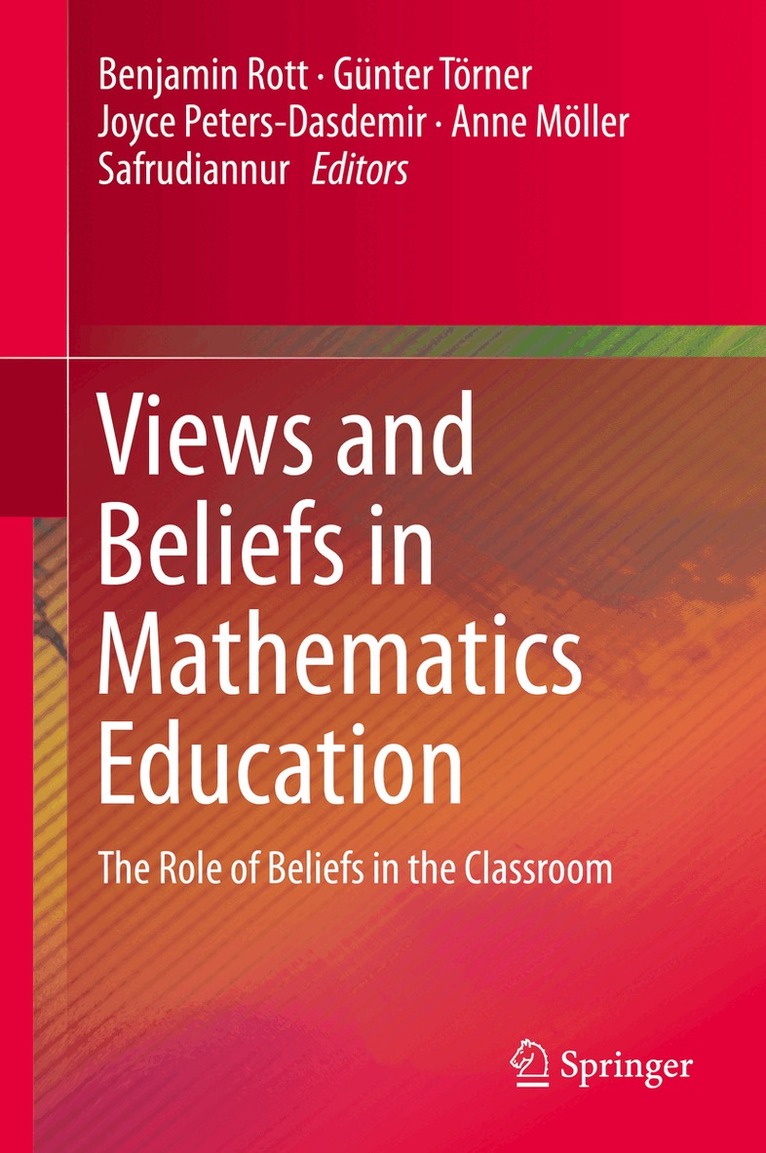
    Views and Beliefs in Mathematics Education

    The Role of Beliefs in the Classroom

    AvBenjamin Rott,Günter Törner

    Inbunden, Engelska, 2019

    1 734 kr

    Beställningsvara. Skickas inom 10-15 vardagar. Fri frakt över 249 kr.

    Beskrivning

    The book is made up of 21 chapters from 25 presentations at the 23rd MAVI conference in Essen, which featured Alan Schoenfeld as keynote speaker. Of major interest to MAVI participants is the relationship between teachers’ professed beliefs and classroom practice. The first section is dedicated to classroom practices and beliefs regarding those practices, taking a look at prospective or practicing teachers’ views of different practices such as decision-making, the roles of explanations, problem-solving, patterning, and the use of play. The focus of the second section in this book deals with teacher change, which is notoriously difficult, even when the teachers themselves are interested in changing their practice. The third section of this book centers on the undercurrents of teaching and learning mathematics, what rises in various situations, causing tensions and inconsistencies. The last section of this book takes a look at emerging themes in affect-related research. In this section,papers discuss attitudes towards assessment.

    Produktinformation

    • Utgivningsdatum:2019-01-25
    • Mått:155 x 235 x 20 mm
    • Vikt:565 g
    • Format:Inbunden
    • Språk:Engelska
    • Antal sidor:253
    • Förlag:Springer Nature Switzerland AG
    • ISBN:9783030012724

    Utforska kategorier

    • Pedagogisk psykologi inom Psykologi och pedagogik
    • Matematik inom Naturvetenskap och teknik
    • Lärarutbildning inom Psykologi och pedagogik

    Mer om författaren

    Benjamin Rott obtained his PhD in Mathematics Education at the University of Hannover. Thereafter, he worked as a postdoctoral researcher at the University of Education Freiburg and at a Professor at the University of Duisburg-Essen. Since 2017, he is a Professor in the Institute of Mathematics Education at the University of Cologne. His research interests include mathematical problem solving, mathematical giftedness, and (epistemological) beliefs. Günter Törner obtained his PhD in Mathematics at the University of Gießen and habilitated within mathematics at the Technical University of Darmstadt. Since 1978, he has been working as a full professor for Mathematics at the University Duisburg-Essen. His research interests are pure mathematics, applied discrete mathematics and cooperation with companies. For seven years, he was the chair of the Committee of Education of the European Mathematical Society. He was a founding member of the DZLM. He isinvolved in initial teacher training and professional development for in- and pre-service teachers. He has published more than fifty mathematical papers, more than eighty papers within educational journals and international proceedings of conferences. He has supervised more than 23 PhD graduate students in the last years.Joyce Peters-Dasdemir is working on her PHD in the group of Prof. Dr. Barzel at the faculty for Mathematics at the University of Duisburg-Essen and she is occupied as a scientific researcher of the German Center for Mathematics Teacher Education (DZLM). She is involved in multiplier programs and professional development programs for in- and pre-service teachers and is active in the field of development coordination. Her research interests are development and implementation of PD Centers, conceptual knowledge, beliefs of teachers about digital technology, the use of digital technology in mathematics and science teaching and the influence of professional development programs on teaching.Anne Möller is a seconded teacher for Mathematics Education in the scientific group of Prof. Dr. Bärbel Barzel at the University of Duisburg-Essen and working on her PhD on teaching mathematics via problem solving supervised by Prof. Dr. Benjamin Rott, University of Cologne. Her research foci include the development and evaluation of using discovery learning and problem solving in class, and the analysis of teachers’ explanation of the use of discovery learning and problem solving in math lessons.Safrudiannur is a doctoral student in mathematics education at the University of Cologne under the supervision of Prof. Dr. Benjamin Rott. His research focuses on mathematical problem solving and teachers’ beliefs.

    Innehållsförteckning

    • Chapter 1.Are researchers in educational theory free of beliefs – in contrast to students and teachers? – is there an overseen research problem or are there ‘blank spots’?.- Part I. Pupils’ and students’ views and beliefs of mathematics.- Chapter 2. Engagement in mathematics forums in a massive open online course (MOOC).- chapter 3. Affect as a system: the case of Sara.- Chapter 4. The roles of teacher and parent attitudes and some student characteristics on confidence in learning mathematics.- Chapter 5. Valuing from children’s perspectives as a lens to understand mathematics learning: the case of Hong Kong.- Chapter 6. Value-focused thinking in the mathematics classroom: engaging students in decision-making through socially open-ended problem solving.- Chapter 7. Young students’ feelings towards problem solving tasks: what does “success” imply?.- Chapter 8. Beliefs and values in upper secondary school students’ mathematical reasoning.- Chapter 9. Attributional beliefs during problemsolving.- Chapter 10. Evaluation of an approach of professional role reflection in mathematics education.- Chapter 11. It’s all about motivation? – a case study concerning dropout and persistence in university mathematics.- Part II. Teachers’ views and beliefs of mathematics.- Chapter 12. How to understand changes in novice mathematics teachers’ talk about good mathematics teaching?.- Chapter 13. Domain specificity of mathematics teachers’ beliefs and goals.- Chapter 14. Teachers’ beliefs about knowledge of teaching and their impact on teaching practices.- Chapter 15. Positive education and teaching for productive disposition in mathematics.- Chapter 16. From relationships in affect toward an attuned mathematics teacher.- Chapter 17. The role of mathematics teachers’ views for their competence of analysing classroom situations.- Chapter 18. Teaching via problem solving or teacher-centric access – teachers’ views and beliefs.- Chapter 19. The evaluation of a questionnaire for studying teachers’ beliefs on their practice (TBTP).- Chapter 20. The role of technology in calculus teaching-beliefs of novice secondary teachers.- Chapter 21. Technology-related beliefs and the mathematics classroom: development of a measurement instrument for pre- and in-service teachers.