• Fri frakt över 249 kr
  • •
  • Snabba leveranser
  • •
  • Billiga böcker
Kundservice

Du är på sajten för privatpersoner.

Företag, bibliotek eller offentlig verksamhet?

Du handlar på classic.bokus.com, där alla dina funktioner finns intakta.
Till classic.bokus.com
Bokus logotyp. Gå till startsidan.
  • Erbjudanden
  • Student
  • Topplistor
  • Barn & ungdom
  • Bokus Play
  • E-böcker
  • Ljudböcker
  • Pocketböcker
  • Spel och pussel

Pocketfynda! Hundratals böcker för 49 kr/st →

Sidfot

Mina sidor

    Hjälp

    • Kundservice
    • Vanliga frågor och svar
    • Frakt och leverans
    • Retur vid ångerrätt
    • Reklamera vara
    • Betalning
    • Köpvillkor
    • Allmänna villkor
    • Information om webbplatsens tillgänglighet

    Om Bokus

    • Om oss
    • Pressrum
    • För studenter
    • För företag
    • För bibliotek och offentlig verksamhet
    • För leverantörer
    • Hållbarhet

    Populärt

    • Aktuella erbjudanden
    • Presentkort
    • Studentlitteratur
    • Nya böcker
    • Topplistor
    • Signerade böcker
    • Engelska böcker

    Inspiration

    • Boktips
    • BookTok
    • Barnbokskaraktärer
    • Populära författare
    Logotyp för Bokus
    Följ oss på Facebook (extern länk)Följ oss på Instagram (extern länk)Följ oss på YouTube (extern länk)Följ oss på TikTok (extern länk)
    bokus @ CookiesAnpassa cookiesIntegritetspolicyKöpvillkor
    Till Citymail hemsida (extern länk)Till Budbee hemsida (extern länk)Till Postnord hemsida (extern länk)Till Schenker hemsida (extern länk)Till Early Bird hemsida (extern länk)Till Walleys hemsida (extern länk)
    1. Naturvetenskap och teknik
    2. Matematik och naturvetenskap
    3. Biologi
    4. Biovetenskap

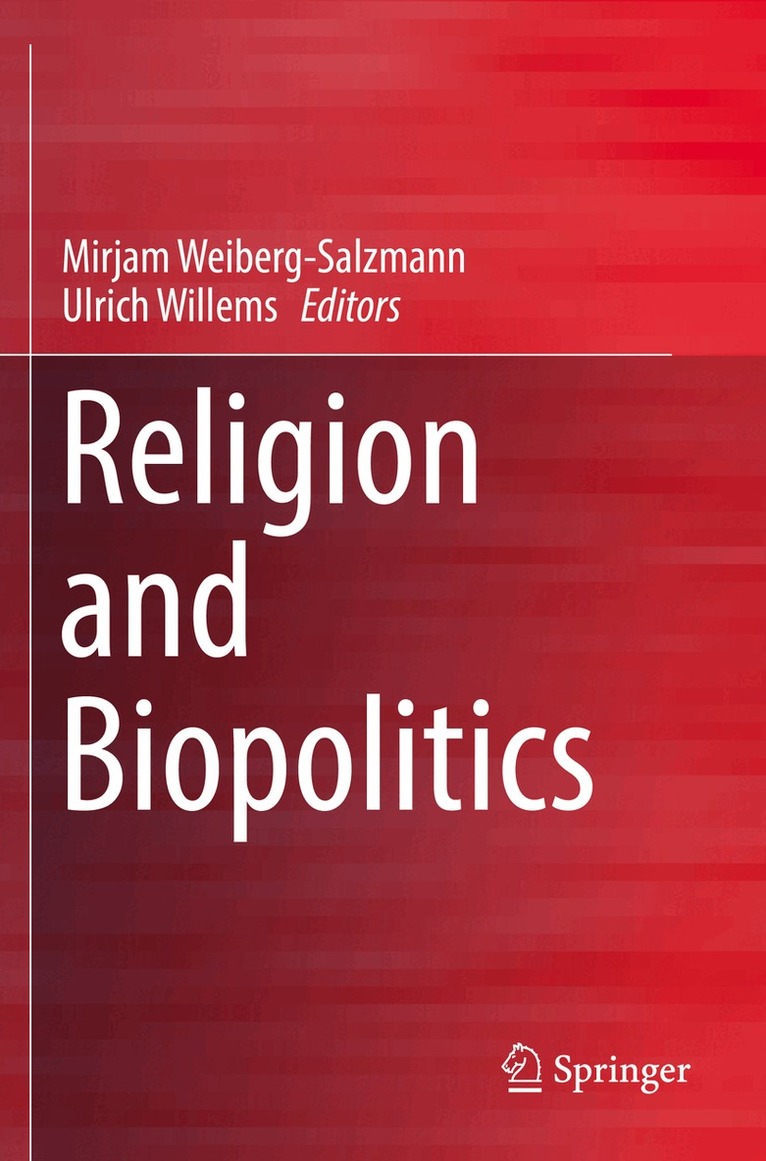
    Religion and Biopolitics

    AvMirjam Weiberg-Salzmann,Ulrich Willems

    Häftad, Engelska, 2020

    1 078 kr

    Beställningsvara. Skickas inom 10-15 vardagar. Fri frakt över 249 kr.

    Beskrivning

    Given the profound moral-ethical controversies regarding the use of new biotechnologies in medical research and treatment, such as embryonic research and cloning, this book sheds new light on the role of religious organizations and actors in influencing the bio-political debates and decision-making processes. Further, it analyzes the ways in which religious traditions and actors formulate their bio-ethical positions and which rationales they use to validate their positions. The book offers a range of case studies on fourteen Western democracies, highlighting the bio-ethical and political debates over human stem cell research, therapeutic and reproductive cloning, and pre-implantation genetic diagnosis. The contributing authors illustrate the ways in which national political landscapes and actors from diverse and often fragmented moral communities with widely varying moral stances, premises and commitments formulate their bio-ethical positions and seek to influence political decisions.

    Produktinformation

    • Utgivningsdatum:2020-08-15
    • Mått:155 x 235 x 21 mm
    • Vikt:563 g
    • Format:Häftad
    • Språk:Engelska
    • Antal sidor:354
    • Förlag:Springer Nature Switzerland AG
    • ISBN:9783030145828

    Utforska kategorier

    • Biovetenskap inom Naturvetenskap och teknik
    • Statsvetenskap och politisk teori inom Samhälle och politik
    • Offentlig förvaltning inom Samhälle och politik

    Mer om författaren

    Mirjam Weiberg-Salzmann is a senior research fellow at the Cluster of Excellence "Religion and Politics" of the University of Münster, Germany. She received her Ph.D. in Political Sciences in 2009. Her research areas are international politics, comparative government and peace and conflict studies. She focuses on the topics religion and politics, violence and conflicts in multi-ethnic and multi-religious states, democracy, democratization and biopolitics. Her regional interests are the USA, Great Britain, Germany, Ireland, Norway and South Asia. She wrote books on the deconstruction of democracy by culture (Nomos 2011) and violent conflicts of democratic states in the Third World (University of Rostock 2008). Her most recent publications are Illiberal Politics and Religion: Actors, Ideologies, and Identity Narrrativews in Europe and Beyond (with Anja Hennig; Campus), "The Radicalisation of Buddhism in the Twentieth and Twenty-first Centuries" (Politics, Religion& Ideology) and "Ending Ethnic Civil Wars by Negotiations or by Military Defeat?" (Journal of Asian and African Studies). Ulrich Willems is a professor of Political Theory and currently director of the Institute of Political Science of the University of Münster, Germany. He is also principal investigator at the Cluster of Excellence "Religion and Politics in Pre-modern and Modern Times". From 2012 to 2016, he was the director of the "Centre for Religion and Modernity" and a member of the "Centre for Advanced Studies in Bioethics" (2010-2017); both located at the University of Münster. Previously, Willems taught at the Darmstadt University of Technology and the University of Hamburg, Germany. His research interests include political theory, political pluralism, democracy and pluralism, interest groups, politics and religion, and morality policy, especially biopolitics. His recent books include The Political Theory of Modus Vivendi (with John Horton and Manon Westphal; Springer 2019) and Wertkonflikte als Herausforderung der Demokratie (Springer VS 2016).

    Innehållsförteckning

    • Introduction: Challenging the Political - Religious Actors and Religious Arguments in Liberal Democracies (Mirjam Weiberg-Salzmann and Ulrich Willems).- Part I: Catholic-Latin states with low level or little religious pluralism.- Discursive Strategies of Catholic Churches in Assisted Reproduction Technology Regulation: Poland and Spain in Comparison (Anja Hennig).- The Role of Religion in Debates on Embryo Research and Surrogacy in France (Jennifer Merchant).- Embryonic Silences: Human Life Between Biomedicine, Religion, and State Authorities in Austria (Ingrid Metzler and Anna Pichelstorfer).- Religion and Biopolitics in Ireland (Mirjam Weiberg-Salzmann).- Part II: Protestant(-English) states with high or moderate level religious pluralism.- Biotechnology and the Non-religious Uses of God Talk (John H. Evans).- The Political Debate on Embryo Research in New Zealand and the Role of Religious Actors and Arguments (David Gareth Jones).- The Political Debate on Embryo Research in Australia and the Role of Religious Actors and Arguments (Frank O’Keeffe and Kevin McGovern).- Part III: Protestant(-Scandinavian) states with low level religious pluralism.- The Status of the Human Embryo: A Case Study of Embryo Experiments and Embryo Research in Denmark (Jacob Dahl Rendtorff).- Religion and Biopolitics in Sweden (Göran Hermerén and Mats Johansson).- Negotiating Embryo Politics in Norway and Italy (Mirjam Weiberg-Salzmann and Massimiliano Passerini).- Part IV: Mixed-confession states with high level religious pluralism.- The Role of Religion in the Political Debate on Embryo Research in the Netherlands (Wybo J. Dondorp and Guido M. W. R. de Wert).- Moralizing Embryo Politics in Germany (Mirjam Weiberg-Salzmann).- Bioethics and Biopolitics in Switzerland: Stem Cell Research and Pre-Implantation Diagnostics in the Public Discourse (Monika Bobbert and Yvonne Zelter).- Morality Policies: How Religion and Politics Interplayin Democratic Decision-making in Belgium (Nathalie Schiffino).-