• Fri frakt över 249 kr
  • •
  • Snabba leveranser
  • •
  • Billiga böcker
Kundservice

Du är på sajten för privatpersoner.

Företag, bibliotek eller offentlig verksamhet?

Du handlar på classic.bokus.com, där alla dina funktioner finns intakta.
Till classic.bokus.com
Bokus logotyp. Gå till startsidan.
  • Erbjudanden
  • Nyheter
  • Student
  • Topplistor
  • Barn & ungdom
  • Bokus Play
  • E-böcker
  • Pocketböcker
  • Spel & pussel

10% rabatt på allt med kod: NYSTART10 →

Sidfot

Mina sidor

    Hjälp

    • Kundservice
    • Vanliga frågor och svar
    • Frakt och leverans
    • Retur vid ångerrätt
    • Reklamera vara
    • Betalning
    • Köpvillkor
    • Allmänna villkor
    • Information om webbplatsens tillgänglighet

    Om Bokus

    • Om oss
    • Pressrum
    • För studenter
    • För företag
    • För bibliotek och offentlig verksamhet
    • För leverantörer
    • Hållbarhet

    Populärt

    • Aktuella erbjudanden
    • Presentkort
    • Studentlitteratur
    • Nya böcker
    • Topplistor
    • Signerade böcker
    • Engelska böcker

    Inspiration

    • Boktips
    • BookTok
    • Populära bokserier
    • Barnbokskaraktärer
    • Populära författare
    Logotyp för Bokus
    Följ oss på Facebook (extern länk)Följ oss på Instagram (extern länk)Följ oss på YouTube (extern länk)Följ oss på TikTok (extern länk)
    bokus @ CookiesAnpassa cookiesIntegritetspolicyKöpvillkor
    Till Citymail hemsida (extern länk)Till Budbee hemsida (extern länk)Till Postnord hemsida (extern länk)Till Schenker hemsida (extern länk)Till Early Bird hemsida (extern länk)Till Walleys hemsida (extern länk)
    1. Psykologi och pedagogik
    2. Pedagogik
    3. Högskola och universitet
    4. Lärarutbildning

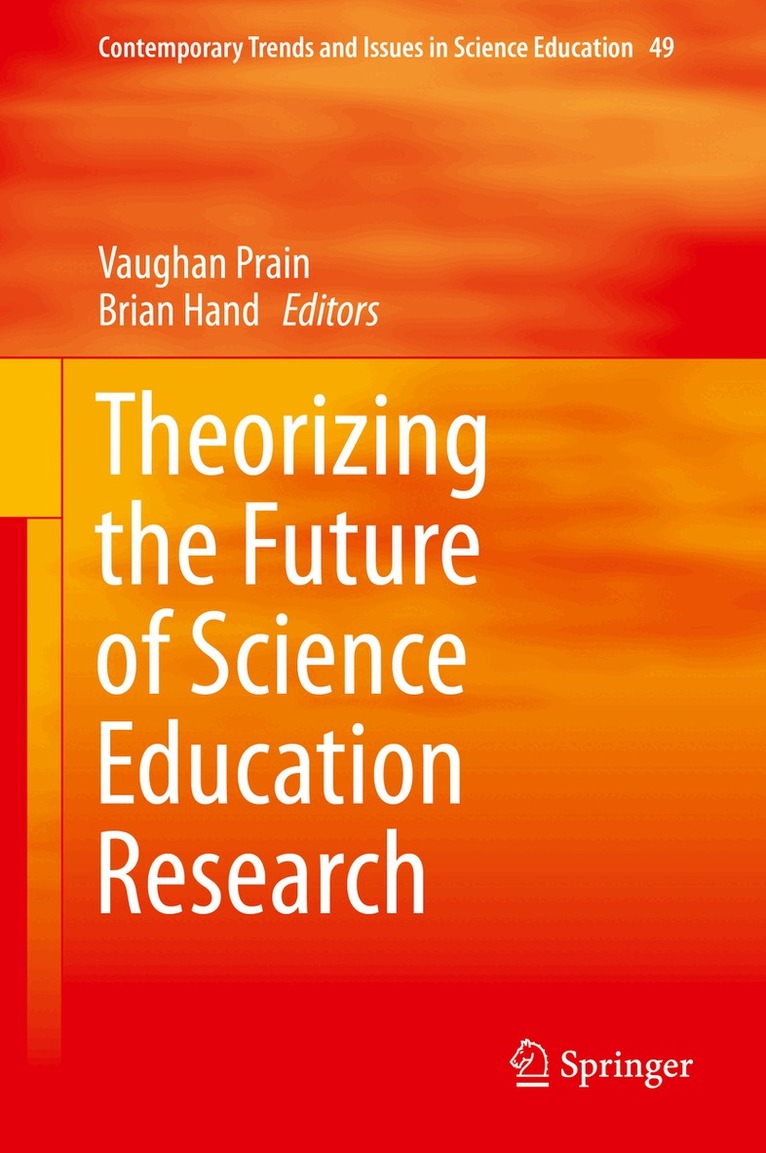
    Theorizing the Future of Science Education Research

    AvVaughan Prain,Brian Hand

    Inbunden, Engelska, 2019

    Del 49 i serien Contemporary Trends and Issues in Science Education

    1 086 kr

    Beställningsvara. Skickas inom 10-15 vardagar. Fri frakt över 249 kr.

    Beskrivning

    This book reviews the current state of theoretical accounts of the what and how of science learning in schools. The book starts out by presenting big-picture perspectives on key issues. In these first chapters, it focuses on the range of resources students need to acquire and refine to become successful learners. It examines meaningful learner purposes and processes for doing science, and structural supports to optimize cognitive engagement and success. Subsequent chapters address how particular purposes, resources and experiences can be conceptualized as the basis to understand current practices. They also show how future learning opportunities should be designed, lived and reviewed to promote student engagement/learning. Specific topics include insights from neuro-imaging, actor-network theory, the role of reasoning in claim-making for learning in science, and development of disciplinary literacies, including writing and multi-modal meaning-making. All together the book offers leads to science educators on theoretical perspectives that have yielded valuable insights into science learning. In addition, it proposes new agendas to guide future practices and research in this subject.

    Produktinformation

    • Utgivningsdatum:2019-11-05
    • Mått:155 x 235 x 17 mm
    • Vikt:477 g
    • Format:Inbunden
    • Språk:Engelska
    • Serie:Contemporary Trends and Issues in Science Education
    • Antal sidor:196
    • Upplaga:19001
    • Förlag:Springer Nature Switzerland AG
    • ISBN:9783030240127

    Utforska kategorier

    • Lärarutbildning inom Psykologi och pedagogik
    • Pedagogisk metodik inom Psykologi och pedagogik
    • Undervisning i specifika ämnen inom Psykologi och pedagogik

    Mer om författaren

    Vaughan Prain is a Professor in Science Interdisciplinary Education Research, Deakin University, Australia.  His research focus is on innovative teaching and learning approaches in primary and secondary science. Initially he focused on the role of writing for learning, and more recently on students engaging with representational affordances within and across visual, spatial, linguistic, mathematical and embodied modes in constructing accounts of scientific processes and claims. Brian Hand is a Distinguished Professor of Science Education at the University of Iowa. He started his career as a chemistry and physics teacher (11 years) before moving into higher education. He has developed a strong research interest in writing and science argument. His focus has been on implementing the Science Writing Heuristic approach to learning for which he has been able to get a series of major grants to explore classroom implementation of the approach.

    Recensioner i media

    “The book is well organized and structured. … the book proposes … a huge amount of new experimental data, many new interesting ideas, and solutions … . the book may be recommended as an excellent resource and background for further studies for a wide range of scientists in fields of education, cognitive and social psychology, and cultural, social, and crisis anthropology, as well as for experts and policymakers in education, who are involved in the strategic planning of science education.” (Yuriy Kostyuchenko, Victor Pushkar and Mohamed Abioui, Science & Education, Vol. 30, 2021)

    Innehållsförteckning

    • 1.Introduction: Theorizing future research for the science classroom; Vaughan Prain and Brian Hand.- SECTION ONE: Mapping the Big Picture.- 2. Merging cognitive and sociocultural approaches: Towards better understandings of the processes of developing thinking and reasoning; Paul Webb and Bill Whitlow.- 3. Frameworks, Committed Testers, and Science as a Form of Life; Jim Gee.- 4. Writers in Community Model: 15 Recommendations for Future Research in Using Writing to Promote Science Learning; Steve Graham.- SECTION TWO: Theorizing Aspects of Science Learning.- 5. An Exploratory Neuroimaging Study of Argumentative and Summary Writing Using Functional Near Infrared Spectroscopy; Richard Lamb, Brian Hand and Sae Yeol Yoon.- 6. Scientific Practices as an Actor-Network of Literacy Events: Forging a Convergence between Disciplinary Literacy and Scientific Practices; Kok-Sing Tang.- 7. Immersive approaches to science argumentation and literacy: What does it mean to “live” the languages of science?; Brian Hand, Andy Cavagnetto, and Lori Norton-Meier.- 8. Writing as an Epistemological Tool: Perspectives from personal, disciplinary, and sociocultural landscapes; Ying-Chih Chen.- 9. Scientific Literacy Practices from a concept of Discourse Space: Focusing on Resources and Demands for Learning; Sae Yeol Yoon.- 10. Future research in learning with, through and from scientific representations;  Vaughan Prain.- 11.  “I’m not a writer”: Shaping the literacy-related attitudes and beliefs of students and teachers in STEM disciplines; Lisa Emerson.- SECTION THREE: Review.- 12. Critical dialogues for emerging research agendas in science education; Greg Kelly.