• Fri frakt över 249 kr
  • •
  • Snabba leveranser
  • •
  • Billiga böcker
Kundservice

Du är på sajten för privatpersoner.

Företag, bibliotek eller offentlig verksamhet?

Du handlar på classic.bokus.com, där alla dina funktioner finns intakta.
Till classic.bokus.com
Bokus logotyp. Gå till startsidan.
  • Erbjudanden
  • Nyheter
  • Student
  • Topplistor
  • Barn & ungdom
  • Bokus Play
  • E-böcker
  • Pocketböcker
  • Spel & pussel

10% rabatt på allt med kod: NYSTART10 →

Sidfot

Mina sidor

    Hjälp

    • Kundservice
    • Vanliga frågor och svar
    • Frakt och leverans
    • Retur vid ångerrätt
    • Reklamera vara
    • Betalning
    • Köpvillkor
    • Allmänna villkor
    • Information om webbplatsens tillgänglighet

    Om Bokus

    • Om oss
    • Pressrum
    • För studenter
    • För företag
    • För bibliotek och offentlig verksamhet
    • För leverantörer
    • Hållbarhet

    Populärt

    • Aktuella erbjudanden
    • Presentkort
    • Studentlitteratur
    • Nya böcker
    • Topplistor
    • Signerade böcker
    • Engelska böcker

    Inspiration

    • Boktips
    • BookTok
    • Populära bokserier
    • Barnbokskaraktärer
    • Populära författare
    Logotyp för Bokus
    Följ oss på Facebook (extern länk)Följ oss på Instagram (extern länk)Följ oss på YouTube (extern länk)Följ oss på TikTok (extern länk)
    bokus @ CookiesAnpassa cookiesIntegritetspolicyKöpvillkor
    Till Citymail hemsida (extern länk)Till Budbee hemsida (extern länk)Till Postnord hemsida (extern länk)Till Schenker hemsida (extern länk)Till Early Bird hemsida (extern länk)Till Walleys hemsida (extern länk)
    1. Naturvetenskap och teknik
    2. Matematik och naturvetenskap
    3. Matematik
    4. Tillämpad matematik

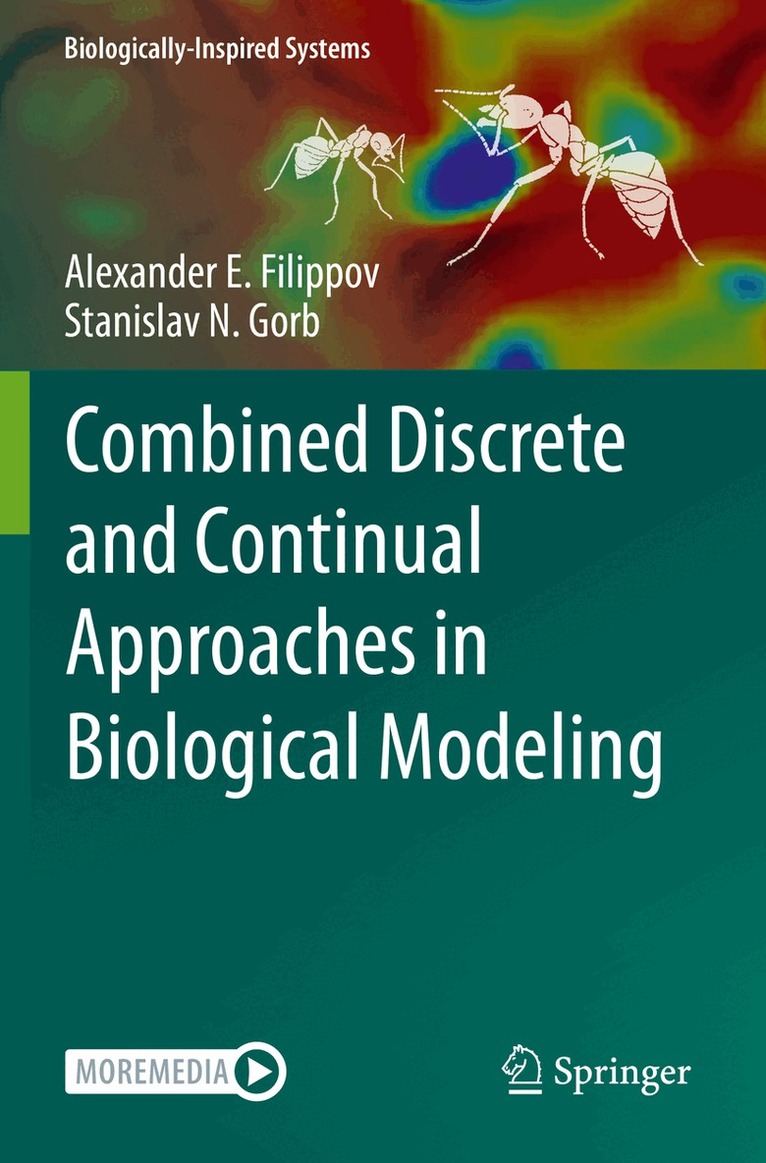
    Combined Discrete and Continual Approaches in Biological Modelling

    AvAlexander E. Filippov,Stanislav N. Gorb

    Häftad, Engelska, 2021

    Del 16 i serien Biologically-Inspired Systems

    1 194 kr

    Beställningsvara. Skickas inom 10-15 vardagar. Fri frakt över 249 kr.

    Fler format och utgåvor

    Inbunden

    1 626 kr

    Beskrivning

    Basic laws of nature are rather simple, but observed biological structures and their dynamic behaviors are unbelievably complicated. This book is devoted to a study of this “strange” relationship by applying mathematical modeling to various structures and phenomena in biology, such as surface patterns, bioadhesion, locomotion, predator-prey behavior, seed dispersal, etc. and revealing a kind of self-organization in these phenomena. In spite of diversity of biological systems considered, two main questions are (1) what does self-organization in biology mean mathematically and (2) how one can apply this knowledge to generate new knowledge about behavior of particular biological system? We believe that this kind of “biomimetics” in computer will lead to better understanding of biological phenomena and possibly towards development of technical implications based on our modeling.

    Produktinformation

    • Utgivningsdatum:2021-07-01
    • Mått:155 x 235 x 18 mm
    • Vikt:581 g
    • Format:Häftad
    • Språk:Engelska
    • Serie:Biologically-Inspired Systems
    • Antal sidor:317
    • Förlag:Springer Nature Switzerland AG
    • ISBN:9783030415303

    Utforska kategorier

    • Tillämpad matematik inom Naturvetenskap och teknik
    • Materietillstånd inom Naturvetenskap och teknik
    • Biologi inom Naturvetenskap och teknik

    Mer om författaren

    Alexander Filippov is Principal Scientist of Donetsk Institute for Physics and Engineering. He received his PhD degree in solid state physics, phase transitions and critical phenomenon in 1985 and in 1990 was habilitated as Doctor of Science in 1990 in former USSR. He is member of the Scientific Council of Donetsk Institute for Physics and Engineering of National Academy of Sciences of Ukraine. Filippov is known specialist in the fields of theoretical and applied physics. His interest ranges from atomic scale friction and planetary systems dynamis to the questions of biological evolution and ecology. He discovered for the first time so-called physical branch of solution of the exact local renormalization group equation and developed new variant of the perturbation theory based on naturally small Fisher exponent. Filippov performed a number of outstanding studies of critical phenomena in magnetic, traditional and high-temperature superconducting systems. Most these works are published in Nature, PNAS, Phys. Rev. Letters, Scientific Reports and other top journals. Using ideas of dynamic chaos and self-organization in nonlinear systems, Filippov published a number of studies related to the general theory of biological evolution and some applications to the bacterial growth, ecology of seed dispersal, animal behaviour, biomimetics, etc. He also has numerous publications in tribology on mesoscopic fractal and nano-scale surfaces, which are extremely well recognized and widely cited by the scientific community. He was invited by numerous working groups worldwide to theoretically solve specific experimental problems: Universite Pierre et Marie Curie (France), University of Nymegen (the Netherlands), Hong Kong  Baptist University (Hong Kong), Tel Aviv University (Israel), Berlin Technical University (Germany), International School for Advanced Studies (SISSA, Trieste, Italy), University of Kiel (Germany), Université de Montréal (Canada). In 2016, Filippov receivedthe Georg Forster Research Award from Humboldt Foundation, Germany. He is author of the book “Phase Transitions in Systems with Competitive Interactions” (1989) and has around 250 papers in peer-reviewed journals.Stanislav Gorb is Professor and Director at the Zoological Institute of the Kiel University, Germany. He received his PhD degree in zoology and entomology at the Schmalhausen Institute of Zoology of the Ukrainian Academy of Sciences in Kiev. Gorb was a postdoctoral researcher at the University of Vienna (Austria), a research assistant at University of Jena, a group leader at the Max Planck Institutes for Developmental Biology in Tübingen and for Metals Research in Stuttgart (Germany). Gorb’s research focuses on morphology, structure, biomechanics, physiology, and evolution of surface-related functional systems in animals and plants, as well as the development of biologically inspired technological surfaces and systems. He received the Schlossmann Award in Biology and Materials Science in 1995, International Forum Design Gold Award in 2011, Materialica "Best of" Award in 2011, Karl Ritter von Frisch Medal of German Zoological Society in 2018 and Outstanding Contribution Award of the International Society of Bionic Engineering in 2019. Gorb is Corresponding member of Academy of the Science and Literature Mainz, Germany (since 2010) and Member of the National Academy of Sciences Leopoldina, Germany (since 2011). Gorb has authored and co-authored several books, more than 500 papers in peer-reviewed journals, and four patents.

    Recensioner i media

    “The book is generously illustrated with both black-and-white and color figures; it has a useful list of references and a detailed index. The monograph is a valuable contribution to existing literature and would be of interest for researchers working in related areas. The book promotes novel ideas regarding self-organization and dynamics of complex biological systems and suggests new approaches to mathematical modeling of such systems leading to a better understanding of the living nature around us.” (Yuriy V. Rogovchenko, Mathematical Reviews, January, 2023)“The expository style adopted in the book is quite unique … . Each chapter begins with an abstract, which prepares the reader to better absorb the mathematical details that follow. The chapters are quite self-contained and can be read independently. … The book is suitable for undergraduate mathematical sciences and engineeringstudents who will benefit from learning … core physical principles. The wide variety of examples could be beneficial to the quantitative-minded biology students and the advanced researchers as well.” (Wasiur Rahman Khuda Bukhsh, zbMATH 1478.92002, 2022)

    Innehållsförteckning

    • Chapter 1. Introduction.- Chapter 2. Various methods of pattern formation.- Chapter 3. Clusterization of biological structures with high aspect ratio.- Chapter 4. Contact between biological attachment devices and rough.- Chapter 5. Anisotropic friction in biological systems.- Chapter 6. Mechanical interlocking of biological fasteners.- Chapter 7. Biomechanics at the microscale.- Chapter 8. Nanoscale pattern formation in biological surfaces.- Chapter 9. Ecology and evolution.