• Fri frakt över 249 kr
  • •
  • Snabba leveranser
  • •
  • Billiga böcker
Kundservice

Du är på sajten för privatpersoner.

Företag, bibliotek eller offentlig verksamhet?

Du handlar på classic.bokus.com, där alla dina funktioner finns intakta.
Till classic.bokus.com
Bokus logotyp. Gå till startsidan.
  • Erbjudanden
  • Nyheter
  • Student
  • Topplistor
  • Barn & ungdom
  • Bokus Play
  • E-böcker
  • Pocketböcker
  • Spel & pussel

10% rabatt på allt med kod: NYSTART10 →

Sidfot

Mina sidor

    Hjälp

    • Kundservice
    • Vanliga frågor och svar
    • Frakt och leverans
    • Retur vid ångerrätt
    • Reklamera vara
    • Betalning
    • Köpvillkor
    • Allmänna villkor
    • Information om webbplatsens tillgänglighet

    Om Bokus

    • Om oss
    • Pressrum
    • För studenter
    • För företag
    • För bibliotek och offentlig verksamhet
    • För leverantörer
    • Hållbarhet

    Populärt

    • Aktuella erbjudanden
    • Presentkort
    • Studentlitteratur
    • Nya böcker
    • Topplistor
    • Signerade böcker
    • Engelska böcker

    Inspiration

    • Boktips
    • BookTok
    • Populära bokserier
    • Barnbokskaraktärer
    • Populära författare
    Logotyp för Bokus
    Följ oss på Facebook (extern länk)Följ oss på Instagram (extern länk)Följ oss på YouTube (extern länk)Följ oss på TikTok (extern länk)
    bokus @ CookiesAnpassa cookiesIntegritetspolicyKöpvillkor
    Till Citymail hemsida (extern länk)Till Budbee hemsida (extern länk)Till Postnord hemsida (extern länk)Till Schenker hemsida (extern länk)Till Early Bird hemsida (extern länk)Till Walleys hemsida (extern länk)
    1. Naturvetenskap och teknik
    2. Teknik och industri
    3. Biokemisk teknik

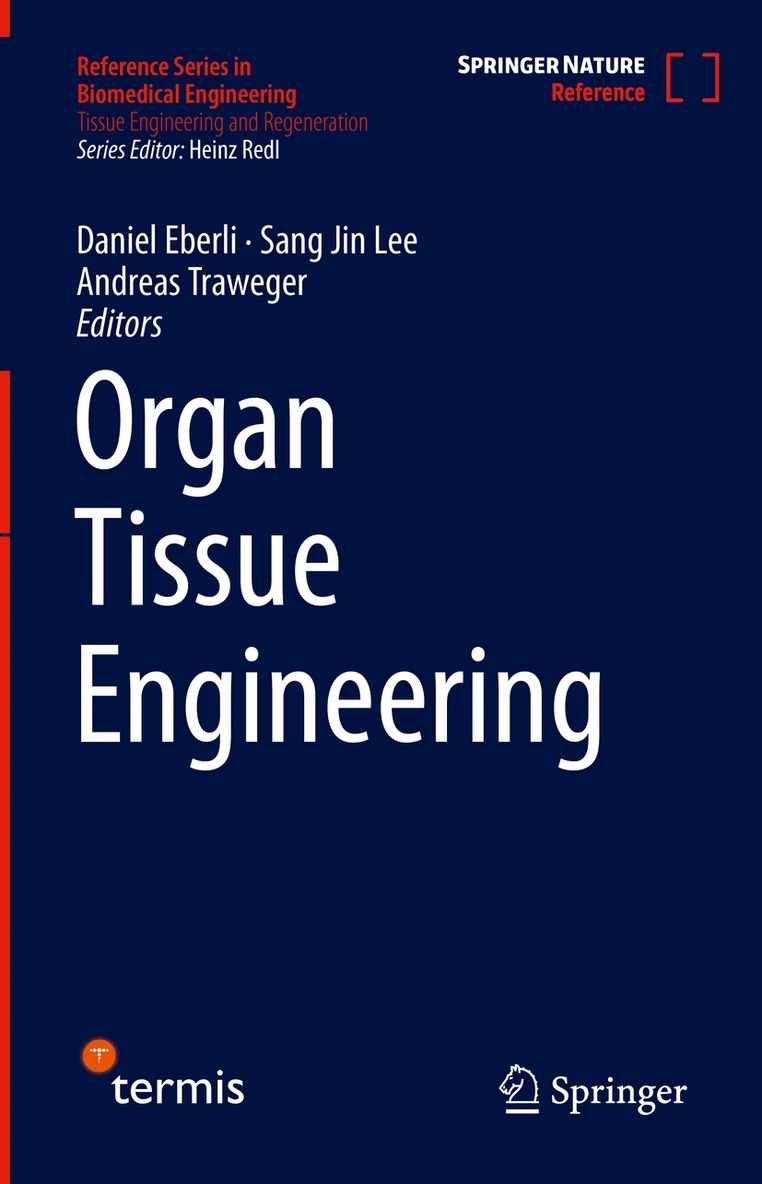
    Organ Tissue Engineering

    AvDaniel Eberli,Sang Jin Lee

    Inbunden, Engelska, 2021

    Del i serien Reference Series in Biomedical Engineering

    5 564 kr

    Beställningsvara. Skickas inom 10-15 vardagar. Fri frakt över 249 kr.

    Beskrivning

    The notion of being able to engineer complete organs has inspired an entire generation of researchers. While recent years have brought significant progress in regenerative medicine and tissue engineering, the immense challenges encountered when trying to engineer an entire organ have to be acknowledged. Despite a good understanding of cell phenotypes, cellular niches and cell-to-biomaterial interactions, the formation of tissues composed of multiple cells remains highly challenging. Only a step-by-step approach will allow the future production of a living tissue construct ready for implantation and to augment organ function.In this book, expert authors present the current state of this approach. It offers a concise overview and serves as a great starting point for anyone interested in the application of tissue engineering or regenerative medicine for organ engineering. Each chapter contains a short overview including physiological and pathological changes as well as the current clinical need. The potential cell sources and suitable biomaterials for each organ type are discussed and possibilities to produce organ-like structures are illustrated. The ultimate goal is for the generated small tissues to unfold their full potential in vivo and to serve as a native tissue equivalent. By integrating and evolving, these implants will form functional tissue in-vivo. This book discusses the desired outcome by focusing on well-defined functional readouts. Each chapter addresses the status of clinical translations and closes with the discussion of current bottlenecks and an outlook for the coming years. A successful regenerative medicine approach could solve organ shortage by providing biological substitutes for clinical use - clearly, this merits a collaborative effort.

    Produktinformation

    • Utgivningsdatum:2021-04-22
    • Mått:155 x 235 x 37 mm
    • Vikt:1 192 g
    • Format:Inbunden
    • Språk:Engelska
    • Serie:Reference Series in Biomedical Engineering
    • Antal sidor:600
    • Förlag:Springer Nature Switzerland AG
    • ISBN:9783030442101

    Utforska kategorier

    • Biokemisk teknik inom Naturvetenskap och teknik
    • Regenerativ medicin inom Medicin
    • Biomedicinsk teknik inom Medicin

    Mer om författaren

    Daniel Eberli is a scientific physician working in the translational field of urologic tissue engineering. He has a medical degree from the Medical School in Zurich, Switzerland, and a Ph.D. in Molecular Medicine from Wake Forest University, Winston Salem, NC. He has a faculty position at the Department of Urology at the University Hospital Zurich, where he devotes half of his time to patient care. Together with his research team, he is working on novel biomaterials for bladder reconstruction, improving autonomic innervation, cellular treatment of incontinence and tracking of stem cells.Sang Jin Lee, Ph.D., is currently a tenured associate professor at Wake Forest Institute for Regenerative Medicine (WFIRM), Wake Forest School of Medicine. Dr. Lee received his Ph.D. in chemical engineering from Hanyang University, Seoul, Korea, in 2003 and took a postdoctoral fellowship in the Laboratories for Tissue Engineering and Cellular Therapeutics at Harvard Medical Schooland Children’s Hospital Boston and the WFIRM, where he is currently a faculty member. He is also cross-appointed to the Virginia Tech–WFU Biomedical Engineering and Science. Dr. Lee has authored more than 140 scientific publications and reviews, has edited 2 textbooks, and has written 34 chapters in several books. Dr. Lee has an ix extensive knowledge and experience in biomaterials science, especially, biodegradable polymers and tunable hydrogels, with specific training and expertise in key research areas for tissue engineering and regenerative medicine. His research team has developed various biomaterial systems that improve cellular interactions by providing appropriate environmental cues. These biomaterial systems consist of drug/protein delivery system, nano/micro-scaled topographical feature, and hybrid materials that can actively participate in functional tissue regeneration. Recently, his team is utilizing automated 3D bioprinting technology to manufacture complex, multicellularliving tissue constructs that mimic the structure of native tissues. This can be accomplished by optimizing the formulation of biomaterials to serve as bioinks for 3D bioprinting, and by providing the biological microenvironment needed for the successful delivery of cells and biomaterials to discrete locations within the 3D structure.Sang Jin Lee, Ph.D., is currently a tenured associate professor at Wake Forest Institute for Regenerative Medicine (WFIRM), Wake Forest School of Medicine. Dr. Lee received his Ph.D. in chemical engineering from Hanyang University, Seoul, Korea, in 2003 and took a postdoctoral fellowship in the Laboratories for Tissue Engineering and Cellular Therapeutics at Harvard Medical School and Children’s Hospital Boston and the WFIRM, where he is currently a faculty member. He is also cross-appointed to the Virginia Tech–WFU Biomedical Engineering and Science. Dr. Lee has authored more than 140 scientific publications and reviews, has edited 2textbooks, and has written 34 chapters in several books. Dr. Lee has an ix extensive knowledge and experience in biomaterials science, especially, biodegradable polymers and tunable hydrogels, with specific training and expertise in key research areas for tissue engineering and regenerative medicine. His research team has developed various biomaterial systems that improve cellular interactions by providing appropriate environmental cues. These biomaterial systems consist of drug/protein delivery system, nano/micro-scaled topographical feature, and hybrid materials that can actively participate in functional tissue regeneration. Recently, his team is utilizing automated 3D bioprinting technology to manufacture complex, multicellular living tissue constructs that mimic the structure of native tissues. This can be accomplished by optimizing the formulation of biomaterials to serve as bioinks for 3D bioprinting, and by providing the biological microenvironment needed for the successful delivery of cells and biomaterials to discrete locations within the 3D structure.

    Innehållsförteckning

    • Brain Central Neural System.- Vison system, retina, cornea.- Olfactory system.- Craniomaxillofacial bone engineering.- Ear, Nose and Throat.- Dental, tooth.- Thymus,  Lymphoid.- Oesophagus, Trachea.- Lung.- Gastro Intestinal Tract (Organoids).- Kidney.- Bladder/Urethra.- Liver (Biomaterial, Cells).- Endocrine Organs (Pancreas).- Salivary grand.- Breast Tissue / Fat Tissue.- Ovary.- Penis.- Great Vessels.- Cell sheets for cardiac tissue engineering.- Heart valve Bioengineering.- Ligament.- Meniskus als muskuloskelettaler Abschnitt.- Tendons.- Skeletal system and Muscle.