• Fri frakt över 249 kr
  • •
  • Snabba leveranser
  • •
  • Billiga böcker
Kundservice

Du är på sajten för privatpersoner.

Företag, bibliotek eller offentlig verksamhet?

Du handlar på classic.bokus.com, där alla dina funktioner finns intakta.
Till classic.bokus.com
Bokus logotyp. Gå till startsidan.
  • Erbjudanden
  • Student
  • Topplistor
  • Barn & ungdom
  • Bokus Play
  • E-böcker
  • Ljudböcker
  • Pocketböcker
  • Spel och pussel

5% studentrabatt – använd koden KURSBOK27 →

Sidfot

Mina sidor

    Hjälp

    • Kundservice
    • Vanliga frågor och svar
    • Frakt och leverans
    • Retur vid ångerrätt
    • Reklamera vara
    • Betalning
    • Köpvillkor
    • Allmänna villkor
    • Information om webbplatsens tillgänglighet

    Om Bokus

    • Om oss
    • Pressrum
    • För studenter
    • För företag
    • För bibliotek och offentlig verksamhet
    • För leverantörer
    • Hållbarhet

    Populärt

    • Aktuella erbjudanden
    • Presentkort
    • Studentlitteratur
    • Nya böcker
    • Topplistor
    • Signerade böcker
    • Engelska böcker

    Inspiration

    • Boktips
    • BookTok
    • Barnbokskaraktärer
    • Populära författare
    Logotyp för Bokus
    Följ oss på Facebook (extern länk)Följ oss på Instagram (extern länk)Följ oss på YouTube (extern länk)Följ oss på TikTok (extern länk)
    bokus @ CookiesAnpassa cookiesIntegritetspolicyKöpvillkor
    Till Citymail hemsida (extern länk)Till Budbee hemsida (extern länk)Till Postnord hemsida (extern länk)Till Schenker hemsida (extern länk)Till Early Bird hemsida (extern länk)Till Walleys hemsida (extern länk)
    1. Psykologi och pedagogik
    2. Psykologi
    3. Psykologi: jaget, identitet och personlighet

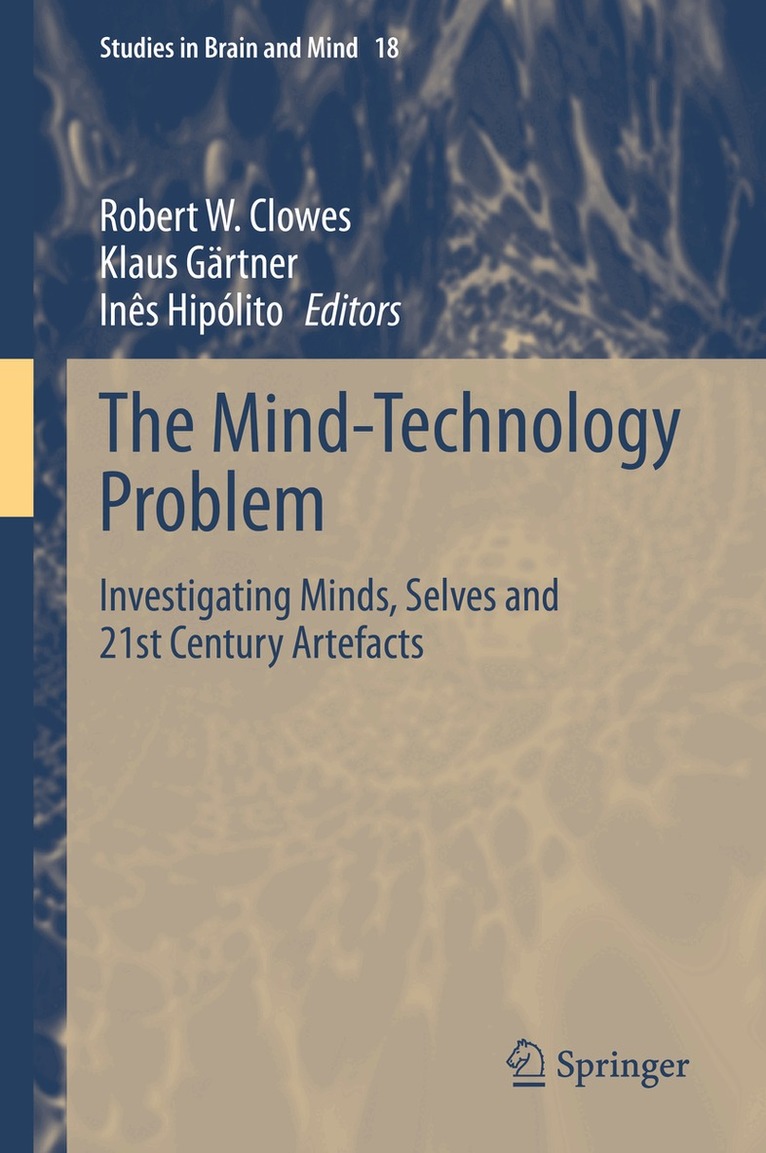
    Mind-Technology Problem

    Investigating Minds, Selves and 21st Century Artefacts

    AvRobert W. Clowes,Klaus Gärtner

    Inbunden, Engelska, 2021

    Del 18 i serien Studies in Brain and Mind

    1 400 kr

    Beställningsvara. Skickas inom 10-15 vardagar. Fri frakt över 249 kr.

    Beskrivning

    This edited book deepens the engagement between 21st century philosophy of mind and the emerging technologies which are transforming our environment. Many new technologies appear to have important implications for the human mind, the nature of our cognition, our sense of identity and even perhaps what we think human beings are. They prompt questions such as: Would an uploaded mind be 'me'? Does our reliance on smart phones, or wearable gadgets enhance or diminish the human mind? and: How does our deep reliance upon ambient artificial intelligence change the shape of the human mind? Readers will discover the best philosophical analysis of what current and near future 21st technology means for the metaphysics of mind. Important questions are addressed on matters relating to the extended mind and the distributed self. Expert authors explore the role that the ubiquitous smart phone might have in creating new forms of self-knowledge. They consider machine consciousness, brain enhancement and smart ambient technology, and what they can tell us about phenomenal consciousness.While ideas of artificial general intelligence, cognitive enhancements and the smart environment are widely commented on, serious analysis of their philosophical implications is only getting started. These contributions from top scholars are therefore very timely, and are of particular relevance to students and scholars of the philosophy of mind, philosophy of technology, computer science and psychology.

    Produktinformation

    • Utgivningsdatum:2021-09-29
    • Mått:155 x 235 x 23 mm
    • Vikt:738 g
    • Format:Inbunden
    • Språk:Engelska
    • Serie:Studies in Brain and Mind
    • Antal sidor:326
    • Förlag:Springer Nature Switzerland AG
    • ISBN:9783030726430

    Utforska kategorier

    • Psykologi: jaget, identitet och personlighet inom Psykologi och pedagogik
    • Historia: teori och metod inom Historia och arkeologi
    • Artificiell intelligens inom Data och IT

    Mer om författaren

    Robert W. Clowes is Senior Researcher and Coordinator of the Lisbon Mind and Reasoning Group at the Universidade Nova de Lisboa, Portugal. His research interests span a range of topics in philosophy and cognitive science, including the philosophy of technology, memory, agency, skills, and the implications of embodiment and cognitive extension for our understanding of the mind and conscious experience. He is particularly interested in the philosophical and cognitive scientific significance of new technologies, especially those involving the Internet and Artificial Intelligence and how these interact with human agency. His work has appeared in a variety of journals, including TOPOI, Review of Philosophy and Psychology, AI & Society, Phenomenology and the Cognitive Sciences, Philosophy and Technology, and the Journal of Consciousness Studies. He received his Ph.D at the University of Sussex. Klaus Gärtner studied Philosophy at the University of Regensburg. He obtained his PhD at the Instituto de Filosofia da Nova (Universidade Nova de Lisboa). Currently, he is a Researcher at the Departamento de História e Filosofia das Ciências and member of the Centro de Filosofia das Ciências da Universidade de Lisboa in the Faculdade de Ciências da Universidade de Lisboa, Portugal. He is also a founding member of the Lisbon Mind and Reasoning Group. His research interests include Philosophy of Mind and Cognitive Science, Philosophy of Science, Epistemology and Metaphysics. Inês Hipólito is a Postdoctoral fellow and a lecturer at the Berlin School of Mind and Brain (Humboldt-Universität zu Berlin), and an affiliated member to the Neurobiology group at the Wellcome centre for Human Neuroimaging (University College London). She works on the intersection between philosophy of cognition and computational neuroscience. More precisely, Hipólito applies tools of conceptual modelling to answer philosophical questions of cognition that are compatible with the formalisms of dynamical systems theory. Hipólito has co-edited special issues for Philosophical Transactions, Consciousness and Cognition, and the Mind and Brain Studies (Springer). She has published work in edited books (Routledge, CUP) and journals (Australasian Philosophical Review, Physics of Life Reviews, Progress in Biophysics and Molecular Biology, Synthese, Network Neuroscience). Hipólito’s work has been honoured with international prizes and awards, including the Portuguese Ministry for Science and Higher Education; the University of Oxford; the Federation of European Neuroscience Societies; and an award by the British Association for Cognitive Neuroscience.

    Recensioner i media

    “The Mind-Technology Problem: Investigating Minds, Selves, and twenty-first century artefacts edited by Clowes et al. (2021) covers a wide range of issues related to the development of technologies that emulate parts or even the whole of our mind. … Mapping out ways to live well and ethically with smart technologies … is a crucial task for science in the twenty-first century (Vuong 2018). Clowes et al. (2021)’s edited volume will equip the readers with in-depth knowledge … .” (Manh‑Tung Ho, AI & SOCIETY, Vol. 39 (2), 2024)

    Innehållsförteckning

    • Part 1. Extended Mind, Extended Cognition, Distributed self.- Chapter 1. The Distributed Self (Richard Heersmink).- Chapter 2. Slow, Continuous Uploading: Super-selves and Alternative Routes to Personal Immortality (Robert Clowes).- Part 2. Metaphysics of the Mind.- Chapter 3. Machine Consciousness: Moving beyond “Is it Possible?” (Ron Chrisley).- Chapter 4. Is the Mind Software? Is it Physical? Metaphysics of Mind for the 21st Century (Susan Schneider).- Part 3. Radical Brain Enhancement and Uploading.- Chapter 5. The Myth of Mind Uploading (Gualtiero Piccinini).- Chapter 6. Predicting Me, Experiencing Us: Predictive Processing, Big Data and the Mind of Society (Paul Smart, Kieron O'Hara and Wendy Hall).