• Fri frakt över 249 kr
  • •
  • Snabba leveranser
  • •
  • Billiga böcker
Kundservice

Du är på sajten för privatpersoner.

Företag, bibliotek eller offentlig verksamhet?

Du handlar på classic.bokus.com, där alla dina funktioner finns intakta.
Till classic.bokus.com
Bokus logotyp. Gå till startsidan.
  • Erbjudanden
  • Nyheter
  • Student
  • Topplistor
  • Barn & ungdom
  • Bokus Play
  • E-böcker
  • Pocketböcker
  • Spel & pussel

10% rabatt på allt med kod: NYSTART10 →

Sidfot

Mina sidor

    Hjälp

    • Kundservice
    • Vanliga frågor och svar
    • Frakt och leverans
    • Retur vid ångerrätt
    • Reklamera vara
    • Betalning
    • Köpvillkor
    • Allmänna villkor
    • Information om webbplatsens tillgänglighet

    Om Bokus

    • Om oss
    • Pressrum
    • För studenter
    • För företag
    • För bibliotek och offentlig verksamhet
    • För leverantörer
    • Hållbarhet

    Populärt

    • Aktuella erbjudanden
    • Presentkort
    • Studentlitteratur
    • Nya böcker
    • Topplistor
    • Signerade böcker
    • Engelska böcker

    Inspiration

    • Boktips
    • BookTok
    • Populära bokserier
    • Barnbokskaraktärer
    • Populära författare
    Logotyp för Bokus
    Följ oss på Facebook (extern länk)Följ oss på Instagram (extern länk)Följ oss på YouTube (extern länk)Följ oss på TikTok (extern länk)
    bokus @ CookiesAnpassa cookiesIntegritetspolicyKöpvillkor
    Till Citymail hemsida (extern länk)Till Budbee hemsida (extern länk)Till Postnord hemsida (extern länk)Till Schenker hemsida (extern länk)Till Early Bird hemsida (extern länk)Till Walleys hemsida (extern länk)
    1. Psykologi och pedagogik
    2. Pedagogik
    3. Pedagogisk metodik

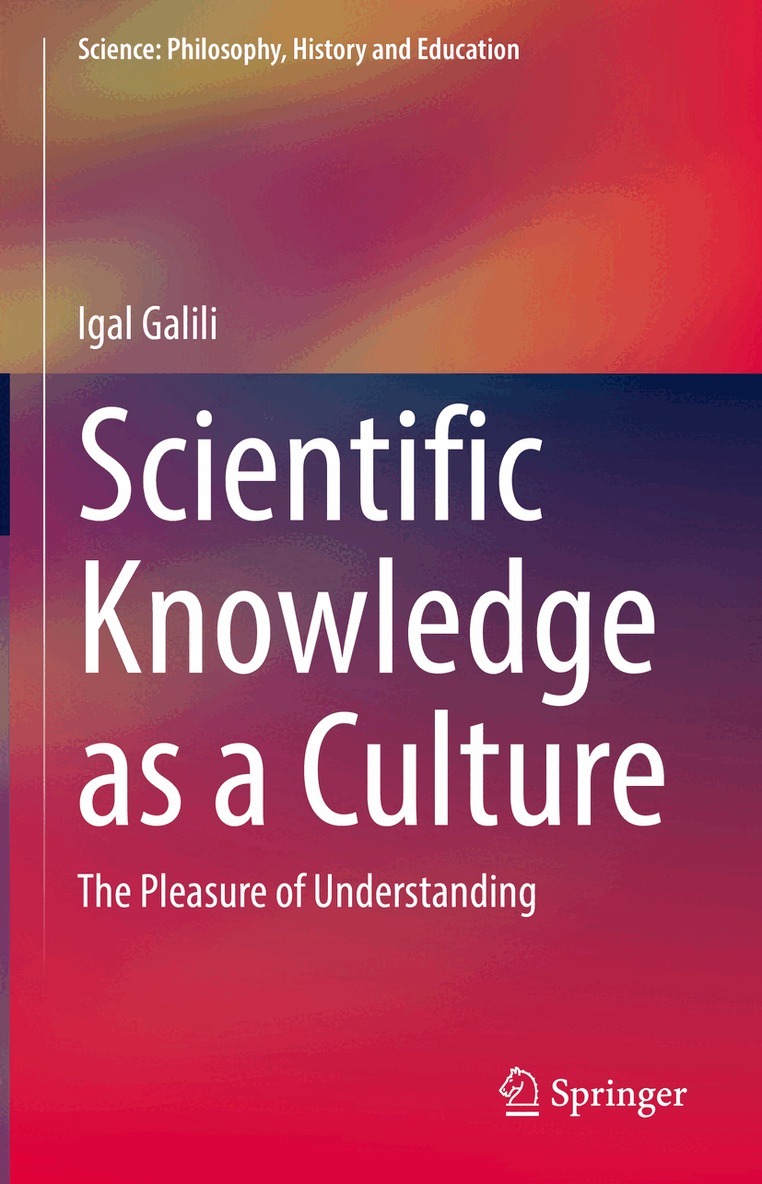
    Scientific Knowledge as a Culture

    The Pleasure of Understanding

    AvIgal Galili

    Inbunden, Engelska, 2022

    Del i serien Science: Philosophy, History and Education

    1 626 kr

    Beställningsvara. Skickas inom 10-15 vardagar. Fri frakt över 249 kr.

    Fler format och utgåvor

    E-bok

    2 049 kr

    Häftad

    1 626 kr

    Beskrivning

    This book, in its first part, contains units of conceptual history of several topics of physics based on the research in physics education and research based articles with regard to several topics involved in teaching science in general and physics in particular.  The second part of the book includes the framework used, the approach considering science knowledge as a special type of culture – discipline-culture. Within this approach, scientific knowledge is considered as comprised of a few inclusive fundamental theories each hierarchically structured in a triadic pattern: nucleus-body-periphery. While nucleus incorporates the basic principles and body comprises their implementations in the variety of laws, models, and experiments, periphery includes concepts at odds to the nucleus.  This structure introduces knowledge in its conceptual variation thus converting disciplinary knowledge to cultural-disciplinary one. The approach draws on history and philosophy of science (HPS) necessary for meaningful learning of science.  It is exemplified in several aspects regarding teaching physics, presenting history in classes, considering the special nature of science, and using artistic images in regular teaching.  The revealed conceptual debate around the chosen topics clarifies the subject matter for school students and teachers encouraging construction of Cultural Content Knowledge.  Often missed in teachers' preparation and common curriculum it helps genuine understanding of science thus providing remedy of students' misconceptions reported in educational research.

    Produktinformation

    • Utgivningsdatum:2022-02-02
    • Mått:155 x 235 x 33 mm
    • Vikt:916 g
    • Format:Inbunden
    • Språk:Engelska
    • Serie:Science: Philosophy, History and Education
    • Antal sidor:477
    • Förlag:Springer Nature Switzerland AG
    • ISBN:9783030802004

    Utforska kategorier

    • Pedagogisk metodik inom Psykologi och pedagogik
    • Undervisning i specifika ämnen inom Psykologi och pedagogik
    • Naturvetenskapens historia inom Naturvetenskap och teknik

    Mer om författaren

    Igal Galili was trained in theoretical physics in The Hebrew University of Jerusalem. He further specialized in physics education research and teaching development in the universities of San Diego (SDSU) and Berkeley (UCB). For years, he served as a professor of science education, a head of the science teaching department and the Amos de Shalit Science Teaching Centre in the Faculty of Mathematics and Natural Science at the Hebrew University of Jerusalem.  His study explored the physics knowledge of school students and teachers structuring it in terms scheme-facets of knowledge. In considering the subject matter for teaching physics he investigated the topics of optics, mechanics, and electromagnetism introducing their conceptual structure and potential obstacles for understanding.  He explored the new approaches to teaching physical concepts (in particular their operational definition and relationship with the structure of knowledge). This study eventually arrived to the production of the paradigm of discipline-culture (DC) as a framework of the scientific knowledge to be mirrored in school curriculum.  Three different forms of DC-based curriculum were introduced and developed in the forms of – long and short disciplinary courses, conceptual excursus and summary lecture.  It was suggested to use artistic images in the holistic representation of scientific ideas and of the features of science nature.  His studies were published in international research journals and supported his production of physics textbooks in introductory physics (classical and modern). In particular, a special culturally oriented course of optics was produced. It considered theory of light and vision as a cluster of four fundamental theories (rays, particles, waves and photons).

    Innehållsförteckning

    • Part I. Conceptual Excursus.- 1 Understanding Classical Mechanics: A Dialogue with the Cartesian Theory of Motion.- 2 De Motu –The History of the Understanding of Motion, from Aristotle to Newton.- 3 Optical Image and Vision: From Pythagoras to Kepler.- 4 Inertial Force – The Unifying Concept.- 5 Weight Concept: From Aristotle to Newton and then to Einstein.- Part II Perspectives.- 6 Scientific Knowledge as a Culture – a Paradigm of Knowledge Representation for the Meaningful Teaching and Learning Science.- 7 Teaching Optics: A Historico-Philosophical Perspective.- 8From Comparison between Scientists to Gaining Cultural Scientific Knowledge - Leonardo and Galileo.- 9 A Refined Account of Nature of Science.- 10 On the Power of Fine Arts Pictorial Imagery in Science Education.- 11 Epilogue – Discipline-Culture for the Pleasure of Understanding.