• Fri frakt över 249 kr
  • •
  • Snabba leveranser
  • •
  • Billiga böcker
Kundservice

Du är på sajten för privatpersoner.

Företag, bibliotek eller offentlig verksamhet?

Du handlar på classic.bokus.com, där alla dina funktioner finns intakta.
Till classic.bokus.com
Bokus logotyp. Gå till startsidan.
  • Erbjudanden
  • Nyheter
  • Student
  • Topplistor
  • Barn & ungdom
  • Bokus Play
  • E-böcker
  • Pocketböcker
  • Spel & pussel

10% rabatt på allt med kod: NYSTART10 →

Sidfot

Mina sidor

    Hjälp

    • Kundservice
    • Vanliga frågor och svar
    • Frakt och leverans
    • Retur vid ångerrätt
    • Reklamera vara
    • Betalning
    • Köpvillkor
    • Allmänna villkor
    • Information om webbplatsens tillgänglighet

    Om Bokus

    • Om oss
    • Pressrum
    • För studenter
    • För företag
    • För bibliotek och offentlig verksamhet
    • För leverantörer
    • Hållbarhet

    Populärt

    • Aktuella erbjudanden
    • Presentkort
    • Studentlitteratur
    • Nya böcker
    • Topplistor
    • Signerade böcker
    • Engelska böcker

    Inspiration

    • Boktips
    • BookTok
    • Populära bokserier
    • Barnbokskaraktärer
    • Populära författare
    Logotyp för Bokus
    Följ oss på Facebook (extern länk)Följ oss på Instagram (extern länk)Följ oss på YouTube (extern länk)Följ oss på TikTok (extern länk)
    bokus @ CookiesAnpassa cookiesIntegritetspolicyKöpvillkor
    Till Citymail hemsida (extern länk)Till Budbee hemsida (extern länk)Till Postnord hemsida (extern länk)Till Schenker hemsida (extern länk)Till Early Bird hemsida (extern länk)Till Walleys hemsida (extern länk)
    1. Medicin
    2. Medicin: allmänt
    3. Den medicinska professionen
    4. Medicinsk etik och läkaretik

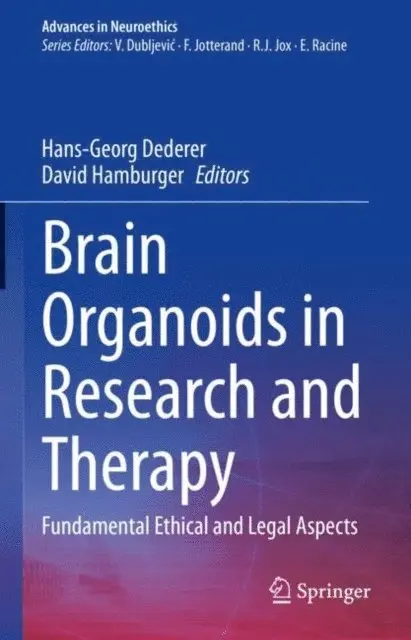
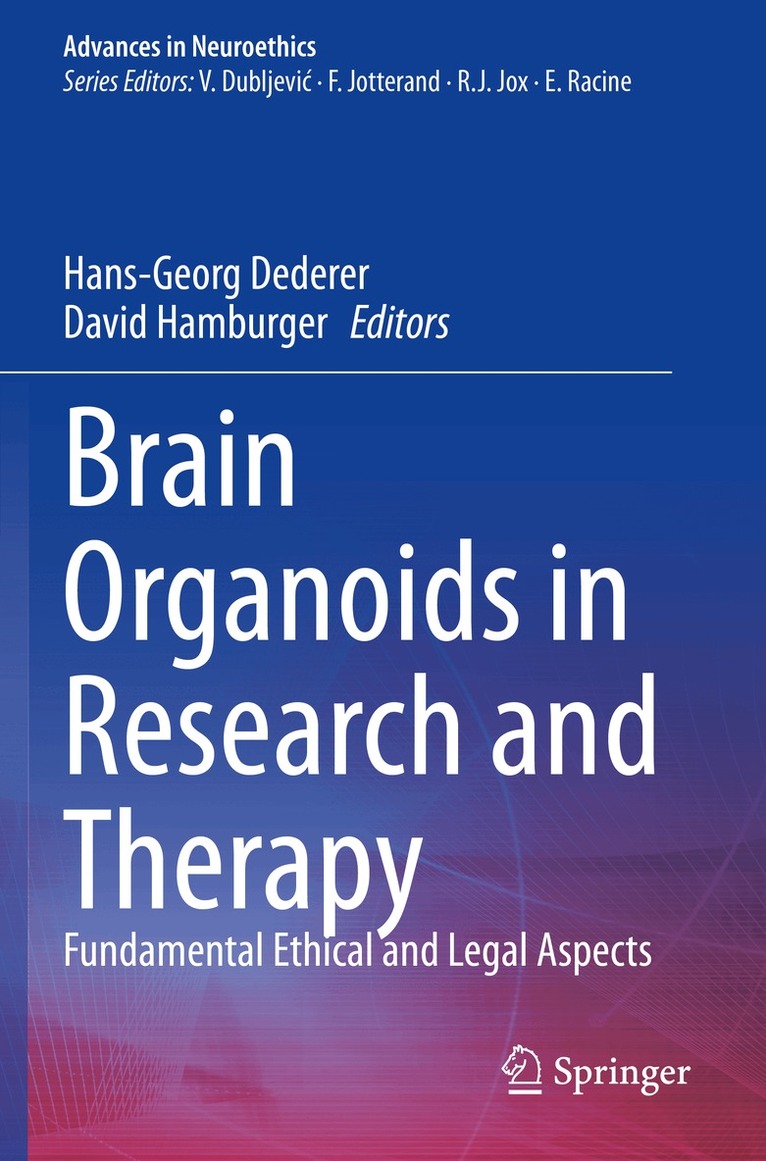
    Brain Organoids in Research and Therapy

    Fundamental Ethical and Legal Aspects

    AvHans-Georg Dederer,David Hamburger

    Inbunden, Engelska, 2022

    Del i serien Advances in Neuroethics

    1 673 kr

    Beställningsvara. Skickas inom 10-15 vardagar. Fri frakt över 249 kr.

    Beskrivning

    This volume elucidates the pivotal ethical and legal issues arising from the use of brain organoids for research, therapeutic and enhancement purposes.The function of the human brain is still a mystery. Until recently, only post-mortem tissue was available for a structural examination of the brain. Consequently, the examination results could only reflect the state at the end of life. However, in order to better understand the development and function of the human brain, dynamic and functional investigations of different human brain cells are necessary. This is where brain organoids, artificially grown in vitro miniature brains, provide the opportunity for more flexible research scenarios.At the same time, however, the use of brain organoids in research and therapy raises the question of how these new entities are to be treated from an ethical and legal point of view. Against this background, this volume aims at clarifying the normative implications of the use of brain organoids in research and therapy.  The ethical reflections on the status of brain organoids, informed consent, human-to-animal chimeras and neuro-enhancement are mirrored by corresponding legal analyses. The ethical and legal assessments are preceded by an introduction to the scientific and medical background of the brain organoid technology. A final chapter will be devoted to the issue of whether international harmonization of normative standards for brain organoid research and therapy is feasible and advisable.

    Produktinformation

    • Utgivningsdatum:2022-07-10
    • Mått:155 x 235 x 20 mm
    • Vikt:639 g
    • Format:Inbunden
    • Språk:Engelska
    • Serie:Advances in Neuroethics
    • Antal sidor:271
    • Förlag:Springer Nature Switzerland AG
    • ISBN:9783030976408

    Utforska kategorier

    • Medicinsk etik och läkaretik inom Medicin
    • Biovetenskap inom Naturvetenskap och teknik
    • Neurologi och klinisk neurofysiologi inom Medicin

    Mer om författaren

    Hans-Georg Dederer is Full Professor at the University of Passau and holds the Chair of Constitutional and Administrative Law, Public International Law, European and International Economic Law. His areas of research include biotechnology and biomedical law. Against that backdrop, he acted since 2010 as principal investigator of several interdisciplinary research projects funded by the Federal Ministry of Education and Research (BMBF). Those research projects dealt with ethical and legal issues of embryo protection, stem cell research and genome editing. From 2019 to 2023 he receives a grant by the Bavarian State Ministry of Science and the Arts for a research project on the legal and ethical implications of brain organoid technology. Hans-Georg Dederer is co-editor of a commentary on international biotechnology law and of the book series “Life Sciences and Law” (LIT Publishing House). He is also a member of the Permanent Senate Commission on Genetic Research of the German Research Foundation (DFG).David Hamburger is research associate at the Chair of Constitutional and Administrative Law, Public International Law, European and International Economic Law of the University of Passau. His research is focused on the regulation of the application of genome-editing in agriculture and medicine. From 2017 to 2019 he was part of a research project that reconsidered from scratch the EU’s regulatory framework for genetically modified organisms (GMOs) in view of the latest biological insights into the genome editing techniques. Since 2019 his research shifted to an analysis of the legal framework for research and therapies with genome-edited brain cells which is part of a research project funded by the Bavarian State Ministry of Science and the Arts. David Hamburger is co-editor of a contributed volume on the regulation of genome-edited plants (Regulation of Genome Editing in Plant Biotechnology. A Comparative Analysis of Regulatory Frameworks of Selected Countries and the EU, Springer, Cham 2019).

    Innehållsförteckning

    • Chapter 1) Introductory Remarks.- Part I) Scientific Background.- Chapter 2) Development of Brain Organoids on the Basis of Genome-Edited iPSC-Derived Brain Cells.- Chapter 3) Cell-Based Therapy and Genome Editing in Parkinson's Disease: Quo Vadis.- Part II) The Status Debate.- Chapter 4) Human Cerebral Organoids: Evolving Entities and Their Moral Status.- Chapter 5). Legal perspective: What is, or Should Be, the Legal Status of Brain Organoids?.- Part III) The Informed Consent Challenge.- Chapter 6) Ethical Perspective: Ethics Considerations Regarding Donors’ and Patients’ Consent.- Chapter 7) The Legal Perspective: The Legal Requirements for—and Limits to—the Donor’s and the Patient’s Consent.- Part IV) The Chimera Issue.- Chapter 8) Moral Permissibility of Transplantation of Human Brain Organoids into Animals.- Chapter 9) Transplantation of Human Brain Organoids into Animals - The Legal Issues.- Part V) The Enhancement Conundrum.- Chapter 10) Building a Better Beast: Enhancing the Minds of Animals.- Chapter 11) Legal Arguments in Favour of and Against Neuroenhancement by Means of Brain Organoids.- Part VI) The Harmonization Problem.- Chapter 12) Legal Perspective: A Global Harmonisation of Legal Standards for Brain Organoid Research and Therapy?.