• Fri frakt över 249 kr
  • •
  • Snabba leveranser
  • •
  • Billiga böcker
Kundservice

Du är på sajten för privatpersoner.

Företag, bibliotek eller offentlig verksamhet?

Du handlar på classic.bokus.com, där alla dina funktioner finns intakta.
Till classic.bokus.com
Bokus logotyp. Gå till startsidan.
  • Erbjudanden
  • Nyheter
  • Student
  • Topplistor
  • Barn & ungdom
  • Bokus Play
  • E-böcker
  • Pocketböcker
  • Spel & pussel

10% rabatt på allt med kod NYSTART10 →

Sidfot

Mina sidor

    Hjälp

    • Kundservice
    • Vanliga frågor och svar
    • Frakt och leverans
    • Retur vid ångerrätt
    • Reklamera vara
    • Betalning
    • Köpvillkor
    • Allmänna villkor
    • Information om webbplatsens tillgänglighet

    Om Bokus

    • Om oss
    • Pressrum
    • För studenter
    • För företag
    • För bibliotek och offentlig verksamhet
    • För leverantörer
    • Hållbarhet

    Populärt

    • Aktuella erbjudanden
    • Presentkort
    • Studentlitteratur
    • Nya böcker
    • Topplistor
    • Signerade böcker
    • Engelska böcker

    Inspiration

    • Boktips
    • BookTok
    • Populära bokserier
    • Barnbokskaraktärer
    • Populära författare
    Logotyp för Bokus
    Följ oss på Facebook (extern länk)Följ oss på Instagram (extern länk)Följ oss på YouTube (extern länk)Följ oss på TikTok (extern länk)
    bokus @ CookiesAnpassa cookiesIntegritetspolicyKöpvillkor
    Till Citymail hemsida (extern länk)Till Budbee hemsida (extern länk)Till Postnord hemsida (extern länk)Till Schenker hemsida (extern länk)Till Early Bird hemsida (extern länk)Till Walleys hemsida (extern länk)
    1. Samhälle och politik
    2. Sociologi och antropologi
    3. Sociologi

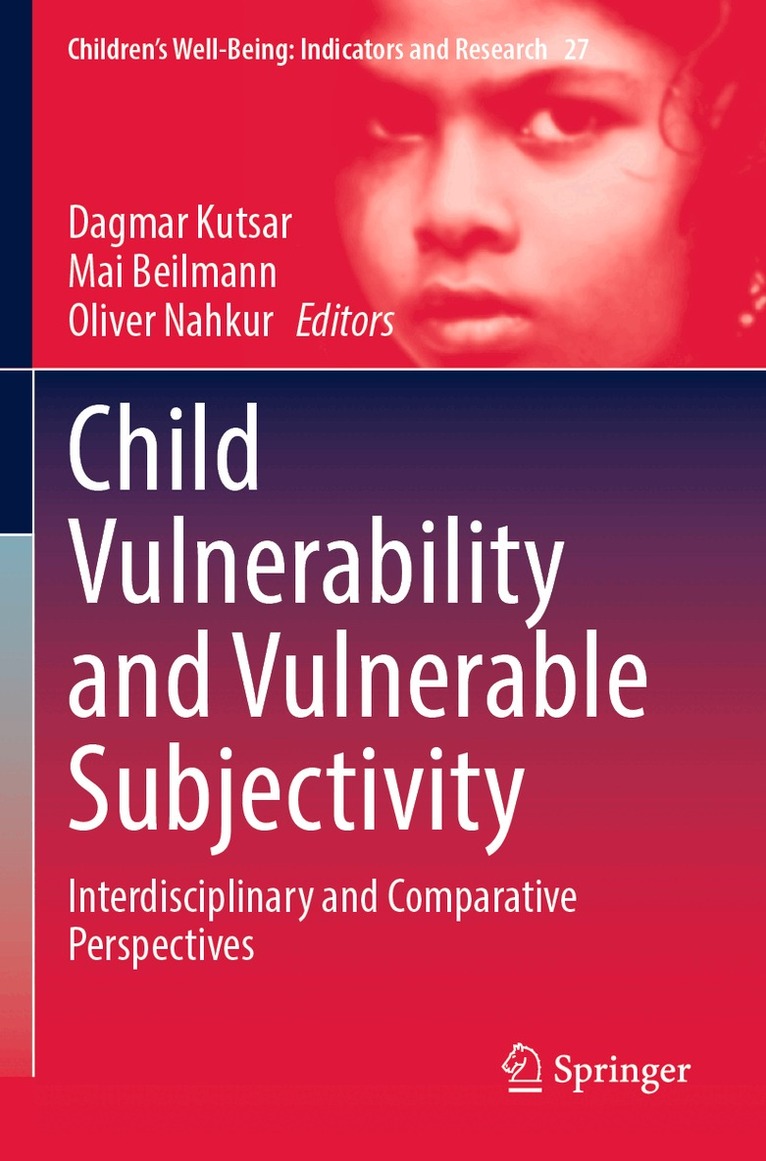
    Child Vulnerability and Vulnerable Subjectivity

    Interdisciplinary and Comparative Perspectives

    AvDagmar Kutsar,Mai Beilmann

    Häftad, Engelska, 2025

    Del 27 i serien Children’s Well-Being: Indicators and Research

    1 783 kr

    Beställningsvara. Skickas inom 10-15 vardagar. Fri frakt över 249 kr.

    Beskrivning

    This book explores child vulnerability in various contexts from a cross-country, comparative perspective. It shows how vulnerability in childhood develops within subjects in relationships with other people (other children, parents, specialists, such as teachers, social workers, and judges), how it is created by welfare, health care, education, and justice systems, and is empowered by multiple crises, such as the COVID-19 pandemic, wars and natural disasters. The authors hope to enhance dialogue between childhood studies and children’s rights studies through these discussions. The role of children’s agency and autonomy, including their right to participate in decision-making processes related to their own life, has a special emphasis in this book. Importantly, the book discusses ethical considerations and challenges connected to the participation of vulnerable children in research. It also adds insights into domain-based child vulnerability, particularly through participatory action research with extremely vulnerable children with traumatic pasts in Estonian substitute care and Ukrainian children with refugee status in Estonia. The book thereby provides deep insights into the ways to increase child well-being by decreasing vulnerabilities and building resilience. It combines approaches from psychology, sociology, law, educational sciences, social work, and media studies, and is an important resource for academics as well as practitioners and policy-makers working on children's well-being.

    Produktinformation

    • Utgivningsdatum:2025-07-31
    • Mått:155 x 235 x 17 mm
    • Vikt:452 g
    • Format:Häftad
    • Språk:Engelska
    • Serie:Children’s Well-Being: Indicators and Research
    • Antal sidor:282
    • Förlag:Springer International Publishing AG
    • ISBN:9783031613357

    Utforska kategorier

    • Sociologi inom Samhälle och politik
    • Folkhälsa och hälsopedagogik inom Medicin
    • Politiskt förtryck inom Samhälle och politik

    Mer om författaren

    Dagmar Kutsar, PhD, is an Associate Professor of Social Policy at the University of Tartu in Estonia. Her research interests are in family, childhood and welfare research and policies. She has been a partner in several international research projects, such as EU 6FP PROFIT, IPROSEC, NoE EQUALSOC, EU FP7 FLOWS, and others. She has been a member of the Standing Committee of Social Sciences of the European Science Foundation, a member of the Executive Committee and Chair of the National Associations Council of the European Sociological Association. She was an Expert on the EU 7FP Youth Social Inclusion Cluster at the European Commission, a member of the Advisory Group of the Widening Programme at the EU Horizon 2020 and an Advisory Group member of the UNICEF Report Card Nr16. Her recent co-edited books in English include Internationalisation of Social Sciences in Central and Eastern Europe. The ‘Catching Up’ – A Myth or a Strategy?’ (Routledge, 2010) and Local Welfare Policymaking in European Cities (Springer, 2015). She has guest-edited a special issue of the Population Review (Special Collection No. 8) in 2021. Mai Beilmann, PhD, is Associate Professor of Empirical Sociology at the Institute of Social Studies, University of Tartu. She has worked on various EU projects and the European Social Survey 2021, related to children's well-being, including youth skills, child vulnerability, urban policy innovations, migration challenges, active citizenship construction of European youth, and so on. She has publications in international peer-reviewed journals and in Estonian publications, including the Journal of Applied Youth Studies, Journal of Media Literacy Education, Journal of Social Science Education and has presented at conferences such as ISPCAN (International Society for the Prevention of Child Abuse and Neglect). Oliver Nahkur, PhD, is a Research Fellow at the Institute of Social Studies, University of Tartu. Oliver does research in quality of life studies, social indicators research, mental health and well-being, interpersonal violence and health politics and policy. He publishes regularly in peer-reviewed edited volumes as well as international journals on subjective well-being, impacts of migration on children's well-being, children's life satisfaction, and related topics. He is a member of the International Society for Quality-of-Life Studies.

    Innehållsförteckning

    • Introduction.- Part I. Theoretical and Ethical Insights into Studying Child Vulnerability.- Conceptual Framework for Understanding Child Vulnerability.- Child Participation in Social Research: Ethical and Methodological Considerations.- Part II. Child Vulnerability from Different Angles.- Child Vulnerability from a Cross-Country Comparative Perspective.- Child Vulnerability within the Complexity of the Family.- Child Vulnerability in the School Environment.- Child Autonomy and Vulnerability in Healthcare.- Child Vulnerability in the Digital World.- Child Vulnerability within the Legal System.- Childhood Vulnerability: Trauma-aware Approaches for Building Resilience in Traumatised Children.- Part III. Child Vulnerability in Times of Crisis.- Subjective Well-Being and Vulnerability of Children During the Covid-19 Pandemic.- Ukrainian Refugee Children in the Estonian Education System During the Russian Invasion of Ukraine: Vulnerable, Traumatised and Displaced.- Part IV. Building Resilience in Children: Looking Forward.- Life Story Work – a Good Method to Reduce Child Vulnerability in Substitute Care.- Building Resilience – Innovation in Research and Practice.- Public Policies to Overcome the Vulnerability of Children.