• Fri frakt över 249 kr
  • •
  • Snabba leveranser
  • •
  • Billiga böcker
Kundservice

Du är på sajten för privatpersoner.

Företag, bibliotek eller offentlig verksamhet?

Du handlar på classic.bokus.com, där alla dina funktioner finns intakta.
Till classic.bokus.com
Bokus logotyp. Gå till startsidan.
  • Erbjudanden
  • Nyheter
  • Student
  • Topplistor
  • Barn & ungdom
  • Bokus Play
  • E-böcker
  • Pocketböcker
  • Spel & pussel

Må bättre, för mindre! Upp till 50% rabatt på hälsoböcker

Sidfot

Mina sidor

    Hjälp

    • Kundservice
    • Vanliga frågor och svar
    • Frakt och leverans
    • Retur vid ångerrätt
    • Reklamera vara
    • Betalning
    • Köpvillkor
    • Allmänna villkor
    • Information om webbplatsens tillgänglighet

    Om Bokus

    • Om oss
    • Pressrum
    • För studenter
    • För företag
    • För bibliotek och offentlig verksamhet
    • För leverantörer
    • Hållbarhet

    Populärt

    • Aktuella erbjudanden
    • Presentkort
    • Studentlitteratur
    • Nya böcker
    • Topplistor
    • Signerade böcker
    • Engelska böcker

    Inspiration

    • Boktips
    • BookTok
    • Populära bokserier
    • Barnbokskaraktärer
    • Populära författare
    Logotyp för Bokus
    Följ oss på Facebook (extern länk)Följ oss på Instagram (extern länk)Följ oss på YouTube (extern länk)Följ oss på TikTok (extern länk)
    bokus @ CookiesAnpassa cookiesIntegritetspolicyKöpvillkor
    Till Citymail hemsida (extern länk)Till Budbee hemsida (extern länk)Till Postnord hemsida (extern länk)Till Schenker hemsida (extern länk)Till Early Bird hemsida (extern länk)Till Walleys hemsida (extern länk)
    1. Samhälle och politik
    2. Politik och statsskick
    3. Centralt styre och förvaltning

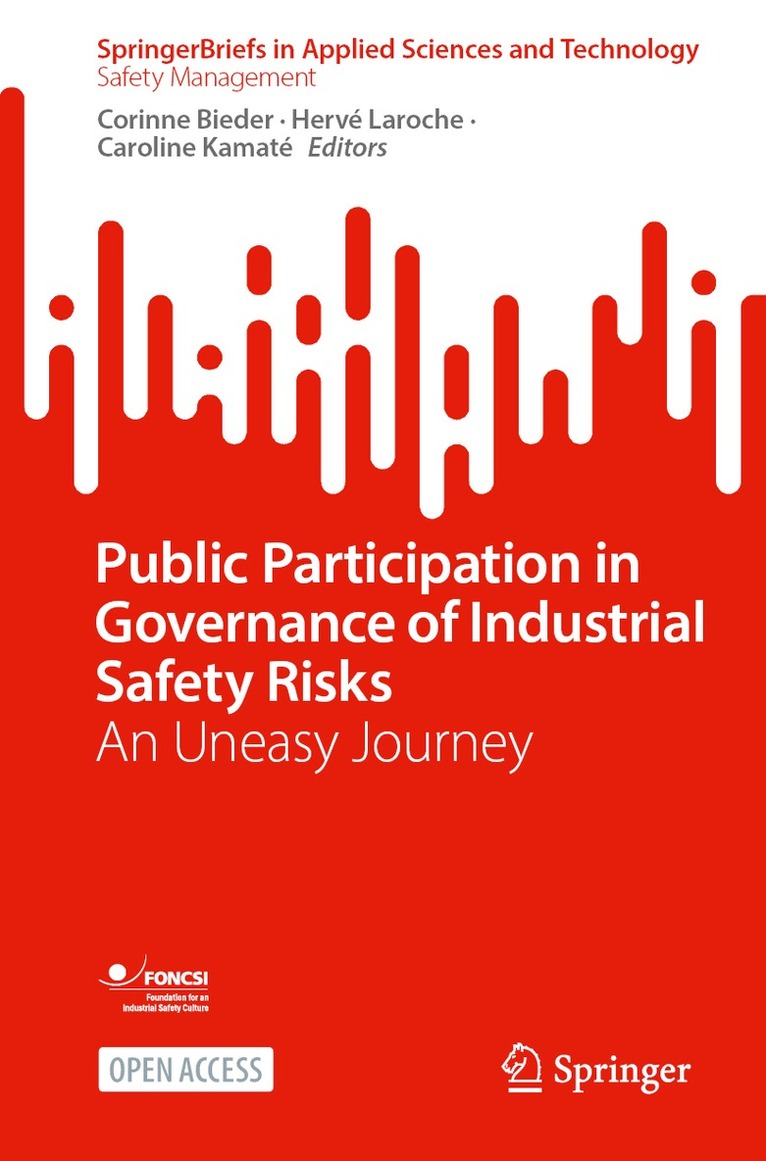
    Public Participation in Governance of Industrial Safety Risks

    An Uneasy Journey

    AvCorinne Bieder,Hervé Laroche

    Häftad, Engelska, 2025

    Del i serien SpringerBriefs in Applied Sciences and Technology

    547 kr

    Beställningsvara. Skickas inom 10-15 vardagar. Fri frakt över 249 kr.

    Beskrivning

    This open access brief-in-two-volumes provides a global overview of the many ways in which today's safety management and governance of high-risk industries may be destabilized in an evolving and rapidly transforming world. Rather than focusing exclusively on the traditional perimeter of safety management and governance, it considers industrial safety within a wider societal, technological, (geo)political, economic and environmental context to explore future challenges in the coupling of safety and its ecosystem and how to live with them.This first volume analyzes the current situation as well as the destabilizations now underway and predicted to come in the future and suggests new frames of reference for this changing world, including:the social contract,AI realism andthe regulatory framework.The second volume focuses on challenges at the organizational level before providing illustrations of ways forward implemented in various areas.In considering the complexity and uncertainty of the topic, the two volumes together rely on the principle of requisite variety to provide contrasting and complementary views by gathering insights on the future of safety from many international academics.

    Produktinformation

    • Utgivningsdatum:2025-01-22
    • Mått:155 x 235 x 7 mm
    • Vikt:178 g
    • Format:Häftad
    • Språk:Engelska
    • Serie:SpringerBriefs in Applied Sciences and Technology
    • Antal sidor:98
    • Förlag:Springer International Publishing AG
    • ISBN:9783031776496

    Utforska kategorier

    • Centralt styre och förvaltning inom Samhälle och politik
    • Mikroekonomi inom Ekonomi och Ledarskap
    • Ledarskapsböcker inom Ekonomi och Ledarskap

    Mer om författaren

    Corinne Bieder is Head of the Safety management research program at ENAC (the French Civil Aviation University). She has worked and conducted research in safety management in a variety of high-risk industries for many years. She has published a number of papers and books on safety management and is a member of the international NeTWork think tank addressing safety from a multidisciplinary perspective. After being a member of its strategic analysis group, she took up the position of scientific director at FonCSI (Foundation for an Industrial Safety Culture) in 2024.Hervé Laroche is Emeritus Professor in the Management department at ESCP Business School. His research concerns decision-making processes in organizations, organizational reliability, and organizational secrecy. It has been published in Management, Organization Science, Organization Studies, Journal of Business Ethics, etc. He has been a member of FonCSI's strategic analysis group since 2014.Caroline Kamaté holds a Ph.D. in immunology. She has post-doctoral experience in academy (University Medical Center, Utrecht, Netherlands) and in industry (Sanofi-Aventis, France). Her interest for scientific communication led her to join FonCSI in 2007 where she is involved in the management of research programmes and dissemination of results.

    Innehållsförteckning

    • Public Participation in the Governance of Risks Associated with Industrial Activities: The New Injunction, Decoy Breakthrough?.- Part I: Models and Cases: Accounting for Context and Complexity.- Public Participation and the Democratic Imaginaries: Why Public Participation May Not Yield the Benefits Expected.- Decision-Making in Projects Involving Public Participation: Regulating the Mess. The Governance of Industrial and Community Risk.- Broadening the Scope of industrial Risk Assessment and Management.- Total  Energies Approach to Stakeholder Engagement.- Part II: Approaches for Developing and Managing Public Participation.- Social Acceptability of Industrial Risk: From the Right to Know ot the Duty to Engage.- Public Participation in the Management of Risk from Industrial Facilities.- Participatory Processes for Industrial Risk Management: Enablers, Barriers and Limitations.- Engaging Citizens in Dialogue on Technoscience: An Endogenous Approach.- Another Kind of Participation is Possible: The Case of the French Institute for Radiation Protection and Nuclear Safety.- Conclusion.