• Fri frakt över 249 kr
  • •
  • Snabba leveranser
  • •
  • Billiga böcker
Kundservice

Du är på sajten för privatpersoner.

Företag, bibliotek eller offentlig verksamhet?

Du handlar på classic.bokus.com, där alla dina funktioner finns intakta.
Till classic.bokus.com
Bokus logotyp. Gå till startsidan.
  • Erbjudanden
  • Nyheter
  • Student
  • Topplistor
  • Barn & ungdom
  • Bokus Play
  • E-böcker
  • Pocketböcker
  • Spel & pussel

10% rabatt på allt med kod: NYSTART10 →

Sidfot

Mina sidor

    Hjälp

    • Kundservice
    • Vanliga frågor och svar
    • Frakt och leverans
    • Retur vid ångerrätt
    • Reklamera vara
    • Betalning
    • Köpvillkor
    • Allmänna villkor
    • Information om webbplatsens tillgänglighet

    Om Bokus

    • Om oss
    • Pressrum
    • För studenter
    • För företag
    • För bibliotek och offentlig verksamhet
    • För leverantörer
    • Hållbarhet

    Populärt

    • Aktuella erbjudanden
    • Presentkort
    • Studentlitteratur
    • Nya böcker
    • Topplistor
    • Signerade böcker
    • Engelska böcker

    Inspiration

    • Boktips
    • BookTok
    • Populära bokserier
    • Barnbokskaraktärer
    • Populära författare
    Logotyp för Bokus
    Följ oss på Facebook (extern länk)Följ oss på Instagram (extern länk)Följ oss på YouTube (extern länk)Följ oss på TikTok (extern länk)
    bokus @ CookiesAnpassa cookiesIntegritetspolicyKöpvillkor
    Till Citymail hemsida (extern länk)Till Budbee hemsida (extern länk)Till Postnord hemsida (extern länk)Till Schenker hemsida (extern länk)Till Early Bird hemsida (extern länk)Till Walleys hemsida (extern länk)
    1. Psykologi och pedagogik
    2. Psykologi
    3. Arbetspsykologi

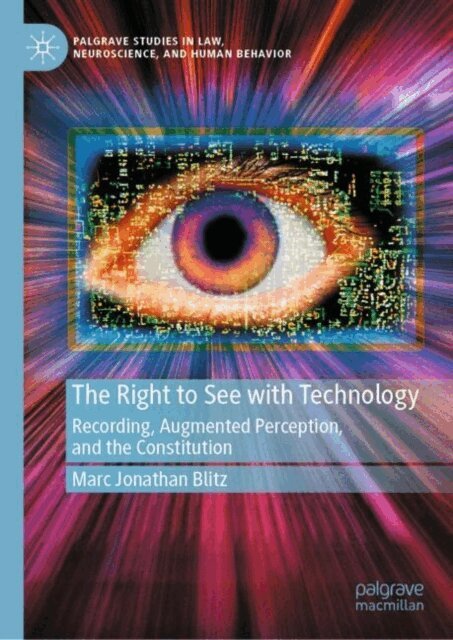
    Right to See with Technology

    Recording, Augmented Perception, and the Constitution

    AvMarc Jonathan Blitz

    E-bok
    Engelska, 2025

    508 kr

    Läs direkt i Bokus Reader – eller ladda ned till din enhet

    Fler format och utgåvor

    Inbunden

    438 kr

    Beskrivning

    This book asks if we have a constitutional right to see or sense our surroundings with technology.  Do we have a constitutional right to record our surroundings with cameras embedded in smartphones or drones?  Or to enhance our vision with extended reality technology, bionic eyes, or brain-computer interfaces? Courts in the United States have already provided a possible foundation for answering such questions.  There is, they have said, a right to document matters of public concern by creating and sharing recordings with others.  Such recordings extend our perception: They let us watch events that are remote in space and time.  Yet sharing them is also a kind of communication and thus, the creation of “speech” protected by the First Amendment.  So too might be other ways of seeing with technology. This emerging case law raises interesting questions and challenges, such as how enhancement of our perceptions can leave room for others’ privacy.This book explores such questions, focusing on American constitutional jurisprudence. It also argues that, in doing so, it is helpful to recognize that our interest in using and enhancing our perceptual power isn’t only an interest in doing so as part of First Amendment communication.  It is also linked closely to other rights - to personal integrity and the liberty to use our body’s perceptual powers and to the constitution’s protection for freedom of thought or what some scholars call “cognitive liberty:” Our exercise of perception and our use of it to learn about our surroundings is a crucial part of exercising our and shaping our mind.

    Produktinformation

    • Utgivningsdatum:2025-07-31
    • Språk:Engelska
    • Filformat:EPUB
    • Kopieringsskydd:LCP
    • ISBN:9783031895333
    • Förlag:Springer Nature Switzerland

    Utforska kategorier

    • Arbetspsykologi inom Psykologi och pedagogik
    • Biologisk psykologi och neuropsykologi inom Psykologi och pedagogik
    • Kognitiv psykologi inom Psykologi och pedagogik