• Fri frakt över 249 kr
  • •
  • Snabba leveranser
  • •
  • Billiga böcker
Kundservice

Du är på sajten för privatpersoner.

Företag, bibliotek eller offentlig verksamhet?

Du handlar på classic.bokus.com, där alla dina funktioner finns intakta.
Till classic.bokus.com
Bokus logotyp. Gå till startsidan.
  • Erbjudanden
  • Nyheter
  • Student
  • Topplistor
  • Barn & ungdom
  • Bokus Play
  • E-böcker
  • Pocketböcker
  • Spel & pussel

10% rabatt på allt med kod NYSTART10 →

Sidfot

Mina sidor

    Hjälp

    • Kundservice
    • Vanliga frågor och svar
    • Frakt och leverans
    • Retur vid ångerrätt
    • Reklamera vara
    • Betalning
    • Köpvillkor
    • Allmänna villkor
    • Information om webbplatsens tillgänglighet

    Om Bokus

    • Om oss
    • Pressrum
    • För studenter
    • För företag
    • För bibliotek och offentlig verksamhet
    • För leverantörer
    • Hållbarhet

    Populärt

    • Aktuella erbjudanden
    • Presentkort
    • Studentlitteratur
    • Nya böcker
    • Topplistor
    • Signerade böcker
    • Engelska böcker

    Inspiration

    • Boktips
    • BookTok
    • Populära bokserier
    • Barnbokskaraktärer
    • Populära författare
    Logotyp för Bokus
    Följ oss på Facebook (extern länk)Följ oss på Instagram (extern länk)Följ oss på YouTube (extern länk)Följ oss på TikTok (extern länk)
    bokus @ CookiesAnpassa cookiesIntegritetspolicyKöpvillkor
    Till Citymail hemsida (extern länk)Till Budbee hemsida (extern länk)Till Postnord hemsida (extern länk)Till Schenker hemsida (extern länk)Till Early Bird hemsida (extern länk)Till Walleys hemsida (extern länk)
    1. Ekonomi och Ledarskap
    2. Företagsekonomi
    3. Entreprenörskap

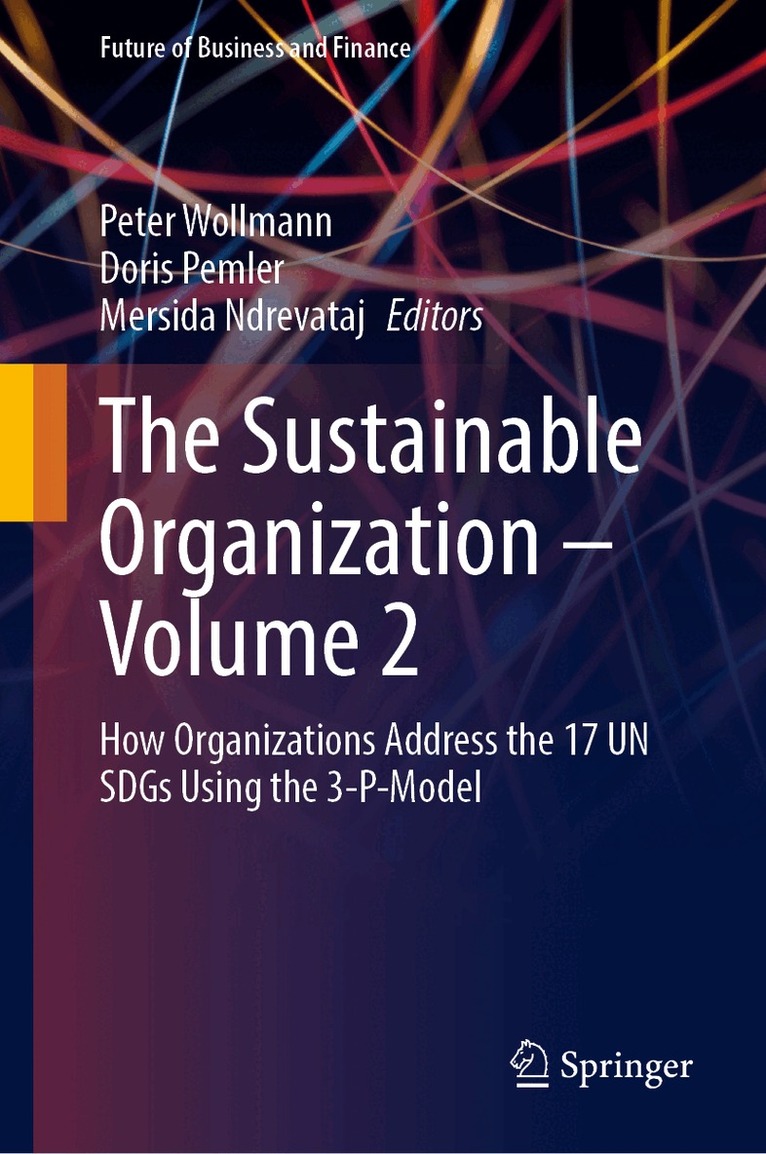
    Sustainable Organization – Volume 2

    How Organizations Address the 17 UN SDGs Using the 3-P-Model

    AvPeter Wollmann,Doris Pemler

    Inbunden, Engelska, 2026

    Del i serien Future of Business and Finance

    1 064 kr

    Kommande

    Beskrivning

    This book explores topics related to sustainability, including the 17 UN Sustainable Development Goals (SDGs) and accountability in various activities. Following the success of Volume 1, this sequel deepens the exploration of sustainability and the UN’s 17 SDGs. It expands on the complex, evolving landscape of organizational efforts toward sustainability, highlighting new use cases and perspectives from global contributors—including UNITAR, Sorbonne Qatar, Ca' Foscari and IUAV in Venice and numerous other universities, and leading local and regional governments and NGOs. Rather than offering a single “Big Picture,” it embraces the diversity of bottom-up and top-down initiatives, emphasizing the Three-Pillar-Model and the power of purpose, transformation, and connectivity. Historical and contemporary examples illustrate the urgency and momentum of change. This volume aims to inspire organizations to shape their own journeys and contribute meaningfully to a fair, sustainable future.

    Produktinformation

    • Utgivningsdatum:2026-08-31
    • Mått:155 x 235 x undefined mm
    • Format:Inbunden
    • Språk:Engelska
    • Serie:Future of Business and Finance
    • Antal sidor:348
    • Förlag:Springer Nature Switzerland AG
    • ISBN:9783032238016

    Utforska kategorier

    • Entreprenörskap inom Ekonomi och Ledarskap
    • Organisationsteori inom Ekonomi och Ledarskap
    • Miljövetenskap och miljöpolitik inom Naturvetenskap och teknik

    Mer om författaren

    Peter Wollmann has been a responsible manager, initiator, mentor and facilitator in large, predominantly global transformations and strategic developments for almost 40 years in large organizations and since 2017 as independent consultant. He is also a member of an advisory board of a R&D oriented company. Peter holds a degree in mathematics and physics from the University of Bonn. He is the author and publisher of numerous books and articles on strategy, leadership, organization design and project and project portfolio management. Doris Pemler is an entrepreneur, artist and researcher based in Zurich.  She received her M.A. in Egyptology, Sudan Archaeology and Archaeology of the Ancient Near East from Humboldt University zu Berlin and FU Berlin. Her research focuses on iconography, gender and intercultural communication in Ancient Egypt and Sudan. As a photographer she contributed to several exhibitions in Germany and Switzerland. As CEO of Ciudad Condal GmbH she leads an aspiring company focused on import and distribution of high-end sustainable products in Switzerland. Mersida Ndrevataj is an urban scholar with a background in architecture, urban planning, and environmental psychology. She holds a PhD in Urban Planning and Public Policy from IUAV University of Venice, where her research focused on the implementation of public policies in cultural heritage management. She is currently a lecturer at IUAV University of Venice and collaborates with several COST Action research networks focused on urban studies. Her work brings together academic research and field-based inquiry by adopting audiovisual and sensory approaches to investigate urban spaces, everyday socio-spatial practices, and lived experiences.

    Innehållsförteckning

    • Part I: Introduction.- Chapter 1: The Framing of the Book – Why a Second Volume is Needed and How It Reflects Current Developments of Sustainability and UN SDG Coverage Activities.- Chapter 2: An Updated “User Manual” for the Three-Pillar Model on Sustainability and UN SDG Coverage.- Part II: Fundamentals.- Chapter 3: Considerations on Crucial Institutional, Cooperation and Communication Preconditions for Achieving Sustainability and Coverage of the UN SDG.- Chapter 4: A Special Book Focus: Advancing Sustainable Development in Urban and Rural Areas.- Chapter 5: The End of Meroe - a Surprisingly Modern Lesson in Climate History.- Part III: Global Institutions to Foster Sustainable Cooperation and Improve Communication.- Chapter 6: Impactful Leadership for the Sustainable Development of a Country: Insights from the Unique Model of Qatar.- Chapter 7: The Rule of Law and Strong Institutions - the Importance of SDG 16 in post-Conflict Settings.- Chapter 8: Towards a Multilateral State-to-State Dispute Resolution Mechanism within the WIPO Framework to Protect Fundamental Right and Enhance Access to Justice in line with SDG 16.- Chapter 9: From Global Goals to Ground-Level Impact: Translating Climate Negotiation into Local and Regional Action.- Chapter 10: From Awareness to Action: The Urgent Role of Education and Communication in Advancing the UN Sustainable Development Goals (SDGs).- Part IV: Advancing Sustainable Development in Urban and Rural Areas.- Chapter 11: Challenges for Sustainable Corporate Management in the Food Supply Chain.- Chapter 12: Sustainability as an Organizational Learning Practice: The Case Study of a Rural Area in Germany.- Chapter 13: Addressing Sustainability and UN SDG Coverage in Rural Areas of India – A Case Study of Bunker Roy’s Endeavors to Develop Rural Regions and its People.- Chapter 14. Social Innovation in Tourism in Venice: A Three-Pillar Model Analysis of Purpose, Adaptability and Connectivity.- Chapter 15.  Horizontal Networks for the Implementation of ‘Next-door’ Welfare Facilities - Case Study from the Third Sector.- Chapter 16: Sustainable Development in World Heritage Policies and Management: The Italian Context.- Chapter 17: The Presence of Absence: Conflicts in Collaborative Spaces -  A Comparative Ethnographic Study in France, Italy, and Czechia.- Part V: Academic Institutions to Enable Sustainable Practice and UN SDG Coverage.- Chapter 18: Sustainable Data Management - Leveraging the Data Value Chain for UN SDG Achievement through the Three Pillar Model.- Chapter 19: Transformative Education and the Earth Charter Enabling Sustainable Development through Transformative Learning in Higher Education.- Chapter 20: Educating Purpose-Driven Innovators for Circularity: Insights from Global Industry – Academia Collaboration.- Chapter 21: Improving Corporate Environmental Responsibility: The Impact of Perceived Stakeholder Pressure, Benefits and Barriers in Switzerland and Germany.- Chapter 22 From Metrics to Meaning: Fostering Sustainability by Reclaiming Leadership as a Conscious and Archetypal Way of Being.- Part VI: Cross-Sectoral Approaches to Sustainability from Industry to Fashion .- Chapter 23. Case study from Swiss Post: Sustainability Matters – How to Transform an Organization.- Chapter 24: Case Studies on Organizational Resilience and Sustainability Through Decision-Oriented Governance Systems.- Chapter 25: Remote Monitoring Advancing Sustainability in the MedTech Industry.- Chapter 26: Driving the Circular Economy: How Multi-Cycle Business Models Turn Circularity into Competitive Advantage.- Chapter 27: Collaborative Sourcing – a Three-Pillar-based Approach to Meeting the 17 SDGs (UN Strategic Development Goals).- Chapter 28:  Fashioning the Future: How Luxury Brands Champion Sustainability – An Interview with Laura Tinti.- Part VII: Conclusions and Take-Aways.- Chapter 29: Desirable Impact of Our Sustainability Books on the Consulting Industry and for Academic Education & Research.- Chapter 30: Toward a Reconstructive Foundation for Sustainability – A Philosophical Deepening of Sustainability Beyond Perception and Performance.- Chapter 31: Conclusions.