• Fri frakt över 249 kr
  • •
  • Snabba leveranser
  • •
  • Billiga böcker
Kundservice

Du är på sajten för privatpersoner.

Företag, bibliotek eller offentlig verksamhet?

Du handlar på classic.bokus.com, där alla dina funktioner finns intakta.
Till classic.bokus.com
Bokus logotyp. Gå till startsidan.
  • Erbjudanden
  • Nyheter
  • Student
  • Topplistor
  • Barn & ungdom
  • Bokus Play
  • E-böcker
  • Pocketböcker
  • Spel & pussel

10% studentrabatt med kod TERM26

Sidfot

Mina sidor

    Hjälp

    • Kundservice
    • Vanliga frågor och svar
    • Frakt och leverans
    • Retur vid ångerrätt
    • Reklamera vara
    • Betalning
    • Köpvillkor
    • Allmänna villkor
    • Information om webbplatsens tillgänglighet

    Om Bokus

    • Om oss
    • Pressrum
    • För studenter
    • För företag
    • För bibliotek och offentlig verksamhet
    • För leverantörer
    • Hållbarhet

    Populärt

    • Aktuella erbjudanden
    • Presentkort
    • Studentlitteratur
    • Nya böcker
    • Topplistor
    • Signerade böcker
    • Engelska böcker

    Inspiration

    • Boktips
    • BookTok
    • Populära bokserier
    • Barnbokskaraktärer
    • Populära författare
    Logotyp för Bokus
    Följ oss på Facebook (extern länk)Följ oss på Instagram (extern länk)Följ oss på YouTube (extern länk)Följ oss på TikTok (extern länk)
    bokus @ CookiesAnpassa cookiesIntegritetspolicyKöpvillkor
    Till Citymail hemsida (extern länk)Till Budbee hemsida (extern länk)Till Postnord hemsida (extern länk)Till Schenker hemsida (extern länk)Till Early Bird hemsida (extern länk)Till Walleys hemsida (extern länk)
    1. Medicin
    2. Medicin: allmänt
    3. Den medicinska professionen
    4. Medicinsk etik och läkaretik

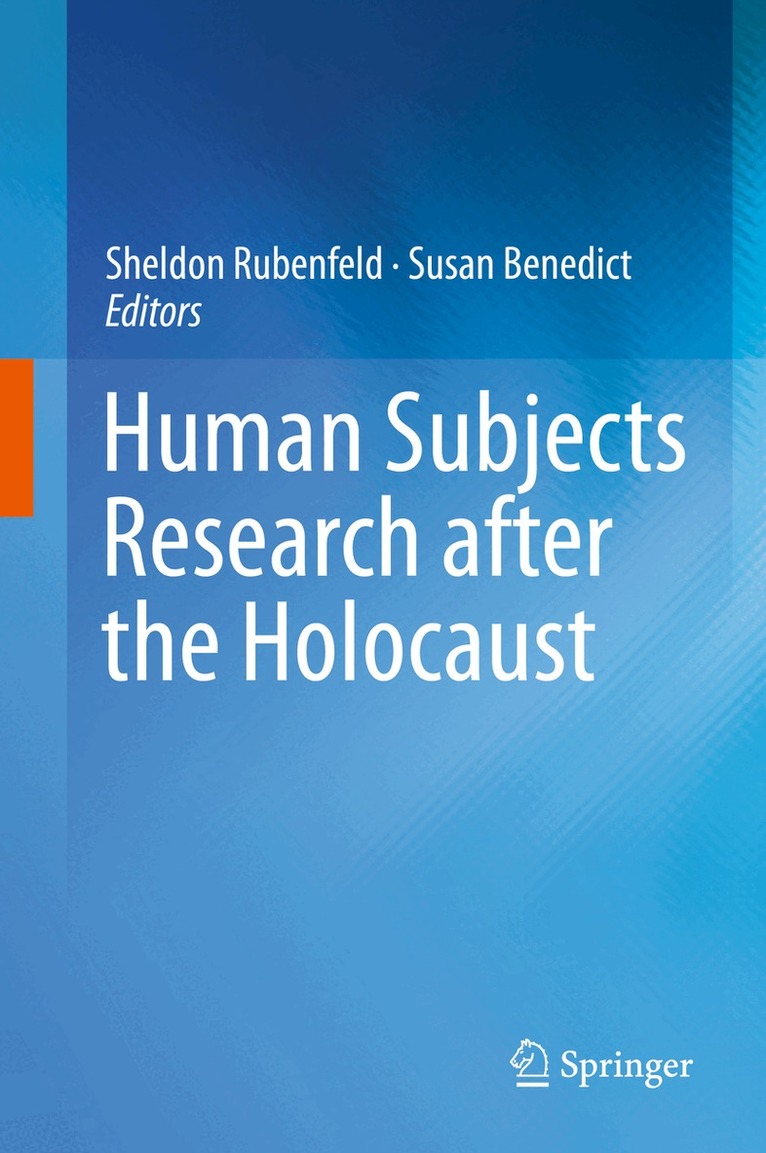
    Human Subjects Research after the Holocaust

    AvSheldon Rubenfeld,Susan Benedict

    Inbunden, Engelska, 2014

    1 124 kr

    Beställningsvara. Skickas inom 10-15 vardagar. Fri frakt över 249 kr.

    Beskrivning

    “An engaging, compelling and disturbing confrontation with evil …a book that will be transformative in its call for individual and collective moral responsibility." – Michael A. Grodin, M.D., Professor and Director, Project on Medicine and the Holocaust, Elie Wiesel Center for Judaic Studies, Boston UniversityHuman Subjects Research after the Holocaust challenges you to confront the misguided medical ethics of the Third Reich personally, and to apply the lessons learned to contemporary human subjects research. While it is comforting to believe that Nazi physicians, nurses, and bioscientists were either incompetent, mad, or few in number, they were, in fact, the best in the world at the time, and the vast majority participated in the government program of “applied biology.” They were not coerced to behave as they did—they enthusiastically exploited widely accepted eugenic theories to design horrendous medical experiments, gas chambers and euthanasia programs, which ultimately led to mass murder in the concentration camps. Americans provided financial support for their research, modeled their medical education and research after the Germans, and continued to perform unethical human subjects research even after the Nuremberg Doctors’ Trial. The German Medical Association apologized in 2012 for the behavior of its physicians during the Third Reich. By examining the medical crimes of human subjects researchers during the Third Reich, you will naturally examine your own behavior and that of your colleagues, and perhaps ask yourself "If the best physicians and bioscientists of the early 20th century could do evil while believing they were doing good, can I be certain that I will never do the same?"

    Produktinformation

    • Utgivningsdatum:2014-07-17
    • Mått:155 x 235 x 17 mm
    • Vikt:594 g
    • Format:Inbunden
    • Språk:Engelska
    • Antal sidor:308
    • Upplaga:2014
    • Förlag:Springer International Publishing AG
    • ISBN:9783319057019

    Utforska kategorier

    • Medicinsk etik och läkaretik inom Medicin
    • Medicinhistoria inom Medicin
    • Medicinsk utrustning och medicinska tekniker inom Medicin

    Recensioner i media

    From the book reviews: "The book makes many valuable and previously little-known contributions to the understanding of relationships between medicine and research during the Nazi period and ethical implications for today. Summing Up: Recommended. Bioethics collections serving upper-division undergraduates and above." (M. D. Lagerwey, Choice, Vol. 52 (7), March, 2015)

    Innehållsförteckning

    • Preface.- Acknowledgments.- Foreword.- 1. Introduction: How Did It Go So Wrong?.- 2. Twin Experiments at Auschwitz: A First-Person Account.- 3. Eugenics and Racial Hygiene: Applied Research Strategies before, during, and after National Socialism.- 4. Medical Ethics and Medical Research on Human Beings in National Socialism.- 5. Sulfonamide Experiments on Prisoners in Nazi Concentration Camps: Coherent Scientific Rationality Combined with Complete Disregard of Humanity.- 6. Stages of Transgression: Anatomical Research in National Socialism.- 7. Nurses and Human Subjects Research during the Third Reich and Now.- 8. Involuntary Abortion and Coercive Research on Pregnant Forced Laborers in National Socialism.- 9. Abusive Medical Practices on “Euthanasia” Victims in Austria during and after World War II.- 10. Medical Research and National Socialist Euthanasia: Carl Schneider and the Heidelberg Research Children 1942 until 1945.- 11. Victims of Human Experiments and Coercive Research under National Socialism: Gender and Racial Aspects.- 12. The White Rose: Resisting National Socialism.- 13. The Origins and Impact of the Nuremberg Doctors’ Trial.- 14. In the Shadow of Nuremberg: Unlearned Lessons from the Medical Trial.- 15. The Ethics of Medical Experiments: Have We Learned the Lessons of Tuskegee and the Holocaust?.- 16. Human Subjects Research during and after the Holocaust: Typhus Vaccine Development and the Legacy of Gerhard Rose.- 17. Ethics in Space Medicine: Holocaust Beginnings, the Present, and the Future.- 18. Reproduction Then and Now: Learning from the Past.- 19. Promoting Clinical Research and Avoiding Bad Medicine: A Clinical Research Curriculum.- 20. The Psychophysiology of Attribution: Why Appreciative Respect Can Keep us Safe.- 21. Confronting Medicine during the Nazi Period: Autobiographical Reflections.- 22. Teaching the Holocaust to Medical Students: A Reflection on Pedagogy and Medical Ethics.- 23. No Exceptions, No Excuses: ATestimonial.- Index.