• Fri frakt över 249 kr
  • •
  • Snabba leveranser
  • •
  • Billiga böcker
Kundservice

Du är på sajten för privatpersoner.

Företag, bibliotek eller offentlig verksamhet?

Du handlar på classic.bokus.com, där alla dina funktioner finns intakta.
Till classic.bokus.com
Bokus logotyp. Gå till startsidan.
  • Erbjudanden
  • Student
  • Topplistor
  • Barn & ungdom
  • Bokus Play
  • E-böcker
  • Ljudböcker
  • Pocketböcker
  • Spel & pussel

Upp till 25% på utvalda nyheter →

Sidfot

Mina sidor

    Hjälp

    • Kundservice
    • Vanliga frågor och svar
    • Frakt och leverans
    • Retur vid ångerrätt
    • Reklamera vara
    • Betalning
    • Köpvillkor
    • Allmänna villkor
    • Information om webbplatsens tillgänglighet

    Om Bokus

    • Om oss
    • Pressrum
    • För studenter
    • För företag
    • För bibliotek och offentlig verksamhet
    • För leverantörer
    • Hållbarhet

    Populärt

    • Aktuella erbjudanden
    • Presentkort
    • Studentlitteratur
    • Nya böcker
    • Topplistor
    • Signerade böcker
    • Engelska böcker

    Inspiration

    • Boktips
    • BookTok
    • Populära bokserier
    • Barnbokskaraktärer
    • Populära författare
    Logotyp för Bokus
    Följ oss på Facebook (extern länk)Följ oss på Instagram (extern länk)Följ oss på YouTube (extern länk)Följ oss på TikTok (extern länk)
    bokus @ CookiesAnpassa cookiesIntegritetspolicyKöpvillkor
    Till Citymail hemsida (extern länk)Till Budbee hemsida (extern länk)Till Postnord hemsida (extern länk)Till Schenker hemsida (extern länk)Till Early Bird hemsida (extern länk)Till Walleys hemsida (extern länk)
    1. Samhälle och politik
    2. Politik och statsskick
    3. Centralt styre och förvaltning

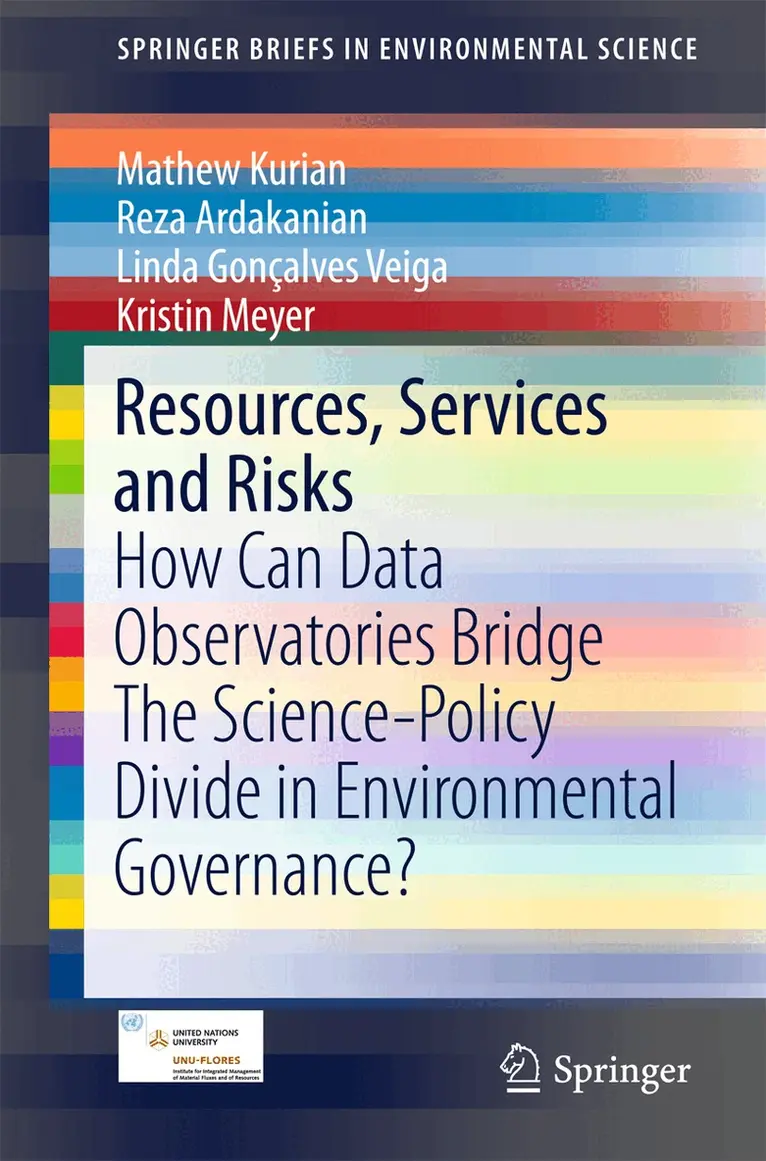
    Resources, Services and Risks

    How Can Data Observatories Bridge The Science-Policy Divide in Environmental Governance?

    AvMathew Kurian,Reza Ardakanian

    Häftad, Engelska, 2016

    Del i serien SpringerBriefs in Environmental Science

    547 kr

    Beställningsvara. Skickas inom 10-15 vardagar. Fri frakt över 249 kr.

    Beskrivning

    This book discusses the role of observatories in supporting evidence-based decision-making. The book focuses on issues of data accessibility, monitoring frameworks and governance processes with regard to environmental resources – water, soil and waste. This publication highlights challenges related to policy-implementation measures and examines current monitoring approaches, and illustrates how the UNU-FLORES Nexus Observatory seeks to overcome concerns related to data, monitoring and governance of water, soil and waste resources. In particular, given that extreme weather events such as droughts and floods are predicted to become more frequent in the future, it discusses the need for improved hazard risk monitoring. It proposes risk indices for drought and floods, which measure exposure and vulnerability to the phenomena through a multitude of bio-physical, socio-economic and institutional indicators. Furthermore, the potential for using openly accessible data made available throughobservatories in decision-making aimed at improving food security is also discussed. It acknowledges governments as key players in environmental resource management, and recognizes that decentralization reforms, as well as the emergence of information and communication technologies, have significantly changed the role of governments in promoting sustainable development. The book is particularly relevant for decision-makers, donor agencies, practitioners and students with an interest in environmental management who are also keen followers of discussions on the post-2015 monitoring agenda.

    Produktinformation

    • Utgivningsdatum:2016-02-08
    • Mått:155 x 235 x 6 mm
    • Vikt:154 g
    • Format:Häftad
    • Språk:Engelska
    • Serie:SpringerBriefs in Environmental Science
    • Antal sidor:75
    • Upplaga:16001
    • Förlag:Springer International Publishing AG
    • ISBN:9783319287041

    Utforska kategorier

    • Centralt styre och förvaltning inom Samhälle och politik
    • Tillämpad matematik inom Naturvetenskap och teknik
    • Miljövetenskap och miljöpolitik inom Naturvetenskap och teknik

    Mer om författaren

    ​Prof. Dr. Reza Ardakanian is the Founding Director of United Nations University Institute for Integrated Management of Material Fluxes and of Resources (UNU-FLORES^ry of Interior (1987–1989).Dr. Mathew Kurian is Academic Officer and leads the Capacity Development and Governance unit at United Nations University Institute for Integrated Management of Material Fluxes and of Resources (UNU-FLORES). Prior to joining UNU-FLORES, he served as Senior Water and Sanitation Specialist at Water and Sanitation Programme (WSP) of The World Bank where he led policy advocacy efforts related to rural water supply, wastewater reuse, and climate adaptation options in secondary towns. He began his career as a Robert McNamara Fellow at the World Bank where his work on land tenure reform was hosted by the Tata Energy Research Institute (TERI), New Delhi.  Upon completing his PhD in Development Studies from the Institute of Social Studies (ISS), Erasmus University, The Hague, Netherlands, Dr. Kurian was employed as Associate Expert (Dutch Ministry of Foreign Affairs) at International Water Management Institute (IWMI-CGIAR) where he undertook assessments of soil and water conservation interventions in the Mekong and Nile river basins. In 2009 as member of faculty at UNESCO-IHE, Delft, Dr. Kurian led the development of a policy note on urban sanitation and the Millennium Development Goals (MDGs) for the Directorate General of International Cooperation (DGIS) in the Netherlands. While still at UNESCO-IHE, Dr. Kurian developed an online e-learning course on governance of water and sanitation services in developing countries.  He has published in the area of water institutions and policy and has mentored students of the MSc programme in environment and development planning while on the faculty of University College London (UCL). His experience in the field of capacity development includes training civil servants and managers of water utilities in Iran and Tanzania, consulting assignments with the Asian Development Bank (ADB), Philippines and teaching undergraduate courses in human geography at the University of British Columbia (UBC) Vancouver, Canada. In his current function, he leads the design of public policy research, policy advocacy in support of evidence-based decision making and fund raising to support establishment of a nexus observatory network.Kristin Meyer is a Research Assistant in the Capacity Development and Governance Unit at United Nations University Institute for Integrated Management of Material Fluxes and of Resources(UNU-FLORES)ition: initial; background-size: initial; background-repeat: initial; background-attachment: initial; background-origin: initial; background-clip: initial;">. Her work includes research on governance and evidence-based decision-making, as well as involvement in the development of the Nexus Observatory concept and platform. Prior to joining UNU-FLORES, she worked with the Delegation of the European Union to the UN in New York tracking and analysing human rights resolutions on the situation in Myanmar and the Democratic People’s Republic of Korea and engaging with UN agencies, civil society organisations, and other missions. Ms. Meyer previously served as a consultant for the UK National Team of Higher Education Reform Experts, where she sensitised stakeholders to and advanced implementation of issues concerning the European Higher Education Area, including student mobility, quality assurance, and academic accreditation. Ms. Meyer received her LL.M. in Public International Law from the University of Nottingham and completed her Bachelor of Laws at the University of Sheffield.

    Innehållsförteckning

    • Part I A Role for Observatories in Support of Evidence-Based Decision-Making.- Part II The role of data, indices, and governance for drought and flood risk monitoring.- Part III Case studies of evidence-based decision-making.