• Fri frakt över 249 kr
  • •
  • Snabba leveranser
  • •
  • Billiga böcker
Kundservice

Du är på sajten för privatpersoner.

Företag, bibliotek eller offentlig verksamhet?

Du handlar på classic.bokus.com, där alla dina funktioner finns intakta.
Till classic.bokus.com
Bokus logotyp. Gå till startsidan.
  • Erbjudanden
  • Nyheter
  • Student
  • Topplistor
  • Barn & ungdom
  • Bokus Play
  • E-böcker
  • Pocketböcker
  • Spel & pussel

10% rabatt på allt med kod NYSTART10 →

Sidfot

Mina sidor

    Hjälp

    • Kundservice
    • Vanliga frågor och svar
    • Frakt och leverans
    • Retur vid ångerrätt
    • Reklamera vara
    • Betalning
    • Köpvillkor
    • Allmänna villkor
    • Information om webbplatsens tillgänglighet

    Om Bokus

    • Om oss
    • Pressrum
    • För studenter
    • För företag
    • För bibliotek och offentlig verksamhet
    • För leverantörer
    • Hållbarhet

    Populärt

    • Aktuella erbjudanden
    • Presentkort
    • Studentlitteratur
    • Nya böcker
    • Topplistor
    • Signerade böcker
    • Engelska böcker

    Inspiration

    • Boktips
    • BookTok
    • Populära bokserier
    • Barnbokskaraktärer
    • Populära författare
    Logotyp för Bokus
    Följ oss på Facebook (extern länk)Följ oss på Instagram (extern länk)Följ oss på YouTube (extern länk)Följ oss på TikTok (extern länk)
    bokus @ CookiesAnpassa cookiesIntegritetspolicyKöpvillkor
    Till Citymail hemsida (extern länk)Till Budbee hemsida (extern länk)Till Postnord hemsida (extern länk)Till Schenker hemsida (extern länk)Till Early Bird hemsida (extern länk)Till Walleys hemsida (extern länk)
    1. Samhälle och politik
    2. Samhälle och kultur
    3. Kultur och medier
    4. Medievetenskap

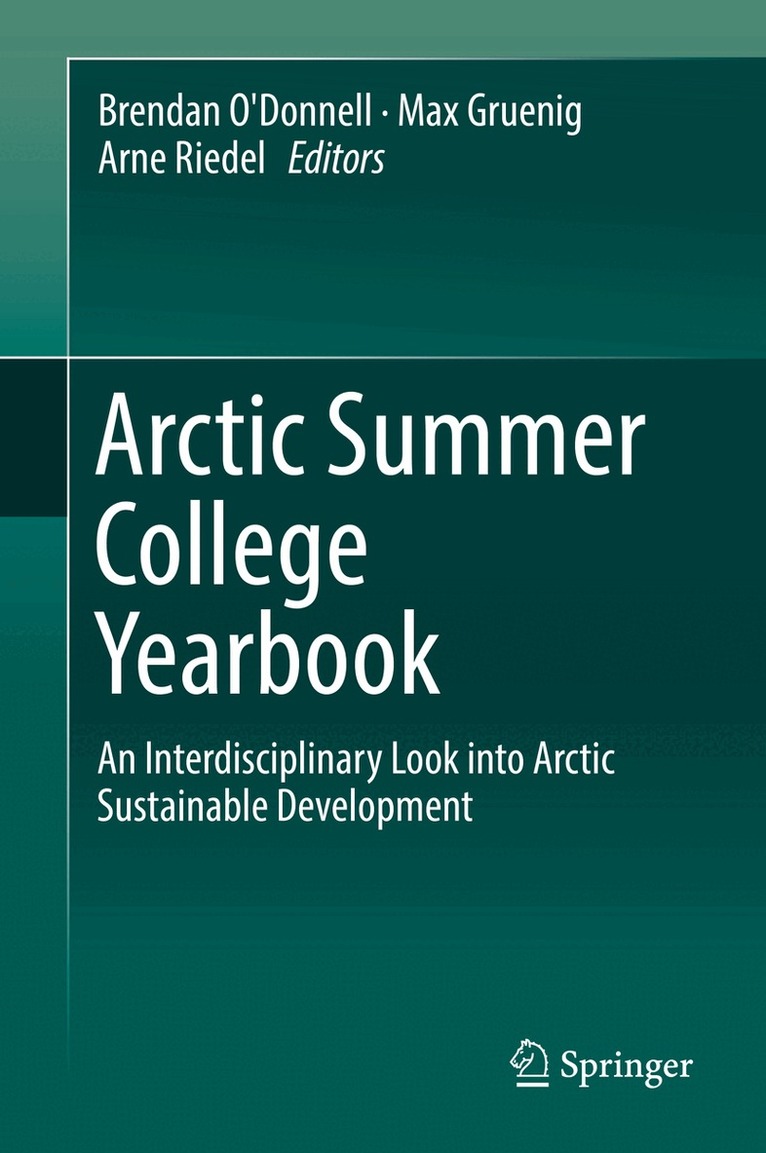
    Arctic Summer College Yearbook

    An Interdisciplinary Look into Arctic Sustainable Development

    AvBrendan O'Donnell,Max Gruenig

    Inbunden, Engelska, 2017

    546 kr

    Beställningsvara. Skickas inom 10-15 vardagar. Fri frakt över 249 kr.

    Beskrivning

    This book highlights both the diversity of perspectives and approaches to Arctic research and the inherent interdisciplinary nature of studying and understanding this incomparable region. The chapters are divided into four liberally-defined sections to provide space for dynamic interpretation and dialogue in search of sustainable solutions to the issues facing the Arctic. From governance to technology, scientific research to social systems, human health to economic development, the authors discuss fundamental questions while looking toward the Arctic’s future. Whether the reader is well-versed in the history and complexity of Arctic policy or looking for an insightful introduction to the vast world of Arctic research, everyone will find answers that lead to new questions and even more discoveries in these pages, laying the foundation for tomorrow’s discussion on the future of the Arctic.    The Arctic’s unique geographic and political characteristics pose questions for the international community, indigenous peoples, and economic interests not easily answered through traditional concepts. To that end, the Arctic Summer College has been engaging leading professionals, students, scholars, and policy makers from across the globe to exchange ideas and support further investigation into the Arctic. A joint venture between Ecologic Institute US and Ecologic Institute Berlin (Germany), the College participates at the annual Arctic Circle Assembly in Reykjavik, Iceland, and continues to be at the forefront of international collaboration in this critical area of economic, political, environmental, and humanitarian development.

    Produktinformation

    • Utgivningsdatum:2017-10-23
    • Mått:155 x 235 x 16 mm
    • Vikt:430 g
    • Format:Inbunden
    • Språk:Engelska
    • Antal sidor:159
    • Upplaga:17001
    • Förlag:Springer International Publishing AG
    • ISBN:9783319664583

    Utforska kategorier

    • Medievetenskap inom Samhälle och politik
    • Högskola och universitet inom Psykologi och pedagogik
    • Miljövetenskap och miljöpolitik inom Naturvetenskap och teknik

    Mer om författaren

    Brendan O’Donnell, Ecologic InstituteBrendan O’Donnell is a research fellow and writer at Ecologic Institute in Washington, DC. His publications with the institute have included research on next generation sustainable finance, low-carbon energy security, urban sustainability, the German energy transition, citizen engagement, the urbanization of the Arctic, the impact of environmental regulations on international trade, and the role of art in the environmental discourse. Prior to joining Ecologic Institute in 2014, Brendan worked for more than a decade as a politics and features journalist, art editor, and writer for international educational media. His academic concentrations were comparative literature and philosophy. He has lived, studied, and worked in Berlin, Germany; Venice, Italy; and throughout the United States.Max Gruenig, Ecologic InstituteMax Gruenig is President of Ecologic Institute in Washington, DC, and has been with Ecologic Institute since 2007. His work focuses on sustainable development in the energy and transport sectors, as well as urban sustainability and resilient cities. Max has served as a director of the Arctic Summer College since 2015. He is a founding member of the European Institute for Sustainable Transport (EURIST), a sustainability advisory board member for German energy provider NaturEnergiePlus, and a member of the Consumer Research Network of the German Federal Ministry for Justice and Consumer Protection (BMJV). Max is a frequent speaker on sustainability issues, reaching audiences in North and South America, the Caribbean, Europe, Asia, and Africa. In 2004, Max completed his Diplom-Volkswirt (MA in economics) at Humboldt-Universität in Berlin, with a focus on natural resource economics and auction theory. He has lived and worked in Germany, Iceland, Japan, and the United States. Arne Riedel LL.M., Ecologic Institute Arne Riedel is an environmental lawyer at Ecologic Institute in Berlin, where he coordinates the Institute’s activities on Arctic issues, serves as a director of the Arctic Summer College, and works on climate and energy laws and governance, including in collaboration with the German government, the European Union (EU), and the WWF International Arctic Programme. Arne’s publications include chapters on Arctic Marine Governance, information gaps between the EU and Arctic stakeholders, and regional environmental and energy governance. He supports the German Ministry of the Environment (BMUB) in the negotiations on the UNFCC and the Paris Agreement and provides legal expertise on renewable energies for the German Ministry for Economic Affairs and Energy (BMWi). Arne completed law school in 2007 at Freie Universität in Berlin, with a concentration on public law. He was awarded a Master of Laws (LLM) in European Law with distinction from the University of Nottingham (UK) in 2009.

    Innehållsförteckning

    • Foreword .- Understanding Diverse Arctic Narratives and Their Role in Arctic Development .- 1. Imagining the Arctic .- 2. Local discourses of global climate change: A case study from Greenland .-  3. From Consultation to Consent: A Comparative Analysis of Arctic States .- Scientific Communication.-1. Arctic Freshwater – A Commons Requires Open Science .-  2. Expanding the Network of Arctic Science Communication.-  3. Human Dimension for Effective Climate Action: Synergies between Traditional Ecological and Hydro Meteorological Scientific Knowledge in the Arctic and beyond .- Arctic Technology and Innovation .- 4. Innovation in the Arctic: Squaring the Circle.-   5. The Arctic Digital Divide.-  International Relations and the Arctic.-6. Russia's Military Build-up in the Arctic: Political Rhetoric vs. Reality .-  7. South Korea's Positioning in the Arctic .-  Arctic Health and Wellness .- 8. ASurvey of Contemporary Circumpolar Health Issues and Innovative Responses in the Anthropocene by  .- 9. Local Initiatives to Reduce the Incidence of Sexual Assault in the North.- Ecologic Institute Arctic Research .-10. Arctic Council Scorecards Analysis.-  11. Climate Adaptation in Arctic Cities.