• Fri frakt över 249 kr
  • •
  • Snabba leveranser
  • •
  • Billiga böcker
Kundservice

Du är på sajten för privatpersoner.

Företag, bibliotek eller offentlig verksamhet?

Du handlar på classic.bokus.com, där alla dina funktioner finns intakta.
Till classic.bokus.com
Bokus logotyp. Gå till startsidan.
  • Erbjudanden
  • Nyheter
  • Student
  • Topplistor
  • Barn & ungdom
  • Bokus Play
  • E-böcker
  • Pocketböcker
  • Spel & pussel

10% rabatt på allt med kod: NYSTART10 →

Sidfot

Mina sidor

    Hjälp

    • Kundservice
    • Vanliga frågor och svar
    • Frakt och leverans
    • Retur vid ångerrätt
    • Reklamera vara
    • Betalning
    • Köpvillkor
    • Allmänna villkor
    • Information om webbplatsens tillgänglighet

    Om Bokus

    • Om oss
    • Pressrum
    • För studenter
    • För företag
    • För bibliotek och offentlig verksamhet
    • För leverantörer
    • Hållbarhet

    Populärt

    • Aktuella erbjudanden
    • Presentkort
    • Studentlitteratur
    • Nya böcker
    • Topplistor
    • Signerade böcker
    • Engelska böcker

    Inspiration

    • Boktips
    • BookTok
    • Populära bokserier
    • Barnbokskaraktärer
    • Populära författare
    Logotyp för Bokus
    Följ oss på Facebook (extern länk)Följ oss på Instagram (extern länk)Följ oss på YouTube (extern länk)Följ oss på TikTok (extern länk)
    bokus @ CookiesAnpassa cookiesIntegritetspolicyKöpvillkor
    Till Citymail hemsida (extern länk)Till Budbee hemsida (extern länk)Till Postnord hemsida (extern länk)Till Schenker hemsida (extern länk)Till Early Bird hemsida (extern länk)Till Walleys hemsida (extern länk)
    1. Psykologi och pedagogik
    2. Pedagogik
    3. Pedagogisk psykologi

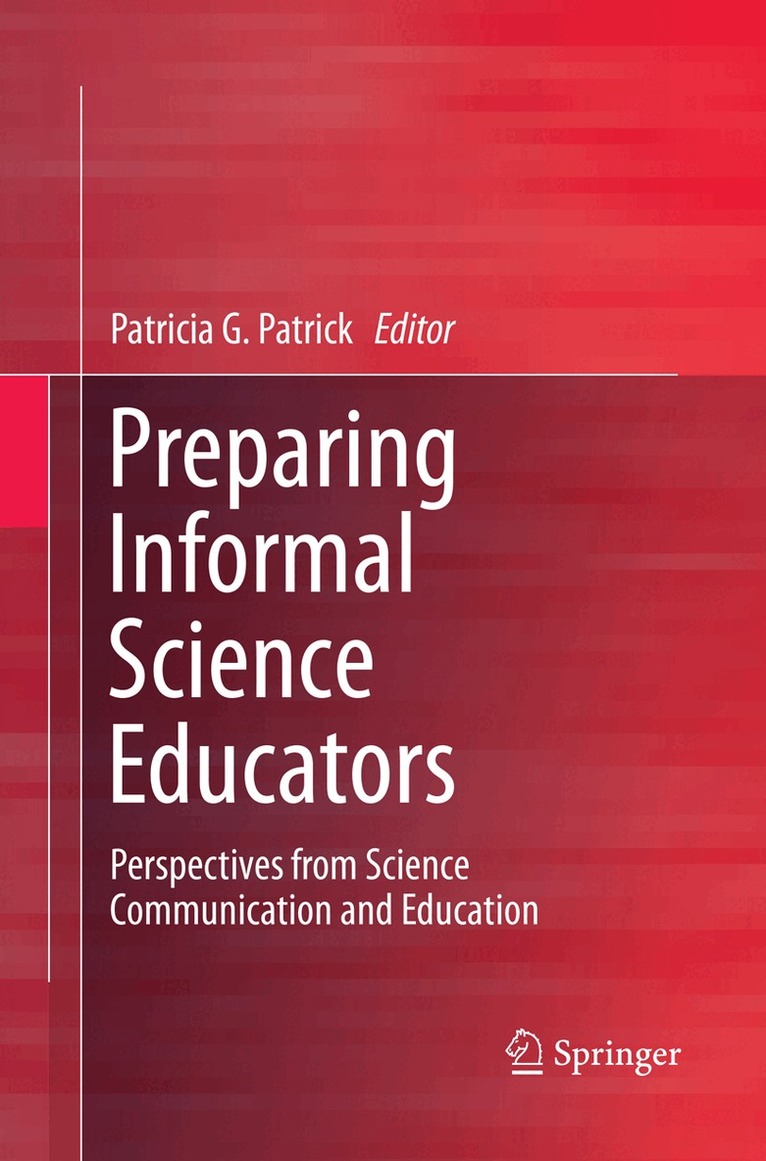
    Preparing Informal Science Educators

    Perspectives from Science Communication and Education

    AvPatricia G Patrick

    Häftad, Engelska, 2018

    2 164 kr

    Beställningsvara. Skickas inom 10-15 vardagar. Fri frakt över 249 kr.

    Beskrivning

    This book provides a diverse look at various aspects of preparing informal science educators. Much has been published about the importance of preparing formal classroom educators, but little has been written about the importance, need, and best practices for training professionals who teach in aquariums, camps, parks, museums, etc. The reader will find that as a collective the chapters of the book are well-related and paint a clear picture that there are varying ways to approach informal educator preparation, but all are important. The volume is divided into five topics: Defining Informal Science Education, Professional Development, Designing Programs, Zone of Reflexivity: The Space Between Formal and Informal Educators, and Public Communication. The authors have written chapters for practitioners, researchers and those who are interested in assessment and evaluation, formal and informal educator preparation, gender equity, place-based education, professional development, program design, reflective practice, and science communication. Readers will draw meaning and usefulness from the array of professional perspectives and be stimulated to begin a quest to scaffold programs and professional development around the frameworks described in this book.

    Produktinformation

    • Utgivningsdatum:2018-07-13
    • Mått:155 x 235 x 34 mm
    • Vikt:949 g
    • Format:Häftad
    • Språk:Engelska
    • Antal sidor:600
    • Förlag:Springer International Publishing AG
    • ISBN:9783319843902

    Utforska kategorier

    • Pedagogisk psykologi inom Psykologi och pedagogik
    • Lärarutbildning inom Psykologi och pedagogik
    • Undervisning i specifika ämnen inom Psykologi och pedagogik

    Mer om författaren

    Patricia Patrick received her MEd and PhD from the University of North Carolina Greensboro. She is an Assistant Professor in Cultural Foundations and Leadership at Columbus State University and an Associate Fellow in the Department of Sociology at the University of Warwick. In cooperation with the Houston Zoo, Dr. Patrick developed a Masters of Education in Curriculum and Instruction for Informal Science Education. She has published numerous articles related to informal science learning, with a focus on sociocultural theory. Her work focuses on the importance of social interactions and the importance of those interactions within families. She published the book Zoo Talk. She has been a guest speaker at the Chester Zoo (England), University College London Institute of Education (England), Sao Paulo Zoo (Brazil), and San Diego Zoo where she discussed questioning skills and preparing science communicators. She has been a Visiting Researcher at the Museum fur Naturkunde inBerlin as a researcher on the development of a new Heinz Sielmann exhibit. Her research interests are in informal science education, preparing informal educators, and the influence of family culture and science knowledge on science learning.

    Innehållsförteckning

    • Foreword, Lynn Dierking.- Introduction, Patricia G. Patrick.- About the Editor.- About the Contributors.- Defining ISE.- 1. Formerly ISE: Preparation for Continual Science Learning, Phyllis Katz.- Professional Development.- 2. Informal Science Educators and the Nine Dimensions of Reflective Practice, Patricia G. Patrick.- 3. Facilitating Deep Conceptual Learning: The Role of Reflection and Learning Communities, Heather King and Lynn Tran.- 4. From Acquisition to Inquiry: Supporting Informal Educators through Iterative Implementation of Practice, Lauren B. Allen and Kevin Crowley.- 5. Museum Science Teaching: Museum Educators’ Personal Epistemologies and Created Learning Experiences, Jung-Hua Yeh.- 6. Informal Science Educator Identity Construction, Brad McLain.- Designing Programs.- 7. There is no “Off Button” to Explaining: Theorizing identity development in youth who work as floor facilitators, Preeti Gupta and Jennifer Correa.- 8. Integrating Mobile Computers into Informal Science Education, Heather Toomey Zimmerman and Susan M. Land.- 9. Designing Informal Astronomy Education Toward Participatory Learning Environments, Mi Song Kim.- 10. Developing Effective Pedagogical Approaches in Science Outreach Programs for Young Children, Christine Howitt, Elaine Blake & Léonie Rennie.- 11. Gender Differences Reflected in Conversations at Exhibits, Sue Dale Tunnicliffe.- 12. The Challenges of ‘Measuring Long-term Impacts of a Science Center on its Community’: A Methodological Review, Eric Jensen and Thomas Lister.- 13. Utilizing indicator-based methods: 'Measuring the impact of a science center on its community', John H. Falk and Mark D. Needham.- Bridging the Gap Between Formal and Informal Educators.- 14. Visualising Social Network Structures in the Training of Professional Learning Communities of Educators in Informal and Formal Settings, Jakob Egg, Suzanne Kapelari & Justin Dillon.- 15. Professional Development: Targeted On-the-Job Trainings, Chance Sanford and Victoria Sokol.- 16. Multiple Approaches to Using Informal Science Education Contexts to Prepare Informal and Formal Science Educators, Emily Hestness, Kelly Riedinger, and J. Randy McGinnis.- 17. Extending Classrooms into Parks Through Informal Science Learning and Place-Based Education, Jennifer Adams and Brett Branco.- 18. Preparing Informal Science Educators in a Formal Science Teacher Education Program: An Oxymoron? Catherine E. Matthews, Susannah Thompson, and Sadie Camfield Payne.- 19. A Comparative Look at Informal Science Education & Environmental Education in Bengkulu Province, Indonesia & North Carolina, USA, Aceng Ruyani and Catherine E. Matthews.- 20. Explorers of Nature in Natural History Museums – An Approach to Integrating Children with Refugee or Migration Status, Alexandra Moormann.- Science Communication.- 21. Preparing Scientists to be Science Communicators, Ayelet Baram-Tsabari and Bruce V. Lewenstein.- 22. ‘User-Generated’ Educators: The New Frontier or a Far-Fetched Dream? Maria Xanthuoudaki and Enrico Miotto.- 23. Teaching the Theory of Evolution in Informal Settings to Those Who Are Uncomfortable with It, Michael J. Reiss.- 24. Addressing Nature of Scientific Knowledge in the Preparation of Informal Educators, Judith S. Lederman and Gary M. Holliday.- 25. The Attributes of Informal Science Education: A Science Communication Perspective, Susan M. Stocklmayer and Léonie J. Rennie.- 26. Sense of Conservation: When is a Black Rat Snake (Elaphe obsolete) Really Just a Snake? Patricia G. Patrick.- 27. Opening Up the Dialogic Space. Using Questions to Facilitate Deeper Informal Learning, Martin Braund and Anthony Lelliott.- Concluding Chapter, Joy Kubarek.