• Fri frakt över 249 kr
  • •
  • Snabba leveranser
  • •
  • Billiga böcker
Kundservice

Du är på sajten för privatpersoner.

Företag, bibliotek eller offentlig verksamhet?

Du handlar på classic.bokus.com, där alla dina funktioner finns intakta.
Till classic.bokus.com
Bokus logotyp. Gå till startsidan.
  • Erbjudanden
  • Student
  • Topplistor
  • Barn & ungdom
  • Bokus Play
  • E-böcker
  • Ljudböcker
  • Pocketböcker
  • Spel och pussel

5% studentrabatt – använd koden KURSBOK27 →

Sidfot

Mina sidor

    Hjälp

    • Kundservice
    • Vanliga frågor och svar
    • Frakt och leverans
    • Retur vid ångerrätt
    • Reklamera vara
    • Betalning
    • Köpvillkor
    • Allmänna villkor
    • Information om webbplatsens tillgänglighet

    Om Bokus

    • Om oss
    • Pressrum
    • För studenter
    • För företag
    • För bibliotek och offentlig verksamhet
    • För leverantörer
    • Hållbarhet

    Populärt

    • Aktuella erbjudanden
    • Presentkort
    • Studentlitteratur
    • Nya böcker
    • Topplistor
    • Signerade böcker
    • Engelska böcker

    Inspiration

    • Boktips
    • BookTok
    • Barnbokskaraktärer
    • Populära författare
    Logotyp för Bokus
    Följ oss på Facebook (extern länk)Följ oss på Instagram (extern länk)Följ oss på YouTube (extern länk)Följ oss på TikTok (extern länk)
    bokus @ CookiesAnpassa cookiesIntegritetspolicyKöpvillkor
    Till Citymail hemsida (extern länk)Till Budbee hemsida (extern länk)Till Postnord hemsida (extern länk)Till Schenker hemsida (extern länk)Till Early Bird hemsida (extern länk)Till Walleys hemsida (extern länk)
    1. Naturvetenskap och teknik
    2. Matematik och naturvetenskap
    3. Matematik
    4. Matematisk statistik

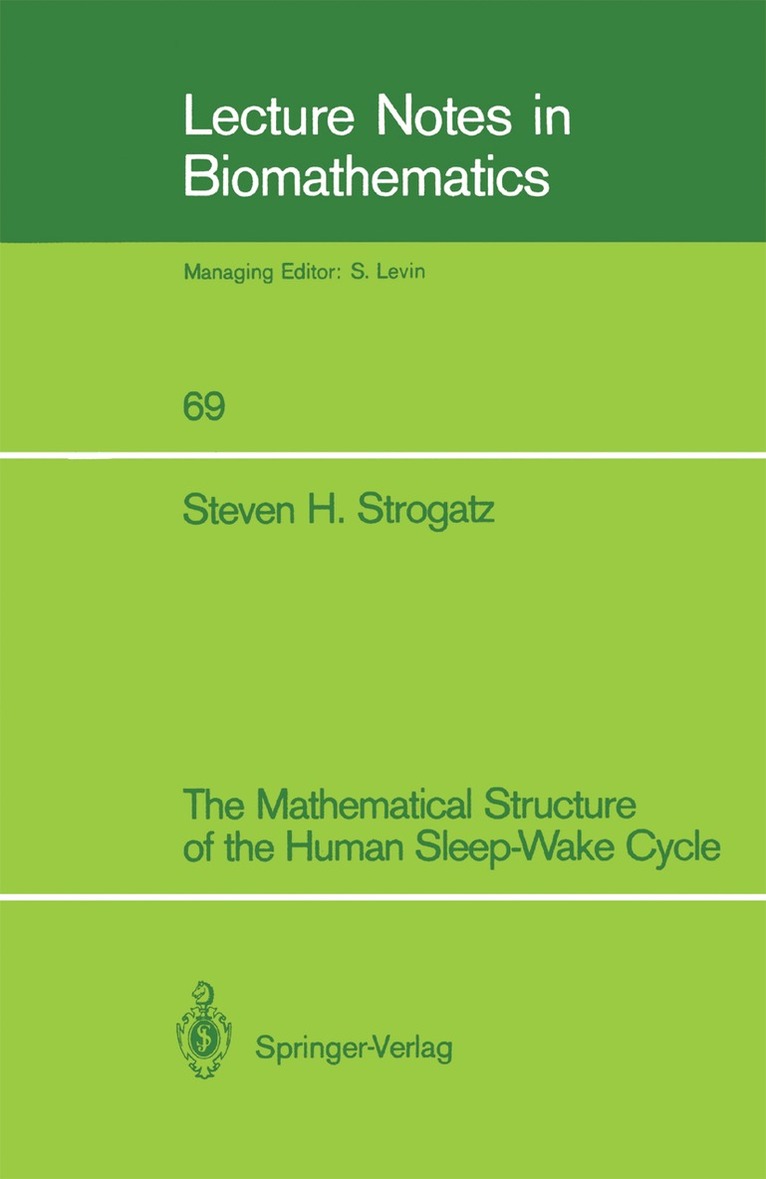
    Mathematical Structure of the Human Sleep-Wake Cycle

    AvSteven H. Strogatz

    Häftad, Engelska, 1986

    Del 69 i serien Lecture Notes in Biomathematics

    543 kr

    Beställningsvara. Skickas inom 10-15 vardagar. Fri frakt över 249 kr.

    Fler format och utgåvor

    E-bok

    710 kr

    Beskrivning

    Over the past three years I have grown accustomed to the puzzled look which appears on people's faces when they hear that I am a mathematician who studies sleep. They wonder, but are usually too polite to ask, what does mathematics have to do with sleep? Instead they ask the questions that fascinate us all: Why do we have to sleep? How much sleep do we really need? Why do we dream? These questions usually spark a lively discussion leading to the exchange of anecdotes, last night's dreams, and other personal information. But they are questions about the func­ tion of sleep and, interesting as they are, I shall have little more to say about them here. The questions that have concerned me deal instead with the timing of sleep. For those of us on a regular schedule, questions of timing may seem vacuous. We go to bed at night and get up in the morning, going through a cycle of sleeping and waking every 24 hours. Yet to a large extent, the cycle is imposed by the world around us.

    Produktinformation

    • Utgivningsdatum:1986-11-01
    • Mått:155 x 235 x 15 mm
    • Vikt:394 g
    • Format:Häftad
    • Språk:Engelska
    • Serie:Lecture Notes in Biomathematics
    • Antal sidor:239
    • Förlag:Springer-Verlag Berlin and Heidelberg GmbH & Co. KG
    • ISBN:9783540171768

    Utforska kategorier

    • Matematisk statistik inom Naturvetenskap och teknik
    • Tillämpad matematik inom Naturvetenskap och teknik
    • Biovetenskap inom Naturvetenskap och teknik

    Innehållsförteckning

    • 1. Introduction.- 1.1 Beyond Time.- 1.2 The Rosetta Stone.- 1.3 Overview.- 2. Experimental Background.- 2.1 Phenomena and Terminology.- 2.2 History of Free-Run Studies.- 3. Data Bank.- 3.1 Subject 1.- 3.2 Subject 2.- 3.3 Subject 3.- 3.4 Subject 4.- 3.5 Subject 5.- 3.6 Subject 6.- 3.7 Subject 7.- 3.8 Subject 8.- 3.9 Subject 9.- 3.10 Subject 10.- 3.11 Subject 11.- 3.12 Subject 12.- 3.13 Subject 13.- 3.14 Subject 14.- 3.15 Subject 15.- 3.16 Subject 16.- 3.17 Subject 17.- 3.18 Subject 18.- 3.19 Subject 19.- 3.20 Subject 20.- 3.21 Subject 21.- 3.22 Subject 22.- 4. Patterns.- 4.1 Durations Vary with Circadian Phase of Sleep Onset.- 4.2 Sleep Length and Prior Wake Length.- 4.3 Timing of Wake-Up.- 4.4 Timing of Sleep Onset.- 4.5 Wake-Maintenance Zones.- 4.6 Estimating Circadian Parameters from Sleep Data Alone.- 4.7 Phase-Trapping.- 4.8 Slow Changes in Sleep-Wake Cycle Length.- 4.9 Miscellany and Missing Patterns.- 4.10 Napping and Split Sleep.- 4.11 Summary: The Basic Patterns of Internal Desynchrony.- 5. Theoretical Background.- 5.1 Conceptual Model of Aschoff and Wever.- 5.2 Wever’s Noninteractive Model.- 5.3 Kronauer’s XY Model: Coupled Van der Pol Oscillators.- 5.4 Conceptual Model of Borbely.- 5.5 Winfree’s Half-Model.- 5.6 Gated Pacemaker of Daan, Beersma, and Borbely.- 5.7 Other Approaches.- 6. Analysis of Models.- 6.1 Introduction.- 6.2 BEATS Model.- 6.3 PHASE Model.- 6.4 XY Model of Kronauer et al..- 6.5 Model of Daan et al..- 7. Simulations.- 7.1 Transition from Synchrony to Desynchrony.- 7.2 Napping and Split Sleep Simulations.- 7.3 A Representative Simulation of Internal Desynchrony.- 7.4 Overall Performance During Desynchrony.- 7.5 Summary and Discussion.- 8. Epilogue.- 8.1 Contributions.- 8.2 Directions for Future Research.- References.- Index of Authors.