• Fri frakt över 249 kr
  • •
  • Snabba leveranser
  • •
  • Billiga böcker
Kundservice

Du är på sajten för privatpersoner.

Företag, bibliotek eller offentlig verksamhet?

Du handlar på classic.bokus.com, där alla dina funktioner finns intakta.
Till classic.bokus.com
Bokus logotyp. Gå till startsidan.
  • Erbjudanden
  • Nyheter
  • Student
  • Topplistor
  • Barn & ungdom
  • Bokus Play
  • E-böcker
  • Pocketböcker
  • Spel & pussel

Upp till 20% på populära nyheter →

Sidfot

Mina sidor

    Hjälp

    • Kundservice
    • Vanliga frågor och svar
    • Frakt och leverans
    • Retur vid ångerrätt
    • Reklamera vara
    • Betalning
    • Köpvillkor
    • Allmänna villkor
    • Information om webbplatsens tillgänglighet

    Om Bokus

    • Om oss
    • Pressrum
    • För studenter
    • För företag
    • För bibliotek och offentlig verksamhet
    • För leverantörer
    • Hållbarhet

    Populärt

    • Aktuella erbjudanden
    • Presentkort
    • Studentlitteratur
    • Nya böcker
    • Topplistor
    • Signerade böcker
    • Engelska böcker

    Inspiration

    • Boktips
    • BookTok
    • Populära bokserier
    • Barnbokskaraktärer
    • Populära författare

    Mina sidor

      Hjälp

      • Kundservice
      • Vanliga frågor och svar
      • Frakt och leverans
      • Retur vid ångerrätt
      • Reklamera vara
      • Betalning
      • Köpvillkor
      • Allmänna villkor
      • Information om webbplatsens tillgänglighet

      Om Bokus

      • Om oss
      • Pressrum
      • För studenter
      • För företag
      • För bibliotek och offentlig verksamhet
      • För leverantörer
      • Hållbarhet

      Populärt

      • Aktuella erbjudanden
      • Presentkort
      • Studentlitteratur
      • Nya böcker
      • Topplistor
      • Signerade böcker
      • Engelska böcker

      Inspiration

      • Boktips
      • BookTok
      • Populära bokserier
      • Barnbokskaraktärer
      • Populära författare
      Logotyp för Bokus
      Följ oss på Facebook (extern länk)Följ oss på Instagram (extern länk)Följ oss på YouTube (extern länk)Följ oss på TikTok (extern länk)
      bokus @ CookiesIntegritetspolicyKöpvillkor
      Till Citymail hemsida (extern länk)Till Budbee hemsida (extern länk)Till Postnord hemsida (extern länk)Till Schenker hemsida (extern länk)Till Early Bird hemsida (extern länk)Till Walleys hemsida (extern länk)
      1. Naturvetenskap och teknik
      2. Teknik och industri
      3. Teknik: allmänt

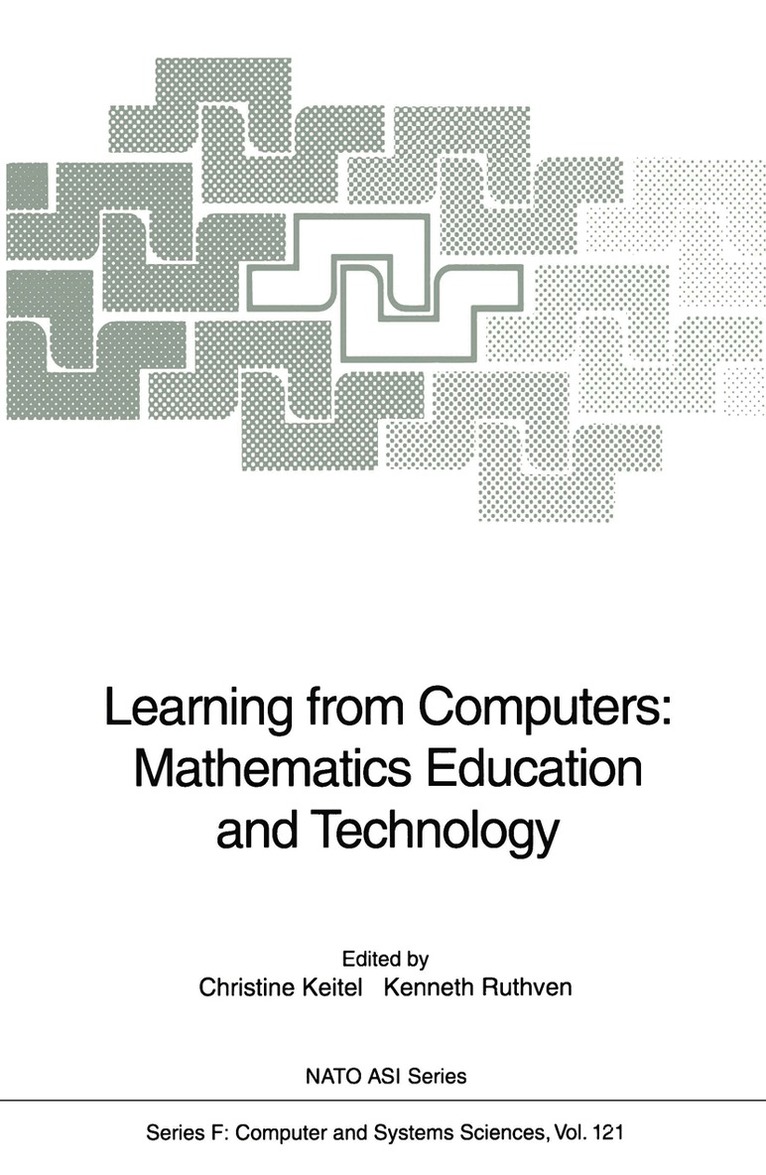
      Learning from Computers: Mathematics Education and Technology

      AvChristine Keitel-Kreidt,Kenneth Ruthven

      Häftad, Engelska, 2011

      Del 121 i serien NATO ASI Subseries F:

      1 092 kr

      Beställningsvara. Skickas inom 10-15 vardagar. Fri frakt över 249 kr.

      Beskrivning

      The NATO Advanced Research Workshop on Mathematics Education and Technology was held in Villard-de-Lans, France, between May 6 and 11, 1993. Organised on the initiative of the BaCoMET (Basic Components of Mathematics Education for Teachers) group (Christiansen, Howson and Otte 1986; Bishop, Mellin-Olsen and van Dormolen 1991), the workshop formed part of a larger NATO programme on Advanced Educational Technology. Some workshop members had already participated in earlier events in this series and were able to contribute insights from them: similarly some members were to take part in later events. The problematic for the workshop drew attention to important speculative developments in the applications of advanced information technology in mathematics education over the last decade, notably intelligent tutoring, geometric construction, symbolic algebra and statistical analysis. Over the same period, more elementary forms of information technology had started to have a significant influence on teaching approaches and curriculum content: notably arithmetic and graphic calculators; standard computer tools, such as spreadsheets and databases; and computer-assisted learning packages and computer microworlds specially designed for educational purposes.

      Produktinformation

      • Utgivningsdatum:2011-12-14
      • Mått:155 x 235 x 20 mm
      • Vikt:540 g
      • Format:Häftad
      • Språk:Engelska
      • Serie:NATO ASI Subseries F:
      • Antal sidor:332
      • Förlag:Springer-Verlag Berlin and Heidelberg GmbH & Co. KG
      • ISBN:9783642785443

      Utforska kategorier

      • Teknik: allmänt inom Naturvetenskap och teknik
      • Matematik inom Naturvetenskap och teknik
      • Artificiell intelligens inom Data och IT

      Innehållsförteckning

      • 1. Microworlds/Schoolworlds: The Transformation of an Innovation.- 1.1 The story of microworlds.- 1.2 The genesis.- 1.3 From designers to mathematics educators.- 1.4 Generating mathematics through microworlds: some illustrations.- 1.5 Evocative computational objects and situated abstractions.- 1.6 Microworlds in school mathematics.- 1.7 Microworlds in the curriculum.- 1.8 Reflections and implications.- 2. Computer Algebra Systems as Cognitive Technologies: Implication for the Practice of Mathematics Education.- 2.1 CAS: Some examples of symbol manipulations.- 2.2 Computers and computer algebras in relation to pure mathematics.- 2.3 Computer Algebra Systems in relation to mathematics education.- 2.4 Opposition to instructional uses of Computer Algebra Systems.- 2.5 Strengths of Computer Algebra Systems as learning tools.- 2.6 Computer algebra in an educational context: One example.- 2.7 CAS: From amplifiers to reorganisers.- 3. The Computer as Part of the Learning Environment: The Case of Geometry.- 3.1 The dual nature of geometrical figures.- 3.2 Difficulties of students.- 3.3 The notion of geometric figure as mediated by the computer.- 3.4 Changes brought by computers to the relationship to the figure.- 3.5 Interactions between student and software.- 4. Software Tools and Mathematics Education: The Case of Statistics.- 4.1 Didactical transposition and software tools.- 4.2 The revolution in statistics.- 4.3 Graphical and interactive data analysis: an example.- 4.4 Making sense of statistical software tools.- 4.5 Statistics education.- 4.6 Statistics and a re-defined school mathematics.- 5. Didactic Design of Computer-based Learning Environments.- 5.1 Understanding mathematics and the use of computers.- 5.2 Designing QuadFun - A case description.- 5.3 Interlude: Experimental aspects of mathematics.- 5.4 Design issues.- 5.5 A systemic view of didactic design.- 6. Artificial Intelligence and Real Teaching.- 6.1 Didactical interaction revisited.- 6.2 The input of artificial intelligence.- 6.3 Student-computer interaction, an overview.- 6.4 Educational software in the classroom, a new complexity.- 6.5 Open questions for future practice.- 7. Computer Use and Views of the Mind.- 7.1 The notion of cognition.- 7.2 Cognitive reorganization by using tools.- 7.3 Cognitive models and concreteness of thinking.- 7.4 Situated thinking and distributed cognition.- 7.5 The computer as a medium for prototypes.- 7.6 Modularity of thought.- 7.7 Conclusion.- 8. Technology and the Rationalisation of Teaching.- 8.1 The rationalisation of social practice.- 8.2 The elusive rationality of teaching.- 8.3 The marginal impact of machines on teaching.- 8.4 The dynamics of pedagogical change.- 8.5 The programming microworld.- 8.6 The tutoring system.- 8.7 The computer and the rationalisation of teaching.- 9. Computers and Curriculum Change in Mathematics.- 9.1 Locating the curriculum.- 9.2 Curriculum change as institutional change.- 9.3 Redefining school mathematics.- 9.4 Planning curriculum change.- 9.5 Alternative scenarios.- 10. On Determining New Goals for Mathematical Education.- 10.1 Goals for mathematics education.- 10.2 Goals for mathematics learners.- 10.3 Role of the teacher and the educational institution.- 10.4 Needed research on goals in mathematics education.- 11. Beyond the Tunnel Vision: Analysing the Relationship Between Mathematics, Society and Technology.- 11.1 Setting the stage.- 11.2 Technology in society.- 11.3 Mathematics shaping society?.- 11.4 Living (together) with abstractions.- 11.5 Mathematical technology as social structures.- 11.6 Structural problems in an abstraction society.- 11.7 Mathematics education as a social enterprise.- 11.8 Mathematics education as a democratic forum.- 11.9 Reflecting on computers in the classroom: Hardware-software-be(a)ware.- 12. Towards a Social Theory of Mathematical Knowledge.- 12.1 The Mechanistic Age - a historical introduction.- 12.2 Mathematical and social individuation.- 12.3 How can we master technology?.- 12.4 Engineers versus mathematicians since the turn of the century.- References.- Software.
      Hoppa över listan

      Du kanske också är intresserad av

      Kenneth Ruthven, Christine Keitel-Kreidt - Learning from Computers: Mathematics Education and Technology, E-bok

      Learning from Computers: Mathematics Education and Technology

      Kenneth Ruthven, Christine Keitel-Kreidt

      E-bok
      2012

      1 413 kr

      Tommy Dreyfus, Michèle Artigue, Despina Potari, Susanne Prediger, Kenneth Ruthven - Developing Research in Mathematics Education, Inbunden

      Developing Research in Mathematics Education

      Tommy Dreyfus, Michèle Artigue, Despina Potari, Susanne Prediger, Kenneth Ruthven

      Inbunden, 2018

      2 373 kr

      Tim Rowland, Kenneth Ruthven - Mathematical Knowledge in Teaching, Häftad
      Del 50

      Mathematical Knowledge in Teaching

      Tim Rowland, Kenneth Ruthven

      Häftad, 2013

      1 588 kr

      Dominique Guin, Kenneth Ruthven, Luc Trouche - Didactical Challenge of Symbolic Calculators, Häftad
      Del 36

      Didactical Challenge of Symbolic Calculators

      Dominique Guin, Kenneth Ruthven, Luc Trouche

      Häftad, 2010

      1 203 kr

      Dominique Guin, Kenneth Ruthven, Luc Trouche - Didactical Challenge of Symbolic Calculators, Inbunden
      Del 36

      Didactical Challenge of Symbolic Calculators

      Dominique Guin, Kenneth Ruthven, Luc Trouche

      Inbunden, 2004

      1 638 kr

      Tommy Dreyfus, Michèle Artigue, Despina Potari, Susanne Prediger, Kenneth Ruthven - Developing Research in Mathematics Education, Häftad

      Developing Research in Mathematics Education

      Tommy Dreyfus, Michèle Artigue, Despina Potari, Susanne Prediger, Kenneth Ruthven

      Häftad, 2018

      584 kr

      Kenneth Ruthven, Susanne Prediger, Despina Potari, Michele Artigue, Tommy Dreyfus - Developing Research in Mathematics Education, E-bok

      Developing Research in Mathematics Education

      Kenneth Ruthven, Susanne Prediger, Despina Potari, Michele Artigue, Tommy Dreyfus

      E-bok
      2018

      692 kr

      Kenneth Ruthven, Susanne Prediger, Despina Potari, Michele Artigue, Tommy Dreyfus - Developing Research in Mathematics Education, E-bok

      Developing Research in Mathematics Education

      Kenneth Ruthven, Susanne Prediger, Despina Potari, Michele Artigue, Tommy Dreyfus

      E-bok
      2018

      686 kr

      Tim Rowland, Kenneth Ruthven - Mathematical Knowledge in Teaching, Inbunden

      Mathematical Knowledge in Teaching

      Tim Rowland, Kenneth Ruthven

      Inbunden, 2010

      1 588 kr

      Kenneth Ruthven, Tim Rowland - Mathematical Knowledge in Teaching, E-bok

      Mathematical Knowledge in Teaching

      Kenneth Ruthven, Tim Rowland

      E-bok
      2011

      2 044 kr