• Fri frakt över 249 kr
  • •
  • Snabba leveranser
  • •
  • Billiga böcker
Kundservice

Du är på sajten för privatpersoner.

Företag, bibliotek eller offentlig verksamhet?

Du handlar på classic.bokus.com, där alla dina funktioner finns intakta.
Till classic.bokus.com
Bokus logotyp. Gå till startsidan.
  • Erbjudanden
  • Nyheter
  • Student
  • Topplistor
  • Barn & ungdom
  • Bokus Play
  • E-böcker
  • Pocketböcker
  • Spel & pussel

10% rabatt på allt med kod NYSTART10 →

Sidfot

Mina sidor

    Hjälp

    • Kundservice
    • Vanliga frågor och svar
    • Frakt och leverans
    • Retur vid ångerrätt
    • Reklamera vara
    • Betalning
    • Köpvillkor
    • Allmänna villkor
    • Information om webbplatsens tillgänglighet

    Om Bokus

    • Om oss
    • Pressrum
    • För studenter
    • För företag
    • För bibliotek och offentlig verksamhet
    • För leverantörer
    • Hållbarhet

    Populärt

    • Aktuella erbjudanden
    • Presentkort
    • Studentlitteratur
    • Nya böcker
    • Topplistor
    • Signerade böcker
    • Engelska böcker

    Inspiration

    • Boktips
    • BookTok
    • Populära bokserier
    • Barnbokskaraktärer
    • Populära författare
    Logotyp för Bokus
    Följ oss på Facebook (extern länk)Följ oss på Instagram (extern länk)Följ oss på YouTube (extern länk)Följ oss på TikTok (extern länk)
    bokus @ CookiesAnpassa cookiesIntegritetspolicyKöpvillkor
    Till Citymail hemsida (extern länk)Till Budbee hemsida (extern länk)Till Postnord hemsida (extern länk)Till Schenker hemsida (extern länk)Till Early Bird hemsida (extern länk)Till Walleys hemsida (extern länk)
    1. Filosofi och religion
    2. Religion och tro
    3. Judendom
    4. Judiska heliga texter

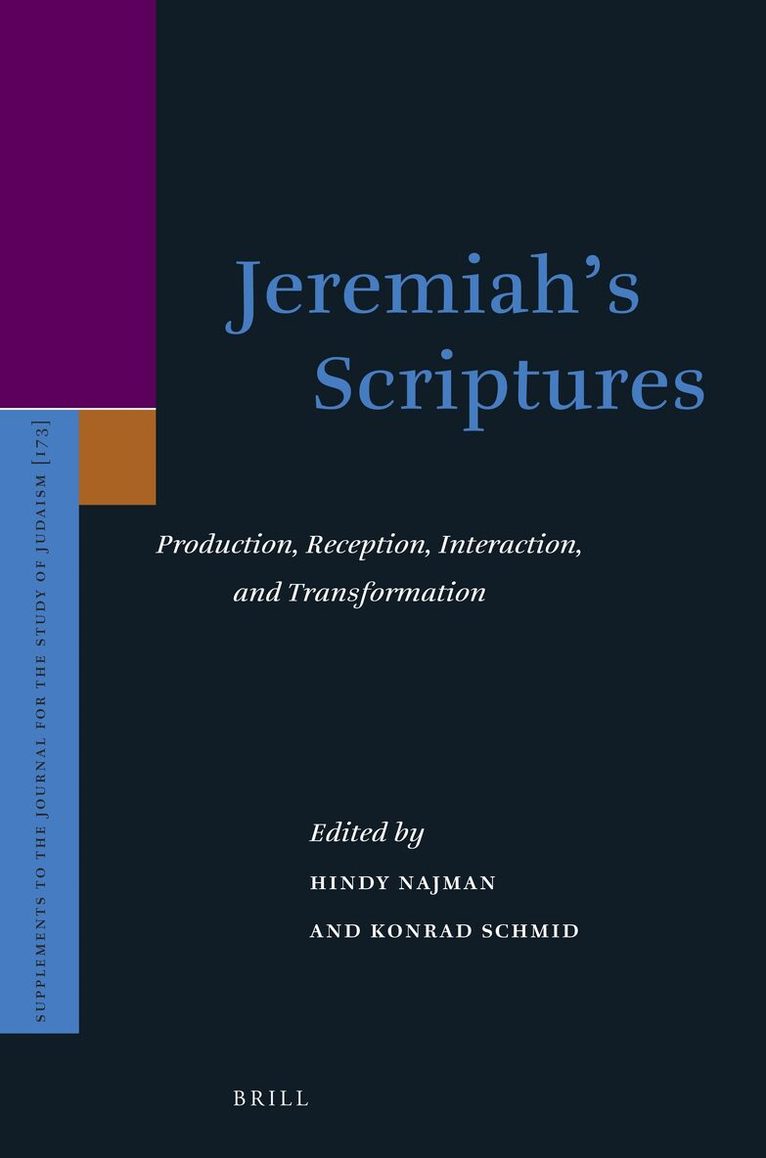
    Jeremiah’s Scriptures

    Production, Reception, Interaction, and Transformation

    AvHindy Najman,Konrad Schmid

    Inbunden, Engelska, 2016

    Del 173 i serien Supplements to the Journal for the Study of Judaism

    3 675 kr

    Beställningsvara. Skickas inom 5-8 vardagar. Fri frakt över 249 kr.

    Beskrivning

    Jeremiah’s Scriptures focuses on the composition of the biblical book of Jeremiah and its dynamic afterlife in ancient Jewish traditions. Jeremiah is an interpretive text that grew over centuries by means of extensive redactional activities on the part of its tradents. In addition to the books within the book of Jeremiah, other books associated with Jeremiah or Baruch were also generated. All the aforementioned texts constitute what we call “Jeremiah's Scriptures.” The papers and responses collected here approach Jeremiah’s scriptures from a variety of perspectives in biblical and ancient Jewish sub-fields. One of the authors' goals is to challenge the current fragmentation of the fields of theology, biblical studies, ancient Judaism. This volume focuses on Jeremiah and his legacy.

    Produktinformation

    • Utgivningsdatum:2016-11-15
    • Mått:155 x 235 x 42 mm
    • Vikt:1 143 g
    • Format:Inbunden
    • Språk:Engelska
    • Serie:Supplements to the Journal for the Study of Judaism
    • Antal sidor:634
    • Förlag:Brill
    • ISBN:9789004320246

    Utforska kategorier

    • Judiska heliga texter inom Filosofi och religion
    • Kristendom inom Filosofi och religion
    • Biblar inom Filosofi och religion

    Mer om författaren

    Hindy Najman, Ph.D. (1998), Harvard University, is the Oriel and Laing Professor of the Interpretation of Holy Scripture at the University of Oxford. She has published monographs and numerous articles on biblical interpretation, history of scholarship and revelation, including Losing the Temple and Recovering the Future: An Analysis of 4Ezra (Cambridge University Press, 2014).Konrad Schmid, Ph.D. (1995), University of Zurich, is Professor of Hebrew Bible and Ancient Judaism at that university. He has published Buchgestalten des Jeremiabuches (WMANT 72; Neukirchen-Vluyn: Neukirchener, 1996) and he is working on a commentary on the book of Jeremiah.

    Recensioner i media

    "Some of the contributors raise fundamental, and for certain readers undoubtedly unsettling, issues about the historical figure of Jeremiah, the nature of the interpretational process from which it emerged and the continuation of this process beyond the canonical forms in which it has been preserved. The editors, for their part, are to be congratulated for their efforts towards bringing scholars into dialogue with one another. Finally, it should not go unnoticed that they invited both established and upcoming scholars to contribute to the volume, which allows for new perspectives on some well-known problems." - H. Debel, in: Ephemerides Theologicae Lovanienses (2018)

    Innehållsförteckning

    • ContentsPart 1: Hebrew Bible1 Exegesis, Expansion, and Tradition-Making in the Book of JeremiahRobert R. Wilson2 A New Understanding of the Book of Jeremiah. A Response to Robert R. WilsonGeorg Fischer3 Ancient Editing and the Coherence of Traditions within the Book of Jeremiah and throughout the .נביאים A Response to Robert R. WilsonFlorian Lippke4 Prophets, Princes, and Kings: Prophecy and Prophetic Books according to Jeremiah 36Friedhelm Hartenstein5 King Jehoiakim’s Attempt to Destroy the Written Word of God (Jeremiah 36). A Response to Friedhelm HartensteinLida Panov6 Scribal Loyalty and the Burning of the Scroll in Jeremiah 36. A Response to Friedhelm HartensteinJustin J. White7 The Nature of Deutero-Jeremianic Texts Christl M. Maier8 The “Deuteronomistic” Character of the Book of Jeremiah. A Response to Christl M. MaierThomas Römer9 A Gap between Style and Context? A Response to Christl M. MaierLaura Carlson10 Deutero-Jeremianic Language in the Temple Sermon. A Response to Christl M. MaierWilliam L. Kelly11 Formulaic Language and the Formation of the Book of Jeremiah Hermann-Josef Stipp12 Mysteries of the Book of Jeremiah: Its Text and Formulaic Language. A Response to Hermann-Josef StippGeorg Fischer13 What Does “Deuteronomistic” Designate? A Response to Hermann-Josef StippElisa Uusimäki14 Less than 300 Years. A Response to Hermann-Josef StippFabian Kuhn15 Why Jeremiah? The Invention of a Prophetic FigureReinhard G. Kratz16 Was Jeremiah Invented? The Relation of an Author to a Literary Tradition. A Response to Reinhard G. KratzBernard M. Levinson17 The Question of Prophetic “Authenticity.” A Response to Reinhard G. KratzOlivia Stewart18 Jeremiah: The Prophet and the Concept. A Response to Reinhard G. KratzZafer Tayseer MohammadPart 2: Ancient Jewish Literature19 Confessing in Exile: The Reception and Composition of Jeremiah in (Daniel and) Baruch Judith H. Newman20 Scribal Culture of the Hebrew Bible and the Burden of the Canon:Human Agency and Textual Production and Consumption in Ancient Judaism. A Response to Judith H. Newman Mladen Popović21 The Meanings of the Jerusalem Temple in Baruch. A Response to Judith H. NewmanZhenshuai Jiang22 Text Reception and Conceptions of Authority in Second Temple Contexts. A Response to Judith H. NewmanPhillip M. Lasater23 The Use and Function of Jeremianic Tradition in 1 Enoch: The Epistle of Enoch in FocusLoren T. Stuckenbruck24 Jeremiah, Deuteronomy and Enoch. A Response to Loren T. StuckenbruckJohn J. Collins25 Is Enoch also among the (Jeremianic) Prophets? A Response to Loren T. StuckenbruckRyan C. Stoner26 Jeremiah’s Scriptures in the Dead Sea Scrolls and the Growth of a TraditionEibert Tigchelaar27 Modelling Jeremiah Traditions in the Light of the Dead Sea Scrolls. A Response to Eibert TigchelaarGeorge J. Brooke28 New Material or Traditions Expanded? A Response to Eibert TigchelaarAnja Klein29 Unities and Boundaries across the Jeremianic Dead Sea Scrolls. A Response to Eibert TigchelaarJames Nati30 Jeremiah, Baruch, and Their Books: Three Phases in a Changing RelationshipMatthias Henze and Liv Ingeborg Lied31 The Reception of a Reception: The Influence of 1 Baruch on the Structure of 5 Ezra. A Response to Matthias Henze and Liv Ingeborg LiedVeronika Hirschberger32 Textual and Material Contexts. A Response to Matthias Henze and Liv Ingeborg LiedNathalie LaCoste33 Retelling the Story of Exile: The Reception of the Jeremiah Tradition in 4 Baruch in the Perspective of the Jewish DiasporaJens Herzer34 The Eagle and the Basket of Figs in 4 Baruch. A Response to Jens HerzerRobin D. Young35 The Development of the Jeremiah Figure in 2 Baruch and 4 Baruch. A Response to Jens HerzerBoyeon Briana Lee36 Jeremiah as Mystagogue: Jeremiah in Philo of AlexandriaGregory E. Sterling37 Philo and Jeremiah: A Mysterious Passage in De Cherubim. A Response to Gregory E. SterlingRené Bloch38 Jeremiah as Hierophant: Jeremiah in Philo of Alexandria. A Response to Gregory E. SterlingFranz Tóth39 “I am the Man”: The Afterlife of a Biblical Verse in Second Temple TimesJames KugelPart 3: Early Christian and Rabbinic Literature40 The Reception of Jeremiah and the Impact of Jeremianic Traditions in the New Testament: A SurveyJörg Frey41 Jeremiah in the Book of Revelation. A Response to Jörg Frey Adela Yarbro Collins42 The Jeremianic Covenant Theology and its Impact in the Gospel of Matthew. A Response to Jörg FreyVeronika Niederhofer43 The Commissioning of Paul: Light from the Prophet Jeremiah on the Self-Understanding of the Apostle?Lutz Doering44 The Apostle Paul in the Prophetic Matrix of Jeremiah. A Response to Lutz DoeringKipp Davis45 Like a Priest Exposing His Own Wayward Mother: Jeremiah in Rabbinic LiteratureIshay Rosen-Zvi46 Jeremiah in Rabbinic Theology and Baruch in Rabbinic Historiography. A Response to Ishay Rosen-ZviShlomo Zuckier47 Probing the Rabbis’ Criticism and Silence with Regard to Jeremiah. A Response to Ishay Rosen-ZviJordash KiffiakAuthor IndexAncient Sources IndexSubject Index