• Fri frakt över 249 kr
  • •
  • Snabba leveranser
  • •
  • Billiga böcker
Kundservice

Du är på sajten för privatpersoner.

Företag, bibliotek eller offentlig verksamhet?

Du handlar på classic.bokus.com, där alla dina funktioner finns intakta.
Till classic.bokus.com
Bokus logotyp. Gå till startsidan.
  • Erbjudanden
  • Student
  • Topplistor
  • Barn & ungdom
  • Bokus Play
  • E-böcker
  • Ljudböcker
  • Pocketböcker
  • Spel och pussel

Skapa nya rutiner – hälsoböcker upp till 50% →

Sidfot

Mina sidor

    Hjälp

    • Kundservice
    • Vanliga frågor och svar
    • Frakt och leverans
    • Retur vid ångerrätt
    • Reklamera vara
    • Betalning
    • Köpvillkor
    • Allmänna villkor
    • Information om webbplatsens tillgänglighet

    Om Bokus

    • Om oss
    • Pressrum
    • För studenter
    • För företag
    • För bibliotek och offentlig verksamhet
    • För leverantörer
    • Hållbarhet

    Populärt

    • Aktuella erbjudanden
    • Presentkort
    • Studentlitteratur
    • Nya böcker
    • Topplistor
    • Signerade böcker
    • Engelska böcker

    Inspiration

    • Boktips
    • BookTok
    • Barnbokskaraktärer
    • Populära författare
    Logotyp för Bokus
    Följ oss på Facebook (extern länk)Följ oss på Instagram (extern länk)Följ oss på YouTube (extern länk)Följ oss på TikTok (extern länk)
    bokus @ CookiesAnpassa cookiesIntegritetspolicyKöpvillkor
    Till Citymail hemsida (extern länk)Till Budbee hemsida (extern länk)Till Postnord hemsida (extern länk)Till Schenker hemsida (extern länk)Till Early Bird hemsida (extern länk)Till Walleys hemsida (extern länk)
    1. Naturvetenskap och teknik
    2. Matematik och naturvetenskap
    3. Matematik
    4. Tillämpad matematik

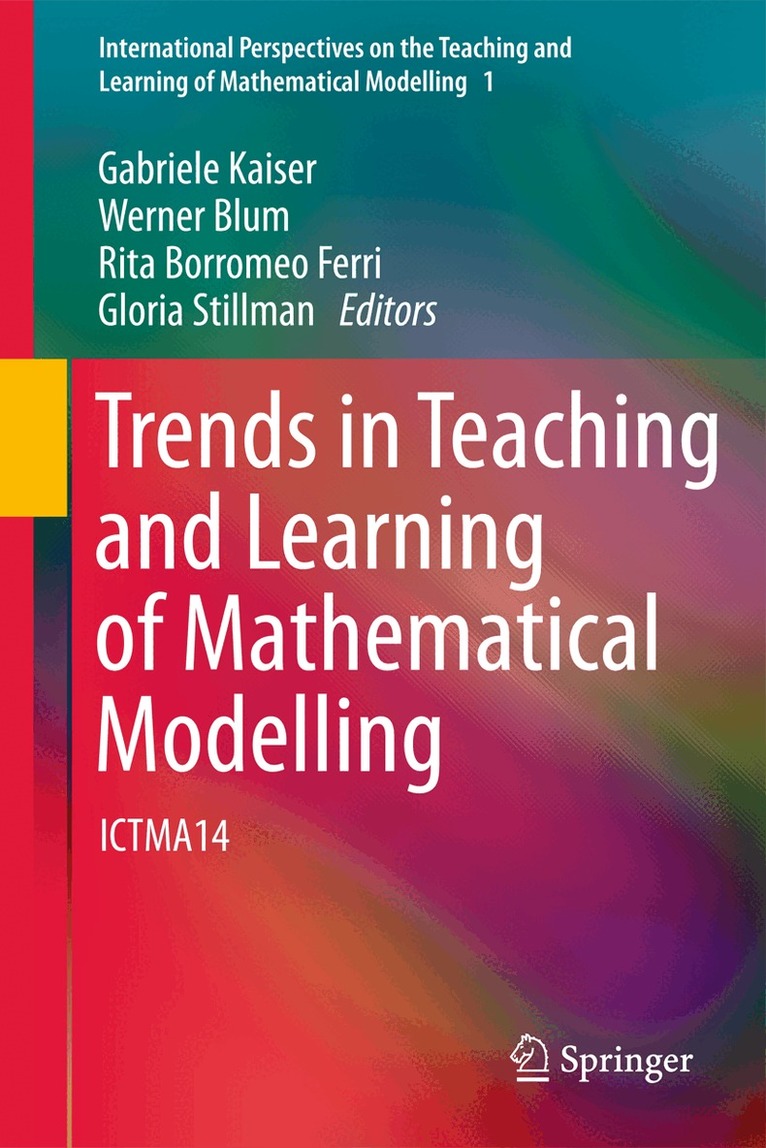
    Trends in Teaching and Learning of Mathematical Modelling

    ICTMA14

    AvGabriele Kaiser,Werner Blum

    Inbunden, Engelska, 2011

    Del 1 i serien International Perspectives on the Teaching and Learning of Mathematical Modelling

    3 219 kr

    Beställningsvara. Skickas inom 10-15 vardagar. Fri frakt över 249 kr.

    Beskrivning

    This book contains suggestions for and reflections on the teaching, learning and assessing of mathematical modelling and applications in a rapidly changing world, including teaching and learning environments. It addresses all levels of education from universities and technical colleges to secondary and primary schools. Sponsored by the International Community of Teachers of Mathematical Modelling and Applications (ICTMA), it reflects recent ideas and methods contributed by specialists from 30 countries in Africa, the Americas, Asia, Australia and Europe. Inspired by contributions to the Fourteenth Conference on the Teaching of Mathematical Modelling and Applications (ICTMA14) in Hamburg, 2009, the book describes the latest trends in the teaching and learning of mathematical modelling at school and university including teacher education. The broad and versatile range of topics will stress the international state-of-the-art on the following issues: Theoretical reflections on the teaching and learning of modellingModelling competenciesCognitive perspectives on modellingModelling examples for all educational levelsPractice of modelling in school and at university levelPractices in Engineering and Applications

    Produktinformation

    • Utgivningsdatum:2011-06-24
    • Mått:155 x 235 x 43 mm
    • Vikt:1 273 g
    • Format:Inbunden
    • Språk:Engelska
    • Serie:International Perspectives on the Teaching and Learning of Mathematical Modelling
    • Antal sidor:734
    • Upplaga:2011
    • Förlag:Springer
    • ISBN:9789400709096

    Utforska kategorier

    • Tillämpad matematik inom Naturvetenskap och teknik
    • Teknik: allmänt inom Naturvetenskap och teknik
    • Matematik inom Naturvetenskap och teknik

    Mer om författaren

    Gabriele Kaiser is a Professor of Mathematics Education at the University of Hamburg. She holds a master's degree as a teacher for mathematics and humanities and completed her doctorate in mathematics education on applications and modelling. She is Editor-in-Chief of "ZDM -- The International Journal on Mathematics Education (formerly Zentralblatt fuer Didaktik der Mathematik) and since July 2007 she serves as president of the "International Community of Teachers of Modelling and Applications" (ICTMA), an ICMI affiliated Study Group. Werner Blum is a Professor of Mathematics Education at the University of Kassel. He got a Ph.D. in Pure Mathematics in 1970 from the University of Karlsruhe. His main research areas include empirical studies into the teaching and learning of mathematics and the professional knowledge of mathematics teachers, national and international comparative studies (especially PISA), quality development in mathematics teaching as well as applications and modelling in mathematics education. Rita Borromeo Ferri is a Guest Professor of Mathematics Education at the University of Hamburg. She holds a master's degree as a teacher for mathematics and geography and completed her doctorate in mathematics education on mathematical thinking styles and her post-doc study on applications and modelling. She taught several years in school and got a teaching award of the Faculty of Education at University of Hamburg.

    Recensioner i media

    "ICTMA14 was inspiring and as a first-time participant, I immediately felt that I was a part of this stimulating group." Usha Kotelawala (New York State University, USA) "The conference provided the participants with a comprehensive and multi-faceted overview of the state-of-the-art of mathematical modelling in school and university, both as regards developmental practice and research." Mogens Niss (Roskilde University, Denmark) "I was able to understand how the Brazilian approach to modeling contrast with the other ones practiced all over the world." Marcelo Borba (Rio Claro, Brazil)

    Innehållsförteckning

    • Series Preface: Gabriele Kaiser and Gloria Stillman.- Chapter 1: Trends in Teaching and Learning of Mathematical Modelling (ICTMA14) – Preface : Gabriele Kaiser, Werner Blum, Rita Borromeo Ferri, Gloria Stillman.- Part I: Modelling from Primary to Upper Secondary School:  Findings of Empirical Research.- Chapter 2: Modelling from Primary to Upper Secondary School: Findings of Empirical Research – Overview: Thomas Lingefjärd.- Chapter 3:  Can Modelling be Taught and Learnt? Some Answers from Empirical Research: Werner Blum.- Chapter 4: Can Modelling Be Taught and Learnt? – A Commentary: Marcelo C. Borba.- Chapter 5: Upper Secondary Students' Handling of Real-World Contexts: Andreas Busse.- Chapter 6: Word Problem Classification: A Promising Modelling Task at the Elementary Level: Dirk de Bock, Kim Vleugels, and Lieven Verschaffel.- Chapter 7 :  Understanding and Promoting Mathematical Modeling Competencies: An Applied Perspective: George Ekol.- Chapter 8: Secondary Teachers’ Beliefs About Teaching Applications - Design and Selected Results of a Qualitative Case Study: Frank Förster.- Chapter 9: Secondary Teachers’ Beliefs on Modelling in Geometry and Stochastics: Boris Girnat and Andreas Eichler.- Chapter 10: Examining Mathematising Activities in Modelling Tasks with a Hidden Mathematical Character:Roxana Grigoras, Fco. Javier García, and Stefan Halverscheid.- Chapter 11: The Sun Hour Project: Thomas Lingefjärd and Stephanie Meier.- Chapter 12: Mathematical Knowledge Application and Student Difficulties in a Design-Based Interdisciplinary Project: Kit Ee Dawn Ng.- Chapter 13: Evaluation of Teaching Activities with Multi-Variable Functions in Context: Yoshiki  Nisawa and Seiji Moriya.- Chapter 14: Mathematical Modelling in Secondary Education: A Case Study: José Ortiz and Aldora Dos Santos.- Chapter 15: Students Overcoming Blockages While Building A Mathematical Model: Exploring A Framework : Sanne Schaap, Pauline Vos, and MartinGoedhart.- Chapter 16: What Did Taiwan Mathematics Teachers Think of Model-Eliciting Activities And Modeling Teaching? : Shih-Yi Yu and Ching-Kuch Chang.- Part II: Looking Deeper into Modelling Processes: Studies with a Cognitive Perspective.- Chapter 17: Looking Deeper into Modelling Processes:  Studies with a Cognitive Perspective – Overview: Susana Carreira.- Chapter 18: Applying Metacognitive Knowledge and Strategies in Applications and Modelling Tasks at Secondary School: Gloria Stillman.- Chapter 19: Effective Mathematical Modelling without Blockages – A Reaction on some Theoretical and Practical Ideas – A Commentary.- Rita Borromeo Ferri.- Chapter 20: Modelling Tasks: Insight into Mathematical Understanding: Jill P. Brown and Ian Edwards.- Chapter 21: Mathematical Modelling of Daily Life in Adult Education: Focusing on the Notion of Knowledge: Susana Carreira, Nélia Amado, and Filipa Lecoq.- Chapter 22: Students’ Modeling Routes in the Context of Object Manipulation and Experimentation in Mathematics: Susana Carreira and Ana Margarida Baioa.- Chapter 23: Engineering Model Eliciting Activities for Elementary School Students: Nicolas G. Mousoulides and Lyn D. English.- Chapter 24: Project Modelling Routes in 12 to 16-year-old Pupils: Manuel Sol, Joaquin Giménez and Núria Rosich.- Part III: Modelling in Teacher Education.- Chapter 25: Modelling in Teacher Education – Overview: Jill P. Brown.- Chapter 26: Models and Modelling: Perspectives on Teaching and Learning Mathematics for the 21st Century: Helen Doerr and Richard Lesh.- Chapter 27: Mathematical Modelling in a Distance Course for Teachers: Maria Salett Biembengut Hein and Thaís Mariane Biembengut Faria.- Chapter 28: In-service and Prospective Teachers’ Views about Modelling Tasks in the Mathematics Classroom – Results of a Quantitative Empirical Study: Sebastian Kuntze.- Chapter 29: Pre-service Secondary Mathematics Teachers’ Affinity with using Modelling Tasks inTeaching Years 8-10: Gloria Stillman and Jill P. Brown. Part IV:    Using Technologies: New Possible Ways of Learning and Teaching Modelling.- Chapter 30: Using Technologies: New Possible Ways of Learning and Teaching Modelling – Overview: Gilbert Greefrath.- Chapter 31: Factors Affecting Teachers’ Adoption of Innovative Practices with Technology and Mathematical Modelling: Vince Geiger.- Chapter 32: Modelling Considering the Influence of Technology: Gilbert Greefrath, Hans-Stefan Siller, and Jens Weitendorf.- Chapter 33: Improving Learning in Science and Mathematics with Exploratory and Interactive Computational Modelling: Rui Gomes Neves, Jorge Carvalho Silva, and Vítor Duarte Teodoro.- Part V: Modelling Competency: Learning, Applying and Developing Competencies.- Chapter 34: Modelling Competency: Learning, Applying and Developing Competencies – Overview: Morten Blomhøj.- Chapter 35. Drivers for Mathematical Modelling: Pragmatism in Practice: Christopher Haines.- Chapter 36: Identifying Drivers for Mathematical Modelling – A Commentary: Katja Maaß .- Chapter 37: Documenting the Development of Modelling Competencies of Grade 7 Mathematics Students: Piera Biccard and Dirk Wessels.- Chapter 38: Students’ Reflections in Mathematical Modelling Projects: Morten Blomhøj and Tinne Hoff Kjeldsen.- Chapter 39: From Data to Functions: Connecting Modeling Competencies and Statistical Literacy: Joachim Engel and Sebastian Kuntze.- Chapter 40: First Results from a Study Investigating Swedish Upper Secondary Students’ Mathematical Modelling Competencies: Peter Frejd and Jonas Bergman Ärlebäck.- Chapter 41: Why Cats Happen to Fall From the Sky or On Good and Bad Models: Hans-Wolfgang Henn.- Chapter 42: Assessing Modelling Competencies Using a Multidimensional IRT-Approach: Luzia Zöttl.- Part VI: Modelling in Tertiary Education.- Chapter 43: Modelling in Tertiary Education - Overview : Peter Galbraith.- Chapter 44: The MathematicalExpertise of Mechanical Engineers – Taking and Processing Measurements: Burkhard Alpers.- Chapter 45: Mathematical Modelling Skills and Creative Thinking Levels: An Experimental Study: Qi Dan and Jinxing Xie.- Chapter 46: Modelling the Evolution of the Belgian Population Using Matrices, Eigenvalues and Eigenvectors: Johan Deprez.- Chapter 47: Modelling and the Educational Challenge in Industrial Mathematics: Matti Heilio.- Chapter 48:Modelling of Infectious Disease with Biomathematics: Implications for Teaching and Research: Norbert Gruenwald, Gabriele Sauerbier, Ajit Narayanan, Sergiy Klymchuk, and Tatyana Zverkova.- Chapter 49: Using Response Analysis Mapping to Display Modellers’ Mathematical Modelling Progress: Akio Matsuzaki.- Part VII: Modelling Examples and Modelling Projects: Concrete Cases.- Chapter 50: Modelling Examples and Modelling Projects: Concrete Cases – Overview:  Hugh Burkhardt.- Chapter 51: The Mathematical Expertise of Mechanical Engineers – Taking and Processing Measurements: Mette Andresen and Asbjoern Petersen.- Chapter 52: Real-World Modelling in Regular Lessons: A Long-Term Experiment: Martin Bracke and Andreas Geiger.- Chapter 53: Modelling Tasks at the Internet Portal “Program for Gifted”: Matthias Brandl.- Chapter 54: Modelling at Primary School Through a French-German Comparison of Curricula and Textbooks: Richard Cabassut and Anke Wagner.- Chapter 55: Modifying Teachers’ Practices: The Case of a European Training Course on Modelling and Applications: Javier García and Luisa Ruiz-Higueras.- Chapter 56: Google’s PageRank – A Present Day Application of Mathematics in Classroom: Hans Humenberger.- Chapter 57:  Authentic Modelling Problems in Mathematics Education:      Gabriele Kaiser, Björn Schwarz, and Nils Buchholtz.- Chapter 58: Using Modelling Experiences to Develop Japanese Senior High School Students' Awareness of the Interrelations between Mathematics and Science: Tetsushi Kawasaki and SeijiMoriya.- Chapter 59: Stochastic Case Problems for the Secondary Classroom with Reliability Theory : Usha Kotelawala.- Chapter 60: LEMA – Professional Development of Teachers in Relation to Mathematical Modelling: atja Maaß and Johannes Gurlitt .- Chapter 61: Modelling in the Classroom – Obstacles from the Teacher’s Perspective: Barbara Schmidt.- Chapter 62: Teachers’ Professional Learning: Modelling at the Boundaries: Geoff Wake.- Part VIII: Theoretical and Curricular Reflections on Modelling.- Chapter 63: Theoretical and Curricular Reflections on Modelling – Overview: Pauline Vos.- Chapter 64: Making Connections between Modelling and Constructing Mathematics Knowledge: An Historical Perspective: Toshikazu Ikeda and Max Stephens.- Chapter 65: Practical Knowledge of Research Mathematicians, Scientists and Engineers about the Teaching of Modelling: Jeroen Spandaw.- Chapter 66: Evolution of Applications and Modelling in a Senior Secondary Curriculum: Gloria Stillman and Peter Galbraith.- Chapter 67: Sense of Reality Through Mathematical Modeling: Jhony A.Villa-Ochoa and Carlos M. Jaramillo L.- Chapter 68: What is ‘Authentic’ in the Teaching and Learning of Mathematical Modelling?: Pauline Vos
    Hoppa över listan

    Du kanske också är intresserad av

    Stanislaw Schukajlow, Gabriele Kaiser, Gloria Stillman - Mathematical Modelling from a Cognitive Perspective, Häftad

    Mathematical Modelling from a Cognitive Perspective

    Stanislaw Schukajlow, Gabriele Kaiser, Gloria Stillman

    Häftad, 2026

    702 kr

    Gloria Ann Stillman, Werner Blum, Maria Salett Biembengut - Mathematical Modelling in Education Research and Practice, Inbunden

    Mathematical Modelling in Education Research and Practice

    Gloria Ann Stillman, Werner Blum, Maria Salett Biembengut

    Inbunden, 2015

    1 078 kr

    Gilbert Greefrath, Susana Carreira, Gloria Ann Stillman - Advancing and Consolidating Mathematical Modelling, Inbunden

    Advancing and Consolidating Mathematical Modelling

    Gilbert Greefrath, Susana Carreira, Gloria Ann Stillman

    Inbunden, 2023

    1 827 kr

    Hans-Stefan Siller, Vince Geiger, Gabriele Kaiser - Researching Mathematical Modelling Education in Disruptive Times, Häftad

    Researching Mathematical Modelling Education in Disruptive Times

    Hans-Stefan Siller, Vince Geiger, Gabriele Kaiser

    Häftad, 2025

    2 363 kr

    Toshikazu Ikeda, Akihiko Saeki, Vince Geiger, Gabriele Kaiser - International Horizons in Mathematics Modelling Education, Inbunden

    International Horizons in Mathematics Modelling Education

    Toshikazu Ikeda, Akihiko Saeki, Vince Geiger, Gabriele Kaiser

    Inbunden, 2025

    2 149 kr

    Gilbert Greefrath, Susana Carreira, Gloria Ann Stillman - Advancing and Consolidating Mathematical Modelling, Häftad

    Advancing and Consolidating Mathematical Modelling

    Gilbert Greefrath, Susana Carreira, Gloria Ann Stillman

    Häftad, 2025

    1 827 kr

    Gloria Ann Stillman, Werner Blum, Maria Salett Biembengut - Mathematical Modelling in Education Research and Practice, Häftad

    Mathematical Modelling in Education Research and Practice

    Gloria Ann Stillman, Werner Blum, Maria Salett Biembengut

    Häftad, 2016

    1 078 kr

    Richard Lesh, Peter L. Galbraith, Christopher R. Haines, Andrew Hurford - Modeling Students' Mathematical Modeling Competencies, Häftad

    Modeling Students' Mathematical Modeling Competencies

    Richard Lesh, Peter L. Galbraith, Christopher R. Haines, Andrew Hurford

    Häftad, 2015

    1 613 kr

    Gloria Stillman, Rita Borromeo Ferri, Werner Blum, Gabriele Kaiser - Trends in Teaching and Learning of Mathematical Modelling, E-bok

    Trends in Teaching and Learning of Mathematical Modelling

    Gloria Stillman, Rita Borromeo Ferri, Werner Blum, Gabriele Kaiser

    E-bok
    2011

    3 809 kr

    Gloria Ann Stillman, Gabriele Kaiser, Werner Blum, Jill P. Brown - Teaching Mathematical Modelling: Connecting to Research and Practice, Inbunden

    Teaching Mathematical Modelling: Connecting to Research and Practice

    Gloria Ann Stillman, Gabriele Kaiser, Werner Blum, Jill P. Brown

    Inbunden, 2013

    1 613 kr