• Fri frakt över 249 kr
  • •
  • Snabba leveranser
  • •
  • Billiga böcker
Kundservice

Du är på sajten för privatpersoner.

Företag, bibliotek eller offentlig verksamhet?

Du handlar på classic.bokus.com, där alla dina funktioner finns intakta.
Till classic.bokus.com
Bokus logotyp. Gå till startsidan.
  • Erbjudanden
  • Student
  • Topplistor
  • Barn & ungdom
  • Bokus Play
  • E-böcker
  • Ljudböcker
  • Pocketböcker
  • Spel och pussel

5% studentrabatt – använd koden KURSBOK27 →

Sidfot

Mina sidor

    Hjälp

    • Kundservice
    • Vanliga frågor och svar
    • Frakt och leverans
    • Retur vid ångerrätt
    • Reklamera vara
    • Betalning
    • Köpvillkor
    • Allmänna villkor
    • Information om webbplatsens tillgänglighet

    Om Bokus

    • Om oss
    • Pressrum
    • För studenter
    • För företag
    • För bibliotek och offentlig verksamhet
    • För leverantörer
    • Hållbarhet

    Populärt

    • Aktuella erbjudanden
    • Presentkort
    • Studentlitteratur
    • Nya böcker
    • Topplistor
    • Signerade böcker
    • Engelska böcker

    Inspiration

    • Boktips
    • BookTok
    • Barnbokskaraktärer
    • Populära författare
    Logotyp för Bokus
    Följ oss på Facebook (extern länk)Följ oss på Instagram (extern länk)Följ oss på YouTube (extern länk)Följ oss på TikTok (extern länk)
    bokus @ CookiesAnpassa cookiesIntegritetspolicyKöpvillkor
    Till Citymail hemsida (extern länk)Till Budbee hemsida (extern länk)Till Postnord hemsida (extern länk)Till Schenker hemsida (extern länk)Till Early Bird hemsida (extern länk)Till Walleys hemsida (extern länk)
    1. Historia och arkeologi
    2. Historia
    3. Historia: teori och metod

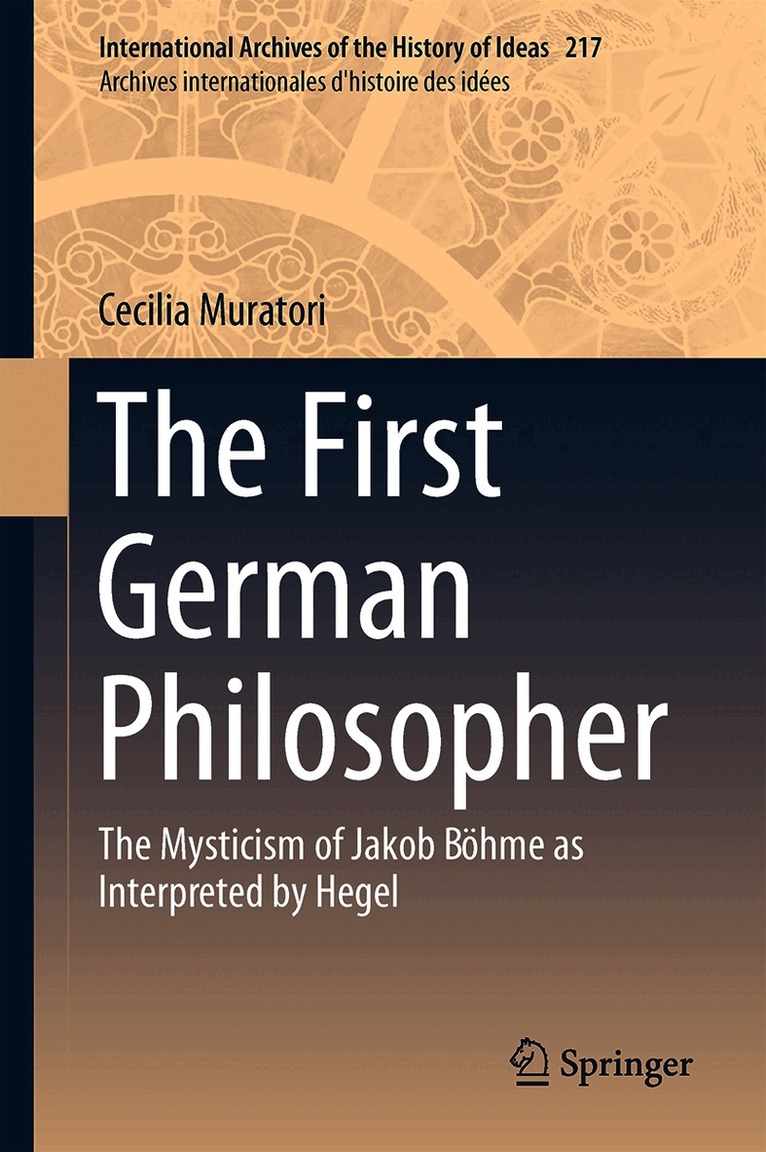
    First German Philosopher

    The Mysticism of Jakob Böhme as Interpreted by Hegel

    AvCecilia Muratori

    Inbunden, Engelska, 2016

    Del i serien International Archives of the History of Ideas Archives internationales d'histoire des idées

    1 400 kr

    Beställningsvara. Skickas inom 10-15 vardagar. Fri frakt över 249 kr.

    Fler format och utgåvor

    E-bok

    1 728 kr

    Häftad

    1 400 kr

    Beskrivning

    This book investigates Hegel’s interpretation of the mystical philosophy of Jakob Böhme (1575-1624), considered in the context of the reception of Böhme in the 18th and 19th centuries, and of Hegel’s own understanding of mysticism as a philosophical approach. The three sections of this book present: the historical background of Hegel’s encounter with Böhme’s writings; the development of two different conceptions of mysticism in Hegel’s work; and finally Hegel’s approach to Böhme’s philosophy, discussing in detail the references to Böhme both in published writings and manuscripts. According to Hegel, Böhme is “the first German philosopher”. The reason for placing Böhme at the very beginning of German philosophy is that Hegel considers him to be a profound thinker, despite his rudimentary education. Hegel’s fascination with Böhme mainly concerns the mystic’s understanding of the symbiotic relation between God and his opposite, the Devil: he considers this to be the true speculative core of Böhme’s thought. By interpreting Böhme, Hegel intends to free the speculative content of his thought from the limitations of the inadequate, barbarous form in which the mystic expressed it, and also to liberate Böhme from the prejudices surrounding his writings, placing him firmly in the territory of philosophy and detaching him from the obscurity of esotericism. Combining historical reconstructions and philosophical argumentation, this book guides the reader through an important phase in German philosophy, and ultimately into an inquiry about the relationship between mysticism and philosophy itself.

    Produktinformation

    • Utgivningsdatum:2016-04-11
    • Mått:155 x 235 x 25 mm
    • Vikt:694 g
    • Format:Inbunden
    • Språk:Engelska
    • Serie:International Archives of the History of Ideas Archives internationales d'histoire des idées
    • Antal sidor:328
    • Upplaga:16001
    • Förlag:Springer
    • ISBN:9789401773386

    Utforska kategorier

    • Historia: teori och metod inom Historia och arkeologi
    • Religion: allmänt inom Filosofi och religion
    • Filosofiska discipliner inom Filosofi och religion

    Mer om författaren

    Cecilia Muratori obtained a PhD in philosophy from the universities of Jena and Urbino in 2009 (‘double degree’). She was then awarded a four-year postdoctoral fellowship from the Ludwig-Maximilians-Universität München, where she worked on a project on the difference between man and the animals in Renaissance philosophy. In particularly she has explored the ethical consequences of this difference, with regard to the philosophical debate on vegetarianism. In 2013-2014 she is Ahmanson Fellow at the Harvard Center for Renaissance Studies I Tatti: her project deals with discourses on vegetarianism and on cannibalism in the Renaissance, and on their paradoxical connections. In 2008 she won first prize in the essay competition of the Schopenhauer-Gesellschaft; and in 2013 she won the prize of the Jacob-Böhme-Institut in Görlitz for an essay on Hegel and Böhme. Among her publications: J. Böhme, Aurora nascente (chapters 1-7), translated and with an introduction by C. Muratori (Milan: Mimesis2008); Ethical Perspectives on Animals in the Renaissance and Early Modern Period, ed. by C. Muratori and B. Dohm (Micrologus’ Library, 58); The Animal Soul and the Human Mind: Renaissance Debates, ed. by C. Muratori, (Bruniana & Campanelliana, Series Studi, 15).

    Recensioner i media

    “Cecilia Muratori’s book is a major contribution to scholarship on the Romantic Age and idealistic philosophy. … The book is clearly structured. The first chapter sets the scene by presenting the immediate context of Hegel’s reception of Böhme in Germany, and especially Jena. … Cecilia Muratori’s The First German Philosopher is a fine book. It exhibits intellectual verve and polish, combining lucid expression with tenacious and resolute intellectual inquiry.” (Douglas Hedley, Journal of the History of Philosophy, Vol. 56 (2), April, 2018)

    Innehållsförteckning

    • 1. The Reception of Böhme’s Philosophy around ‘800.- 2. Two Different Conceptions of Mysticism in Hegel’s Writings.- 3. Hegel as Interpreter of Böhme.- Conclusion, or How to Liberate Böhme’s Philosophy.​