• Fri frakt över 249 kr
  • •
  • Snabba leveranser
  • •
  • Billiga böcker
Kundservice

Du är på sajten för privatpersoner.

Företag, bibliotek eller offentlig verksamhet?

Du handlar på classic.bokus.com, där alla dina funktioner finns intakta.
Till classic.bokus.com
Bokus logotyp. Gå till startsidan.
  • Erbjudanden
  • Nyheter
  • Student
  • Topplistor
  • Barn & ungdom
  • Bokus Play
  • E-böcker
  • Pocketböcker
  • Spel & pussel

10% rabatt på allt med kod: NYSTART10 →

Sidfot

Mina sidor

    Hjälp

    • Kundservice
    • Vanliga frågor och svar
    • Frakt och leverans
    • Retur vid ångerrätt
    • Reklamera vara
    • Betalning
    • Köpvillkor
    • Allmänna villkor
    • Information om webbplatsens tillgänglighet

    Om Bokus

    • Om oss
    • Pressrum
    • För studenter
    • För företag
    • För bibliotek och offentlig verksamhet
    • För leverantörer
    • Hållbarhet

    Populärt

    • Aktuella erbjudanden
    • Presentkort
    • Studentlitteratur
    • Nya böcker
    • Topplistor
    • Signerade böcker
    • Engelska böcker

    Inspiration

    • Boktips
    • BookTok
    • Populära bokserier
    • Barnbokskaraktärer
    • Populära författare
    Logotyp för Bokus
    Följ oss på Facebook (extern länk)Följ oss på Instagram (extern länk)Följ oss på YouTube (extern länk)Följ oss på TikTok (extern länk)
    bokus @ CookiesAnpassa cookiesIntegritetspolicyKöpvillkor
    Till Citymail hemsida (extern länk)Till Budbee hemsida (extern länk)Till Postnord hemsida (extern länk)Till Schenker hemsida (extern länk)Till Early Bird hemsida (extern länk)Till Walleys hemsida (extern länk)
    1. Historia och arkeologi
    2. Historia
    3. Europas historia

    Anti-modernism

    Radical Revisions of Collective Identity

    AvAhmet Ersoy,0

    Inbunden, Engelska, 2014

    2 190 kr

    Beställningsvara. Skickas inom 10-15 vardagar. Fri frakt över 249 kr.

    Beskrivning

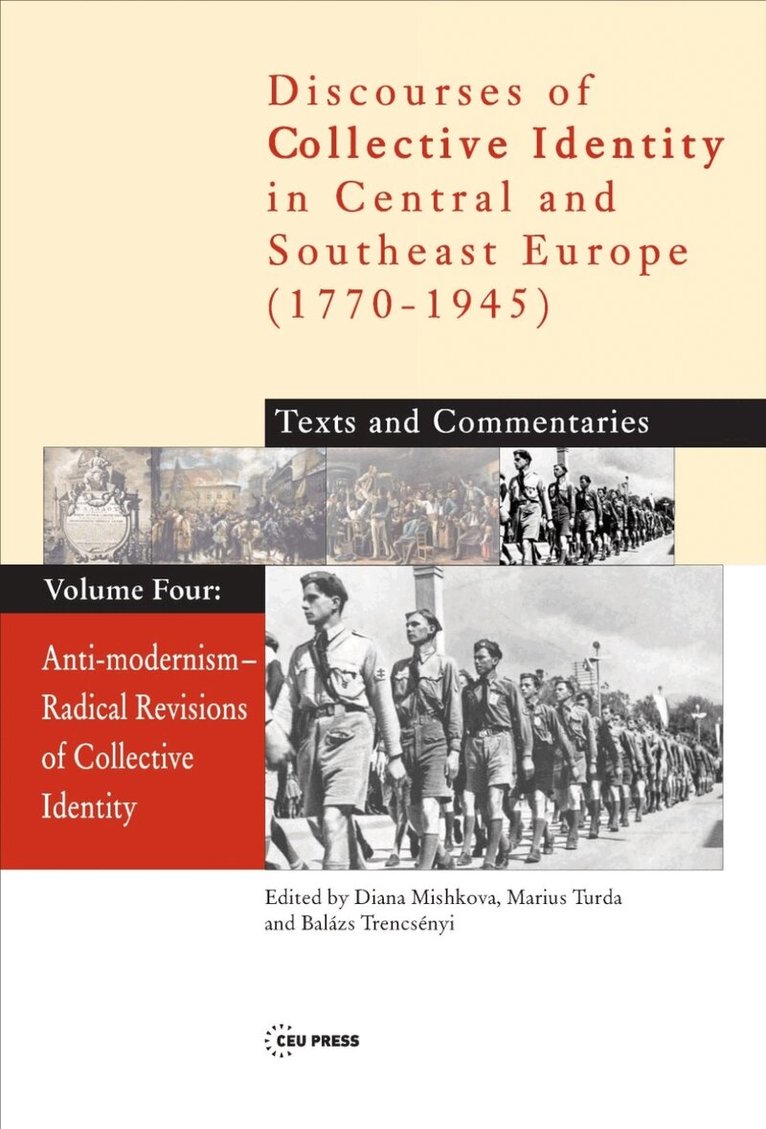
    The last volume of the Discourses of Collective Identity in Central and Southeast Europe 1770–1945 series presents 46 texts under the heading of "antimodernism". In a dynamic relationship with modernism, from the 1880s to the 1940s, and especially during the interwar period, the antimodernist political discourse in the region offered complex ideological constructions of national identification. These texts rejected the linear vision of progress and instead offered alternative models of temporality, such as the cyclical one as well as various narratives of decline. This shift was closely connected to the rejection of liberal democratic institutionalism, and the preference for organicist models of social existence, emphasizing the role of the elites (and charismatic leaders) shaping the whole body politic. Along these lines, antimodernist authors also formulated alternative visions of symbolic geography: rejecting the symbolic hierarchies that focused on the normativity of Western European models, they stressed the cultural and political autarchy of their own national community, which in some cases was also coupled with the reevaluation of the Orient. At the same time, this antimodernist turn should not be confused with rightwing radicalism—in fact, the dialogue with the modernist tradition was often very subtle and the anthology also contains texts which offered a criticism of 'modern' totalitarianism in an antimodernist key.

    Produktinformation

    • Utgivningsdatum:2014-09-01
    • Mått:159 x 234 x 27 mm
    • Vikt:714 g
    • Format:Inbunden
    • Språk:Engelska
    • Antal sidor:452
    • Upplaga:4
    • Förlag:Central European University Press
    • ISBN:9789637326622

    Utforska kategorier

    • Europas historia inom Historia och arkeologi

    Mer om författaren

    Ahmet Ersoy is lecturer at the Department of History, Bogaziçi University, Istanbul.Michal Kopecek is Research Fellow at the Institute of Contemporary History, Prague.Balázs Trencsényi is a Professor at the History Department of Central European University. Vangelis Kechriotis is lecturer at the Department of History, Bogaziçi University, Istanbul.Marius Turda is Professor in 20th Century Central and Eastern European Biomedicine at Oxford Brookes University. He is Director of the Centre for Medical Humanities.Maciej Górny is Research Fellow at the Institute of History of the Polish Academy of Sciences in Warsaw and Centre for Historical Research in Berlin.Diana Mishkova is Associate Professor in Modern History of Southeastern Europe, Senior Researcher and Director of the Centre for Advanced Study Sofia.

    Recensioner i media

    "More than a decade in the making, these volumes represent an impressive achievement. More than that, they are a vital tool for scholarship. Few individual scholars can hope to master the languages and historical traditions required to examine identity projects and discourses in the region in comparative and transnational perspective. This collection allows us to begin to explore the potential of such a project. The imaginatively chosen and carefully annotated extracts prompt the reader to identify unexpected patterns and interactions - by no means limited to reactions to Western ideas and models - while intelligent introductions to each separate volume not only set the context but raise issues and questions that go well beyond the geographical boundaries of Central and Southeastern Europe. The editors of this series have put all scholars working on the region in their debt; they have also laid down a challenge to future scholarship to pursue the possibilities opened up by their labors." - Wendy Bracewell, University College London "A well-edited and exceptionally useful collection of identity statements from Central and Southeastern Europe over a longer time span. The editors have covered the range of the region's many languages, made informed selections, prepared excellent translations, and provided contextual introductions both to the individual extracts and to the main themes of each volume. There is no comparable work in any language; and with the appearance of the final volume in the series, dedicated to anti-modernist discourses in the first half of the twentieth century, it is worth stressing how invaluable a resource this is for teachers and researchers alike. No university library with ambitions to make the region's cultural and intellectual history available to English-speaking students should be without it." - Alex Drace-Francis, University of Amsterdam "This volume, as the entire series, is a challenging collection of essential primary sources, accompanied by introductory essays and contextual analyses in the best senses of the term: their high level of scholarship demands the intelligent engagement of the reader throughout; it invites the educated elites of Eastern Europe to throw away the crutch of myth and half-truth when promoting or interrogating their unique national identity; it demands that scholars working in the Western humanities rethink widely-held assumptions about 'Eastern Europe, what constitutes conservatism and progressiveness, and the idea of a 'normal' path to a liberal modernity. The introduction proposes a concept of 'anti-modernism' to categorize phenomena in Eastern Europe that may be difficult to grasp for those whose path to liberal democracy has not been blocked by decades of totalitarianism, since they evoke an atavistic rootedness (conservativism) but in a paradoxically futural spirit (modernism). As a result, the reader of whatever cultural background emerges with a more lucid feel for what it means to be Eastern European, modern, and human after the End of History." - Roger Griffin, Oxford Brookes University "The collection does an admirable job of addressing multiple audiences. One could imagine these texts being used to great effect in an undergraduate course and, although the contexts would likely be too dense for students at this level, they would make the volume well suited to a graduate course. The series could just as easily be used by scholars well-versed in the intellectual history of one or more of the areas represented who are looking to broaden the context of their understanding." - Slavic and East European Journal "Discourses of Collective Identity bietet eine eindrucksvolle Lekture und sei auch solchen Lesern empfohlen, die sich jenseits der ostmittel-, sudosteuropaischen Area Studies fur Nationalismusforschung interessieren. Fur jene Regionalstudien bedeutet er einen gewichtigen Versuch, das Feld fur eine kritische Ideengeschichte zuruckzugewinnen, nachdem besonders fur Sudosteuropa ethnologisch-anthropologische, kultur- und sozialgeschichtliche Fragestellungen in letzter Zeit eine dominierende Stellung einnehmen." - H-Soz-u-Kult

    Innehållsförteckning

    • Introduction Balázs Trencsényi and Sorin Antohi: Approaching Anti-Modernism Chapter I. Integral Nationalism Nikola Pašic: The Agreement of Serbs and Croats Georg Schönerer: The Pan-Germans’ program for the future Roman Dmowski: Thoughts of a modern Pole Nicolae Iorga: On national culture Aurel C. Popovici: At the crossroads of two worlds Vladimir Cerina: In the city of cynics Babanzâde Ahmed Naim: The question of nationalism in Islam Jozef Tiso: The ideology of the Slovak People’s Party Dezso Szabó: Tomorrow’s nationalism Chapter II. The Crisis of the European Conscience Karl Kraus: The last days of mankind Mircea Eliade: Spiritual itinerary Ahmet Hamdi Tanpinar: On East and West Leopold Andrian: Austria through the prism of the Idea Mihály Babits: Mass and nation Stanislaw Ignacy Witkiewicz: Unkempt souls Ivan Hadzhiyski: An optimistic theory of our people Chapter III. In Search of a National Ontology Ion Dragoumis: Hellenic civilization Jaroslav Durych: The mission of the Czech state France Veber: The ideal foundations of Slavic agrarianism Anton Wildgans: Speech about Austria Lucian Blaga: The Mioritic space Vladimir Dvornikovic: Epic man Nikolaj Velimirovic: Serbian nation as a servant of God Nayden Sheytanov: The Bulgarian worldview László Németh: In the minority Chapter IV. Conservative Redefinitions of Tradition and Modernity Hugo von Hofmannsthal: Writing as the spiritual space of the Nation Gyula Szekfu: Three generations Heinrich von Srbik: Austria in the Holy Roman Empire and in the German Confederation Živojin Peric: Religion in the Serbian Civil Code Milan Šufflay: The depths of national consciousness Karel Kramár: In defense of Slavic politics Petar Mutafchiev: Towards a philosophy of the Bulgarian history Nichifor Crainic: The meaning of tradition Ömer Lütfi Barkan: The legal status of the peasant class in the Ottoman Empire Ladislav Hanus: Slovak statehood Manifesto of the Slovenian National Defense Corps Chapter V. The Anti-Modernist Revolution Ideological declaration of the Camp of Great Poland Janko Janev: The spirit of the nation Hüseyin Nihal Atsiz: Turkish unity Ioannis Metaxas: Speech on the occasion of the inauguration of public works Emil Cioran: The transfiguration of Romania Lazër Radi: Fascism and the Albanian Spirit Štefan Polakovic: Slovak National Socialism Emanuel Vajtauer: Czech myth Svetislav Stefanovic: The building of New Serbia as a peasant state Edvard Kocbek: Comradeship Basic secondary literature on identity discourses in Central and Southeast Europe Glossary