• Fri frakt över 249 kr
  • •
  • Snabba leveranser
  • •
  • Billiga böcker
Kundservice

Du är på sajten för privatpersoner.

Företag, bibliotek eller offentlig verksamhet?

Du handlar på classic.bokus.com, där alla dina funktioner finns intakta.
Till classic.bokus.com
Bokus logotyp. Gå till startsidan.
  • Erbjudanden
  • Nyheter
  • Student
  • Topplistor
  • Barn & ungdom
  • Bokus Play
  • E-böcker
  • Pocketböcker
  • Spel & pussel

Må bättre, för mindre! Upp till 50% rabatt på hälsoböcker

Sidfot

Mina sidor

    Hjälp

    • Kundservice
    • Vanliga frågor och svar
    • Frakt och leverans
    • Retur vid ångerrätt
    • Reklamera vara
    • Betalning
    • Köpvillkor
    • Allmänna villkor
    • Information om webbplatsens tillgänglighet

    Om Bokus

    • Om oss
    • Pressrum
    • För studenter
    • För företag
    • För bibliotek och offentlig verksamhet
    • För leverantörer
    • Hållbarhet

    Populärt

    • Aktuella erbjudanden
    • Presentkort
    • Studentlitteratur
    • Nya böcker
    • Topplistor
    • Signerade böcker
    • Engelska böcker

    Inspiration

    • Boktips
    • BookTok
    • Populära bokserier
    • Barnbokskaraktärer
    • Populära författare
    Logotyp för Bokus
    Följ oss på Facebook (extern länk)Följ oss på Instagram (extern länk)Följ oss på YouTube (extern länk)Följ oss på TikTok (extern länk)
    bokus @ CookiesAnpassa cookiesIntegritetspolicyKöpvillkor
    Till Citymail hemsida (extern länk)Till Budbee hemsida (extern länk)Till Postnord hemsida (extern länk)Till Schenker hemsida (extern länk)Till Early Bird hemsida (extern länk)Till Walleys hemsida (extern länk)
    1. Naturvetenskap och teknik
    2. Geovetenskap
    3. Miljövetenskap och miljöpolitik

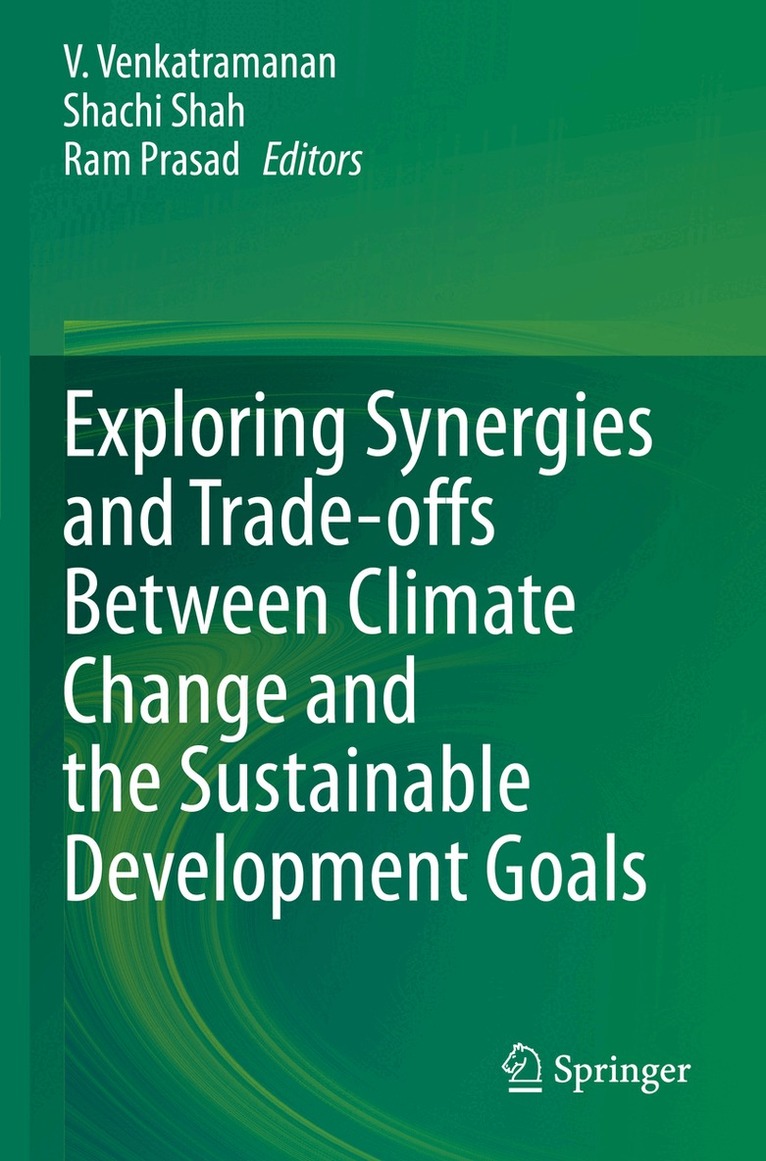
    Exploring Synergies and Trade-offs between Climate Change and the Sustainable Development Goals

    AvV. Venkatramanan,Shachi Shah

    Häftad, Engelska, 2021

    1 626 kr

    Beställningsvara. Skickas inom 10-15 vardagar. Fri frakt över 249 kr.

    Beskrivning

    The existential environmental crisis prompted the United Nations to formulate the Millennium Development Goals at the turn of the 21st century in order to embark on an era of sustainable development. The progress and deficiencies in achieving the Millennium Development Goals provided impetus to the intelligentsia and policymakers to map out the pertinent goals for a sustainable growth trajectory for humanity and the planet. The United Nations’ 2030 Agenda for Sustainable Development, which was adopted in September 2015, took the shape of 17 Sustainable Development Goals (SDGs) and 169 targets. In effect, the 17 Sustainable Development Goals focus on protecting the earth's life support systems for intra- and inter-generational equity and for development that is rooted in sustainability science. Attaining these goals is an uphill task; nevertheless, scientific knowledge, trans and interdisciplinary inquiries, concerted global action and capacity building would provide an enabling environment for achieving the SDGs. This book explores the synergies and trade-offs between climate change management and other SDGs. It highlights the policy imperatives as well as the interrelations between combating climate change and its impacts (SDG 13) and food and nutritional security (SDG 2), water security (SDG 6), soil security (SDG 15), energy security (SDG 7), poverty eradication (SDG 1), gender equality (SDG 5), resilient infrastructure (SDG 9), and sustainable and resilient cities (SDG 11).

    Produktinformation

    • Utgivningsdatum:2021-11-18
    • Mått:155 x 235 x 23 mm
    • Vikt:628 g
    • Format:Häftad
    • Språk:Engelska
    • Antal sidor:402
    • Förlag:Springer Verlag, Singapore
    • ISBN:9789811573033

    Utforska kategorier

    • Miljövetenskap och miljöpolitik inom Naturvetenskap och teknik
    • Biovetenskap inom Naturvetenskap och teknik
    • Agronomi inom Naturvetenskap och teknik

    Mer om författaren

    V. Venkatramanan, Ph.D. is an Assistant Professor at the School of Interdisciplinary and Transdisciplinary Studies, Indira Gandhi National Open University, New Delhi. His interests include climate smart agriculture, climate policy, biodegradation and green technologies for environmental management. He has published more than 20 research papers in peer- reviewed journals and book chapters.Shachi Shah, Ph.D. is an environmentalist with nearly two decades of teaching and research experience at various respected universities and institutes. She is an Associate Professor (Environmental Studies) at the School of Interdisciplinary and Transdisciplinary Studies, IGNOU, New Delhi. Her research interests include green technologies for waste management and energy generation, bioremediation, waste valorization, plant growth promoting organisms, and biodiversity conservation. Moreover, she has authored more than 50 publications.Ram Prasad, Ph.D.is associated with the Department of Botany, Mahatma Gandhi Central University, Motihari, Bihar, India. His research interests include applied & environmental microbiology, plant-microbe-interactions, sustainable agriculture and nanobiotechnology. He has published more than 150 research papers, review articles & book chapters, has five patents issued or pending, and edited or authored several books. Dr. Prasad has twelve years of teaching experience and has been awarded the Young Scientist Award & Prof. J.S. Datta Munshi Gold Medal by the International Society for Ecological Communications; FSAB fellowship by the Society for Applied Biotechnology; the American Cancer Society UICC International Fellowship for Beginning Investigators, USA; Outstanding Scientist Award in the field of microbiology by Venus International Foundation; and the BRICPL Science Investigator Award and Research Excellence Award. He is an editorial board member for Frontiers in Microbiology, Frontiers in Nutrition,Archives of Phytopathology and Plant Protection, Phyton-International Journal of Experimental Botany, Academia Journal of Biotechnology, and the Journal of Renewable Materials, and series editor of Nanotechnology in the Life Sciences, Springer Nature, USA. Previously, Dr. Prasad served as an Assistant Professor at Amity University Uttar Pradesh, India; Visiting Assistant Professor, Whiting School of Engineering, Department of Mechanical Engineering at Johns Hopkins University, Baltimore, United States and Research Associate Professor at the School of Environmental Science and Engineering, Sun Yat-sen University, Guangzhou, China.

    Innehållsförteckning

    • Chapter 1. Achieving Food and Nutrition Security and Climate Change: Clash of the Titans or Alignment of the Stars?.- Chapter 2. Climate Change, Hunger and Food Security in Asia with special reference to Sri Lanka: Can the SDGs be Achieved by 2030?.- Chapter 3. The Status of Climate Variability and Food Accessibility: A Case of Households in Gauteng Province, South Africa.- Chapter 4. Climate resilient mariculture technologies for food and nutritional security.- Chapter 5. Climate change and adaptation: Recommendations for agriculture sector.- Chapter 6. Integrated Farming Systems: Climate Resilient Sustainable Food Production System in the Indian Himalayan Region.- Chapter 7. Adaptation mechanism of methylotrophic bacteria to drought condition and its strategies in mitigating plant stress caused by climate change.- Chapter 8. Synergies and Trade-offs between Climate Change and the Sustainable Development Goals in the Context of Marine Fisheries.- Chapter 9. Increasing Synergies between Climate Change and Sustainable Development in Energy Policy.- Chapter 10. Ensuring Domestic Water Security for Cities under Rapid Urbanisation and Climate Change Risks.- Chapter 11. Improving Water Productivity for Smallholder Rice Farmers in the Upper West Region of Ghana: A Review of Sustainable Approaches.- Chapter 12. Synergies between climate change, biodiversity, ecosystem function and services, indirect drivers of change and human well-being in forests.- Chapter 13. Climate change projections of current and future distributions of the endemic Loris lydekkerianus (Lorinae) in peninsular India.- Chapter 14. Climate Change, Air Pollution and SDG 3: An Indian Perspective.- Chapter 15. Empowerment of fisherwomen through marine farming.