• Fri frakt över 249 kr
  • •
  • Snabba leveranser
  • •
  • Billiga böcker
Kundservice

Du är på sajten för privatpersoner.

Företag, bibliotek eller offentlig verksamhet?

Du handlar på classic.bokus.com, där alla dina funktioner finns intakta.
Till classic.bokus.com
Bokus logotyp. Gå till startsidan.
  • Erbjudanden
  • Nyheter
  • Student
  • Topplistor
  • Barn & ungdom
  • Bokus Play
  • E-böcker
  • Pocketböcker
  • Spel & pussel

10% rabatt på allt med kod NYSTART10 →

Sidfot

Mina sidor

    Hjälp

    • Kundservice
    • Vanliga frågor och svar
    • Frakt och leverans
    • Retur vid ångerrätt
    • Reklamera vara
    • Betalning
    • Köpvillkor
    • Allmänna villkor
    • Information om webbplatsens tillgänglighet

    Om Bokus

    • Om oss
    • Pressrum
    • För studenter
    • För företag
    • För bibliotek och offentlig verksamhet
    • För leverantörer
    • Hållbarhet

    Populärt

    • Aktuella erbjudanden
    • Presentkort
    • Studentlitteratur
    • Nya böcker
    • Topplistor
    • Signerade böcker
    • Engelska böcker

    Inspiration

    • Boktips
    • BookTok
    • Populära bokserier
    • Barnbokskaraktärer
    • Populära författare
    Logotyp för Bokus
    Följ oss på Facebook (extern länk)Följ oss på Instagram (extern länk)Följ oss på YouTube (extern länk)Följ oss på TikTok (extern länk)
    bokus @ CookiesAnpassa cookiesIntegritetspolicyKöpvillkor
    Till Citymail hemsida (extern länk)Till Budbee hemsida (extern länk)Till Postnord hemsida (extern länk)Till Schenker hemsida (extern länk)Till Early Bird hemsida (extern länk)Till Walleys hemsida (extern länk)
    1. Naturvetenskap och teknik
    2. Geovetenskap
    3. Miljövetenskap och miljöpolitik

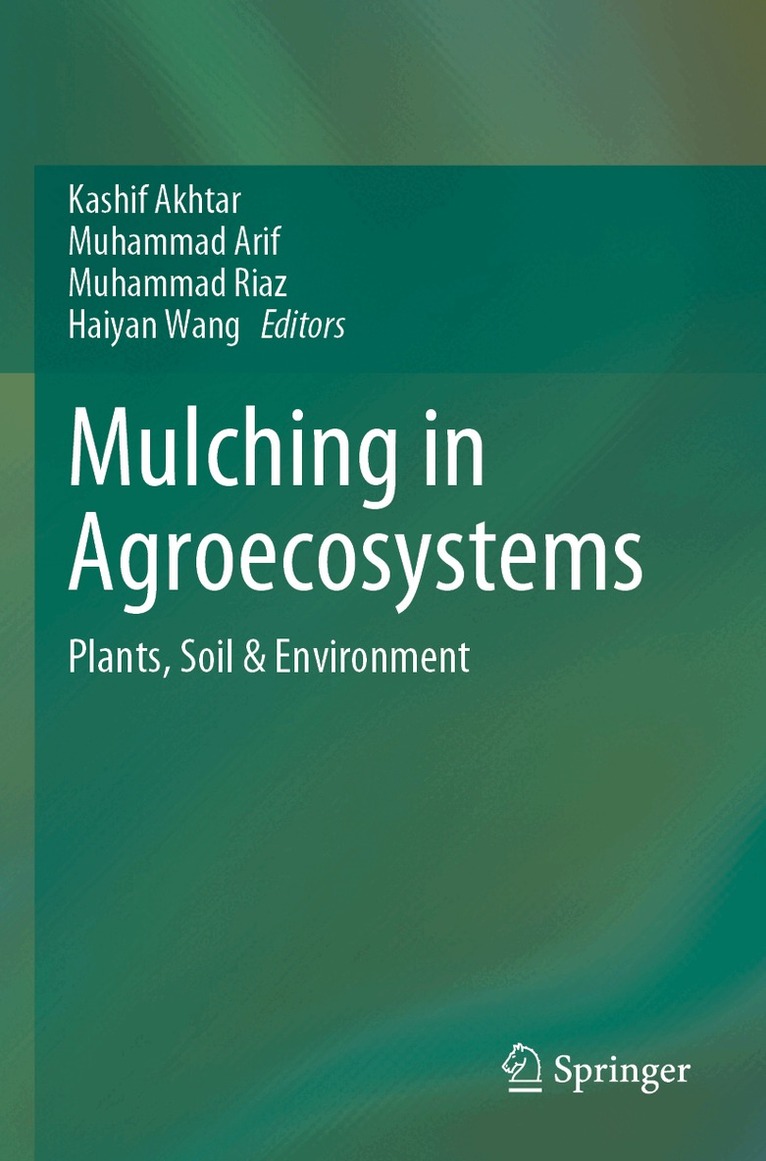
    Mulching in Agroecosystems

    Plants, Soil & Environment

    AvKashif Akhtar,Muhammad Arif

    Häftad, Engelska, 2023

    2 485 kr

    Beställningsvara. Skickas inom 10-15 vardagar. Fri frakt över 249 kr.

    Beskrivning

    This book provides insights into recent developments in the use of mulching in agroecosystems with emphasis on the major pros and cons. Increase in human population, climatic changes and agricultural intensification have put enormous pressure on soil and water resources. As a result, we are confronted with challenges to enhance nutrient and water use efficiencies and conserve soil organic matter without compromising crop yields and food security. Increasing the soil organic matter (SOM) via residue return increased nutrient availability and soil physical and biological properties. Management practices, such as straw mulching or incorporation, have significant effects on soil health. Straw addition also increases functionality related to carbon and N metabolism via increasing the microbes and thus greatly contributes to CO2 and N2O emissions. However, the co-use of organic and inorganic fertilizer reduces the N2O emission without compromising crop yield. Mulching has long been advocated to conserve soil moisture and increase the efficiency of macro- and micro-nutrients by improving soil physical, chemical, and biological properties. These effects of mulch are translated into better crop yields while improving soil health and quality in the long run. Therefore, the use of mulching techniques is on the rise in organic as well as conventional agriculture. The book is of great interest for researchers, academics, agriculture extensionists, soil and plant scientist, fertilizer industry, farmers, agro-industrial workers, farm managers, NGOs, and climate and civil society activists.

    Produktinformation

    • Utgivningsdatum:2023-11-26
    • Mått:155 x 235 x 23 mm
    • Vikt:622 g
    • Format:Häftad
    • Språk:Engelska
    • Antal sidor:404
    • Förlag:Springer Verlag, Singapore
    • ISBN:9789811964121

    Utforska kategorier

    • Miljövetenskap och miljöpolitik inom Naturvetenskap och teknik
    • Biovetenskap inom Naturvetenskap och teknik
    • Agronomi inom Naturvetenskap och teknik

    Mer om författaren

    Dr. Kashif Akhtar now is Postdoctoral Researcher in College of Life Science and Technology, Guangxi University, Nanning, China. His main research interests are soil quality & stabilization, predicting the effects of environmental changes on the soil and plant health, sustainable crop production, GHG emission, plant-soil-microbe interactions, C stocks, waste management, and C3/C4 vegetation shift.Dr. Muhammad Arif is Professor/Director Farms, Department of Agronomy, The University of Agriculture Peshawar, Pakistan. His research areas of interests are seed priming, crop nutrition and dual purpose crops, and use of biochar as soil amendment.Dr. Muhammad Riaz is Associate Professor at Department of Environmental Sciences & Engineering, Government College University Faisalabad, Pakistan. His main research interests are biogeochemical carbon and nitrogen cycling under changing climate and land use in agroecosystems; biochar for carbon sequestration, organic matter stabilization, and food security; sustainable soil quality management using multiple and multiscale approaches.Dr. Haiyan Wang is Associate Professor at College of Agriculture and Biotechnology, Zhejiang University. Her main research interests are pesticide and environmental chemistry.

    Innehållsförteckning

    • Chapter 1. Effects of mulches on soil physical properties i.e. porosity, aggregate stability, infiltration rates, bulk density, compaction.- Chapter 2. Mulching and soil erosion.- Chapter 3. Effects of mulching on soil chemical, biological and enzymatic activities.- Chapter 4. Mulching and soil biota.- Chapter 5. Effects of mulches on soil moisture conservations, evapotranspiration and water use efficiency.- Chapter 6. Effects of mulching on soil organic carbon dynamics.- Chapter 7. Effects of mulches on mineral fertilizer (N, P & K) management and fertilizer use efficiency.- Chapter 8. Mulching to manage drought stress.- Chapter 9. Interactions of mulches with inorganic and organic fertilizers i.e. manures, biochar, bio-fertilizers.- Chapter 10. Organic vs synthetic i.e. plastic mulches.- Chapter 11. Mulches in rain-fed vs irrigated agroecosystems.- Chapter 12. Mulching and tillage practices effects on soil and plants.- Chapter 13. Mulching, soil quality and health.- Chapter 14. Mulches and abiotic stresses i.e. heavy metals, salinity, pesticides.- Chapter 15. Effects of mulching on crop growth, productivity and yield.- Chapter 16. Mulches for management of diseases and weeds in crops.- Chapter 17. Mulching and plant physiological attributes under abiotic stress i.e. drought, salinity, heavy metal etc.- Chapter 18. Mulching and plant-water relations.- Chapter 19. Mulching and nutrient use efficiencies in plants.- Chapter 20. Agronomic and economic valuation of mulches.- Chapter 21. Effects of mulching on soil and air temperature.- Chapter 22. Effect of mulches on greenhouse gas emissions i.e. CO2, N2O and CH4.- Chapter 23. Response of mulching in combination with inorganic fertilizer on agroecosystem.- Chapter 24. Role of mulching in global warming potential and greenhouse gas intensity.