• Fri frakt över 249 kr
  • •
  • Snabba leveranser
  • •
  • Billiga böcker
Kundservice

Du är på sajten för privatpersoner.

Företag, bibliotek eller offentlig verksamhet?

Du handlar på classic.bokus.com, där alla dina funktioner finns intakta.
Till classic.bokus.com
Bokus logotyp. Gå till startsidan.
  • Erbjudanden
  • Nyheter
  • Student
  • Topplistor
  • Barn & ungdom
  • Bokus Play
  • E-böcker
  • Pocketböcker
  • Spel & pussel

10% rabatt på allt med kod: NYSTART10 →

Sidfot

Mina sidor

    Hjälp

    • Kundservice
    • Vanliga frågor och svar
    • Frakt och leverans
    • Retur vid ångerrätt
    • Reklamera vara
    • Betalning
    • Köpvillkor
    • Allmänna villkor
    • Information om webbplatsens tillgänglighet

    Om Bokus

    • Om oss
    • Pressrum
    • För studenter
    • För företag
    • För bibliotek och offentlig verksamhet
    • För leverantörer
    • Hållbarhet

    Populärt

    • Aktuella erbjudanden
    • Presentkort
    • Studentlitteratur
    • Nya böcker
    • Topplistor
    • Signerade böcker
    • Engelska böcker

    Inspiration

    • Boktips
    • BookTok
    • Populära bokserier
    • Barnbokskaraktärer
    • Populära författare
    Logotyp för Bokus
    Följ oss på Facebook (extern länk)Följ oss på Instagram (extern länk)Följ oss på YouTube (extern länk)Följ oss på TikTok (extern länk)
    bokus @ CookiesAnpassa cookiesIntegritetspolicyKöpvillkor
    Till Citymail hemsida (extern länk)Till Budbee hemsida (extern länk)Till Postnord hemsida (extern länk)Till Schenker hemsida (extern länk)Till Early Bird hemsida (extern länk)Till Walleys hemsida (extern länk)
    1. Naturvetenskap och teknik
    2. Teknik och industri
    3. Agronomi och lantbruk

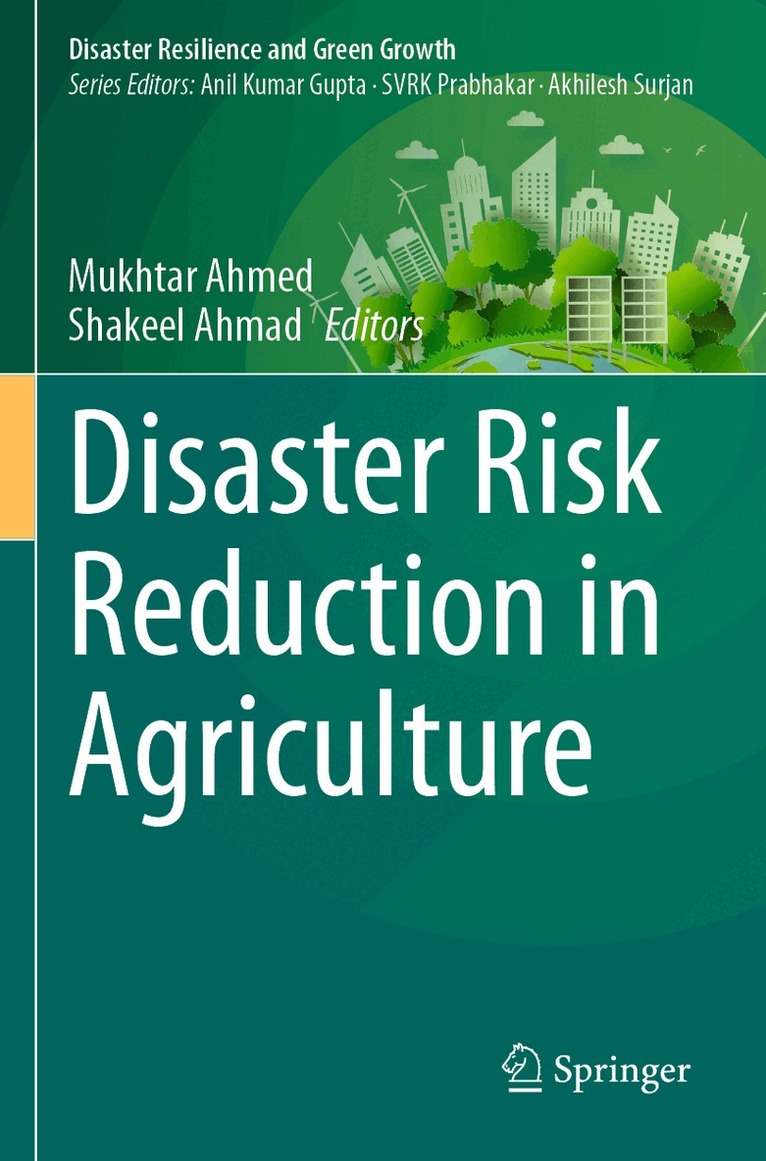
    Disaster Risk Reduction in Agriculture

    AvMukhtar Ahmed,Shakeel Ahmad

    Häftad, Engelska, 2024

    Del i serien Disaster Resilience and Green Growth

    2 704 kr

    Beställningsvara. Skickas inom 10-15 vardagar. Fri frakt över 249 kr.

    Beskrivning

    This book is related to disaster risk reduction in agriculture particularly under changing climate. Climate change refers to significant, long-term changes in the global climate. There is unequivocal evidence that Earth is warming at an unprecedented rate. Human activity is the principal cause. The planets average surface temperature has risen to about 1oC since the late 19th century and most of the warming occurred in the past 40 years. The years 2016 and 2020 are tied for the warmest year on the record. Similarly, other evidence of rapid climate change includes warming of oceans, shrinking of ice sheets, retreating glaciers, decreasing snow cover, rising of sea level, declining artic sea ice, increased frequency of extreme events, ocean acidification and loss of biodiversity. Hence, climate change impacts, both extreme weather and slow-onset events, have impacted several sectors of the national economies and activities, in particular agriculture and food production, augmented by other challenges be it geopolitical, cost of finance or supply chain related, and in a time of increased food insecurity. Without CO2 fertilization, effective adaptation, and genetic improvement, each degree-Celsius increase in global mean temperature would, on average, reduce global yields of wheat by 6.0%, rice by 3.2%, maize by 7.4%, and soybean by 3.1%. Hence this book is useful as a study material to teach in the field of agriculture and climate change. The book is useful for instructors and postgraduate as well as undergraduate students involved in the study of climate change. The book also provide guidance to multiple stakeholders to design mitigation and adaptation efforts to climate change and ensure food security in the developing world.

    Produktinformation

    • Utgivningsdatum:2024-11-03
    • Mått:155 x 235 x 32 mm
    • Vikt:867 g
    • Format:Häftad
    • Språk:Engelska
    • Serie:Disaster Resilience and Green Growth
    • Antal sidor:558
    • Förlag:Springer Verlag, Singapore
    • ISBN:9789819917655

    Utforska kategorier

    • Agronomi och lantbruk inom Naturvetenskap och teknik
    • Lantbruk, fiske och skogsbruk inom Ekonomi och Ledarskap
    • Biovetenskap inom Naturvetenskap och teknik

    Mer om författaren

    Dr. Mukhtar Ahmed’s research focuses on the impact of climate change on crop ecology, crop physiology, cropping system, and rain-fed ecosystem management. He has specialization in the field of environmental sciences, precision agriculture, agro-ecosystem modeling, climate change, and climate variability with teaching and research experience. He has research experience from Sydney University, Australia, where he worked on the application of APSIM as a decision support tool, and rainfall forecasting using generalized additive models.Dr. Shakeel Ahmad is Professor of Agronomy at Bahauddin Zakariya University, Multan, Pakistan since 2016. In 2006, he received PhD from the University of Agriculture, Faisalabad. Later, he completed postdoctoral research from the University of Georgia, USA. He has been devoting himself to teaching and research regarding field crops focusing on crop modeling, climate change, and adaptation strategies. He earned Research Productivity Award for 5 years from Pakistan Council for Science and Technology through the Ministry of Science and Technology, Government of Pakistan, Islamabad.

    Innehållsförteckning

    • Chapter 1 Climate change and farming system- a review of status, potentials, and further work needs.- Chapter 2 Disaster Risk Reduction in Agriculture.- Chapter 3 Agricultural Producers' Behavioral Adaptation to Climate Change Disaster in Turkiye.- Chapter 4 Water Management Strategies for Agricultural Disasters.- Chapter 5 Disasters impacts on soil and their management.- Chapter 6 Role of Soil Science in Mitigating Natural and Anthropogenic Disasters.- Chapter 7 Role of Environmental Science for Disaster Risk Reduction in Agriculture.- Chapter 8 Sustainable Development in Agriculture beyond the Notion of Minimizing Environmental Impacts.- Chapter 9 Drought Stress in Crop Plants and its Management.- Chapter 10 - Impact of Heat Stress on Cereal Crops and its Mitigation Strategies.- chapter 11 Causes of Soil Erosion, its Measurements and Management.- chapter 12 Management of Crops in Water-Logged Soil.- Chapter 13 Climate Change Impact on Mangrove Forests in Pakistan.- Chapter 14 ClimateChange, Flash Floods and It’s Consequences; A Case Study of Gilgit-Baltistan.- Chapter 15 Conservation agriculture a sustainable approach for disaster Risk reduction in rice wheat cropping system of Pakistan.- Chapter 16 Forestry a Way Forward for Disaster Risk Reduction in Agriculture.- Chapter 17 Risks of Deserts Locust and Its Mitigation.- Chapter 18 Role of Horticulture in Disaster Risk Management.- Chapter 19 Disaster Hazards and Vulnerabilities In Agriculture- Role of Food Technologist.- Chapter 20 Role of Livestock for Disaster Risk Reduction.- Chapter 21 Role of Social Sciences in Reducing Disaster Risk in Agriculture.- Chapter 22 Use of AI for Disaster Risk Reduction in Agriculture.- Chapter 23 Disaster Risk Reduction through Agricultural Engineering technologies.- Chapter 24 Integrated Approach for Disaster Risk Reduction in Agriculture through Crop, Livestock, Forestry, Poultry, and Fish farming.-  Chapter 25 Key Challenges and Financial Needs to Promote Climate SmartAgriculture (CSA) in Pakistan: A Case Study of Hunza, Pakistan.