• Fri frakt över 249 kr
  • •
  • Snabba leveranser
  • •
  • Billiga böcker
Kundservice

Du är på sajten för privatpersoner.

Företag, bibliotek eller offentlig verksamhet?

Du handlar på classic.bokus.com, där alla dina funktioner finns intakta.
Till classic.bokus.com
Bokus logotyp. Gå till startsidan.
  • Erbjudanden
  • Nyheter
  • Student
  • Topplistor
  • Barn & ungdom
  • Bokus Play
  • E-böcker
  • Pocketböcker
  • Spel & pussel

10% rabatt på allt med kod NYSTART10 →

Sidfot

Mina sidor

    Hjälp

    • Kundservice
    • Vanliga frågor och svar
    • Frakt och leverans
    • Retur vid ångerrätt
    • Reklamera vara
    • Betalning
    • Köpvillkor
    • Allmänna villkor
    • Information om webbplatsens tillgänglighet

    Om Bokus

    • Om oss
    • Pressrum
    • För studenter
    • För företag
    • För bibliotek och offentlig verksamhet
    • För leverantörer
    • Hållbarhet

    Populärt

    • Aktuella erbjudanden
    • Presentkort
    • Studentlitteratur
    • Nya böcker
    • Topplistor
    • Signerade böcker
    • Engelska böcker

    Inspiration

    • Boktips
    • BookTok
    • Populära bokserier
    • Barnbokskaraktärer
    • Populära författare
    Logotyp för Bokus
    Följ oss på Facebook (extern länk)Följ oss på Instagram (extern länk)Följ oss på YouTube (extern länk)Följ oss på TikTok (extern länk)
    bokus @ CookiesAnpassa cookiesIntegritetspolicyKöpvillkor
    Till Citymail hemsida (extern länk)Till Budbee hemsida (extern länk)Till Postnord hemsida (extern länk)Till Schenker hemsida (extern länk)Till Early Bird hemsida (extern länk)Till Walleys hemsida (extern länk)
    1. Naturvetenskap och teknik
    2. Teknik och industri
    3. Teknik: allmänt

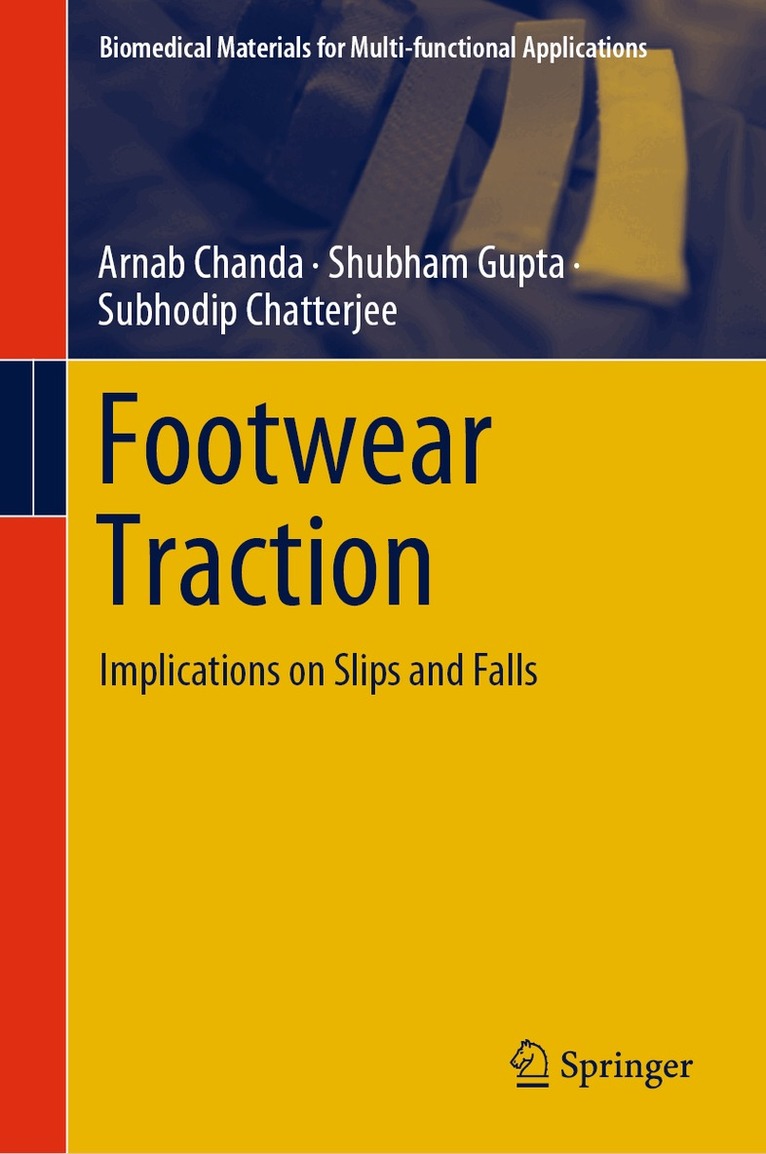
    Footwear Traction

    Implications on Slips and Falls

    AvArnab Chanda,Shubham Gupta

    Inbunden, Engelska, 2023

    Del i serien Biomedical Materials for Multi-functional Applications

    1 450 kr

    Beställningsvara. Skickas inom 10-15 vardagar. Fri frakt över 249 kr.

    Fler format och utgåvor

    Häftad

    1 408 kr

    Beskrivning

    This book discusses the science of footwear traction and its relationship with slips and falls. It presents a detailed introduction to slips and falls and how crucial footwear traction is to avoid such incidents. The book covers ergonomics involved in the development of tread designs and the study of their effect on traction across footwear and systematically modified shoes. It discusses characterization techniques employed in the study of footwear traction across normal gait activities, such as walking and running and in sports, such as sprinting, basketball, and football. The book also covers the role of flooring and slippery contaminants on footwear traction and its generalizability. Additionally, the book also presents how the wear of footwear outsoles may reduce the traction at the shoe-floor and lead to slips and falls. It also discusses the challenges with the existing footwear traction testing methods, and the latest developments in this niche area are highlighted. The bookis a valuable reference for researchers and professionals interested in ergonomics, footwear technology, manufacturing engineering, safety engineering, and design engineering and its allied fields.

    Produktinformation

    • Utgivningsdatum:2023-12-04
    • Mått:155 x 235 x 14 mm
    • Vikt:428 g
    • Format:Inbunden
    • Språk:Engelska
    • Serie:Biomedical Materials for Multi-functional Applications
    • Antal sidor:140
    • Förlag:Springer Verlag, Singapore
    • ISBN:9789819978229

    Utforska kategorier

    • Teknik: allmänt inom Naturvetenskap och teknik
    • Maskinteknik och material inom Naturvetenskap och teknik
    • Produktdesign inom Kultur

    Mer om författaren

    Dr. Arnab Chanda is an assistant professor at the Centre for Biomedical Engineering, Indian Institute of Technology (IIT) Delhi, India, and a joint faculty at the Department of Biomedical Engineering, All India Institute of Medical Sciences (AIIMS), Delhi, India. He is also the founder of a startup company BIOFIT Technologies LLC, USA. Dr. Chanda is an expert in the area of biomechanics, especially foot mechanics. Dr. Chanda has been studying slips and falls caused due to footwear for more than eight years. He has conducted experiments with more than 100 human subjects, with a range of new and worn footwear, in gait laboratories to study unexpected slips and measure the biomechanical parameters at different stages of slips and falls. Also, he has worked with several footwear traction measurement devices used across the industry, such as BPN and SATRA, for measurement of traction in 200+ footwear designs, and provided consultancy services to footwear companies, such asNike. Recently, the most advanced footwear traction characterization device, which is also the first portable device, was developed in his with funding support from government and private agencies. This pioneering device is current being used to study traction across footwear in a range of cohorts. To date, Dr. Chanda has been involved in the research of footwear traction as a part of University of Pittsburgh, USA; IIT Delhi; AIIMS Delhi; and Indian Spinal Injury Centre (ISIC), Delhi. He has received young researcher awards from ASME and MHRD, holds 7 US patents and 2 Indian patents, and has authored more than 50 articles in reputed international journals, and his research has been featured in news in Times of India, NDTV, and IndiaWest, USA. Currently, Dr. Chanda heads the “Disease and Injury Mechanics Lab (DIML)”, where his team is working on developing cutting-edge technologies to study and improve traction in footwear. Shubham is a Ph.D. scholar in the Diseaseand Injury Mechanics Lab (DIML). He completed his B.Tech. in Mechanical Engineering from the University of Pune in 2019. His research is focused on the study of traction performance of worn footwear. He was instrumental in the development of the advanced portable footwear traction characterization device and has also experimented with a range of worn footwear to estimate their traction reduction and determine replacement thresholds. Shubham has also developed a pioneering computational fluid dynamics-based (CFD) model to study the underlying physics behind the traction properties presented by a new or worn footwear on slippery fluid contaminated floorings. He also aims to integrate different fields of engineering that would produce impressive technologies to benefit mankind. Subhodip is a Ph.D. Scholar in the Disease and Injury Mechanics Lab (DIML). He previously worked as an assistant professor at Regent Education and Research Foundation College of Engineering, West Bengal. He has completed his M.Tech. in Metallurgy and Materials Engineering from the Indian Institute of Engineering Science and Technology, Shibpur, West Bengal, and B.Tech. in Mechanical Engineering from the West Bengal University of Technology. His research focus is on the experimental study of barefoot and footwear traction. He has tested a range of footwear-floor-contaminant combinations and studied the science of footwear traction through systematically modifying the footwear tread patterns. His work has been valuable in establishing correlations among footwear tread design, traction, and the incidences of slips and falls.

    Innehållsförteckning

    • ​Part I: Slips and Falls.- Chapter 1: Introduction.- Chapter 2: Worldwide Statistics of Slips and Falls.- Chapter 3: Basic Principles of Slip Resistance.- Chapter 4: Impact of Slips in The Realm of Footwear.- Chapter 5: Prevalence of Slips and Falls In Specific Sectors.- Part II: Ergonomics in Footwear.-Chapter 6: Overview of The Footwear Industry.- Chapter 7: Design and Effects of Different Types of Footwear.- Chapter 8: Activity Specific Footwear.- Chapter 9: Biomechanics of different footwear.-Part III: Traction Testing Methodologies of Footwear.- Chapter 10: Traditional Methods of Footwear Traction Testing.- Chapter 11: Recent Methods of Footwear Traction Testing.- Part IV: Effect of Popular Tread Orientations on Slip Performance.- Chapter 12: Horizontal Outsole Tread Orientation.-Chapter 13: Vertical Outsole Tread Orientation.- Chapter 14: Square Outsole Tread Orientation.-Chapter 15: Oblique Outsole Tread Orientation.- Part V: Effect of Wearing or footwear traction.-Chapter 16: Background on Footwear Wear.- Chapter 17: Wear Mechanisms.- Chapter 18: Effect of Footwear Wear on the Available Traction.- Part VI: Future Opportunities on footwear traction methodologies.- Chapter 19: Challenges Involved in Slip Testing in Actual Realistic Locations.- Chapter 20: New developments in the Area of Slip Testers.