Andreas Kruck - Böcker
Visar alla böcker från författaren Andreas Kruck. Handla med fri frakt och snabb leverans.
9 produkter
9 produkter
671 kr
Skickas inom 10-15 vardagar
This volume provides researchers and students with a discussion of a broad range of methods and their practical application to the study of non-state actors in international security.All researchers face the same challenge, not only must they identify a suitable method for analysing their research question, they must also apply it. This volume prepares students and scholars for the key challenges they confront when using social-science methods in their own research. To bridge the gap between knowing methods and actually employing them, the book not only introduces a broad range of interpretive and explanatory methods, it also discusses their practical application. Contributors reflect on how they have used methods, or combinations of methods, such as narrative analysis, interviews, qualitative comparative analysis (QCA), case studies, experiments or participant observation in their own research on non-state actors in international security. Moreover, experts on the relevant methods discuss these applications as well as the merits and limitations of the various methods in use. Research on non-state actors in international security provides ample challenges and opportunities to probe different methodological approaches. It is thus particularly instructive for students and scholars seeking insights on how to best use particular methods for their research projects in International Relations (IR), security studies and neighbouring disciplines. It also offers an innovative laboratory for developing new research techniques and engaging in unconventional combinations of methods.This book will be of much interest to students of non-state security actors such as private military and security companies, research methods, security studies and International Relations in general.
486 kr
Tillfälligt slut
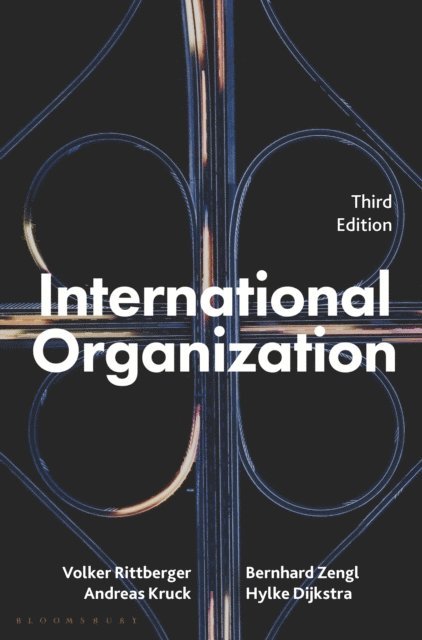
The third edition of this popular core textbook provides wide-ranging coverage of the structure, internal working, policies and performance of international organizations such as the UN, EU, IMF and World Bank. Such organizations have never been so important in addressing the challenges that face our increasingly globalised world. This book introduces students to theories with which to approach international organizations, their history, and their ability to respond to contemporary issues in world politics from nuclear disarmament, climate change and human rights protection, to trade, monetary and financial relations, and international development. Underpinning the text is the authors' unique model that views international organizations as actual organizations. Reacting to world events, political actors provide the 'inputs' which are converted by the political systems of these organizations (through various decision-making procedures) into 'outputs' that achieve varying levels of real-world impact and effectiveness.This is the perfect text for undergraduate and postgraduate students of politics and international relations taking courses on International organization and global governance, as well as essential reading for those studying the UN, the EU and Globalization. New to this Edition:- Draws on the most recent research in the field and considers some of the significant world events of the last decade to ensure that the book is completely up to date.- Two separate chapters considering Trade and Development, and Finance and Monetary Relations respectively.- Fully accounts for the challenges to international organizations by the emerging powers, the Trump administration and Brexit
2 088 kr
Skickas inom 10-15 vardagar
This volume provides researchers and students with a discussion of a broad range of methods and their practical application to the study of non-state actors in international security.All researchers face the same challenge, not only must they identify a suitable method for analysing their research question, they must also apply it. This volume prepares students and scholars for the key challenges they confront when using social-science methods in their own research. To bridge the gap between knowing methods and actually employing them, the book not only introduces a broad range of interpretive and explanatory methods, it also discusses their practical application. Contributors reflect on how they have used methods, or combinations of methods, such as narrative analysis, interviews, qualitative comparative analysis (QCA), case studies, experiments or participant observation in their own research on non-state actors in international security. Moreover, experts on the relevant methods discuss these applications as well as the merits and limitations of the various methods in use. Research on non-state actors in international security provides ample challenges and opportunities to probe different methodological approaches. It is thus particularly instructive for students and scholars seeking insights on how to best use particular methods for their research projects in International Relations (IR), security studies and neighbouring disciplines. It also offers an innovative laboratory for developing new research techniques and engaging in unconventional combinations of methods.This book will be of much interest to students of non-state security actors such as private military and security companies, research methods, security studies and International Relations in general.The Open Access version of this book, available at https://www.routledge.com/Researching-Non-state-Actors-in-International-Security-Theory-and-Practice/Kruck-Schneiker/p/book/9780367141561, has been made available under a Creative Commons Attribution-Non Commercial-No Derivatives 4.0 license.
1 476 kr
Skickas inom 10-15 vardagar
The fourth edition of this popular core textbook provides wide-ranging coverage of the structure, workings, policies and performance of international organizations such as the UN, EU, IMF and World Bank. Such organizations have never been so important in addressing the challenges that face our increasingly globalised world. This book introduces students to theories with which to approach international organizations, their history, and their ability to respond to contemporary issues in world politics from security and defence and climate change, to trade, migration and refugees, human rights protection, and international development. Underpinning the text is the authors' unique model that views international organizations as actual organizations. Reacting to world events, political actors provide the 'inputs' which are converted by the political systems of these organizations into 'outputs' that achieve varying levels of real-world impact and effectiveness.This is the perfect text for undergraduate and postgraduate students of politics and international relations taking courses on international organization and global governance, as well as essential reading for those studying the UN, the EU and globalization.New to this Edition:- Draws on the most recent research in the field and considers some of the significant world events of the last decade to ensure that the book is completely up to date.- New separate chapters considering NATO, international organizations in the field of migration and refugees as well as a new chapter on regional organizations such as the African Union, ASEAN and MERCOSUR.- Fully accounts for the challenges to international organizations by the emerging powers, the Trump administration, geopolitics and crises of legitimacy.
448 kr
Skickas
The fourth edition of this popular core textbook provides wide-ranging coverage of the structure, workings, policies and performance of international organizations such as the UN, EU, IMF and World Bank. Such organizations have never been so important in addressing the challenges that face our increasingly globalised world. This book introduces students to theories with which to approach international organizations, their history, and their ability to respond to contemporary issues in world politics from security and defence and climate change, to trade, migration and refugees, human rights protection, and international development. Underpinning the text is the authors' unique model that views international organizations as actual organizations. Reacting to world events, political actors provide the 'inputs' which are converted by the political systems of these organizations into 'outputs' that achieve varying levels of real-world impact and effectiveness.This is the perfect text for undergraduate and postgraduate students of politics and international relations taking courses on international organization and global governance, as well as essential reading for those studying the UN, the EU and globalization.New to this Edition:- Draws on the most recent research in the field and considers some of the significant world events of the last decade to ensure that the book is completely up to date.- New separate chapters considering NATO, international organizations in the field of migration and refugees as well as a new chapter on regional organizations such as the African Union, ASEAN and MERCOSUR.- Fully accounts for the challenges to international organizations by the emerging powers, the Trump administration, geopolitics and crises of legitimacy.
1 170 kr
Skickas inom 10-15 vardagar
This edited volume analyzes mistakes in different areas of international relations including the realms of security, foreign policy, finance, health, development, environmental policy and migration. By starting out from a broad concept of mistakes as “something [considered to have] gone wrong” the edited volume enables comparisons of various kinds of mistakes from a range of analytical perspectives, including objectivist and interpretivist approaches, in order to draw out answers to the following guiding questions:• How does one identify and research a mistake?• Why do mistakes happen?• How are actors made responsible?• When and how do actors learn from mistakes?This book will be of great interest to scholars, undergraduate and postgraduate students as well as practitioners in International Relations, Foreign Policy Analysis, Security Studies, International Political Economy, and Diplomatic History.
1 578 kr
Skickas inom 10-15 vardagar
This edited volume analyzes mistakes in different areas of international relations including the realms of security, foreign policy, finance, health, development, environmental policy and migration. By starting out from a broad concept of mistakes as “something [considered to have] gone wrong” the edited volume enables comparisons of various kinds of mistakes from a range of analytical perspectives, including objectivist and interpretivist approaches, in order to draw out answers to the following guiding questions:• How does one identify and research a mistake?• Why do mistakes happen?• How are actors made responsible?• When and how do actors learn from mistakes?This book will be of great interest to scholars, undergraduate and postgraduate students as well as practitioners in International Relations, Foreign Policy Analysis, Security Studies, International Political Economy, and Diplomatic History.
501 kr
Skickas inom 10-15 vardagar
452 kr
Skickas inom 7-10 vardagar
Schließlich werden die Tätigkeiten eines breiten Spektrums internationaler Organisationen und deren Beitrag zur kooperativen Bearbeitung grenzüberschreitender Probleme in den Sachbereichen „Sicherheit“, „Wirtschaft“, „Umwelt“ und „Menschenrechte“ untersucht.