Darren Lilleker – författare
Visar alla böcker från författaren Darren Lilleker. Handla med fri frakt och snabb leverans.
16 produkter
16 produkter
Häftad, Engelska, 2021
602 kr
Skickas inom 10-15 vardagar
This edited collection compares and analyses the most prominent political communicative responses to the outbreak and global spread of the COVID-19 strain of coronavirus within 27 nations across five continents and two supranational organisations: the EU and the WHO. The book encompasses the various governments’ communication of the crisis, the role played by opposition and the vibrancy of the information environment within each nation.The chapters analyse the communication drawing on theoretical perspectives drawn from the fields of crisis communication, political communication and political psychology. In doing so the book develops a framework to assess the extent to which state communication followed the key indicators of effective communication encapsulated in the principles of: being first; being right; being credible; expressing empathy; promoting action; and showing respect. The book also examines how communication circulated within the mass and social media environments and what impact differences in spokespersons, messages and the broader context has on the success of implementing measures likely to reduce the spread of the virus. Cumulatively, the authors develop a global analysis of the responses and how these are shaped by their specific contexts and by the flow of information, while offering lessons for future political crisis communication.This book will be of great interest to students and researchers of politics, communication and public relations, specifically on courses and modules relating to current affairs, crisis communication and strategic communication, as well as practitioners working in the field of health crisis communication.The Open Access version of this book, available at www.taylorfrancis.com, has been made available under a Creative Commons Attribution-Non Commercial-No Derivatives 4.0 license. Thanks to the support of libraries working with Knowledge Unlatched www.knowledgeunlatched.org
Inbunden, Engelska, 2021
2 201 kr
Skickas inom 10-15 vardagar
This edited collection compares and analyses the most prominent political communicative responses to the outbreak and global spread of the COVID-19 strain of coronavirus within 27 nations across five continents and two supranational organisations: the EU and the WHO. The book encompasses the various governments’ communication of the crisis, the role played by opposition and the vibrancy of the information environment within each nation.The chapters analyse the communication drawing on theoretical perspectives drawn from the fields of crisis communication, political communication and political psychology. In doing so the book develops a framework to assess the extent to which state communication followed the key indicators of effective communication encapsulated in the principles of: being first; being right; being credible; expressing empathy; promoting action; and showing respect. The book also examines how communication circulated within the mass and social media environments and what impact differences in spokespersons, messages and the broader context has on the success of implementing measures likely to reduce the spread of the virus. Cumulatively, the authors develop a global analysis of the responses and how these are shaped by their specific contexts and by the flow of information, while offering lessons for future political crisis communication.This book will be of great interest to students and researchers of politics, communication and public relations, specifically on courses and modules relating to current affairs, crisis communication and strategic communication, as well as practitioners working in the field of health crisis communication.The Open Access version of this book, available at www.taylorfrancis.com, has been made available under a Creative Commons Attribution-Non Commercial-No Derivatives 4.0 license. Thanks to the support of libraries working with Knowledge Unlatched www.knowledgeunlatched.org
Inbunden, Engelska, 2011
1 381 kr
Skickas inom 10-15 vardagar
The Internet first played a minor role in the 1992 U.S. Presidential election, and has gradually increased in importance so that it is central to election campaign strategy. However, election campaigners have, until very recently, focused on Web 1.0: websites and email. Political Campaigning, Elections and the Internet contextualises the US Presidential campaign of 2008 within three other contests: France 2007; Germany 2009; and the UK 2010. In offering a comparative history of the use of the Internet as an election tool, the authors are able to test the optimistic view that the Internet is transforming elections while also mapping the role the Internet plays and performs for parties and candidates. Lilleker and Jackson offer in-depth analysis demonstrating how interactive Web 2.0 online tools, including weblogs, social networking sites and file-sharing sites, are utilised and evaluate the role of these tools in the marketing and branding of parties and candidates.Examining the interactivity between candidate, party, and voter, this important book will be of strong interest to students and scholars of political science, elections, international relations and political communication. It will be of value to those within public relations, marketing and related communication and media programmes.
Inbunden, Engelska, 2013
2 220 kr
Skickas inom 10-15 vardagar
Technological, cultural and economic forces are transforming political communication, posing challenges and opportunities for politicians and media organisations, while at the same time many governments and civil society express concerns about the extent and nature of political empowerment and civic engagement.This book offers an international perspective on current thinking and practice about civic and audience empowerment, focusing on the ways and means through which media can empower or dis-empower citizens as audiences. It features theoretical and empirical chapters that draw specific attention to a reappraisal of the theories, methods and issues that inform our understanding of citizens and audiences in contemporary politics. The authors address the following questions: How much and what sorts of civic and audience empowerment are most desirable, and how does this differ cross-nationally? How do citizens relate to private and public spaces? How do citizens function in online, networked, liminal and alternative spaces? How do audiences of ‘non-political’ media spaces relate their experiences to politics? How are political parties and movements utilising audiences as co-creators of political communication and what are the consequences for democracy?With examples from the UK, USA, Holland, France, Germany, The Middle East, South Africa and Mexico, this innovative volume will be of interest to students and scholars of political science, marketing, journalism, cultural studies, public relations, media and international relations.
Häftad, Engelska, 2005
349 kr
Skickas inom 5-8 vardagar
Political marketing has become a global phenomenon as parties try to copy the market-oriented approach employed by Tony Blair to win power for New Labour in 1997. Increasingly voters choose parties like consumers choose products, and this study looks at how some political parties, such as Sinn Fein, have been able to capitalise on this to gain support. It raises fresh perspectives on the more established political marketing practices in the UK and US, such as how to incorporate political leadership within the market-oriented framework and the democratic implications when faced with the actually business of governing. This book also highlights how the market-oriented party approach has spread around the world, including Europe and the new democracies of Brazil and Peru. The chapters, in demonstrating this convergence in practices, also question whether this strategy is appropriate for political systems based on proportional representation and coalition governments such as those in Austria, Germany, New Zealand, Canada, and devolved systems in Northern Ireland and Scotland. The collection also introduces the debate on whether such practices enhance or undermine democracy, raising important questions on the future of political marketing.This book should become an established essential text for students and academics of political science and marketing.
Inbunden, Engelska, 2006
1 053 kr
Skickas inom 5-8 vardagar
What is political marketing and how does it work? This question sits at the heart of this book. Using the British General Election of 2005 as a case study, this collection focuses on three important elements: the products offered by the parties; the campaign communication; and the perceptions, reactions and attitudes of the voters. Within each chapter is a discussion of the role of marketing in constructing the elements of an election campaign, how marketing informs the communicational aspects and how the strategy is perceived by the voters. This analysis, the first of its kind, allows us to understand how marketing informs the disparate elements of a campaign to understand if politics has entered a market-oriented phase. The book raises a number of important questions, particularly the extent to which marketing has become the new political ideology, and what affect this is having on the voter perceptions of the parties.
Häftad, Engelska, 2006
317 kr
Skickas inom 7-10 vardagar
What is political marketing and how does it work? This question sits at the heart of this book. Using the British General Election of 2005 as a case study, this collection focuses on three important elements: the products offered by the parties; the campaign communication; and the perceptions, reactions and attitudes of the voters. Within each chapter is a discussion of the role of marketing in constructing the elements of an election campaign, how marketing informs the communicational aspects and how the strategy is perceived by the voters. This analysis, the first of its kind, allows us to understand how marketing informs the disparate elements of a campaign to understand if politics has entered a market-oriented phase. The book raises a number of important questions, particularly the extent to which marketing has become the new political ideology, and what affect this is having on the voter perceptions of the parties.
Inbunden, Engelska, 2024
3 168 kr
Skickas inom 10-15 vardagar
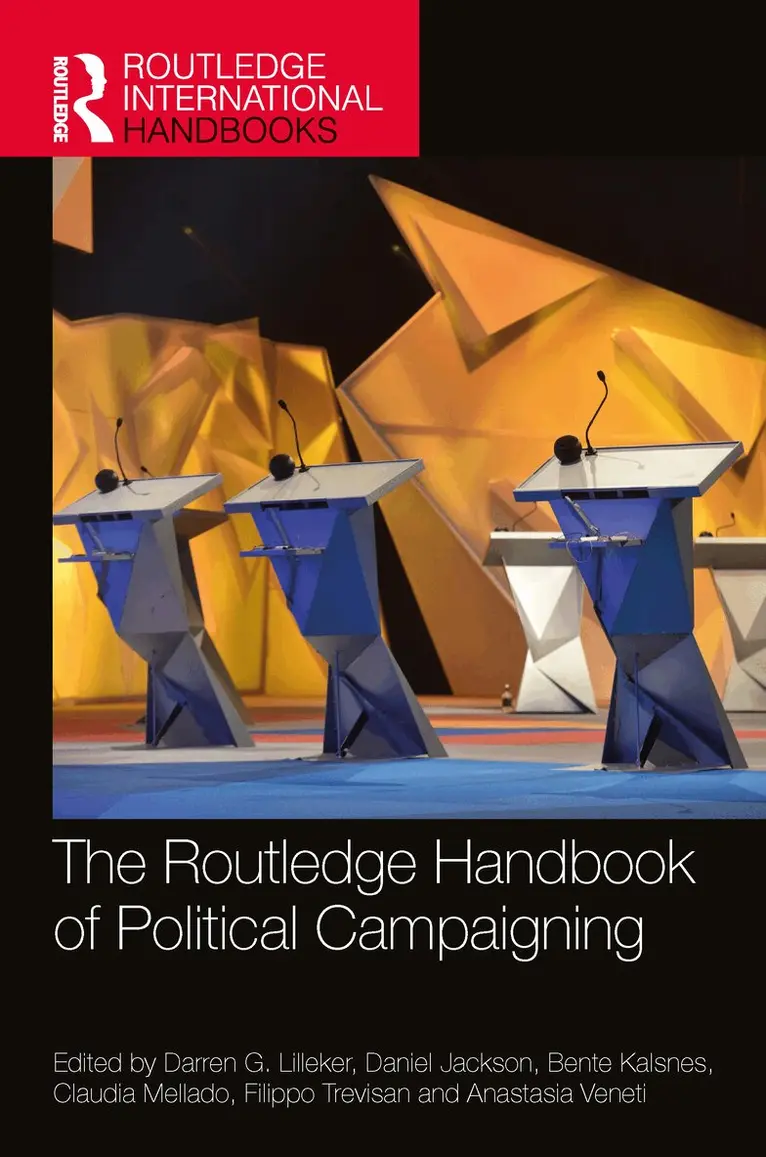
The Routledge Handbook of Political Campaigning provides an essential, global, and timely overview of current realities, as well as anticipating the trajectory and evolution of campaigning in the coming years.Offering a comprehensive analysis, the handbook is structured into seven thematic sections, including the campaign environment; rhetoric and persuasion; campaign strategies; campaign tactics and platform affordances; news and journalism; citizens and voters; and civil society. The chapters within each section reflect on the latest societal, technological, and cultural developments and their impact on campaigning, on democratic culture within societies, and on the roles that campaigns might play in both facilitating and impeding political engagement. Key trends and innovations are examined alongside case studies and examples from a range of nations and political contexts. Issues around trust and representation are further reflected in a focus on the wider campaigning environment and the rise in importance of grassroots and pressure groups, social movements, and movements that coalesce within digital environments.The Routledge Handbook of Political Campaigning is an essential resource for scholars, students, and practitioners in political communication, media and communication, elections and voting behavior, digital media, journalism, social movements, strategic communication, social media, and more broadly to democracy, sociology, and public policy.
Häftad, Engelska, 2026
708 kr
Skickas inom 10-15 vardagar
The Routledge Handbook of Political Campaigning provides an essential, global, and timely overview of current realities, as well as anticipating the trajectory and evolution of campaigning in the coming years.Offering a comprehensive analysis, the handbook is structured into seven thematic sections, including the campaign environment; rhetoric and persuasion; campaign strategies; campaign tactics and platform affordances; news and journalism; citizens and voters; and civil society. The chapters within each section reflect on the latest societal, technological, and cultural developments and their impact on campaigning, on democratic culture within societies, and on the roles that campaigns might play in both facilitating and impeding political engagement. Key trends and innovations are examined alongside case studies and examples from a range of nations and political contexts. Issues around trust and representation are further reflected in a focus on the wider campaigning environment and the rise in importance of grassroots and pressure groups, social movements, and movements that coalesce within digital environments.The Routledge Handbook of Political Campaigning is an essential resource for scholars, students, and practitioners in political communication, media and communication, elections and voting behavior, digital media, journalism, social movements, strategic communication, social media, and more broadly to democracy, sociology, and public policy.
Häftad, Engelska, 2024
559 kr
Skickas inom 10-15 vardagar
Risk Communication and COVID-19 explores the “risk communication” responses by national governments to the outbreak and global spread of the COVID-19 strain of coronavirus.The book focuses on 17 country case studies, representing countries all around the world, covering a range of democratic and authoritarian systems, styles of leadership, and political contexts. The chapters analyze communication drawing on a modified risk communication framework to determine what patterns governmental risk communication followed in several areas: messenger attributes, consistency and clarity of communication, communication methods, message attributes, and public trust in government. The book also analyzes how these attributes changed and developed over time from 2020 to 2022. The analyzed period is divided into several parts representing different pandemic milestones, such as the first cases, the second wave of the pandemic, vaccination, and adaptation to the endemic logic of dealing with the COVID-19 virus. Importantly, the book draws out key lessons which can inform communication strategies during crises, particularly when the crisis necessitates public behavioral adjustments. The lessons are framed to further understanding of the challenges faced within the field of political risk communication during crises in the twenty-first century.This book will be of great interest to students and researchers of politics, communication, and public relations, specifically on courses and modules relating to current affairs, risk communication, crisis communication, and strategic communication, as well as practitioners working in the field of health crisis communication.
Inbunden, Engelska, 2024
2 059 kr
Skickas inom 10-15 vardagar
Risk Communication and COVID-19 explores the “risk communication” responses by national governments to the outbreak and global spread of the COVID-19 strain of coronavirus.The book focuses on 17 country case studies, representing countries all around the world, covering a range of democratic and authoritarian systems, styles of leadership, and political contexts. The chapters analyze communication drawing on a modified risk communication framework to determine what patterns governmental risk communication followed in several areas: messenger attributes, consistency and clarity of communication, communication methods, message attributes, and public trust in government. The book also analyzes how these attributes changed and developed over time from 2020 to 2022. The analyzed period is divided into several parts representing different pandemic milestones, such as the first cases, the second wave of the pandemic, vaccination, and adaptation to the endemic logic of dealing with the COVID-19 virus. Importantly, the book draws out key lessons which can inform communication strategies during crises, particularly when the crisis necessitates public behavioral adjustments. The lessons are framed to further understanding of the challenges faced within the field of political risk communication during crises in the twenty-first century.This book will be of great interest to students and researchers of politics, communication, and public relations, specifically on courses and modules relating to current affairs, risk communication, crisis communication, and strategic communication, as well as practitioners working in the field of health crisis communication.
Inbunden, Engelska, 2024
2 000 kr
Skickas inom 10-15 vardagar
Central and Eastern European (CEE) countries have faced significant political, economic, social, and technological transformations over the last four decades. Democratic processes, after relative stabilisation, have begun to tremble again around polarizing values, populist leaders, or nationalistic ideologies. Online communication, especially social media platforms, play a vital role in shaping how citizens interact with the state, political actors, media, and other citizens.This book focuses on some of the challenges democratic institutions in Central and Eastern European (CEE) countries face in transforming and sustaining civil society and captures how the digital media environments mitigate or exacerbate those challenges. The chapters in this book focus on the role that online platforms play in shaping satisfaction with democracy in the CEE region, the interactions between journalists and political actors, the strategic media coverage of elections, affective polarisation and political antagonism, and discursive attempts to discourage young people from civic engagement. The first section of the book looks at CEE countries from a comparative perspective, and the second section examines specific case studies within different CEE countries such as Albania and Kosovo, Czechia and Hungary, Poland and Ukraine.This volume will be a key resource for scholars and researchers of Communication Studies, Politics, Media Studies, Sociology and Central and Eastern European studies. The chapters in this book were originally published in the Journal of Information, Technology & Politics.
Häftad, Engelska, 2026
665 kr
Kommande
Central and Eastern European (CEE) countries have faced significant political, economic, social, and technological transformations over the last four decades. Democratic processes, after relative stabilisation, have begun to tremble again around polarizing values, populist leaders, or nationalistic ideologies. Online communication, especially social media platforms, play a vital role in shaping how citizens interact with the state, political actors, media, and other citizens.This book focuses on some of the challenges democratic institutions in Central and Eastern European (CEE) countries face in transforming and sustaining civil society and captures how the digital media environments mitigate or exacerbate those challenges. The chapters in this book focus on the role that online platforms play in shaping satisfaction with democracy in the CEE region, the interactions between journalists and political actors, the strategic media coverage of elections, affective polarisation and political antagonism, and discursive attempts to discourage young people from civic engagement. The first section of the book looks at CEE countries from a comparative perspective, and the second section examines specific case studies within different CEE countries such as Albania and Kosovo, Czechia and Hungary, Poland and Ukraine.This volume will be a key resource for scholars and researchers of Communication Studies, Politics, Media Studies, Sociology and Central and Eastern European studies. The chapters in this book were originally published in the Journal of Information, Technology & Politics.
Häftad, Engelska, 2024
570 kr
Skickas inom 10-15 vardagar
The Internet first played a minor role in the 1992 U.S. Presidential election, and has gradually increased in importance so that it is central to election campaign strategy. However, election campaigners have, until very recently, focused on Web 1.0: websites and email. Political Campaigning, Elections and the Internet contextualises the US Presidential campaign of 2008 within three other contests: France 2007; Germany 2009; and the UK 2010. In offering a comparative history of the use of the Internet as an election tool, the authors are able to test the optimistic view that the Internet is transforming elections while also mapping the role the Internet plays and performs for parties and candidates. Lilleker and Jackson offer in-depth analysis demonstrating how interactive Web 2.0 online tools, including weblogs, social networking sites and file-sharing sites, are utilised and evaluate the role of these tools in the marketing and branding of parties and candidates.Examining the interactivity between candidate, party, and voter, this important book will be of strong interest to students and scholars of political science, elections, international relations and political communication. It will be of value to those within public relations, marketing and related communication and media programmes.
Häftad, Engelska, 2014
763 kr
Skickas inom 10-15 vardagar
Technological, cultural and economic forces are transforming political communication, posing challenges and opportunities for politicians and media organisations, while at the same time many governments and civil society express concerns about the extent and nature of political empowerment and civic engagement.This book offers an international perspective on current thinking and practice about civic and audience empowerment, focusing on the ways and means through which media can empower or dis-empower citizens as audiences. It features theoretical and empirical chapters that draw specific attention to a reappraisal of the theories, methods and issues that inform our understanding of citizens and audiences in contemporary politics. The authors address the following questions: How much and what sorts of civic and audience empowerment are most desirable, and how does this differ cross-nationally? How do citizens relate to private and public spaces? How do citizens function in online, networked, liminal and alternative spaces? How do audiences of ‘non-political’ media spaces relate their experiences to politics? How are political parties and movements utilising audiences as co-creators of political communication and what are the consequences for democracy?With examples from the UK, USA, Holland, France, Germany, The Middle East, South Africa and Mexico, this innovative volume will be of interest to students and scholars of political science, marketing, journalism, cultural studies, public relations, media and international relations.
Inbunden, Engelska, 2023
3 519 kr
Skickas inom 5-8 vardagar
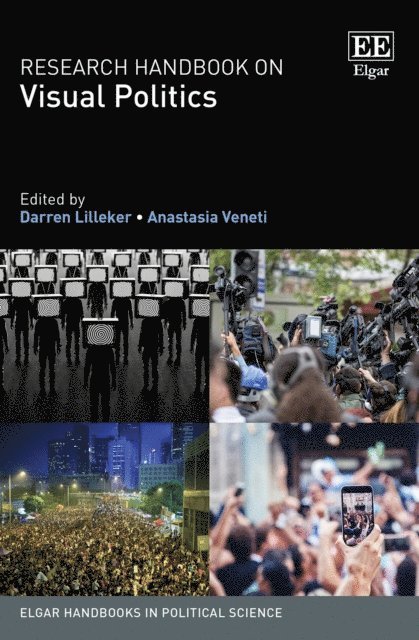
The Research Handbook on Visual Politics focuses on key theories and methodologies for better understanding visual political communication. It also concentrates on the depictions of power within politics, taking a historical and longitudinal approach to the topic of placing visuals within a wider framework of political understanding.The Handbook provides an introduction to the theoretical underpinning of the study of visual politics as well as an overview of the current thinking and research traditions in the field of visual politics. The impressive selection of contributors explore all types of media, including studies of the tools utilised for visual politics such as social media, art and photography, featuring the latest platforms such as TikTok and Instagram. The editors also include discussions of visual politics covering a range of nations and political systems while placing current practices in visual politics within their historical context.Offering a rich range of studies exploring differing practices within their contexts to highlight current studies and support the development of future research, this Research Handbook is designed for researchers and students interested in the broad field of politics and the subfields of political communication, persuasion, propaganda and rhetoric.