360 kr
Jonas Tallberg – författare
- Häftad, Svenska, 2025EU är en integrerad del av svenskt samhällsliv, precis som Sverige är en del av EU:s politiska system. Svenska ministrar, parlamentariker, tjänstemän, intressegrupper och väljare medverkar alla på olika sätt i EU:s politiska processer, samtidigt som de beslut som fattas i något av EU:s olika organ får politiska, ekonomiska och sociala konsekvenser i Sverige.Trots detta är det få som känner till hur EU:s politiska system fungerar. Den här boken syftar till att göra EU:s politiska maskineri begripligt. Vad gör EU:s politiska institutioner? Vem har makt och inflytande i EU:s politiska process? Hur omsätts konkurrerande intressen i gemensam EU-politik?Boken vänder sig främst till universitetsstuderande i ämnen med krav på en grundläggande förståelse av EU, men är även lämplig som referensverk för den svenska statsförvaltningen. Denna nionde och reviderade upplaga redogör för hur EU fungerar efter Storbritanniens utträde och Europaparlamentsvalen 2024.
- Häftad, Svenska, 2021
549 kr
Skickas
I denna heltäckande grundbok ges en introduktion till studiet av internationella relationer. Boken redogör för de dominerande teoretiska perspektiven inom internationella relationer, för de processer som formar den internationella fördelningen av makt och resurser, samt för de mest framträdande politikområdena i världspolitiken idag. Genom sitt breda anslag behandlar boken frågor som: Varför uppstår krig? Vad har globaliseringen för politiska effekter? Vem har makt i internationell politik? Hur kan utvecklingsländerna hävas ur fattigdom? Vilka motiv driver transnationella terroristnätverk? När har normer och internationella institutioner betydelse? Under vilka omständigheter får nationella identiteter genomslag i världspolitiken?I boken medverkar många av de främsta forskarna inom internationell politik i Sverige. Alla är experter inom sina respektive områden, och är väl integrerade i den internationella forskningsmiljön. På ett pedagogiskt sätt introducerar de centrala perspektiv och begrepp och knyter samtidigt an till aktuella exempel och illustrationer. Flera exempel hämtas från en svensk kontext och boken belyser därmed på ett unikt sätt Sveriges relationer med omvärlden. I denna fjärde upplaga har samtliga kapitel uppdaterats. Boken vänder sig i första hand till introduktionskurser i internationell politik eller internationella relationer vid universitet och högskolor. - Häftad, Svenska, 2026
810 kr
Skickas
SeSam är ett nytt läromedel i samhällskunskap för gymnasiet. Med engagerande texter, konkreta exempel och klargörande modeller ger läromedlet eleverna verktyg att förstå och analysera den komplexa värld de lever i. Hur hänger politik, ekonomi och samhällsstrukturer ihop? Vilken förståelse av samhället behövs för att kunna delta i och forma både nuet och framtiden?
I SeSam får eleverna även metoder och verktyg för att kritiskt granska samhällsfrågor, vilket är avgörande i en tid av snabb förändring och ökande informationsflöden. Med SeSam får eleverna inte bara lära sig om samhället – de får även hjälp att se sambanden, se samspelet och se samhället i ett större perspektiv.
Skrivet av ämnesexperter
När allt fler ifrågasätter fakta och vedertagen kunskap är det extra viktigt att låta experter förklara det som är svårt på ett tillgängligt och tydligt sätt. Därför skrivs SeSam av fem professorer i statsvetenskap, nationalekonomi och sociologi som har gedigna kunskaper och är uppdaterade på den senaste forskningen inom respektive ämnesområde. För att utveckla elevernas kunskaper och förståelse behövs uppgifter och dessa skrivs av en ämnesdidaktiker och verksam gymnasielärare.
Tydlig struktur och progression
SeSam består av fyra delar – verktyg & metoder, politik, ekonomi och sociala frågor. För att knyta samman de olika delarna och visa på ämnets tvärvetenskapliga karaktär återkommer ett antal centrala begrepp i bokens olika delar, exempelvis makt, hållbarhet, jämlikhet, rättvisa, mänskliga rättigheter och välfärd.
Varje kapitel inleds på ett sätt som väcker elevernas intresse för ämnet och aktiverar deras förkunskaper. Rubriker stöttar läsförståelsen och uppgifterna i slutet av varje kapitel utvecklar både förståelse och elevernas analytiska förmåga.
Läromedlet konkretiserar progressionen mellan samhällskunskap nivå 1, 2 och 3. Nytt ämnesinnehåll, till exempel rättsstaten och mediers roll i demokratin samt Sveriges totalförsvar, får en naturlig plats i det enda läromedlet på marknaden som är nyskrivet för Gy25.
En komplett serie i samhällskunskap
SeSam nivå 1b & 2. Utkommer i januari 2027SeSam nivå 123. Utkommer i januari 2028
Digitalt läromedel med smarta funktioner
Underlätta för dig själv och hjälp eleverna genom att använda den fysiska läroboken och det digitala läromedlet tillsammans.
Fler sätt att variera undervisningen
Smarta verktyg och funktioner som inläst text, klickbara ordförklaringar och möjlighet att anpassa texten.
Inlämningsfunktion för alla uppgifter
Möjligt att skapa egna skräddasydda kurser.
- E-bokPDF, Engelska, 2018
1 190 kr
Läs direkt efter köp
Legitimacy is central for the capacity of global governance institutions to address problems such as climate change, trade protectionism, and human rights abuses. However, despite legitimacy''s importance for global governance, its workings remain poorly understood. That is the core concern of this volume: to develop an agenda for systematic and comparative research on legitimacy in global governance. In complementary fashion, the chapters address different aspects ofthe overarching question: whether, why, how, and with what consequences global governance institutions gain, sustain, and lose legitimacy?The volume makes four specific contributions. First, it argues for a sociological approach to legitimacy, centered on perceptions of legitimate global governance among affected audiences. Second, it moves beyond the traditional focus on states as the principal audience for legitimacy in global governance and considers a full spectrum of actors from governments to citizens. Third, it advocates a comparative approach to the study of legitimacy in global governance, and suggests strategies forcomparison across institutions, issue areas, countries, societal groups, and time. Fourth, the volume offers the most comprehensive treatment so far of the sociological legitimacy of global governance, covering three broad analytical themes: (1) sources of legitimacy, (2) processes of legitimation anddelegitimation, and (3) consequences of legitimacy. - E-bokEngelska, 2018
1 202 kr
Läs direkt efter köp
Legitimacy is central for the capacity of global governance institutions to address problems such as climate change, trade protectionism, and human rights abuses. However, despite legitimacy''s importance for global governance, its workings remain poorly understood. That is the core concern of this volume: to develop an agenda for systematic and comparative research on legitimacy in global governance. In complementary fashion, the chapters address different aspects ofthe overarching question: whether, why, how, and with what consequences global governance institutions gain, sustain, and lose legitimacy?The volume makes four specific contributions. First, it argues for a sociological approach to legitimacy, centered on perceptions of legitimate global governance among affected audiences. Second, it moves beyond the traditional focus on states as the principal audience for legitimacy in global governance and considers a full spectrum of actors from governments to citizens. Third, it advocates a comparative approach to the study of legitimacy in global governance, and suggests strategies forcomparison across institutions, issue areas, countries, societal groups, and time. Fourth, the volume offers the most comprehensive treatment so far of the sociological legitimacy of global governance, covering three broad analytical themes: (1) sources of legitimacy, (2) processes of legitimation anddelegitimation, and (3) consequences of legitimacy. - E-bokEngelska, 2022
1 135 kr
Läs direkt efter köp
This is an open access title available under the terms of a CC BY-NC-ND 4.0 International licence. It is free to read at Oxford Scholarship Online and offered as a free PDF download from OUP and selected open access locations.Citizens, Elites, and the Legitimacy of Global Governance offers the first full comparative study of citizen and elite legitimacy beliefs toward global governance. Empirically, it provides a comprehensive analysis of public and elite opinion toward global governance, building on two uniquely coordinated surveys covering multiple countries and international organizations. Theoretically, it develops an individual-level approach, exploring how a person''s characteristics in respect of socioeconomic status, political values, geographical identification, and institutional trust shape legitimacy beliefs toward global governance. The book''s central findings are three-fold. First, there is a notable and general elite-citizen gap in legitimacy beliefs toward global governance. While elites on average hold moderately high levels of legitimacy toward international organizations, the general public is decidedly more skeptical. Second, individual-level differences in interests, values, identities, and trust dispositions provide significant drivers of citizen and elite legitimacy beliefs toward global governance, as well as the gap between them. Most important on the whole are differences in the extent to which citizens and elites trust domestic political institutions, which systematically shape how they assess the legitimacy of international organizations. Third, both patterns and sources of citizen and elite legitimacy beliefs vary across organizations and countries. These variations suggest that institutional and societal contexts condition attitudes toward global governance. The book''s findings shed important light on future opportunities and constraints in international cooperation, suggesting that current levels of legitimacy point neither to a general crisis of global governance nor to a general readiness for its expansion. - Inbunden, Engelska, 2022
1 388 kr
Skickas inom 5-8 vardagar
This is an open access title available under the terms of a CC BY-NC-ND 4.0 International licence. It is free to read at Oxford Scholarship Online and offered as a free PDF download from OUP and selected open access locations.Citizens, Elites, and the Legitimacy of Global Governance offers the first full comparative study of citizen and elite legitimacy beliefs toward global governance. Empirically, it provides a comprehensive analysis of public and elite opinion toward global governance, building on two uniquely coordinated surveys covering multiple countries and international organizations. Theoretically, it develops an individual-level approach, exploring how a person's characteristics in respect of socioeconomic status, political values, geographical identification, and institutional trust shape legitimacy beliefs toward global governance. The book's central findings are three-fold. First, there is a notable and general elite-citizen gap in legitimacy beliefs toward global governance. While elites on average hold moderately high levels of legitimacy toward international organizations, the general public is decidedly more skeptical. Second, individual-level differences in interests, values, identities, and trust dispositions provide significant drivers of citizen and elite legitimacy beliefs toward global governance, as well as the gap between them. Most important on the whole are differences in the extent to which citizens and elites trust domestic political institutions, which systematically shape how they assess the legitimacy of international organizations. Third, both patterns and sources of citizen and elite legitimacy beliefs vary across organizations and countries. These variations suggest that institutional and societal contexts condition attitudes toward global governance. The book's findings shed important light on future opportunities and constraints in international cooperation, suggesting that current levels of legitimacy point neither to a general crisis of global governance nor to a general readiness for its expansion. - Inbunden, Engelska, 2018
1 402 kr
Skickas inom 7-10 vardagar
Legitimacy is central for the capacity of global governance institutions to address problems such as climate change, trade protectionism, and human rights abuses. However, despite legitimacy's importance for global governance, its workings remain poorly understood. That is the core concern of this volume: to develop an agenda for systematic and comparative research on legitimacy in global governance. In complementary fashion, the chapters address different aspects of the overarching question: whether, why, how, and with what consequences global governance institutions gain, sustain, and lose legitimacy? The volume makes four specific contributions. First, it argues for a sociological approach to legitimacy, centered on perceptions of legitimate global governance among affected audiences. Second, it moves beyond the traditional focus on states as the principal audience for legitimacy in global governance and considers a full spectrum of actors from governments to citizens. Third, it advocates a comparative approach to the study of legitimacy in global governance, and suggests strategies for comparison across institutions, issue areas, countries, societal groups, and time. Fourth, the volume offers the most comprehensive treatment so far of the sociological legitimacy of global governance, covering three broad analytical themes: (1) sources of legitimacy, (2) processes of legitimation and delegitimation, and (3) consequences of legitimacy. - Inbunden, Engelska, 2010
558 kr
Skickas inom 10-15 vardagar
The nature of global governance is changing, as are the standards by which we judge its legitimacy. We are witnessing a gradual and partial shift from inter-state co-operation to more complex forms of governance, involving participation by transnational actors, such as NGOs, party associations, philanthropic foundations and corporations. - E-bokPDF, Engelska, 2010
763 kr
Läs direkt efter köp
The nature of global governance is changing, as are the standards by which we judge its legitimacy. We are witnessing a gradual and partial shift from inter-state co-operation to more complex forms of governance, involving participation by transnational actors, such as NGOs, party associations, philanthropic foundations and corporations. - Häftad, Engelska, 2006
468 kr
Skickas inom 11-20 vardagar
In this 2006 book, Jonas Tallberg offers a novel perspective on some of the most fundamental questions about international cooperation and European Union politics. Offering the first systematic theoretical and empirical exploration of the influence wielded by chairmen of multilateral negotiations, Tallberg develops a rationalist theory of formal leadership and demonstrates its explanatory power through carefully selected case studies of EU negotiations. He shows that the rotating Presidency of the EU constitutes a power platform that grants governments unique opportunities to shape the outcomes of negotiations. His provocative analysis establishes that Presidencies, while performing vital functions for the EU, simultaneously exploit their privileged political position to favour national interests. Extending the scope of the analysis to international negotiations on trade, security and the environment, Tallberg further demonstrates that the influence of the EU Presidency is not an isolated occurrence but the expression of a general phenomenon in world politics - the power of the chair. - Inbunden, Engelska, 2006
1 214 kr
Skickas inom 11-20 vardagar
In this 2006 book, Jonas Tallberg offers a novel perspective on some of the most fundamental questions about international cooperation and European Union politics. Offering the first systematic theoretical and empirical exploration of the influence wielded by chairmen of multilateral negotiations, Tallberg develops a rationalist theory of formal leadership and demonstrates its explanatory power through carefully selected case studies of EU negotiations. He shows that the rotating Presidency of the EU constitutes a power platform that grants governments unique opportunities to shape the outcomes of negotiations. His provocative analysis establishes that Presidencies, while performing vital functions for the EU, simultaneously exploit their privileged political position to favour national interests. Extending the scope of the analysis to international negotiations on trade, security and the environment, Tallberg further demonstrates that the influence of the EU Presidency is not an isolated occurrence but the expression of a general phenomenon in world politics - the power of the chair. - Häftad, Engelska, 2024
414 kr
Skickas inom 11-20 vardagar
Once staunch advocates of international cooperation, political elites are increasingly divided over the merits of global governance. Populist leaders attack international organizations for undermining national democracy, while mainstream politicians defend their importance for solving transboundary problems. Bridging international relations, comparative politics, and cognitive psychology, Lisa Dellmuth and Jonas Tallberg explore whether, when, and why elite communication shapes the popular legitimacy of international organizations. Based on novel theory, experimental methods, and comparative evidence, they show that elites are influential in shaping how citizens perceive global governance and explain why some elites and messages are more effective than others. The book offers fresh insights into major issues of our day, such as the rise of populism, the power of communication, the backlash against global governance, and the relationship between citizens and elites. It will be of interest to scholars and students of international organisations, and experimental and survey research methods. - Inbunden, Engelska, 2023
1 118 kr
Skickas inom 11-20 vardagar
Once staunch advocates of international cooperation, political elites are increasingly divided over the merits of global governance. Populist leaders attack international organizations for undermining national democracy, while mainstream politicians defend their importance for solving transboundary problems. Bridging international relations, comparative politics, and cognitive psychology, Lisa Dellmuth and Jonas Tallberg explore whether, when, and why elite communication shapes the popular legitimacy of international organizations. Based on novel theory, experimental methods, and comparative evidence, they show that elites are influential in shaping how citizens perceive global governance and explain why some elites and messages are more effective than others. The book offers fresh insights into major issues of our day, such as the rise of populism, the power of communication, the backlash against global governance, and the relationship between citizens and elites. It will be of interest to scholars and students of international organisations, and experimental and survey research methods. 479 kr
Läs direkt efter köp
Once staunch advocates of international cooperation, political elites are increasingly divided over the merits of global governance. Populist leaders attack international organizations for undermining national democracy, while mainstream politicians defend their importance for solving transboundary problems. Bridging international relations, comparative politics, and cognitive psychology, Lisa Dellmuth and Jonas Tallberg explore whether, when, and why elite communication shapes the popular legitimacy of international organizations. Based on novel theory, experimental methods, and comparative evidence, they show that elites are influential in shaping how citizens perceive global governance and explain why some elites and messages are more effective than others. The book offers fresh insights into major issues of our day, such as the rise of populism, the power of communication, the backlash against global governance, and the relationship between citizens and elites. It will be of interest to scholars and students of international organisations, and experimental and survey research methods.- E-bokPDF, Engelska, 2023
479 kr
Läs direkt efter köp
Once staunch advocates of international cooperation, political elites are increasingly divided over the merits of global governance. Populist leaders attack international organizations for undermining national democracy, while mainstream politicians defend their importance for solving transboundary problems. Bridging international relations, comparative politics, and cognitive psychology, Lisa Dellmuth and Jonas Tallberg explore whether, when, and why elite communication shapes the popular legitimacy of international organizations. Based on novel theory, experimental methods, and comparative evidence, they show that elites are influential in shaping how citizens perceive global governance and explain why some elites and messages are more effective than others. The book offers fresh insights into major issues of our day, such as the rise of populism, the power of communication, the backlash against global governance, and the relationship between citizens and elites. It will be of interest to scholars and students of international organisations, and experimental and survey research methods. - Inbunden, Engelska, 2013
1 118 kr
Skickas inom 11-20 vardagar
Once the exclusive preserve of member states, international organizations have become increasingly open in recent decades. Now virtually all international organizations at some level involve NGOs, business actors and scientific experts in policy-making. This book offers the first systematic and comprehensive analysis of this development. Combining statistical analysis and in-depth case studies, it maps and explains the openness of international organizations across issue areas, policy functions and world regions from 1950 to 2010. Addressing the question of where, how and why international organizations offer transnational actors access to global policy-making, this book has implications for critical issues in world politics. When do states share authority with private actors? What drives the design of international organizations? How do activists and businesses influence global politics? Is civil society involvement a solution to democratic deficits in global governance? - E-bokEngelska, 2013
411 kr
Läs direkt efter köp
Once the exclusive preserve of member states, international organizations have become increasingly open in recent decades. Now virtually all international organizations at some level involve NGOs, business actors and scientific experts in policy-making. This book offers the first systematic and comprehensive analysis of this development. Combining statistical analysis and in-depth case studies, it maps and explains the openness of international organizations across issue areas, policy functions and world regions from 1950 to 2010. Addressing the question of where, how and why international organizations offer transnational actors access to global policy-making, this book has implications for critical issues in world politics. When do states share authority with private actors? What drives the design of international organizations? How do activists and businesses influence global politics? Is civil society involvement a solution to democratic deficits in global governance? - E-bokPDF, Engelska, 2013
412 kr
Läs direkt efter köp
Once the exclusive preserve of member states, international organizations have become increasingly open in recent decades. Now virtually all international organizations at some level involve NGOs, business actors and scientific experts in policy-making. This book offers the first systematic and comprehensive analysis of this development. Combining statistical analysis and in-depth case studies, it maps and explains the openness of international organizations across issue areas, policy functions and world regions from 1950 to 2010. Addressing the question of where, how and why international organizations offer transnational actors access to global policy-making, this book has implications for critical issues in world politics. When do states share authority with private actors? What drives the design of international organizations? How do activists and businesses influence global politics? Is civil society involvement a solution to democratic deficits in global governance? - Häftad, Engelska, 2013
344 kr
Skickas inom 11-20 vardagar
Once the exclusive preserve of member states, international organizations have become increasingly open in recent decades. Now virtually all international organizations at some level involve NGOs, business actors and scientific experts in policy-making. This book offers the first systematic and comprehensive analysis of this development. Combining statistical analysis and in-depth case studies, it maps and explains the openness of international organizations across issue areas, policy functions and world regions from 1950 to 2010. Addressing the question of where, how and why international organizations offer transnational actors access to global policy-making, this book has implications for critical issues in world politics. When do states share authority with private actors? What drives the design of international organizations? How do activists and businesses influence global politics? Is civil society involvement a solution to democratic deficits in global governance? - Häftad, Engelska, 2010
558 kr
Skickas inom 10-15 vardagar
The nature of global governance is changing, as are the standards by which we judge its legitimacy. We are witnessing a gradual and partial shift from inter-state co-operation to more complex forms of governance, involving participation by transnational actors, such as NGOs, party associations, philanthropic foundations and corporations. - Häftad, Svenska, 2027
749 kr
Kommande
- Del 24 - RJ:s skriftserie
Globala institutioners legitimitet : slutrapport från ett forskningsprogram
Häftad, Svenska, 2022141 kr
Skickas inom 5-8 vardagar
Frågan om globala institutioners legitimitet är av stor betydelse i vår samtid och har inte tidigare belysts i ett så omfattande forskningsprogram. Programmet har tre kompletterande teman: källor till legitimitet för globala institutioner, legitimerings- och delegitimeringsprocesser i förhållande till globala institutioner, samt konsekvenser av legitimitet för globala institutioners funktionssätt. I rapporten presenteras de viktigaste resultaten inom vart och ett av dessa tre forskningsteman samt programmets övergripande slutsatser. - Del 2009 - Demokratirådets rapport
Europa efter utvidgningen
Häftad, Svenska, 2009325 kr
Skickas
Utvidgningen av EU år 2004 var en historisk händelse i ordets sanna bemärkelse. Efter ett halvsekel av politisk uppdelning i Europa, återförenades öst och väst inom ramen för EU. Men jämte alla förhoppningar som knöts till utvidgningen, fanns också farhågor om unionens förmåga att integrera de nya medlemsländerna. I Europa efter utvidgningen tar SNS Demokratiråd temperaturen på EU fem år efter östutvidgningen. Vilka förväntningar infriades och vilka kom på skam? Rapporten uppmärksammar särskilt tre teman: Hur effektiva är EU:s institutioner i en union med 27 medlemsstater? Vilka förändringar har skett i EU:s politiska inriktning sedan utvidgningen? Hur har EU:s nya medlemsländer utvecklats politiskt efter inträdet? SNS Demokratiråd 2009 består av Li Bennich-Björkman (Uppsala universitet), Anna Michalski (Svenska institutet för europapolitiska studier), Daniel Naurin (Göteborgs universitet) och Jonas Tallberg (Stockholms universitet). - Del 2010 - Demokratirådets rapport
Europeiseringen av Sverige
Häftad, Svenska, 2010325 kr
Skickas
År 2010 är det femton år sedan Sverige blev medlem i Europeiska unionen. Inträdet 1995 markerade slutpunkten på en tid av tveksamhet inför den europeiska integrationsprocessen och startpunkten för integreringen av Sverige i EU:s politiska system, rättsliga gemenskap och ekonomiska marknad. I 2010 års rapport från SNS Demokratiråd analyseras hur svensk politik och demokrati har förändrats som en följd av EU-medlemskapet. Författarna uppmärksammar särskilt fyra områden: statsskicket, förvaltningen, partipolitiken och välfärdsmodellen. I vad mån har EU förstärkt eller försvagat historiska karaktärsdrag inom dessa områden? I vilken utsträckning har EU bidragit till att förskjuta maktbalanser i svensk politik? På vilket sätt avviker Sverige i dag från andra europeiska länder? SNS Demokratiråd 2010 består av Jonas Tallberg, professor i statsvetenskap, Stockholms universitet, Nicholas Aylott, docent och lektor i statsvetenskap, Södertörns högskola, Carl Fredrik Bergström, professor i Europarätt, Uppsala universitet, Åsa Casula Vifell, fil.dr i statsvetenskap, Stockholms universitet och Södertörns högskola, Joakim Palme, professor i statskunskap, Uppsala universitet, och vd för Institutet för Framtidsstudier. - Häftad, Svenska, 2010
302 kr
Skickas
Tolv forskare i statvetenskap och nationalekonomi analyserar det svenska ordförandeskapet i EU hösten 2009. De granskar den faktiska politikutvecklingen inom en rad områden och i vilken utsträckning svenska intressen realiserats. De problematiserar ordförandeinstitutionen i EU-systemet och bidrar därmed till en djupare förståelse av EU:s politiska system samt av hur den europeiska politiska nivån och statsnivån länkas samman i ett komplext politiskt arrangemang. Här besvaras och diskuteras en rad nyckelfrågor. Hur väl nådde Sverige de målsättningar som ställts upp inför ordförandeskapet? Vilken roll spelade det institutionella kaos som rådde under hösten, med tanke på det nytillträdda parlamentet, frånvaron av en fungerande kommission och turerna kring Lissabonfördraget? Vilken betydelse hade ordförandeskapet i den svenska inrikespolitiken? Vilka tecken kan skönjas på bestående avtryck vad gäller svensk Europapolitik? Vad kännetecknade det svenska ordförandeskapet 2009 i termer av ledarskap, effektivitet och legitimitet i de andra EU-medlemmarnas ögon? Boken avslutas med en sammanfattande analys i form av en jämförelse med det första svenska ordförandeskapet 2001. Rikard Bengtsson är docent i statsvetenskap vid Lunds universitet. Övriga författare Hans E. Andersson, Matilda Broman, Karin Bäckstrand, Jonas Eriksson; Karl Magnus Johansson, Fredrik Langdal, Madelene Lindström, Malena Rosén Sundström, Henrik Sikström, Göran von Sydow och Jonas Tallberg. - Del 2011 - Demokratirådets rapport
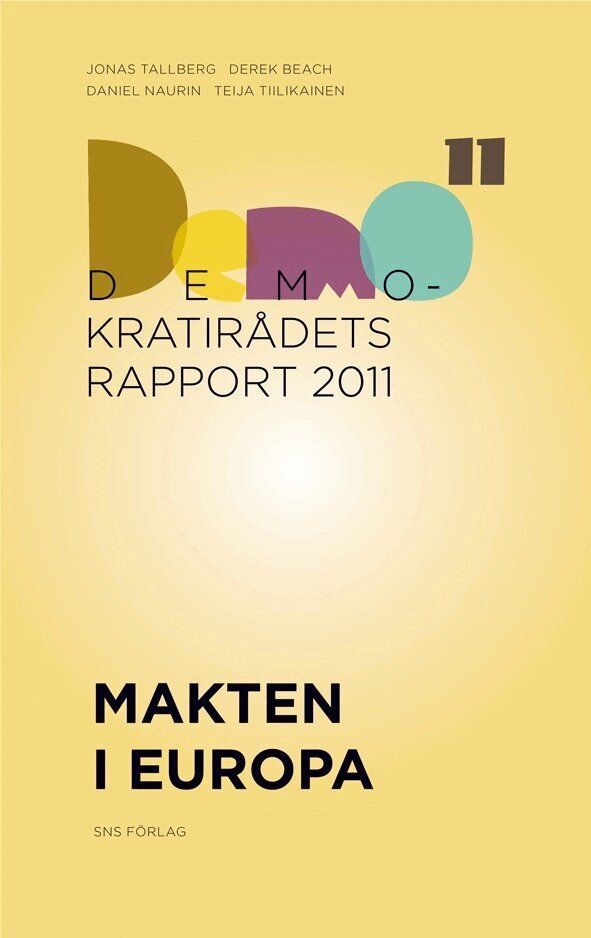
Makten i Europa
Häftad, Svenska, 2011288 kr
Skickas inom 5-8 vardagar
Var finns egentligen den politiska makten i EU? Håller makten inom EU på att förändras? Demokratirådet 2011 undersöker maktens natur i EU. Den kommande rapporten från SNS Demokratiråd handlar om relationerna mellan och dynamiken inom tre kategorier av aktörer: medlemsregeringarna (den mellanstatliga makten), EU:s institutioner (den överstatliga makten) och organiserade intressen (den transnationella makten). Projektets resultat kommer att redovisas i form av en rapport från SNS Demokratiråd i maj 2011, den sista av tre rapporter från Demokratirådet med fokus på Europafrågor. Medverkande forskare: Jonas Tallberg (ordf.), professor, Statsvetenskapliga institutionen, Stockholms universitet Derek Beach, docent och lektor i statsvetenskap, Aarhus universitet, Danmark Daniel Naurin, docent och lektor, Statsvetenskapliga institutionen och Centrum för Europaforskning, Göteborgs universitet Teija Tiilikainen, direktör för Finska Utrikespolitiska Institutet, tidigare den finländska regeringens representant i EU:s framtidskonvent och statssekreterare i Finlands utrikesdepartement