Joseph S. Freedman – författare
Visar alla böcker från författaren Joseph S. Freedman. Handla med fri frakt och snabb leverans.
3 produkter
3 produkter
Philosophy and the Arts in Central Europe, 1500-1700
Teaching and Texts at Schools and Universities
Inbunden, Engelska, 2019
1 909 kr
Skickas inom 10-15 vardagar
Published in 1999. The articles in this collection focus on instruction - and writings arising from that instruction - in philosophy and the arts during the sixteenth and seventeenth centuries with emphasis on Central Europe. The introduction brings together and expands upon many of the topics discussed - and conclusions reached - in the remaining seven articles. Four of these articles are devoted to examining the significance of two ancient authors (Aristotle and Cicero) and of two more recent ones (Petrus Ramus and Bartholomew Keckermann). The article on Keckermann is based in part on previously unpublished biographical and bibliographical source materials. Two concepts - encyclopedia and philosophy - as utilized in the 16th and 17th centuries constitute the subject matter of separate articles. And one article focuses primarily on curriculum plans written during the 16th and early 17th centuries. These eight articles are based on a wide array of printed and manuscript source materials which are cited together with library/archive locations and call numbers and which are made more easily accessible through three indices at the conclusion of this volume.
Philosophy and the Arts in Central Europe, 1500-1700
Teaching and Texts at Schools and Universities
Häftad, Engelska, 2020
496 kr
Skickas inom 10-15 vardagar
Published in 1999. The articles in this collection focus on instruction - and writings arising from that instruction - in philosophy and the arts during the sixteenth and seventeenth centuries with emphasis on Central Europe. The introduction brings together and expands upon many of the topics discussed - and conclusions reached - in the remaining seven articles. Four of these articles are devoted to examining the significance of two ancient authors (Aristotle and Cicero) and of two more recent ones (Petrus Ramus and Bartholomew Keckermann). The article on Keckermann is based in part on previously unpublished biographical and bibliographical source materials. Two concepts - encyclopedia and philosophy - as utilized in the 16th and 17th centuries constitute the subject matter of separate articles. And one article focuses primarily on curriculum plans written during the 16th and early 17th centuries. These eight articles are based on a wide array of printed and manuscript source materials which are cited together with library/archive locations and call numbers and which are made more easily accessible through three indices at the conclusion of this volume.
Del 31 - Spätmittelalter, Humanismus, Reformation / Studies in the Late Middle Ages, Humanism, and the Reformation
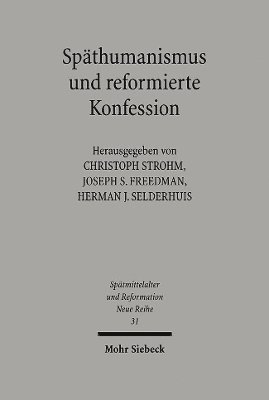
Späthumanismus und reformierte Konfession
Theologie, Jurisprudenz und Philosophie in Heidelberg an der Wende zum 17. Jahrhundert
Inbunden, Tyska, 2006
1 828 kr
Tillfälligt slut
Das internationale Symposium, das 2004 in der Johannes a Lasco Bibliothek in Emden stattfand, ging der Frage nach, ob und in welcher Weise konfessionelle Orientierungen am Ende des 16. Jahrhunderts in der Lehre der Philosophie, Jurisprudenz und Theologie an der Universität Heidelberg einen Niederschlag gefunden haben. Gerade die Vorreiterrolle der Kurpfalz mit der Universität Heidelberg bei den Versuchen einer Calvinisierung des Reiches läßt eine verstärkte Wirkung der Konfessionalisierung in den verschiedenen Lebensbereichen vermuten. Der vorläufige Befund ist jedoch widersprüchlich. Bei den Theologen kann man eine klare konfessionelle Abgrenzung feststellen, die sich gegen die sogenannten Gnesiolutheraner und das Luthertum der Konkordienformel, nicht jedoch gegen das melanchthonianisch gesinnte Luthertum richtet. Bei den Philosophen ist das kaum greifbar, wie gerade die ambivalente Haltung zur ramistischen Methode zeigt. Bei den Juristen, die sich in der großen Mehrheit der reformierten Konfession verbunden wissen, lassen sich Aspekte herausarbeiten, die eine scharfe Abgrenzung gegenüber dem "Papismus" deutlich machen. Hingegen wird auf innerprotestantische Abgrenzungen fast völlig verzichtet und vielmehr durchgängig Kritik an dem ärgerlichen "Theologengezänk" formuliert. Insgesamt wird deutlich, wie wenig aussagekräftig die Etiketten "calvinistisch" oder "reformiert" sind. Nicht weniger charakteristisch für das damalige Heidelberger Gelehrtenmilieu ist die tiefe Verbundenheit mit humanistischem Gedankengut sowie die starke Präsenz westeuropäischer Beziehungen und Erfahrungshorizonte.