Laila Dybkjær – författare
Visar alla böcker från författaren Laila Dybkjær. Handla med fri frakt och snabb leverans.
23 produkter
Spoken Multimodal Human-Computer Dialogue in Mobile Environments
Av Wolfgang Minker, Dirk Bühler m. fl.
Inbunden, 2005
1690 kr
Lägg i varukorg
This book is based on publications from the ISCA Tutorial and Research Workshop on Multi-Modal Dialogue in Mobile Environments held at Kloster Irsee, Germany, in 2002. The workshop covered various aspects of devel- ment and evaluation of spoken multimodal dialogue systems and components with …
Spoken Multimodal Human-Computer Dialogue in Mobile Environments
Av Wolfgang Minker, Dirk Bühler m. fl.
Häftad, 2005
1690 kr
Lägg i varukorg
This book is based on publications from the ISCA Tutorial and Research Workshop on Multi-Modal Dialogue in Mobile Environments held at Kloster Irsee, Germany, in 2002. The workshop covered various aspects of devel- ment and evaluation of spoken multimodal dialogue systems and components with …
Spoken Multimodal Human-Computer Dialogue in Mobile Environments
Av Laila Dybkjaer, Dirk Buhler m. fl.
E-bok, 2005
2174 kr
Lägg i varukorg
This book is based on publications from the ISCA Tutorial and Research Workshop on Multi-Modal Dialogue in Mobile Environments held at Kloster Irsee, Germany, in 2002. The workshop covered various aspects of devel- ment and evaluation of spoken multimodal dialogue systems and components with …
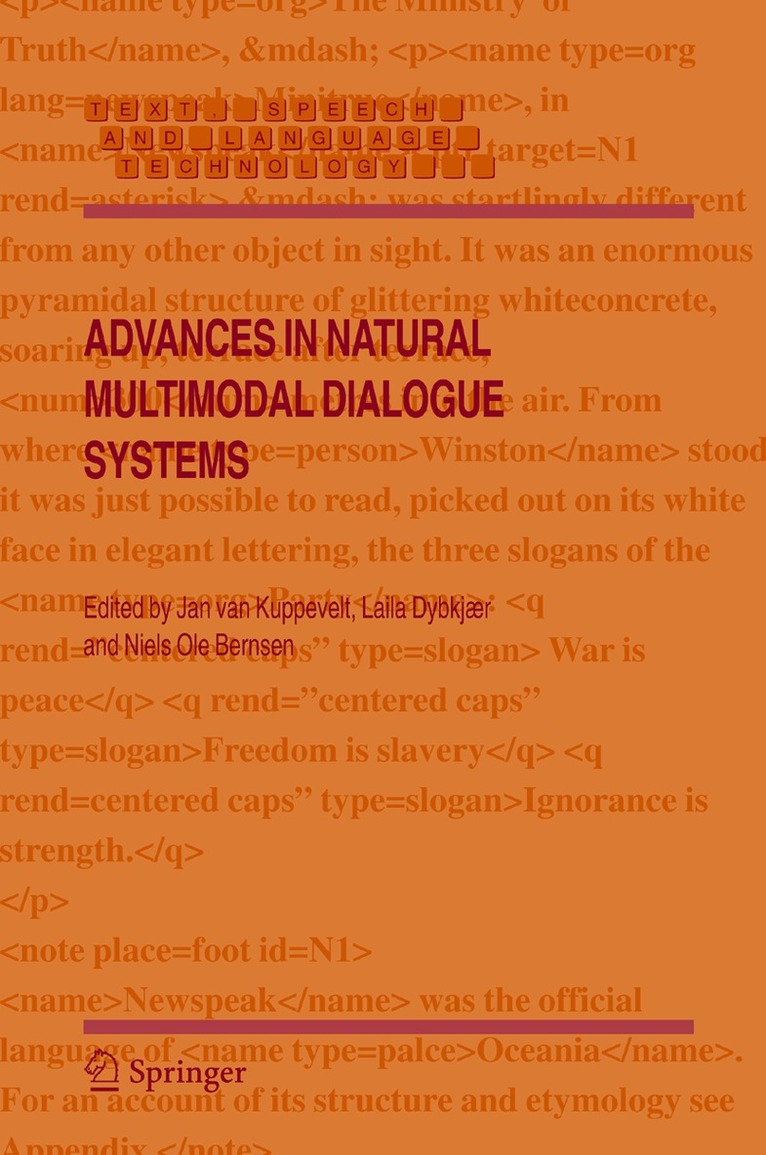
Advances in Natural Multimodal Dialogue Systems
Av Jan van Kuppevelt, Laila Dybkjær m. fl.
Inbunden, 2005
1080 kr
Lägg i varukorg
References 74 Part II Annotation and Analysis of Multimodal Data: Speech and Gesture 4 FORM 79 Craig H. Martell 1. Introduction 79 2. Structure of FORM 80 3. Annotation Graphs 85 4. Annotation Example 86 5. Preliminary Inter-Annotator Agreement Results 88 6. Conclusion: Applications to HLT and HCI? …
Advances in Natural Multimodal Dialogue Systems
Av Niels Ole Bernsen, Laila Dybkjaer m. fl.
E-bok, 2006
1459 kr
Lägg i varukorg
References 74 Part II Annotation and Analysis of Multimodal Data: Speech and Gesture 4 FORM 79 Craig H. Martell 1. Introduction 79 2. Structure of FORM 80 3. Annotation Graphs 85 4. Annotation Example 86 5. Preliminary Inter-Annotator Agreement Results 88 6. Conclusion: Applications to HLT and HCI? …
Advances in Natural Multimodal Dialogue Systems
Av Jan van Kuppevelt, Laila Dybkjær m. fl.
Häftad, 2005
1080 kr
Lägg i varukorg
References 74 Part II Annotation and Analysis of Multimodal Data: Speech and Gesture 4 FORM 79 Craig H. Martell 1. Introduction 79 2. Structure of FORM 80 3. Annotation Graphs 85 4. Annotation Example 86 5. Preliminary Inter-Annotator Agreement Results 88 6. Conclusion: Applications to HLT and HCI? …
Evaluation of Text and Speech Systems
Av Laila Dybkjær, Holmer Hemsen m. fl.
Inbunden, 2007
568 kr
Lägg i varukorg
In its nine chapters, this book provides an overview of the state-of-the-art and best practice in several sub-fields of evaluation of text and speech systems and components. The evaluation aspects covered include speech and speaker recognition, speech synthesis, animated talking agents, …
Evaluation of Text and Speech Systems
Av Laila Dybkjær, Holmer Hemsen m. fl.
Häftad, 2008
568 kr
Lägg i varukorg
In its nine chapters, this book provides an overview of the state-of-the-art and best practice in several sub-fields of evaluation of text and speech systems and components. The evaluation aspects covered include speech and speaker recognition, speech synthesis, animated talking agents, …
Evaluation of Text and Speech Systems
Av Wolfgang Minker, Holmer Hemsen m. fl.
E-bok, 2007
732 kr
Lägg i varukorg
In its nine chapters, this book provides an overview of the state-of-the-art and best practice in several sub-fields of evaluation of text and speech systems and components. The evaluation aspects covered include speech and speaker recognition, speech synthesis, animated talking agents, …
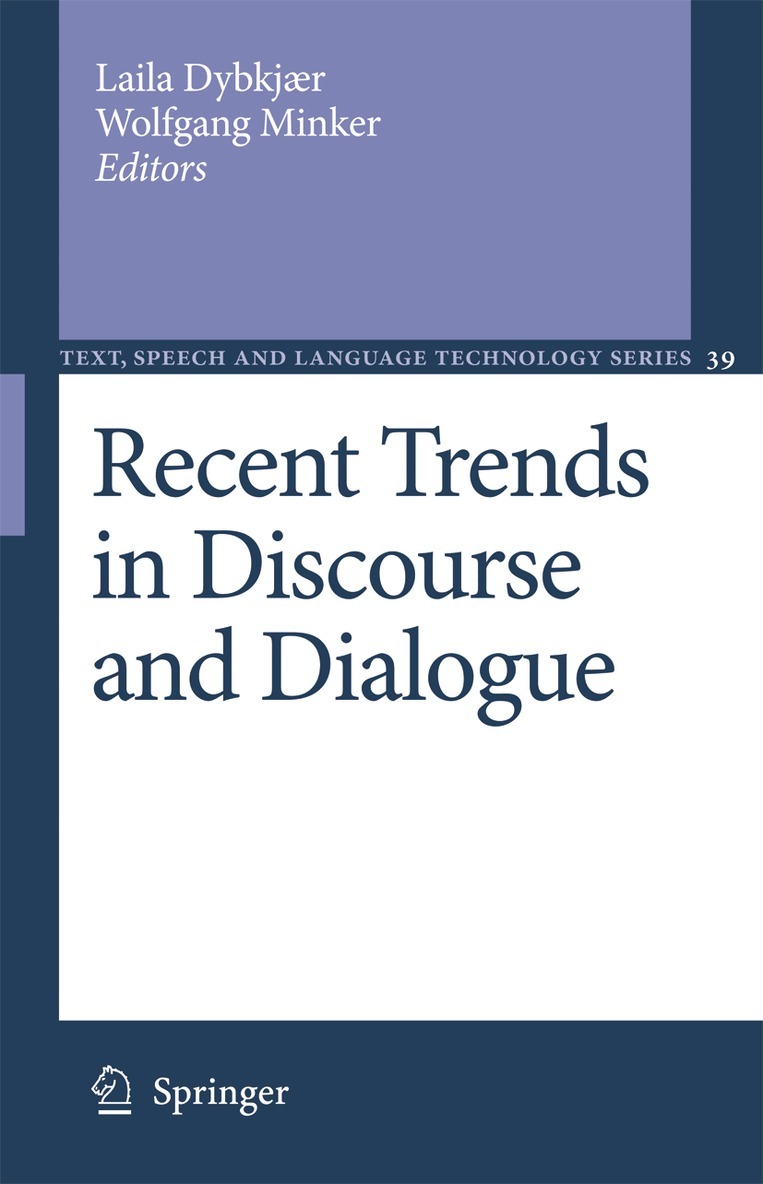
Recent Trends in Discourse and Dialogue
Av Laila Dybkjær, Wolfgang Minker
Inbunden, 2008
1690 kr
Lägg i varukorg
This book edition highlights recent trends and important issues that still remain only partially solved or even unsolved within the broad ?eld of discourse and dialogue. The ?eld is discussed and illustrated both from an overall spoken (multimodal) dialogue system perspective as well as from a more …
Recent Trends in Discourse and Dialogue
Av Wolfgang Minker, Laila Dybkjaer
E-bok, 2008
2174 kr
Lägg i varukorg
This book edition highlights recent trends and important issues that still remain only partially solved or even unsolved within the broad ?eld of discourse and dialogue. The ?eld is discussed and illustrated both from an overall spoken (multimodal) dialogue system perspective as well as from a more …
Designing Interactive Speech Systems
From First Ideas to User Testing
Av Laila Dybkjaer, Hans Dybkjaer m. fl.
E-bok, 2012
755 kr
Lägg i varukorg
Designing Interactive Speech Systems describes the design and implementation of spoken language dialogue within the context of SLDS (spoken language dialogue systems) development. Using an applications-oriented SLDS developed through the Danish Dialogue project, the authors describe the complete …
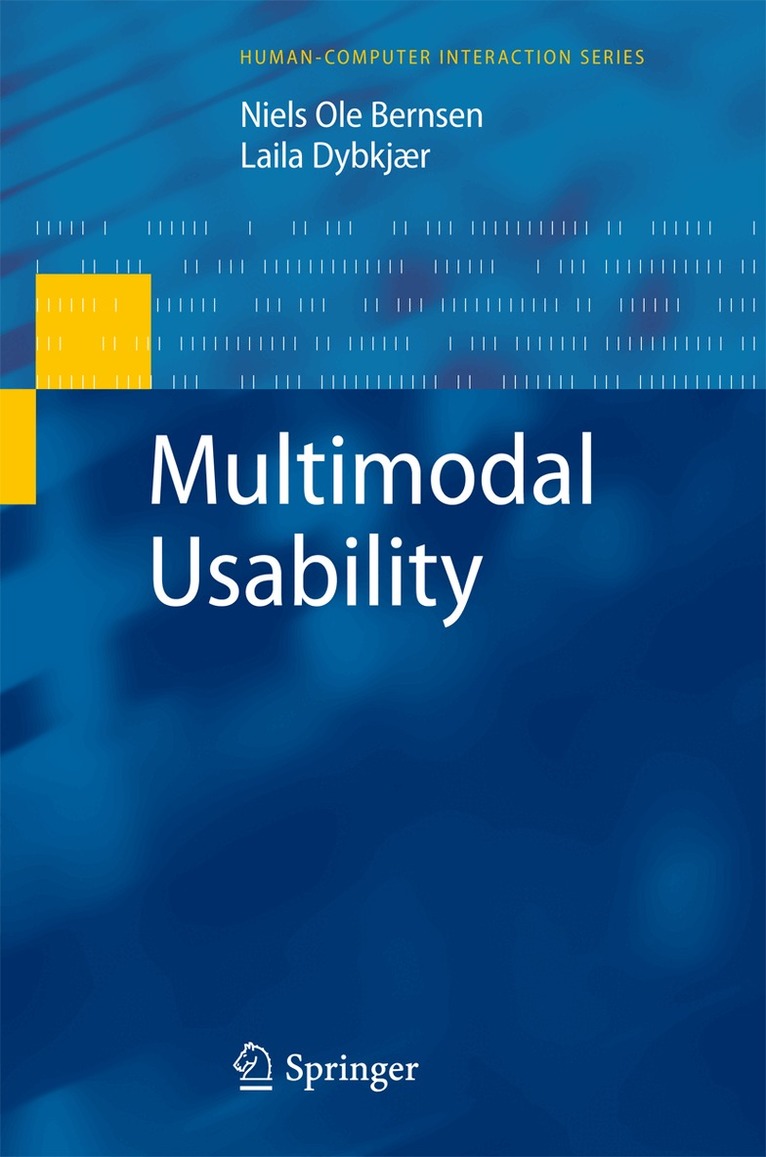
Multimodal Usability
Av Niels Ole Bernsen, Laila Dybkjær
Häftad, 2012
1690 kr
Lägg i varukorg
This preface tells the story of how Multimodal Usability responds to a special challenge. Chapter 1 describes the goals and structure of this book. The idea of describing how to make multimodal computer systems usable arose in the European Network of Excellence SIMILAR – “Taskforce for cre- ing …
Multimodal Usability
Av Niels Ole Bernsen, Laila Dybkjær
Inbunden, 2009
1690 kr
Lägg i varukorg
This preface tells the story of how Multimodal Usability responds to a special challenge. Chapter 1 describes the goals and structure of this book. The idea of describing how to make multimodal computer systems usable arose in the European Network of Excellence SIMILAR – “Taskforce for cre- ing …
Multimodal Usability
Av Laila Dybkjaer, Niels Ole Bernsen
E-bok, 2009
2127 kr
Lägg i varukorg
This preface tells the story of how Multimodal Usability responds to a special challenge. Chapter 1 describes the goals and structure of this book. The idea of describing how to make multimodal computer systems usable arose in the European Network of Excellence SIMILAR – “Taskforce for cre- ing …
Affective Dialogue Systems
Tutorial and Research Workshop, ADS 2004, Kloster Irsee, Germany, June 14-16, 2004, Proceedings
Av Elisabeth André, Laila Dybkjaer m. fl.
Häftad, 2004
568 kr
Lägg i varukorg
Human conversational partners are able, at least to a certain extent, to detect the speaker’s or listener’s emotional state and may attempt to respond to it accordingly. When instead one of the interlocutors is a computer a number of questions arise, such as the following: To what extent are …
Affective Dialogue Systems
Tutorial and Research Workshop, ADS 2004, Kloster Irsee, Germany, June 14-16, 2004, Proceedings
Av Paul Heisterkamp, Wolfgang Minker m. fl.
E-bok, 2004
718 kr
Lägg i varukorg
Human conversational partners are able, at least to a certain extent, to detect the speaker’s or listener’s emotional state and may attempt to respond to it accordingly. When instead one of the interlocutors is a computer a number of questions arise, such as the following: To what extent are …
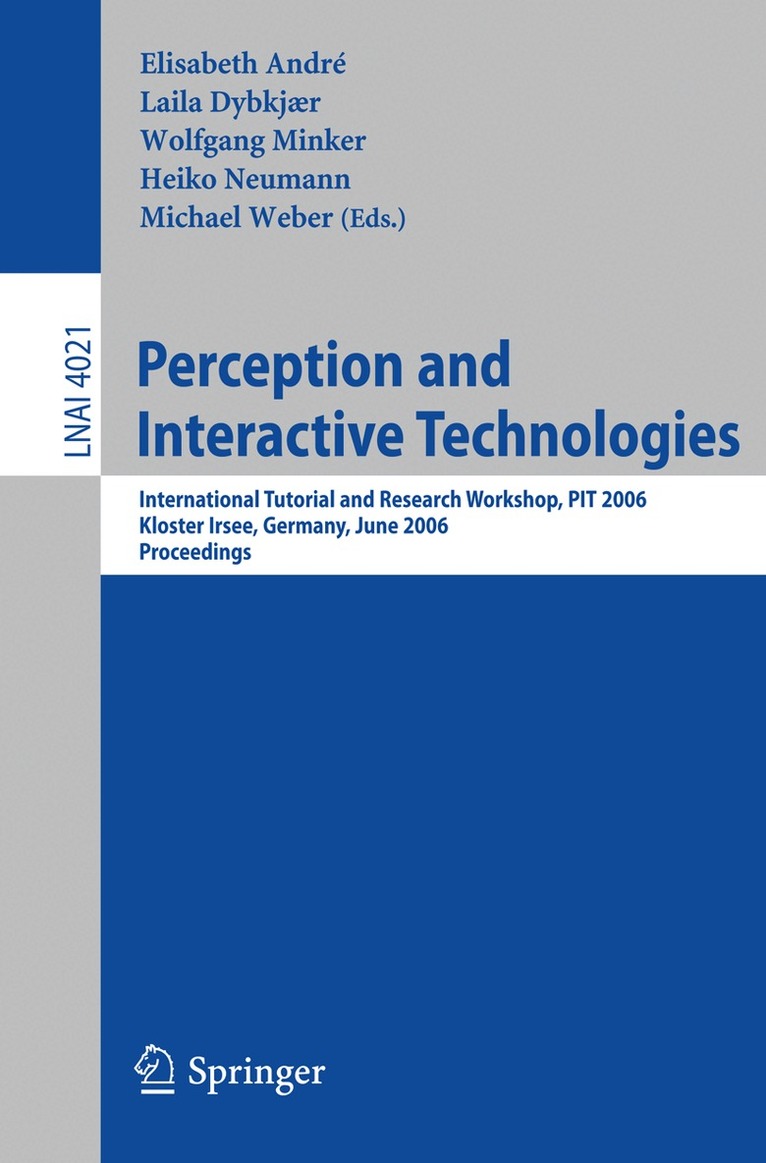
Perception and Interactive Technologies
International Tutorial and Research Workshop, Kloster Irsee, PIT 2006, Germany, June 19-21, 2006
Av Elisabeth André, Laila Dybkjær m. fl.
Häftad, 2006
568 kr
Lägg i varukorg
This book constitutes the refereed proceedings of the International Tutorial and Research Workshop on Perception and Interactive Technologies, PIT 2006, held at Kloster Irsee, Germany, June 2006. The book presents 16 revised full papers together with 4 revised poster papers and 6 system …
Perception and Interactive Technologies
International Tutorial and Research Workshop, Kloster Irsee, PIT 2006, Germany, June 19-21, 2006
Av Michael Weber, Heiko Neumann m. fl.
E-bok, 2006
732 kr
Lägg i varukorg
Perception in Multimodal Dialogue Systems
4th IEEE Tutorial and Research Workshop on Perception and Interactive Technologies for Speech-Based Systems, PIT 2008, Kloster Irsee, Germany, June 16-18, 2008, Proceedings
Av Elisabeth André, Laila Dybkjær m. fl.
Häftad, 2008
568 kr
Lägg i varukorg
This book constitutes the refereed proceedings of the 4th IEEE Tutorial and Research Workshop on Perception and Interactive Technologies for Speech-Based Systems, PIT 2008, held in Kloster Irsee, Germany, in June 2008. The 37 revised full papers presented together with 1 invited keynote lecture …
Perception in Multimodal Dialogue Systems
4th IEEE Tutorial and Research Workshop on Perception and Interactive Technologies for Speech-Based Systems, PIT 2008, Kloster Irsee, Germany, June 16-18, 2008, Proceedings
Av Michael Weber, Roberto Pieraccini m. fl.
E-bok, 2008
739 kr
Lägg i varukorg
This book constitutes the refereed proceedings of the 4th IEEE Tutorial and Research Workshop on Perception and Interactive Technologies for Speech-Based Systems, PIT 2008, held in Kloster Irsee, Germany, in June 2008. The 37 revised full papers presented together with 1 invited keynote lecture …
Designing Interactive Speech Systems
From First Ideas to User Testing
Av Niels O. Bernsen, Hans Dybkjaer m. fl.
Häftad, 1998
568 kr
Lägg i varukorg
Designing Interactive Speech Systems describes the design and implementation of spoken language dialogue within the context of SLDS (spoken language dialogue systems) development. Using an applications-oriented SLDS developed through the Danish Dialogue project, the authors describe the complete …
Recent Trends in Discourse and Dialogue
Av Laila Dybkjær, Wolfgang Minker
Häftad, 2010
1690 kr
Lägg i varukorg
This book edition highlights recent trends and important issues that still remain only partially solved or even unsolved within the broad ?eld of discourse and dialogue. The ?eld is discussed and illustrated both from an overall spoken (multimodal) dialogue system perspective as well as from a more …