Mathematical Sciences Education Board – författare
757 kr
Läs direkt efter köp
This book reviews the evaluation research literature that has accumulated around 19 K-12 mathematics curricula and breaks new ground in framing an ambitious and rigorous approach to curriculum evaluation that has relevance beyond mathematics. The committee that produced this book consisted of mathematicians, mathematics educators, and methodologists who began with the following charge:
Evaluate the quality of the evaluations of the thirteen National Science Foundation (NSF)-supported and six commercially generated mathematics curriculum materials; Determine whether the available data are sufficient for evaluating the efficacy of these materials, and if not; Develop recommendations about the design of a project that could result in the generation of more reliable and valid data for evaluating such materials.The committee collected, reviewed, and classified almost 700 studies, solicited expert testimony during two workshops, developed an evaluation framework, established dimensions/criteria for three methodologies (content analyses, comparative studies, and case studies), drew conclusions on the corpus of studies, and made recommendations for future research.
390 kr
Läs direkt efter köp
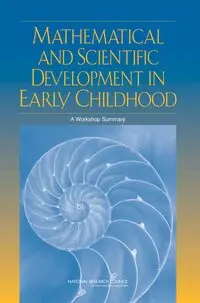
Expectations for early learning are very different than they were even as recently as a decade ago. With increased recognition of the intellectual capacities of young children, as well as a growing understanding of how these capacities develop and can be fostered, has come a growing recognition that early childhood education, in both formal and informal settings, may not be helping all children maximize their cognitive capacities. Mathematical and Scientific Development in Early Childhood explores the research in cognition and developmental psychology that sheds light on children''s capacity to learn mathematical and scientific ideas. This summary report of the discussions and presentations at the workshop is designed to frame the issues relevant to advancing research useful to the development of research-based curricula for mathematics and science for young children.
599 kr
Läs direkt efter köp
Assessment in Support of Instruction and Learning is the summary of a National Research Council workshop convened to examine the gap between external andclassroom assessment. This report discusses issues associated with designing an assessment system that meets the demands of public accountability and, at the same time, improves the quality of the education that students receive day by day. This report focuses on assessment that addresses both accountability and learning.
773 kr
Läs direkt efter köp
379 kr
Läs direkt efter köp
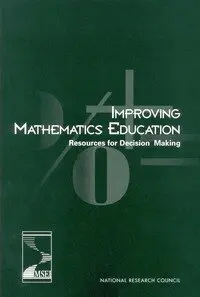
Improving Mathematics Education has been designed to help inform stakeholders about the decisions they face, to point to recent research findings, and to provide access to the most recent thinking of experts on issues of national concern in mathematics education. The essence of the report is that information is available to help those charged with improving student achievement in mathematics. The documents cited above can guide those who make decisions about content, learning, teaching, and assessment. The report is organized around five key questions:
What should we teach, given what we know and value about mathematics and its roles? How should we teach so children learn, given what we know about students, mathematics, and how people learn mathematics? What preparation and support do teachers need? How do we know whether what we are doing is working? What must change?Each of the five main chapters in this report considers a key area of mathematics education and describes the core messages of current publication(s) in that area. To maintain the integrity of each report''s recommendations, we used direct quotes and the terminology defined and used in that report. If the wording or terminology seems to need clarification, the committee refers the reader directly to the original document. Because these areas are interdependent, the documents often offer recommendations related to several different areas. While the individual documents are discussed under only one of the components in Improving Mathematics Education, the reader should recognize that each document may have a broader scope. In general, the references in this report should serve as a starting point for the interested reader, who can refer to the original documents for fuller discussions of the recommendations and, in some cases, suggestions for implementation. Improving Mathematics Education is designed to help educators build a critical knowledge base about mathematics education, recognizing that the future of the nation''s students is integrally intertwined with the decisions we make (or fail to make) about the mathematics education they receive.
568 kr
Läs direkt efter köp
There are many questions about the mathematical preparation teachers need. Recent recommendations from a variety of sources state that reforming teacher preparation in postsecondary institutions is central in providing quality mathematics education to all students. The Mathematics Teacher Preparation Content Workshop examined this problem by considering two central questions:
What is the mathematical knowledge teachers need to know in order to teach well? How can teachers develop the mathematical knowledge they need to teach well?The Workshop activities focused on using actual acts of teaching such as examining student work, designing tasks, or posing questions, as a medium for teacher learning. The Workshop proceedings, Knowing and Learning Mathematics for Teaching, is a collection of the papers presented, the activities, and plenary sessions that took place.
599 kr
Läs direkt efter köp
The MSEB, with generous support and encouragement from the Carnegie Corporation of New York, seeks to bring discussion of assessment to school-and district-based practitioners through an initiative called Assessment in Practice (AIP). Originally conceived as a series of "next steps" to follow the publication of Measuring Up and For Good Measure, the project, with assistance from an advisory board, developed a publication agenda to provide support to teachers and others directly involved with the teaching and assessment of children in mathematics classrooms at the elementary, middle, and high school levels.
In a series of three booklets, AIP presents an exploration of issues in assessment. The first booklet, Learning About Assessment, Learning Through Assessment discusses ways to assist teachers in learning about assessment and how student work can be a rich resource in professional development. The second, Assessment in Support of Instruction, makes a case for aligning assessments with state and district curriculum frameworks and examines ways in which states have shifted their curriculum frameworks and related state assessment programs to reflect the NCTM Standards and other perspectives. The third booklet, Keeping Score, discusses issues to be considered while developing high quality mathematics assessments. This series is specifically designed to be used at the school and school district level by teachers, principals, supervisors, and measurement specialists.
521 kr
Läs direkt efter köp
Traditionally, vocational mathematics and precollege mathematics have been separate in schools. But the technological world in which today''s students will work and live calls for increasing connection between mathematics and its applications. Workplace-based mathematics may be good mathematics for everyone.
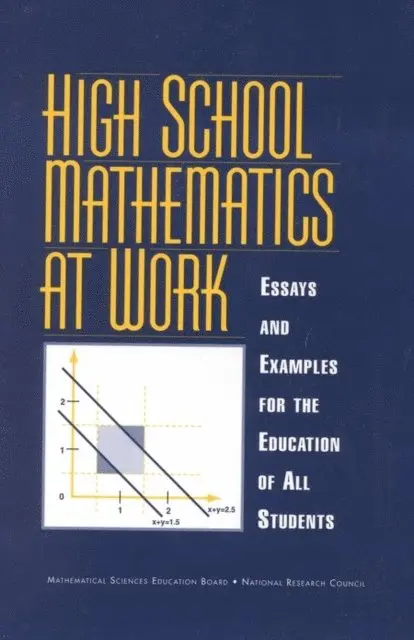
High School Mathematics at Work illuminates the interplay between technical and academic mathematics. This collection of thought-provoking essays—by mathematicians, educators, and other experts—is enhanced with illustrative tasks from workplace and everyday contexts that suggest ways to strengthen high school mathematical education.
This important book addresses how to make mathematical education of all students meaningful—how to meet the practical needs of students entering the work force after high school as well as the needs of students going on to postsecondary education.
The short readable essays frame basic issues, provide background, and suggest alternatives to the traditional separation between technical and academic mathematics. They are accompanied by intriguing multipart problems that illustrate how deep mathematics functions in everyday settings—from analysis of ambulance response times to energy utilization, from buying a used car to "rounding off" to simplify problems.
The book addresses the role of standards in mathematics education, discussing issues such as finding common ground between science and mathematics education standards, improving the articulation from school to work, and comparing SAT results across settings.
Experts discuss how to develop curricula so that students learn to solve problems they are likely to encounter in life—while also providing them with approaches to unfamiliar problems. The book also addresses how teachers can help prepare students for postsecondary education.
For teacher education the book explores the changing nature of pedagogy and new approaches to teacher development. What kind of teaching will allow mathematics to be a guide rather than a gatekeeper to many career paths? Essays discuss pedagogical implication in problem-centered teaching, the role of complex mathematical tasks in teacher education, and the idea of making open-ended tasks—and the student work they elicit—central to professional discourse.
High School Mathematics at Work presents thoughtful views from experts. It identifies rich possibilities for teaching mathematics and preparing students for the technological challenges of the future. This book will inform and inspire teachers, teacher educators, curriculum developers, and others involved in improving mathematics education and the capabilities of tomorrow''s work force.
1 104 kr
Läs direkt efter köp
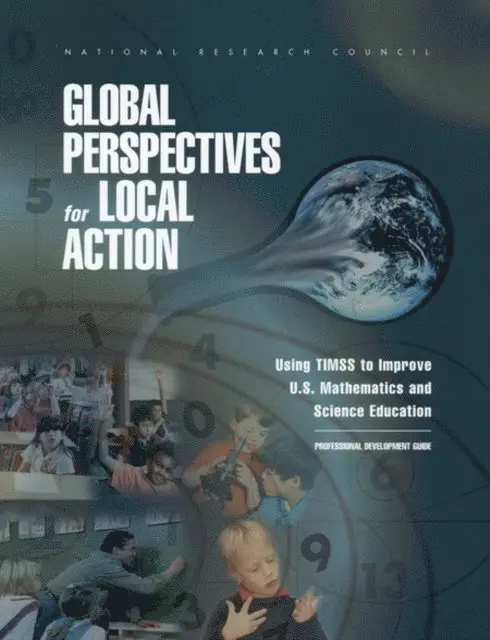
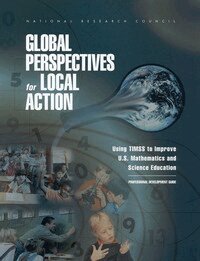
The Third International Mathematics and Science Study (TIMSS) is a rich source of information that can be used by a broad range of stakeholders to promote discussions and actions to improve K-12 mathematics and science teaching and learning. To support educators, administrators, parents, and others interested in education in using TIMSS materials, the National Research Council (NRC) has prepared a report, Global Perspectives for Local Action: Using TIMSS to Improve U.S. Mathematics and Science Education (see "Resources"). This report will help educators, administrators, parents and others interested in education to understand what can be learned from TIMSS findings, and it will encourage them to use the information to make improvements in mathematics and science education. Provided in the report are insights into mathematics and science achievement, curriculum, instruction, and school support systems, such as professional development, in the United States and around the world. To make TIMSS information more accessible and useful to educators and the public, the NRC prepared this professional development guide to accompany its report. This guide provides directions and support materials for leading workshops and planning sessions for teachers, educational administrators, higher education faculty, and the interested public.
442 kr
Läs direkt efter köp
Curriculum reform, performance assessment, standards, portfolios, and high stakes testing-what''s next? What does this all mean for me in my classroom? Many teachers have asked such questions since mathematics led the way in setting standards with the publication of the Curriculum and Evaluation Standards for School Mathematics (National Council of Teachers of Mathematics [NCTM], 1989). This seminal document and others that followed served as catalysts for mathematics education reform, giving rise to new initiatives related to curriculum, instruction, and assessment over the past decade. In particular, approaches to classroom, school, and district-wide assessment have undergone a variety of changes as educators have sought to link classroom teaching to appropriate assessment opportunities.
Since the publication of Everybody Counts (National Research Council [NRC], 1989), the Mathematical Sciences Education Board (MSEB) has dedicated its efforts to the improvement of mathematics education. A national summit on assessment led to the publication of For Good Measure (NRC, 1991). This statement of goals and objectives for assessment in mathematics was followed by Measuring Up (NRC, 1993a), which provided prototypical fourth-grade performance assessment tasks linked to the goals of the NCTM''s Curriculum and Evaluation Standards. Measuring What Counts (NRC, 1993b) demonstrated the importance of mathematics content, learning, and equity as they relate to assessment. The MSEB is now prepared to present perspectives on issues in mathematics education assessment for those most directly engaged in implementing the reform initiatives on a daily basis-classroom teachers, school principals, supervisors, and others in school-based settings.
268 kr
Läs direkt efter köp
Amid current efforts to improve mathematics and science education in the United States, people often ask how these subjects are organized and taught in other countries. They hear repeatedly that other countries produce higher student achievement. Teachers and parents wonder about the answers to questions like these: Why do the children in Asian cultures seem to be so good at science and mathematics? How are biology and physics taught in the French curriculum? What are textbooks like elsewhere, and how much latitude do teachers have in the way they follow the texts? Do all students receive the same education, or are they grouped by ability or perceived educational promise? If students are grouped, how early is this done? What are tests like, and what are the consequences for students? Are other countries engaged in Standards-like reforms? Does anything like "standards" play a role in other countries? Questions such as these reflect more than a casual interest in other countries'' educational practices. They grow out of an interest in identifying ways to improve mathematics and science education in the United States.
The focus of this short report is on what the Third International Mathematics and Science Study (TIMSS), a major international investigation of curriculum, instruction, and learning in mathematics and science, will be able to contribute to understandings of mathematics and science education around the world as well as to current efforts to improve student learning, particularly in the United States.
325 kr
Läs direkt efter köp
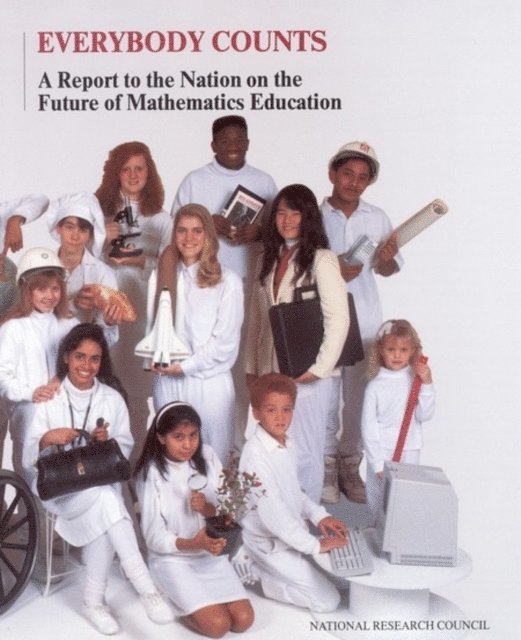
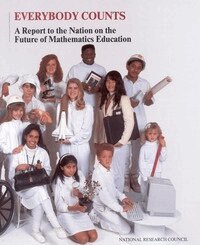
Mathematics is the key to opportunity. No longer only the language of science, mathematics is now essential to business, finance, health, and defense. Yet because of the lack of mathematical literacy, many students are not prepared for tomorrow''s jobs. Everybody Counts suggests solutions. Written for everyone concerned about our children''s education, this book discusses why students in this country do not perform well in mathematics and outlines a comprehensive plan for revitalizing mathematics education in America, from kindergarten through college.
single copy, $8.95; 2-9 copies, $7.50 each; 10 or more copies, $6.95 each (no other discounts apply)
544 kr
Läs direkt efter köp
1 072 kr
Läs direkt efter köp
The Third International Mathematics and Science Study (TIMSS) is a rich source of information that can be used by a broad range of stakeholders to promote discussions and actions to improve K-12 mathematics and science teaching and learning. To support educators, administrators, parents, and others interested in education in using TIMSS materials, the National Research Council (NRC) has prepared a report, Global Perspectives for Local Action: Using TIMSS to Improve U.S. Mathematics and Science Education (see "Resources"). This report will help educators, administrators, parents and others interested in education to understand what can be learned from TIMSS findings, and it will encourage them to use the information to make improvements in mathematics and science education. Provided in the report are insights into mathematics and science achievement, curriculum, instruction, and school support systems, such as professional development, in the United States and around the world. To make TIMSS information more accessible and useful to educators and the public, the NRC prepared this professional development guide to accompany its report. This guide provides directions and support materials for leading workshops and planning sessions for teachers, educational administrators, higher education faculty, and the interested public.
308 kr
Läs direkt efter köp
Curriculum reform, performance assessment, standards, portfolios, and high stakes testing-what''s next? What does this all mean for me in my classroom? Many teachers have asked such questions since mathematics led the way in setting standards with the publication of the Curriculum and Evaluation Standards for School Mathematics (National Council of Teachers of Mathematics [NCTM], 1989). This seminal document and others that followed served as catalysts for mathematics education reform, giving rise to new initiatives related to curriculum, instruction, and assessment over the past decade. In particular, approaches to classroom, school, and district-wide assessment have undergone a variety of changes as educators have sought to link classroom teaching to appropriate assessment opportunities.
Since the publication of Everybody Counts (National Research Council [NRC], 1989), the Mathematical Sciences Education Board (MSEB) has dedicated its efforts to the improvement of mathematics education. A national summit on assessment led to the publication of For Good Measure (NRC, 1991). This statement of goals and objectives for assessment in mathematics was followed by Measuring Up (NRC, 1993a), which provided prototypical fourth-grade performance assessment tasks linked to the goals of the NCTM''s Curriculum and Evaluation Standards. Measuring What Counts (NRC, 1993b) demonstrated the importance of mathematics content, learning, and equity as they relate to assessment. The MSEB is now prepared to present perspectives on issues in mathematics education assessment for those most directly engaged in implementing the reform initiatives on a daily basis-classroom teachers, school principals, supervisors, and others in school-based settings.
363 kr
Läs direkt efter köp
Traditionally, vocational mathematics and precollege mathematics have been separate in schools. But the technological world in which today''s students will work and live calls for increasing connection between mathematics and its applications. Workplace-based mathematics may be good mathematics for everyone.
High School Mathematics at Work illuminates the interplay between technical and academic mathematics. This collection of thought-provoking essays—by mathematicians, educators, and other experts—is enhanced with illustrative tasks from workplace and everyday contexts that suggest ways to strengthen high school mathematical education.
This important book addresses how to make mathematical education of all students meaningful—how to meet the practical needs of students entering the work force after high school as well as the needs of students going on to postsecondary education.
The short readable essays frame basic issues, provide background, and suggest alternatives to the traditional separation between technical and academic mathematics. They are accompanied by intriguing multipart problems that illustrate how deep mathematics functions in everyday settings—from analysis of ambulance response times to energy utilization, from buying a used car to "rounding off" to simplify problems.
The book addresses the role of standards in mathematics education, discussing issues such as finding common ground between science and mathematics education standards, improving the articulation from school to work, and comparing SAT results across settings.
Experts discuss how to develop curricula so that students learn to solve problems they are likely to encounter in life—while also providing them with approaches to unfamiliar problems. The book also addresses how teachers can help prepare students for postsecondary education.
For teacher education the book explores the changing nature of pedagogy and new approaches to teacher development. What kind of teaching will allow mathematics to be a guide rather than a gatekeeper to many career paths? Essays discuss pedagogical implication in problem-centered teaching, the role of complex mathematical tasks in teacher education, and the idea of making open-ended tasks—and the student work they elicit—central to professional discourse.
High School Mathematics at Work presents thoughtful views from experts. It identifies rich possibilities for teaching mathematics and preparing students for the technological challenges of the future. This book will inform and inspire teachers, teacher educators, curriculum developers, and others involved in improving mathematics education and the capabilities of tomorrow''s work force.
426 kr
Läs direkt efter köp
The MSEB, with generous support and encouragement from the Carnegie Corporation of New York, seeks to bring discussion of assessment to school-and district-based practitioners through an initiative called Assessment in Practice (AIP). Originally conceived as a series of "next steps" to follow the publication of Measuring Up and For Good Measure, the project, with assistance from an advisory board, developed a publication agenda to provide support to teachers and others directly involved with the teaching and assessment of children in mathematics classrooms at the elementary, middle, and high school levels.
In a series of three booklets, AIP presents an exploration of issues in assessment. The first booklet, Learning About Assessment, Learning Through Assessment discusses ways to assist teachers in learning about assessment and how student work can be a rich resource in professional development. The second, Assessment in Support of Instruction, makes a case for aligning assessments with state and district curriculum frameworks and examines ways in which states have shifted their curriculum frameworks and related state assessment programs to reflect the NCTM Standards and other perspectives. The third booklet, Keeping Score, discusses issues to be considered while developing high quality mathematics assessments. This series is specifically designed to be used at the school and school district level by teachers, principals, supervisors, and measurement specialists.
426 kr
Läs direkt efter köp
Assessment in Support of Instruction and Learning is the summary of a National Research Council workshop convened to examine the gap between external andclassroom assessment. This report discusses issues associated with designing an assessment system that meets the demands of public accountability and, at the same time, improves the quality of the education that students receive day by day. This report focuses on assessment that addresses both accountability and learning.
592 kr
Läs direkt efter köp
This book reviews the evaluation research literature that has accumulated around 19 K-12 mathematics curricula and breaks new ground in framing an ambitious and rigorous approach to curriculum evaluation that has relevance beyond mathematics. The committee that produced this book consisted of mathematicians, mathematics educators, and methodologists who began with the following charge:
Evaluate the quality of the evaluations of the thirteen National Science Foundation (NSF)-supported and six commercially generated mathematics curriculum materials; Determine whether the available data are sufficient for evaluating the efficacy of these materials, and if not; Develop recommendations about the design of a project that could result in the generation of more reliable and valid data for evaluating such materials.The committee collected, reviewed, and classified almost 700 studies, solicited expert testimony during two workshops, developed an evaluation framework, established dimensions/criteria for three methodologies (content analyses, comparative studies, and case studies), drew conclusions on the corpus of studies, and made recommendations for future research.
308 kr
Läs direkt efter köp
What mathematics should be learned by today''s young people as well as tomorrow''s workforce? On the Shoulders of Giants is a vision of richness of mathematics expressed in essays on change, dimension, quantity, shape, and uncertainty, each of which illustrate fundamental strands for school mathematics. These essays expand on the idea of mathematics as the language and science of patterns, allowing us to realize the importance of providing hands-on experience and the development of a curriculum that will enable students to apply their knowledge to diverse numerical problems.
268 kr
Läs direkt efter köp
Expectations for early learning are very different than they were even as recently as a decade ago. With increased recognition of the intellectual capacities of young children, as well as a growing understanding of how these capacities develop and can be fostered, has come a growing recognition that early childhood education, in both formal and informal settings, may not be helping all children maximize their cognitive capacities. Mathematical and Scientific Development in Early Childhood explores the research in cognition and developmental psychology that sheds light on children''s capacity to learn mathematical and scientific ideas. This summary report of the discussions and presentations at the workshop is designed to frame the issues relevant to advancing research useful to the development of research-based curricula for mathematics and science for young children.
261 kr
Läs direkt efter köp
Improving Mathematics Education has been designed to help inform stakeholders about the decisions they face, to point to recent research findings, and to provide access to the most recent thinking of experts on issues of national concern in mathematics education. The essence of the report is that information is available to help those charged with improving student achievement in mathematics. The documents cited above can guide those who make decisions about content, learning, teaching, and assessment. The report is organized around five key questions:
What should we teach, given what we know and value about mathematics and its roles? How should we teach so children learn, given what we know about students, mathematics, and how people learn mathematics? What preparation and support do teachers need? How do we know whether what we are doing is working? What must change?Each of the five main chapters in this report considers a key area of mathematics education and describes the core messages of current publication(s) in that area. To maintain the integrity of each report''s recommendations, we used direct quotes and the terminology defined and used in that report. If the wording or terminology seems to need clarification, the committee refers the reader directly to the original document. Because these areas are interdependent, the documents often offer recommendations related to several different areas. While the individual documents are discussed under only one of the components in Improving Mathematics Education, the reader should recognize that each document may have a broader scope. In general, the references in this report should serve as a starting point for the interested reader, who can refer to the original documents for fuller discussions of the recommendations and, in some cases, suggestions for implementation. Improving Mathematics Education is designed to help educators build a critical knowledge base about mathematics education, recognizing that the future of the nation''s students is integrally intertwined with the decisions we make (or fail to make) about the mathematics education they receive.
130 kr
Läs direkt efter köp
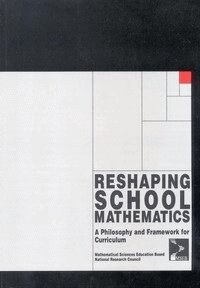
The United States must restructure mathematics education—both what is learned and the way it is taught—if children are to develop the mathematical knowledge and skills they will need to be personally and professionally competent in the twenty-first century. Joining the recent reports that have opened a national dialogue on these issues, Reshaping School Mathematics focuses discussion on essential ideas that transcend details of current curricula or assessment results. It examines changing perspectives on the role of mathematics in society and changing practice in the use of technology—particularly calculators and computers—in mathematics education.
158 kr
Läs direkt efter köp
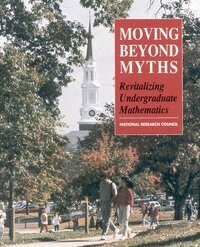
Over the next decade, the mathematical community and the nation''s colleges and unversities must restructure fundamentally the culture, content, and context of undergraduate mathematics. Acknowledging the weaknesses in the present college mathematics curriculum and the ways in which it is taught, this book cites exemplary programs that point the way toward achieving the same world-wide preeminence for mathematics education that the United States enjoys in mathematical research.
Moving Beyond Myths sets forth ambitious goals for collegiate mathematics by the year 2000 and provides a sweeping plan of action to accomplish them. It calls on mathematics faculty, their departments, their professional societies, colleges and universities, and government agencies to do their parts to implement the plan, help the public move beyond commonly held myths about mathematics, and bring about a revitalization of undergraduate mathematics.
134 kr
Läs direkt efter köp
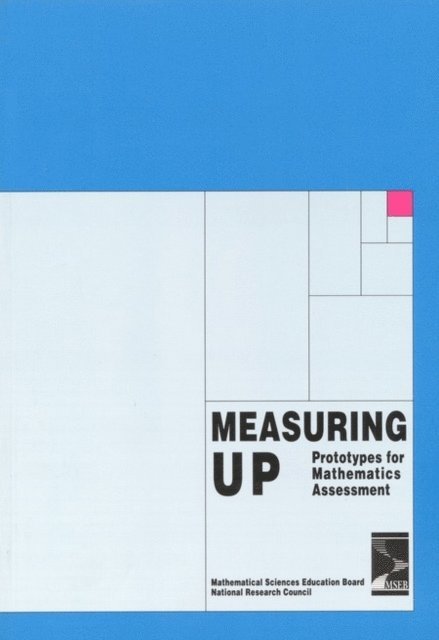
Glimpse the future of mathematics assessment in Measuring Up This book features 13 classroom exercises for fourth grade students that demonstrate the dramatic meaning of inquiry, performance, communication, and problem solving as standards for mathematics education.
Policymakers, education leaders, classroom teachers, university-based educators, and parents can learn from the use of these genuine mathematics problems to challenge and prepare students for the future.
single copy, $10.95; 2-9 copies, $8.50 each; 10 or more copies, $6.95 each (no other discounts apply)
252 kr
Läs direkt efter köp
To achieve national goals for education, we must measure the things that really count. Measuring What Counts establishes crucial research- based connections between standards and assessment.
Arguing for a better balance between educational and measurement concerns in the development and use of mathematics assessment, this book sets forth three principles—related to content, learning, and equity—that can form the basis for new assessments that support emerging national standards in mathematics education.
182 kr
Läs direkt efter köp
Amid current efforts to improve mathematics and science education in the United States, people often ask how these subjects are organized and taught in other countries. They hear repeatedly that other countries produce higher student achievement. Teachers and parents wonder about the answers to questions like these: Why do the children in Asian cultures seem to be so good at science and mathematics? How are biology and physics taught in the French curriculum? What are textbooks like elsewhere, and how much latitude do teachers have in the way they follow the texts? Do all students receive the same education, or are they grouped by ability or perceived educational promise? If students are grouped, how early is this done? What are tests like, and what are the consequences for students? Are other countries engaged in Standards-like reforms? Does anything like "standards" play a role in other countries? Questions such as these reflect more than a casual interest in other countries'' educational practices. They grow out of an interest in identifying ways to improve mathematics and science education in the United States.
The focus of this short report is on what the Third International Mathematics and Science Study (TIMSS), a major international investigation of curriculum, instruction, and learning in mathematics and science, will be able to contribute to understandings of mathematics and science education around the world as well as to current efforts to improve student learning, particularly in the United States.
114 kr
Läs direkt efter köp
Mathematics is the key to opportunity. No longer only the language of science, mathematics is now essential to business, finance, health, and defense. Yet because of the lack of mathematical literacy, many students are not prepared for tomorrow''s jobs. Everybody Counts suggests solutions. Written for everyone concerned about our children''s education, this book discusses why students in this country do not perform well in mathematics and outlines a comprehensive plan for revitalizing mathematics education in America, from kindergarten through college.
single copy, $8.95; 2-9 copies, $7.50 each; 10 or more copies, $6.95 each (no other discounts apply)
57 kr
Läs direkt efter köp
Measuring What Counts: A Policy Brief provides highlights of the main volume in the context of implications for educational policy.
1 530 kr
Tillfälligt slut