Patrick Langdon - Böcker
Visar alla böcker från författaren Patrick Langdon. Handla med fri frakt och snabb leverans.
11 produkter
11 produkter
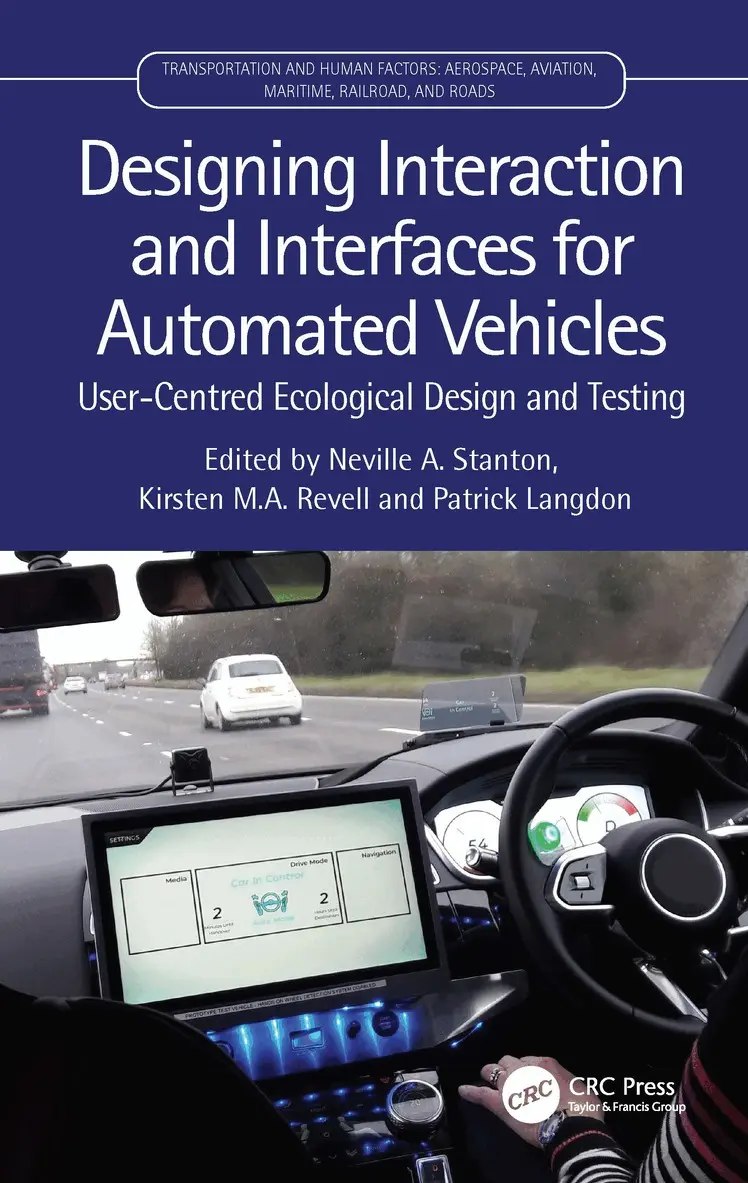
Designing Interaction and Interfaces for Automated Vehicles
User-Centred Ecological Design and Testing
Inbunden, Engelska, 2021
2 103 kr
Skickas inom 10-15 vardagar
Driving automation and autonomy are already upon us and the problems that were predicted twenty years ago are beginning to appear. These problems include shortfalls in expected benefits, equipment unreliability, driver skill fade, and error-inducing equipment designs. Designing Interaction and Interfaces for Automated Vehicles: User-Centred Ecological Design and Testing investigates the difficult problem of how to interface drivers with automated vehicles by offering an inclusive, human-centred design process that focusses on human variability and capability in interaction with interfaces. This book introduces a novel method that combines both systems thinking and inclusive user-centred design. It models driver interaction, provides design specifications, concept designs, and the results of studies in simulators on the test track, and in road going vehicles. This book is for designers of systems interfaces, interactions, UX, Human Factors and Ergonomics researchers and practitioners involved with systems engineering and automotive academics._"In this book, Prof Stanton and colleagues show how Human Factors methods can be applied to the tricky problem of interfacing human drivers with vehicle automation. They have developed an approach to designing the human-automation interaction for the handovers between the driver and the vehicle. This approach has been tested in driving simulators and, most interestingly, in real vehicles on British motorways. The approach, called User-Centred Ecological Interface Design, has been validated against driver behaviour and used to support their ongoing work on vehicle automation. I highly recommend this book for anyone interested, or involved, in designing human-automation interaction in vehicles and beyond." Professor Michael A. Regan, University of NSW Sydney, AUSTRALIA
Designing Interaction and Interfaces for Automated Vehicles
User-Centred Ecological Design and Testing
Häftad, Engelska, 2024
676 kr
Skickas inom 10-15 vardagar
Driving automation and autonomy are already upon us and the problems that were predicted twenty years ago are beginning to appear. These problems include shortfalls in expected benefits, equipment unreliability, driver skill fade, and error-inducing equipment designs. Designing Interaction and Interfaces for Automated Vehicles: User-Centred Ecological Design and Testing investigates the difficult problem of how to interface drivers with automated vehicles by offering an inclusive, human-centred design process that focusses on human variability and capability in interaction with interfaces. This book introduces a novel method that combines both systems thinking and inclusive user-centred design. It models driver interaction, provides design specifications, concept designs, and the results of studies in simulators on the test track, and in road going vehicles. This book is for designers of systems interfaces, interactions, UX, Human Factors and Ergonomics researchers and practitioners involved with systems engineering and automotive academics._"In this book, Prof Stanton and colleagues show how Human Factors methods can be applied to the tricky problem of interfacing human drivers with vehicle automation. They have developed an approach to designing the human-automation interaction for the handovers between the driver and the vehicle. This approach has been tested in driving simulators and, most interestingly, in real vehicles on British motorways. The approach, called User-Centred Ecological Interface Design, has been validated against driver behaviour and used to support their ongoing work on vehicle automation. I highly recommend this book for anyone interested, or involved, in designing human-automation interaction in vehicles and beyond." Professor Michael A. Regan, University of NSW Sydney, AUSTRALIA
2 181 kr
Skickas inom 10-15 vardagar
Designing inclusively is no longer an option for companies. It is a business essential. Global populations are getting older, legislation is increasingly prohibitive of unnecessary exclusion and consumer attitudes are beginning to change. Exclusivity is out, inclusivity is in. Research communities the world over are responding to this change in design emphasis. Conferences such as the Cambridge Workshops on Universal Access and Assistive Technology (CWUAAT) offer a forum for researchers from diverse and varied disciplines to bring their perspectives on inclusive design together. This book has been inspired by the second CWUAAT, held in Cambridge, England in March 2004. It contains chapters from an international group of leading researchers in this field. Contributions focus on the following topics: design issues for universal access and assistive technology; enabling computer access and new technologies; and, assistive technology and rehabilitation robotics. This series of conferences is aimed at a broad range of interests, with a general focus on the development of products and solutions. Numerous case studies are used to raise awareness of the challenges faced in developing truly inclusive products, along with examples of good practice for design for a more inclusive world.
2 181 kr
Skickas inom 10-15 vardagar
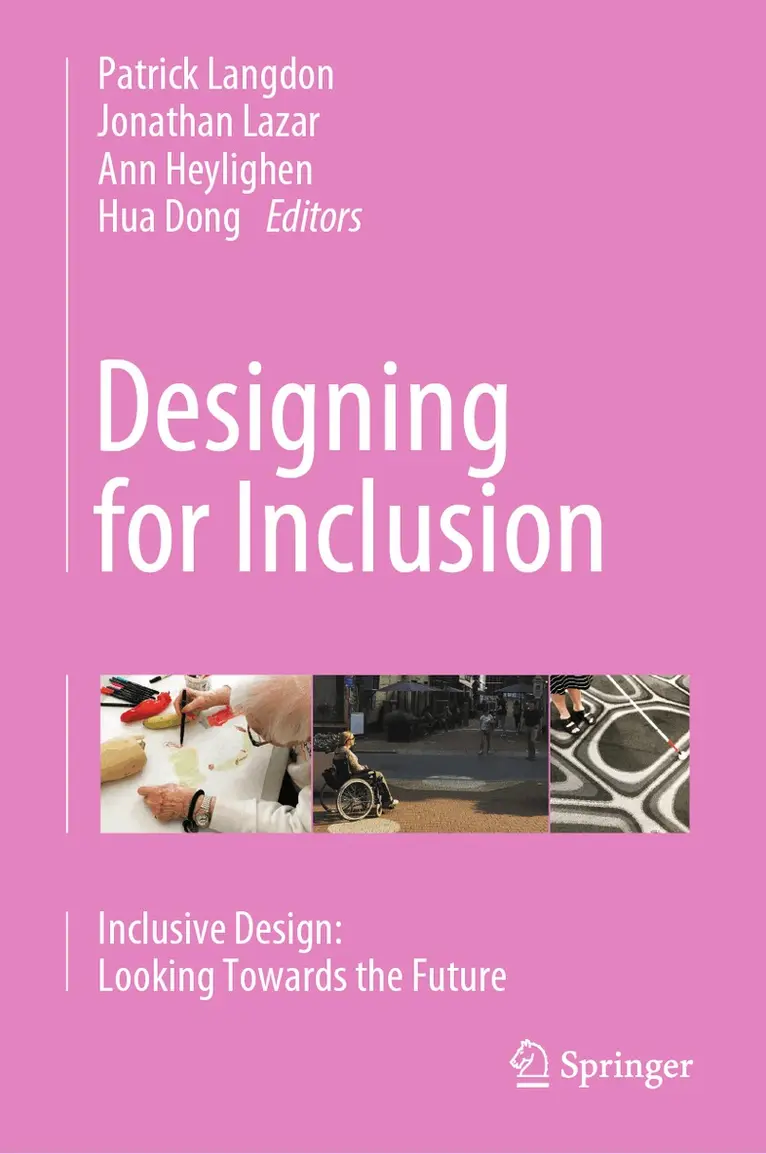
The Cambridge Workshops on Universal Access and Assistive Technology (CWUAAT) are a series of workshops held at a Cambridge University College every two years. The workshop theme: “Designing inclusion for real-world applications” refers to the emerging potential and relevance of the latest generations of inclusive design thinking, tools, techniques, and data, to mainstream project applications such as healthcare and the design of working environments. Inclusive Design Research involves developing tools and guidance enabling product designers to design for the widest possible population, for a given range of capabilities. There are five main themes:Designing for the Real-World Measuring Demand And CapabilitiesDesigning Cognitive Interaction with Emerging Technologies Design for Inclusion Designing Inclusive Architecture In the tradition of CWUAAT, we have solicited and accepted contributions over a wide range of topics, both within individual themes and also across the workshop’s scope. We ultimately hope to generate more inter-disciplinary dialogues based on focused usage cases that can provide the discipline necessary to drive further novel research, leading to better designs. The aim is to impact industry and end-users as well governance and public design, thereby effectively reducing exclusion and difficulty in peoples’ daily lives and society.
Universal Access and Assistive Technology
Proceedings of the Cambridge Workshop on UA and AT ’02
Häftad, Engelska, 2013
1 638 kr
Skickas inom 10-15 vardagar
The first Cambridge Workshop on Universal Access and Assistive Technology (CWUAAT) was held at Trinity Hall, Cambridge, in March 2002. It was inspired by the earlier, highly successful Cambridge Workshops on Rehabilitation Robotics organised by the late Robin Jackson. Robin was the founder of Rehabilitation Research at Cambridge which now continues in the Engineering Design Centre within the Department of Engineering, led by John Clarkson and Simeon Keates, and in the Rainbow Group within the Computer Laboratory led by Peter Robinson. CWUAAT represents the first in a new series of workshops that we are aiming to hold every two years which, reflecting the spirit of recent moves to extend the rights for universal accessibility, will encourage discussion of a broad range of interests. There will be a general focus on product/solution development. Hence it is intended that the principal requirements for the successful design of assistive technology shall be addressed, where these range from the identification and capture of the needs of the users, through to the development and evaluation of truly usable and accessible systems for users with special needs. The best submissions received for the first CWUAAT are contained in this book, where the contributors are all leading researchers in the fields of Universal Access and Assistive Technology and represent a large part of the international research community. They include, though not exclusively, computer scientists, designers, engineers, industrial representatives, ergonomists and sociologists.
2 181 kr
Skickas inom 10-15 vardagar
The Cambridge Workshops on Universal Access and Assistive Technology (CWUAAT) are a series of workshops held at a Cambridge University College every two years. The workshop theme: “Designing inclusion for real-world applications” refers to the emerging potential and relevance of the latest generations of inclusive design thinking, tools, techniques, and data, to mainstream project applications such as healthcare and the design of working environments. Inclusive Design Research involves developing tools and guidance enabling product designers to design for the widest possible population, for a given range of capabilities. There are five main themes:Designing for the Real-World Measuring Demand And CapabilitiesDesigning Cognitive Interaction with Emerging Technologies Design for Inclusion Designing Inclusive Architecture In the tradition of CWUAAT, we have solicited and accepted contributions over a wide range of topics, both within individual themes and also across the workshop’s scope. We ultimately hope to generate more inter-disciplinary dialogues based on focused usage cases that can provide the discipline necessary to drive further novel research, leading to better designs. The aim is to impact industry and end-users as well governance and public design, thereby effectively reducing exclusion and difficulty in peoples’ daily lives and society.
540 kr
Skickas inom 10-15 vardagar
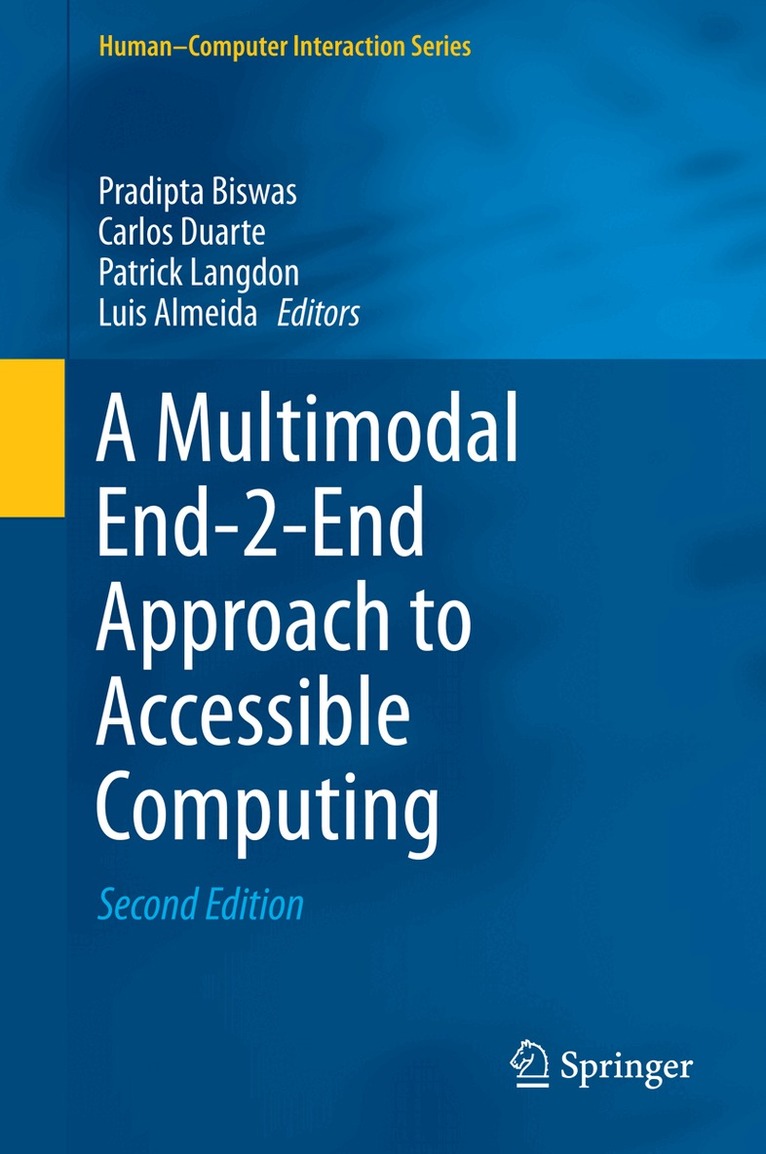
This book illustrates how Interactive Systems can help elderly and disabled populations engage with the world around them by finding methods of overcoming the difficulties these communities face when using such systems by presenting the latest in state-of-the-art technology and providing a vision for accessibility for the near future.The challenges faced by accessibility practitioners are discussed and the different phases of delivering accessible products and services are explored. A collection of eminent researchers from around the world cover topics on developing and standardizing user models for inclusive design, adaptable multimodal system development for digital TV and ubiquitous devices, presenting research on intelligent voice recognition, adaptable pointing, browsing and navigation, and affect and gesture recognition. The research not only focuses on how these can be hugely beneficial to primary users, but often finding useful applications for their able-bodied counterparts.For this new edition, new chapters have been added focusing on the latest developments in games for the visually impaired, inclusive interfaces for the agricultural industry in India and technologies to improve accessibility in broadcasting in Japan. A Multimodal End-2-End Approach to Accessible Computing will be an invaluable resource for both researchers and practitioners alike.
540 kr
Skickas inom 10-15 vardagar
This book illustrates how Interactive Systems can help elderly and disabled populations engage with the world around them by finding methods of overcoming the difficulties these communities face when using such systems by presenting the latest in state-of-the-art technology and providing a vision for accessibility for the near future.The challenges faced by accessibility practitioners are discussed and the different phases of delivering accessible products and services are explored. A collection of eminent researchers from around the world cover topics on developing and standardizing user models for inclusive design, adaptable multimodal system development for digital TV and ubiquitous devices, presenting research on intelligent voice recognition, adaptable pointing, browsing and navigation, and affect and gesture recognition. The research not only focuses on how these can be hugely beneficial to primary users, but often finding useful applications for their able-bodied counterparts.For this new edition, new chapters have been added focusing on the latest developments in games for the visually impaired, inclusive interfaces for the agricultural industry in India and technologies to improve accessibility in broadcasting in Japan. A Multimodal End-2-End Approach to Accessible Computing will be an invaluable resource for both researchers and practitioners alike.
2 118 kr
Skickas inom 10-15 vardagar
Designing inclusively is no longer an option for companies. It is a business essential. Global populations are getting older, legislation is increasingly prohibitive of unnecessary exclusion and consumer attitudes are beginning to change. Exclusivity is out, inclusivity is in. Research communities the world over are responding to this change in design emphasis. Conferences such as the Cambridge Workshops on Universal Access and Assistive Technology (CWUAAT) offer a forum for researchers from diverse and varied disciplines to bring their perspectives on inclusive design together. This book has been inspired by the second CWUAAT, held in Cambridge, England in March 2004. It contains chapters from an international group of leading researchers in this field. Contributions focus on the following topics: design issues for universal access and assistive technology; enabling computer access and new technologies; and, assistive technology and rehabilitation robotics. This series of conferences is aimed at a broad range of interests, with a general focus on the development of products and solutions. Numerous case studies are used to raise awareness of the challenges faced in developing truly
1 964 kr
Skickas inom 10-15 vardagar
This proceedings book presents papers from the 10th Cambridge Workshops on Universal Access and Assistive Technology. The CWUAAT series of workshops have celebrated a long history of interdisciplinarity, including design disciplines, computer scientists, engineers, architects, ergonomists, ethnographers, ethicists, policymakers, practitioners, and user communities. This reflects the wider increasing realisation over the long duration of the series that design for inclusion is not limited to technology, engineering disciplines, and computer science but instead requires an interdisciplinary approach. The key to this is providing a platform upon which the different disciplines can engage and see each other’s antecedents, methods, and point of view.This proceedings book of the 10th CWUAAT conference presents papers in a variety of topics includingReconciling usability, accessibility, and inclusive design;Designing inclusive assistive and rehabilitationsystems;Designing cognitive interaction with emerging technologies;Designing inclusive architecture;Data mining and visualising inclusion;Legislation, standards, and policy in inclusive design;Situational inclusive interfaces; andThe historical perspective: 20 years of CWUAAT.CWUAAT has always aimed to be inclusive in the fields that it invites to the workshop. We must include social science, psychologies, anthropologies, economists, politics, governance, and business. This requirement is now energised by imminent new challenges arising from techno-social change. In particular, artificial intelligence, wireless technologies, and the Internet of Things generate a pressing need for more socially integrated projects with operational consequences on individuals in the built environment and at all levels of design and society. Business cases and urgent environmental issues such as sustainability and transportation should now be a focus point for inclusion in an increasingly challenging world. This proceedings book continues the goal of designing for inclusion, as set out by the CWUAAT when it first started.
1 964 kr
Skickas inom 10-15 vardagar
This proceedings book presents papers from the 10th Cambridge Workshops on Universal Access and Assistive Technology. The CWUAAT series of workshops have celebrated a long history of interdisciplinarity, including design disciplines, computer scientists, engineers, architects, ergonomists, ethnographers, ethicists, policymakers, practitioners, and user communities. This reflects the wider increasing realisation over the long duration of the series that design for inclusion is not limited to technology, engineering disciplines, and computer science but instead requires an interdisciplinary approach. The key to this is providing a platform upon which the different disciplines can engage and see each other’s antecedents, methods, and point of view.This proceedings book of the 10th CWUAAT conference presents papers in a variety of topics includingReconciling usability, accessibility, and inclusive design;Designing inclusive assistive and rehabilitationsystems;Designing cognitive interaction with emerging technologies;Designing inclusive architecture;Data mining and visualising inclusion;Legislation, standards, and policy in inclusive design;Situational inclusive interfaces; andThe historical perspective: 20 years of CWUAAT.CWUAAT has always aimed to be inclusive in the fields that it invites to the workshop. We must include social science, psychologies, anthropologies, economists, politics, governance, and business. This requirement is now energised by imminent new challenges arising from techno-social change. In particular, artificial intelligence, wireless technologies, and the Internet of Things generate a pressing need for more socially integrated projects with operational consequences on individuals in the built environment and at all levels of design and society. Business cases and urgent environmental issues such as sustainability and transportation should now be a focus point for inclusion in an increasingly challenging world. This proceedings book continues the goal of designing for inclusion, as set out by the CWUAAT when it first started.