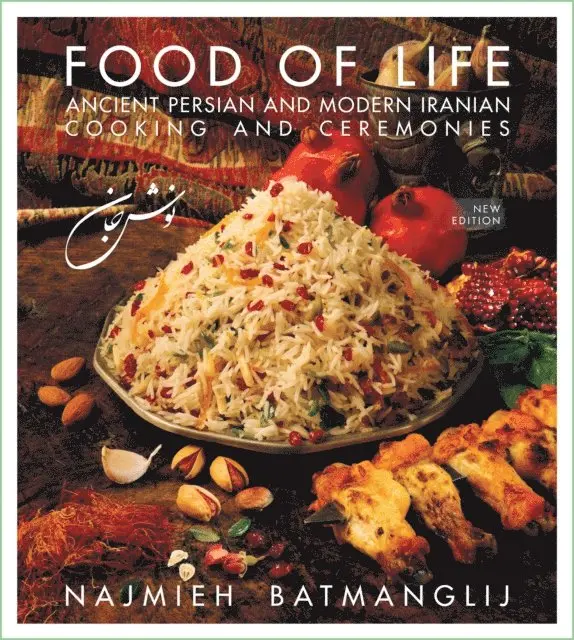
Completely redesigned for today’s generation of cooks and food enthusiasts, the 25th Anniversary Edition of Food of Life: Ancient Persian and Modern Iranian Cooking and Ceremonies by Najmieh Batmanglij; provides a treasure trove of recipes, along with an immersive cultural experience for those seeking to understand this ancient and timeless cuisine. This edition is a more user-friendly edition of the award-winning and critically acclaimed cookbook series which began in 1986. Food of Life provides 330 classical and regional Iranian recipes as well as an introduction to Persian art, history and culture. The book’s hundreds of full color photographs are intertwined with descriptions of ancient and modern Persian ceremonies, poetry, folktales, travelogue excerpts and anecdotes. The 2011 Edition of Food of Life is a labor of love. The book began in exile after the Iranian Revolution of 1979 as a love letter to Batmanglij’s children. Today, as accomplished adults in their own fields, her two sons, Zal and Rostam, encouraged her to redesign the book for their generation. Food of Life propels Persian cooking into the 21st Century, even as it honors venerable traditions and centuries of artistic expression. It is the result of 30 years of collecting, testing and adapting authentic and traditional Persian recipes for the American kitchen. Most of its ingredients are readily available throughout the U.S. enabling anyone from a master chef to a novice to reproduce the refined tastes, textures, and beauty of Persian cuisine. Food-related pieces from such classics as the 10th century Book of Kings, and 1,001 Nights to the miniatures of Mir Mosavvar and Aq Mirak, from the poetry of Omar Khayyam and Sohrab Sepehri to the humor of Mulla Nasruddin are all included. Each recipe is presented with steps that are logical and easy to follow. Readers learn how to simply yet deliciously cook rice, the jewel of Persian cooking, which, when combined with a little meat, fowl, or fish, vegetables, fruits, and herbs, provides the perfect balanced diet. The full-color Food of Life 25th Anniversary Edition contains 50% more pages than its 2009 predecessor and special added features:*New Recipes adapted from Sixteenth-Century Persian cookbooks*Added vegetarian section for most recipes*Comprehensive dictionary of all ingredients*A glance at a few thousand years of the history of Persian Cooking*Master recipes with photos illustrating the steps.*Color photos of most recipes with tips on presentation*Updated section on Persian stores and Internet suppliers*Fahrenheit and Centigrade temperatures for all recipes*Choices for cooking recipes such as “kuku” in oven or on stovetop.*Encourages use of seasonal and local ingredients from farmers markets, Community Supported Agriculture (CSAs) sources or one’s own backyard Batmanglij’s cookbooks reflect the tradition and culture of her Persian background and the multi-tasking demands of a busy mother and professional. She views preparing a meal not only as a culinary experience, but also as a means to bring family and friends together. She encourages her readers to do as she was taught in Iran: to cook, to laugh, to tell jokes and stories, and to recite poetry. Over the past quarter century, Batmanglij’s books have acted as both a beacon and a bible to Iranian-American and mixed-ethnicity families in the English-speaking world. Food of Life is one of the few volumes whose breadth ranges from the exacting measures that go into cooking a perfect bowl of rice to the intricacies of a traditional ancient Persian marriage ceremony. Her life and her work meet at the vortex of feminism, tradition, ceremony, and the nourishment of body and mind, proving that none of these concepts need be foreign to one another. ABOUT PERSIAN FOOD You know more about Persian food than you might think. When you ask for oranges, pistachios, spinach, or saffron, you are using words derived from Persian that refer to foods either originating in the region or introduced from there, for Persia was a great entrepôt of the ancient and medieval worlds. The land was the first home of many common herbs, including basil cilantro, and spices such as fenugreek and cumin, as well as vegetables that include fava beans and chickpeas. Iran was also home to scores of familiar preparations, including sweet and sour sauces, kababs, noodles, marzipan, and baklava. Such preparations are most delicious in their original forms, which you will find in the recipes in this book. ABOUT THE PERSIAN NEW YEAR The publication of this book coincides with the arrival of the Persian new year, Nowruz. Nowruz is the most important holiday for Iranians all over the world. Nowruz ceremonies consist of a series of symbolic rituals dating back to pre-Islamic ancient times. Nowruz is not a religious holiday but a celebration of the earth, which everyone can enjoy wherever they are and whatever their religion may be. The Nowruz celebrationalways begins on the first day of spring marked by the vernal equinox, or Tahvil, when the sun crosses the celestial equator. This year Nowruz falls on March 20 at 7:21 PM Eastern DST. To welcome the new year, Iranians thoroughly clean and rearrange their homes. They buy new clothes, bake pastries, germinate seeds, color eggs, and prepare a menu of green dishes as signs of renewal. Troubadours, called Haji Firuz or “heralds of rebirth,” disguised with makeup and wearing red outfits, sing and dance through the streets with tambourines, kettle drums, and trumpets to spread good cheer and the news of the coming new year. In every Iranian household a ceremonial setting called sofreh-ye haft sinn is spread to symbolize rebirth and renewal, and to welcome the arrival of the new year (see page 562). ABOUT THE USE OF PERSIAN AND IRANIAN IN FOOD OF LIFE All the recipes come from the land Europeans have long called Persia. That name is the Hellenized form of Pars, the southwestern province that was the homeland of the rulers of the first Persian Empire. They, however, called themselves Iranians and their country Iran, the name of their ancestral tribes. Nowadays the words are used interchangeably, describing a people whose civilization and cuisine are ancient indeed. Cooking plays important roles in every culture, but Persian cuisine can claim a relationship to its native land that is uniquely deep and intricate. This book celebrates the central place of food in the life of Iran, a story extending back almost 4,000 years, when recipes were first recorded in a cuneiform script on clay tablets. ABOUT THE BOOK’S TITLE Food of Life, the title of the book, comes from the Persian words nush-e jan, literally “food of life”—a traditional wish in Iran that a dish will be enjoyed. For the updated 1993 edition the title was changed to New Food of Life. Now, for the 25th anniversary edition the title returns to its original name, Food of Life.