Encyclopedia of Complexity and Systems Science Series – serie
Visar alla böcker i serien Encyclopedia of Complexity and Systems Science Series. Handla med fri frakt och snabb leverans.
20 produkter
20 produkter
Inbunden, Engelska, 2020
5 371 kr
Skickas inom 10-15 vardagar
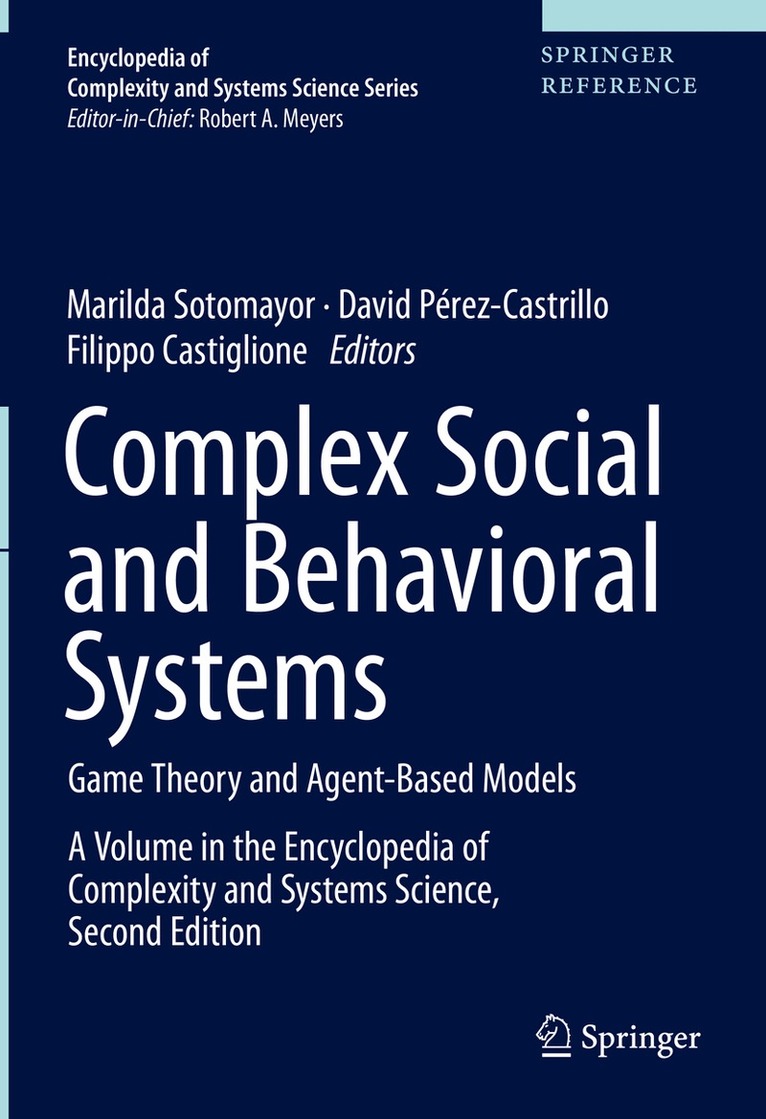
This volume in the Encyclopedia of Complexity and Systems Science, Second Edition, combines the main features of Game Theory, covering most of the fundamental theoretical aspects under the cooperative and non-cooperative approaches, with the procedures of Agent-Based Modeling for studying complex systems composed of a large number of interacting entities with many degrees of freedom. In Game Theory, the cooperative approach focuses on the possible outcomes of the decision-makers’ interaction by abstracting from the "rational" actions or decisions that may lead to these outcomes. The non-cooperative approach focuses on the actions that the decision-makers can take. As John von Neumann and Oskar Morgenstern argued in their path-breaking book of 1944 entitled Theory of Games and Economic Behavior, most economic questions should be analyzed as games. The models of game theory are abstract representations of a number of real-life situations and have applications to economics, political science, computer science, evolutionary biology, social psychology, and law among others. Agent-Based Modeling (ABM) is a relatively new computational modeling paradigm which aims to construct the computational counterpart of a conceptual model of the system under study on the basis of discrete entities (i.e., the agent) with some properties and behavioral rules, and then to simulate them in a computer to mimic the real phenomena. Given the relative immaturity of this modeling paradigm, and the broad spectrum of disciplines in which it is applied, a clear cut and widely accepted definition of high level concepts of agents, environment, interactions and so on, is still lacking. This volume explores the state-of-the-art in the development of a real ABM ontology to address the epistemological issues related to this emerging paradigm for modeling complex systems.
Inbunden, Engelska, 2020
5 908 kr
Skickas inom 10-15 vardagar
This volume of the “Encyclopedia of Complexity and Systems Science, Second Edition” (ECSS), introduces the fundamental physical and mathematical concepts underlying the theory of complex physical, chemical, and biological systems.
Inbunden, Engelska, 2022
4 835 kr
Skickas inom 10-15 vardagar
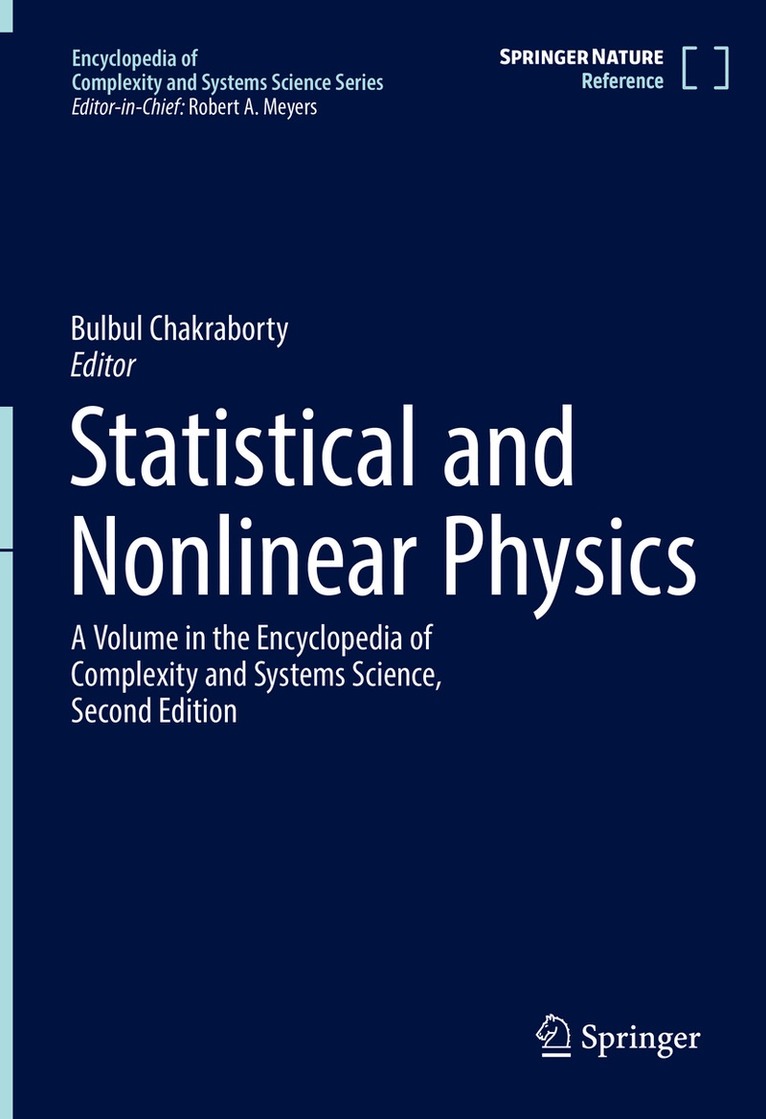
This volume of the Encyclopedia of Complexity and Systems Science, Second Edition, focuses on current challenges in the field from materials and mechanics to applications of statistical and nonlinear physics in the life sciences.
10 186 kr
Kommande
This volume of the Encyclopedia of Complexity and Systems Science, Second Edition, focuses on current challenges in the field from materials and mechanics to applications of statistical and nonlinear physics in the life sciences. Challenges today are mostly in the realm of non-equilibrium systems, although certain equilibrium systems also present serious hurdles. Where possible, pairwise articles focus on a single topic, one from a theoretical perspective and the other from an experimental one, providing valuable insights. In other cases, theorists and experimentalists have collaborated on a single article. Coverage includes both quantum and classical systems, and emphasizes 1) mature fields that are not covered in the current specialist literature, (2) topics that fall through the cracks in disciplinary journals/books, or (3) developing areas where the knowledge base is large and robust and upon which future developments will depend. The result is an invaluable resource for condensed matter physicists, material scientists, engineers and life scientists.
Inbunden, Engelska, 2021
4 084 kr
Skickas inom 10-15 vardagar
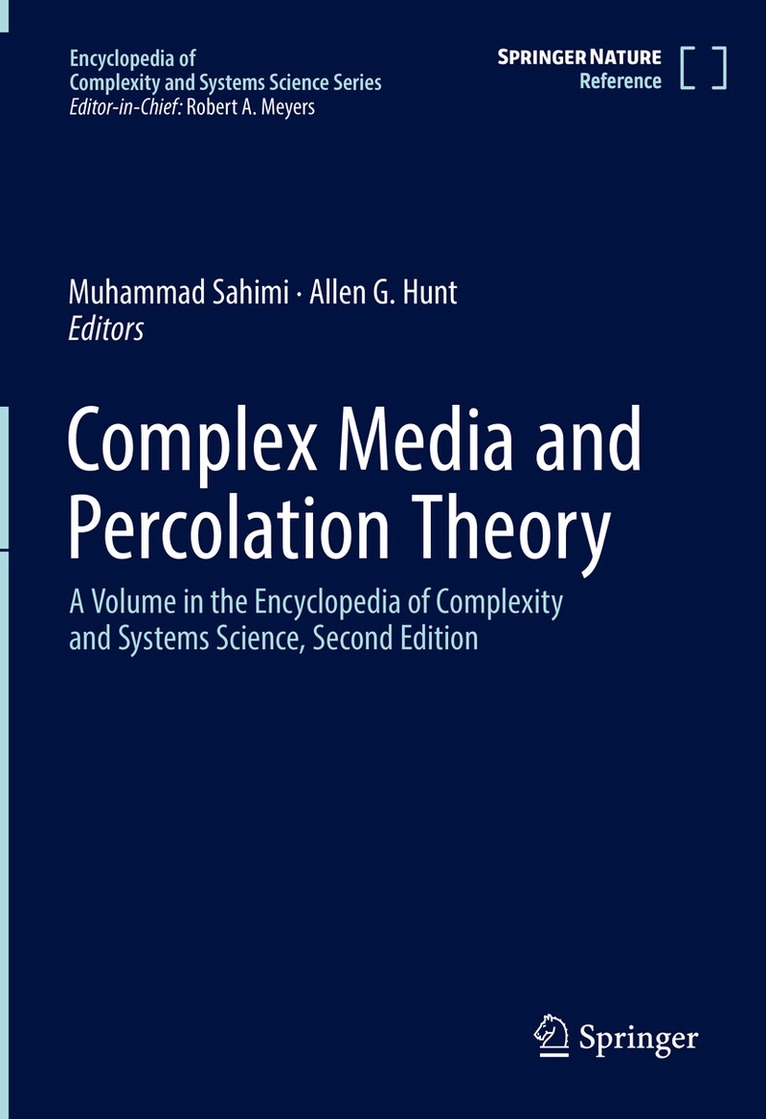
Percolation theory describes the effects of the connectivity of microscopic or small-scale elements of a complex medium to its macroscopic or large-scale properties. It also describes the conditions under which there may be a continuously connected path of local elements across the medium. The point at which the path is formed is called the percolation threshold. Percolation theory also predicts that many macroscopic properties of complex media follow universal power laws near the percolation threshold that are independent of many microscopic features of such media.There are many applications of percolation theory across the natural sciences, from porous materials, to composite solids, complex networks, and biological systems. This book presents the essential elements of percolation theory, covers the problem of calculating the exponents that characterize the power laws that the percolation quantities follow near the percolation threshold, provides a clear description of the geometry of percolation clusters of the connected paths, and addresses several variations of percolation theory. In particular, bootstrap percolation, explosive percolation, and invasion percolation are featured, which expand the range of natural systems to which percolation may be applicable. In addition, coverage includes several important applications of percolation theory to a range of phenomena, ranging from electrical conductivity, thermopower, the Hall effect, and photoconductivity of disordered semiconductors, to flow, transport and reaction in porous media, geochemistry, biology, and ecology.
12 916 kr
Kommande
Percolation theory describes the effects of the connectivity of microscopic or small-scale elements of a complex medium to its macroscopic or large-scale properties. It also describes the conditions under which there may be a continuously connected path of local elements across the medium. The point at which the path is formed is called the percolation threshold. Percolation theory also predicts that many macroscopic properties of complex media follow universal power laws near the percolation threshold that are independent of many microscopic features of such media.There are many applications of percolation theory across the natural sciences, from porous materials, to composite solids, complex networks, and biological systems. This book presents the essential elements of percolation theory, covers the problem of calculating the exponents that characterize the power laws that the percolation quantities follow near the percolation threshold, provides a clear description of the geometry of percolation clusters of the connected paths, and addresses several variations of percolation theory. In particular, bootstrap percolation, explosive percolation, and invasion percolation are featured, which expand the range of natural systems to which percolation may be applicable. In addition, coverage includes several important applications of percolation theory to a range of phenomena, ranging from electrical conductivity, thermopower, the Hall effect, and photoconductivity of disordered semiconductors, to flow, transport and reaction in porous media, geochemistry, biology, and ecology.
Inbunden, Engelska, 2021
4 835 kr
Skickas inom 10-15 vardagar
This volume of the Encyclopedia of Complexity and Systems Science, Second Edition is an authoritative single source for understanding and applying the basic tenets of complexity and systems theory, as well as the tools and measures for analyzing complex systems, to the prediction, monitoring, and evaluation of earthquakes, tsunamis, and volcanoes. Early warning, damage, and the immediate response of human populations to these extreme environmental events are also covered from the point of view of complexity and nonlinear systems. In authoritative, state-of-the art articles, world experts in each field apply such complexity tools and concepts as fractals, cellular automata, solitons game theory, network theory, and statistical physics to an understanding of these complex geophysical phenomena.
15 220 kr
Kommande
This volume of the Encyclopedia of Complexity and Systems Science, Second Edition is an authoritative single source for understanding and applying the basic tenets of complexity and systems theory, as well as the tools and measures for analyzing complex systems, to the prediction, monitoring, and evaluation of earthquakes, tsunamis, and volcanoes. Early warning, damage, and the immediate response of human populations to these extreme environmental events are also covered from the point of view of complexity and nonlinear systems. In authoritative, state-of-the art articles, world experts in each field apply such complexity tools and concepts as fractals, cellular automata, solitons game theory, network theory, and statistical physics to an understanding of these complex geophysical phenomena.
Inbunden, Engelska, 2023
3 226 kr
Skickas inom 10-15 vardagar
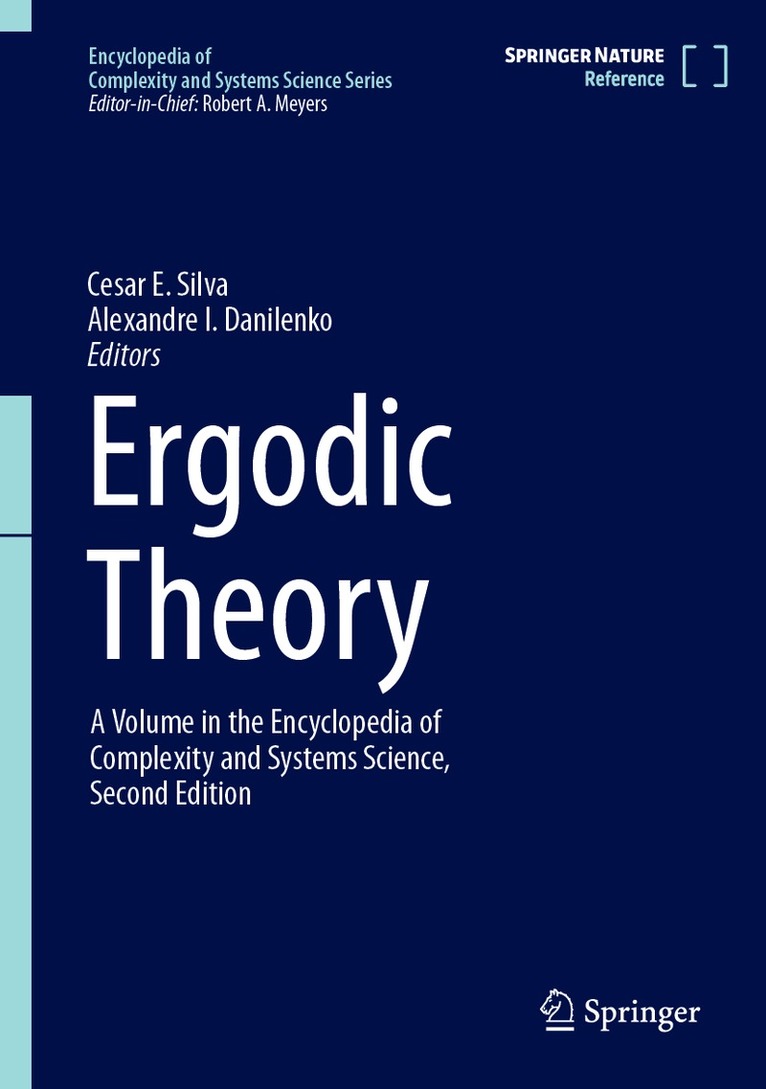
This volume in the Encyclopedia of Complexity and Systems Science, Second Edition, covers recent developments in classical areas of ergodic theory, including the asymptotic properties of measurable dynamical systems, spectral theory, entropy, ergodic theorems, joinings, isomorphism theory, recurrence, nonsingular systems.
Inbunden, Engelska, 2022
4 084 kr
Skickas inom 10-15 vardagar
Different linear mathematical methods can be used to solve these models analytically, such as the Inverse Scattering Transformation (IST), Adomian Decomposition Method, Variational Iteration Method (VIM), Homotopy Analysis Method (HAM) and Homotopy Perturbation Method (HPM).
Inbunden, Engelska, 2022
4 835 kr
Skickas inom 10-15 vardagar
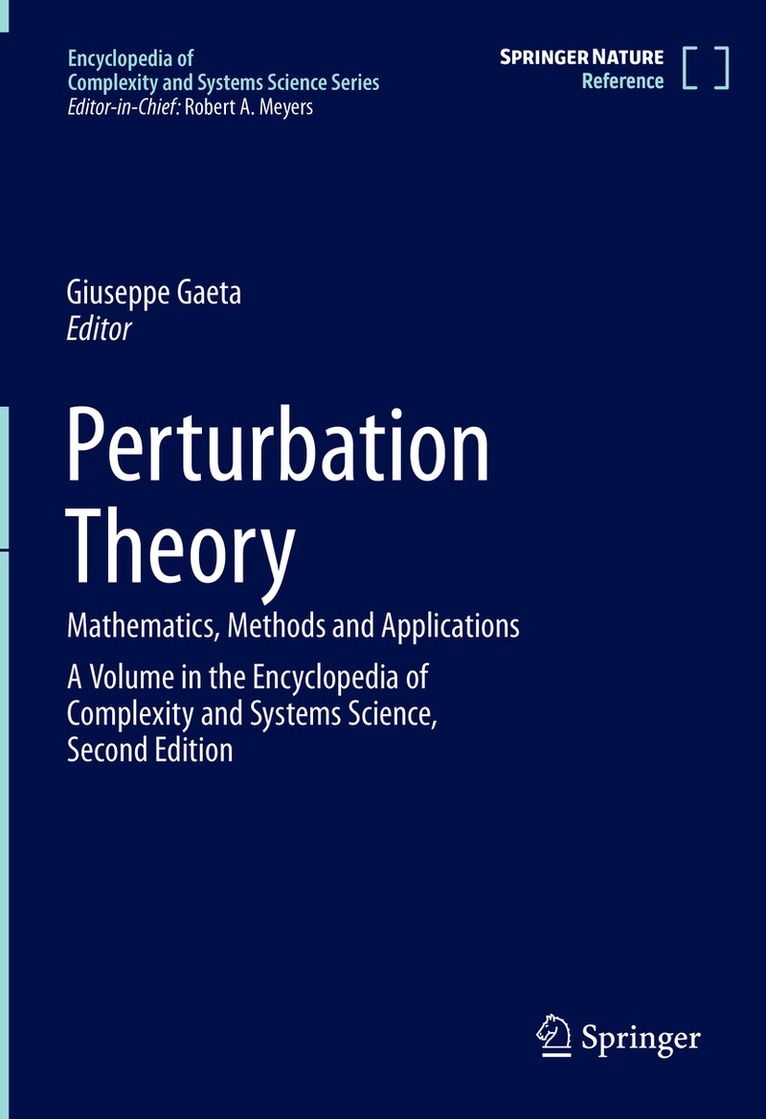
This volume in the Encyclopedia of Complexity and Systems Science, Second Edition, is devoted to the fundamentals of Perturbation Theory (PT) as well as key applications areas such as Classical and Quantum Mechanics, Celestial Mechanics, and Molecular Dynamics. Less traditional fields of application, such as Biological Evolution, are also discussed. Leading scientists in each area of the field provide a comprehensive picture of the landscape and the state of the art, with the specific goal of combining mathematical rigor, explicit computational methods, and relevance to concrete applications. New to this edition are chapters on Water Waves, Rogue Waves, Multiple Scales methods, legged locomotion, Condensed Matter among others, while all other contributions have been revised and updated. Coverage includes the theory of (Poincare’-Birkhoff) Normal Forms, aspects of PT in specific mathematical settings (Hamiltonian, KAM theory, Nekhoroshev theory, and symmetric systems), technical problems arising in PT with solutions, convergence of series expansions, diagrammatic methods, parametric resonance, systems with nilpotent real part, PT for non-smooth systems, and on PT for PDEs [write out this acronym partial differential equations]. Another group of papers is focused specifically on applications to Celestial Mechanics, Quantum Mechanics and the related semiclassical PT, Quantum Bifurcations, Molecular Dynamics, the so-called choreographies in the N-body problem, as well as Evolutionary Theory. Overall, this unique volume serves to demonstrate the wide utility of PT, while creating a foundation for innovations from a new generation of graduate students and professionals in Physics, Mathematics, Mechanics, Engineering and the Biological Sciences.
Inbunden, Engelska, 2023
4 835 kr
Skickas inom 10-15 vardagar
The first edition of the Encyclopedia of Complexity and Systems Science (ECSS, 2009) presented a comprehensive overview of granular computing (GrC) broadly divided into several categories: Granular computing from rough set theory, Granular Computing in Database Theory, Granular Computing in Social Networks, Granular Computing and Fuzzy Set Theory, Grid/Cloud Computing, as well as general issues in granular computing. In 2011, the formal theory of GrC was established, providing an adequate infrastructure to support revolutionary new approaches to computer/data science, including the challenges presented by so-called big data. For this volume of ECSS, Second Edition, many entries have been updated to capture these new developments, together with new chapters on such topics as data clustering, outliers in data mining, qualitative fuzzy sets, and information flow analysis for security applications. Granulations can be seen as a natural and ancient methodology deeply rooted in the human mind. Many daily "things" are routinely granulated into sub "things": The topography of earth is granulated into hills, plateaus, etc., space and time are granulated into infinitesimal granules, and a circle is granulated into polygons of infinitesimal sides. Such granules led to the invention of calculus, topology and non-standard analysis. Formalization of general granulation was difficult but, as shown in this volume, great progress has been made in combing discrete and continuous mathematics under one roof for a broad range of applications in data science.
Inbunden, Engelska, 2018
6 444 kr
Skickas inom 10-15 vardagar
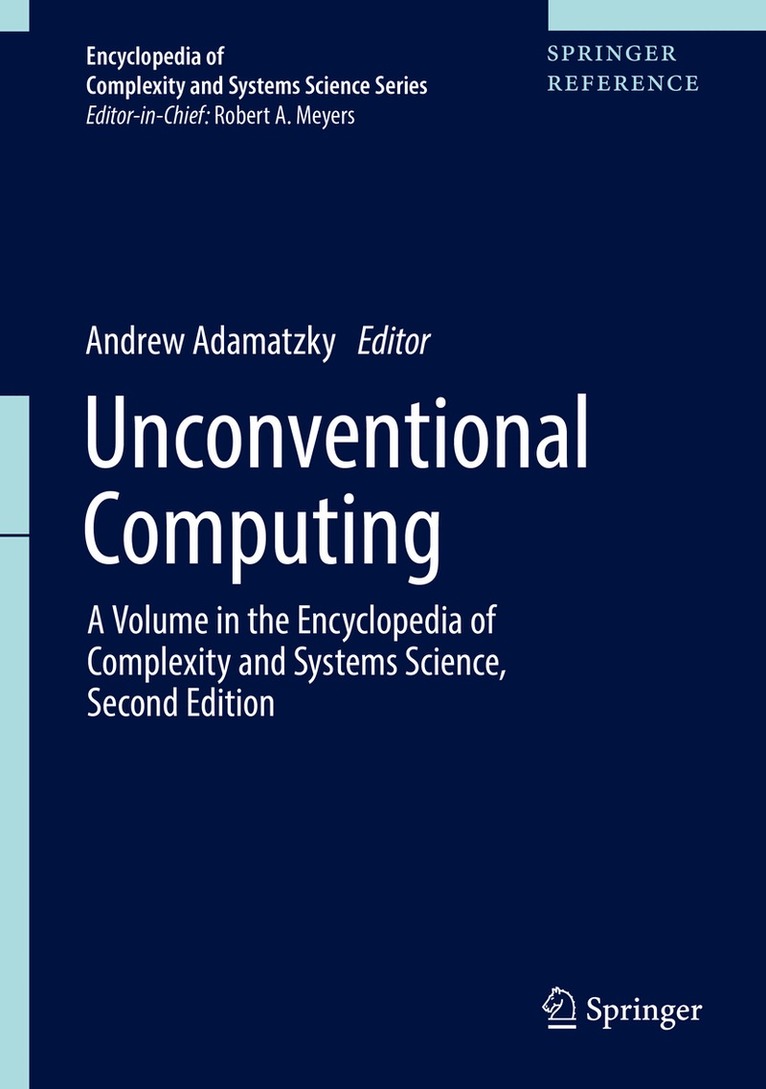
This volume of the Encyclopedia of Complexity and Systems Science, Second Edition, is a unique collection of concise overviews of state-of-art, theoretical and experimental findings, prepared by the world leaders in unconventional computing. Topics covered include bacterial computing, artificial chemistry, amorphous computing, computing with Solitons, evolution in materio, immune computing, mechanical computing, molecular automata, membrane computing, bio-inspired metaheuristics, reversible computing, sound and music computing, enzyme-based computing, structural machines, reservoir computing, infinity computing, biomolecular data structures, slime mold computing, nanocomputers, analog computers, DNA computing, novel hardware, thermodynamics of computation, and quantum and optical computing. Topics added to the second edition include: social algorithms, unconventional computational problems, enzyme-based computing, inductive Turing machines, reservoir computing, Grossone Infinity computing, slime mould computing, biomolecular data structures, parallelization of bio-inspired unconventional computing, and photonic computing.Unconventional computing is a cross-breed of computer science, physics, mathematics, chemistry, electronic engineering, biology, materials science and nanotechnology. The aims are to uncover and exploit principles and mechanisms of information processing in, and functional properties of, physical, chemical and living systems, with the goal to develop efficient algorithms, design optimal architectures and manufacture working prototypes of future and emergent computing devices.
Inbunden, Engelska, 2024
3 905 kr
Kommande
This volume in the Encyclopedia of Complexity and Systems Science, Second Edition, offers a detailed account of fractional calculus tools, signatures of complex systems, hidden connections to fractional calculus, and applications and case studies involving fractional calculus in complex signal analysis and complex system modelling, analysis and control (MAD). The authors document both the foundational concepts of fractional calculus in complexity science as well as their applications to, and role in, the optimization of, complex engineered systems. Fractional calculus is about differentiation and integration of non-integer orders. Convenience has driven the use of integer-order models and controllers for complex natural or man-made systems, but these traditional models and tools for the control of dynamic systems may result in suboptimum performance and even “anomalous” behavior. In contrast, a growing literature documents “more optimal” performance when fractional order calculus tools are applied. From an engineering point of view, new and beneficial uses of this versatile mathematical tool are both possible and important, and may become an enabler of new scientific discoveries.
7 169 kr
Kommande
This volume in the Encyclopedia of Complexity and Systems Science, Second Edition, offers a detailed account of fractional calculus tools, signatures of complex systems, hidden connections to fractional calculus, and applications and case studies involving fractional calculus in complex signal analysis and complex system modelling, analysis and control (MAD). The authors document both the foundational concepts of fractional calculus in complexity science as well as their applications to, and role in, the optimization of, complex engineered systems. Fractional calculus is about differentiation and integration of non-integer orders. Convenience has driven the use of integer-order models and controllers for complex natural or man-made systems, but these traditional models and tools for the control of dynamic systems may result in suboptimum performance and even “anomalous” behavior. In contrast, a growing literature documents “more optimal” performance when fractional order calculus tools are applied. From an engineering point of view, new and beneficial uses of this versatile mathematical tool are both possible and important, and may become an enabler of new scientific discoveries.
Inbunden, Engelska, 2018
8 054 kr
Skickas inom 10-15 vardagar
This volume of the Encyclopedia of Complexity and Systems Science, Second Edition, provides an authoritative introduction and overview of the latest research in cellular automata (CA) models of physical systems, emergent phenomena, computational universality, chaos, growth phenomena, phase transitions, self-organised criticality, reaction-diffusion systems, self-replications, parallel computation, and more. Fundamental topics of algorithmic complexity, algebraic groups, language theory, evolving CA, ergodic theory, synchronisation, tiling problems and undecidability and topological dynamics of CA are addressed. Cellular automata are regular uniform networks of locally-connected finite-state machines, and represent discrete systems with non-trivial behavior, including waves, patterns and travelling localisations. CA are ubiquitous: they are mathematical models of computation and computer models of natural systems. Classes of CA presented in this book include additive CA, automatain hyperbolic spaces and non-compact spaces, CA in triangular, pentagonal and hexagonal tessellations, automata with memory, quantum and reversible automata, structurally-dynamic CA, and asynchronous automata. Topics added to the second edition include: asynchronous cellular automata, stochastic cellular automata as models of reaction-diffusion processes, cellular automata hardware implementation, cellular automata basins of attraction, orbits of Bernoulli measures in cellular automata, and graphs related to reversibility and complexity in cellular. This state-of-the-art reference is unique in bringing together unequalled expertise of interdisciplinary studies at the edge of mathematics, computer science, and physics.
Inbunden, Engelska, 2019
4 084 kr
Skickas inom 10-15 vardagar
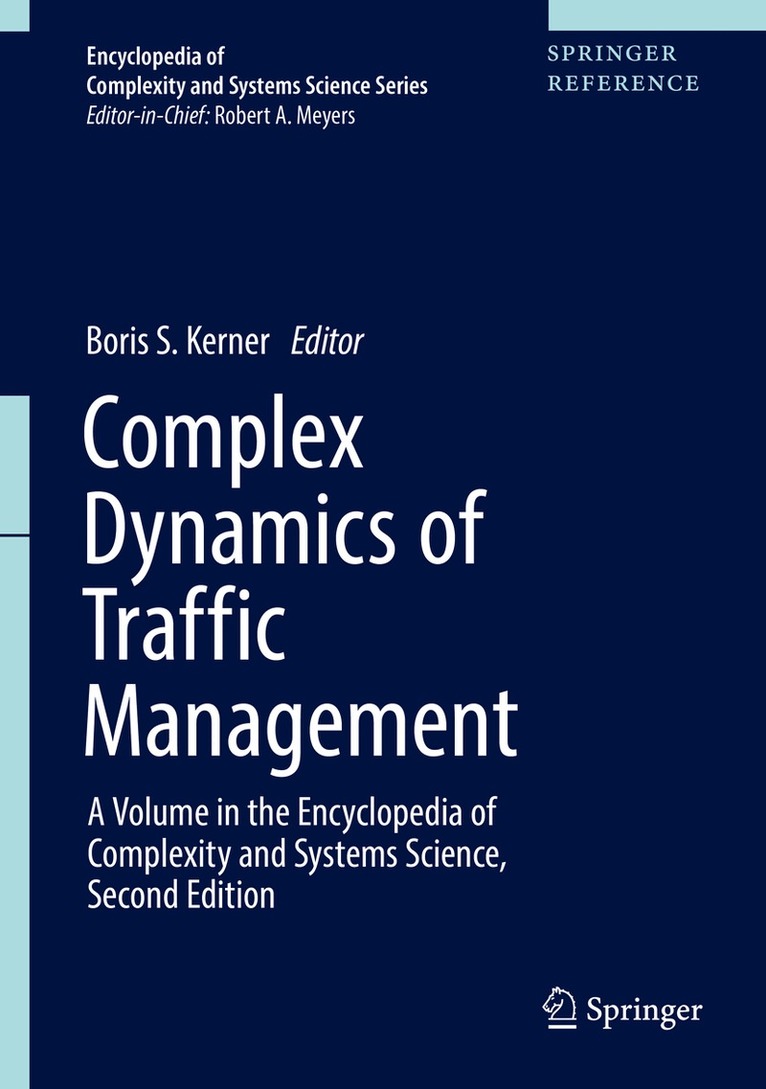
This volume in the Encyclopedia of Complexity and Systems Science (ECSS) covers such fascinating and practical topics as (i) Vehicular traffic flow theory, (ii) Studies of real field traffic data, (iii) Complex phenomena of self-organization in vehicular traffic, (iv) Effect of automatic driving (self-driving vehicles) on traffic flow, v) Complex dynamics of city traffic, (vi) Dynamic control and optimization of traffic and transportation networks, including dynamic traffic assignment in the network, (vii) Pedestrian traffic, (viii) Evacuation scenarios, and (ix) Network characteristics of air control. Review articles are written by international experts covering the diverse and complex dynamics of traffic management. Topics new to the Second Edition of ECSS include microscopic traffic flow models, self-driving, complex dynamics of bus, tram and elevator delays, and breakdown minimization.
Inbunden, Engelska, 2020
6 981 kr
Skickas inom 10-15 vardagar
This new book addresses the status of the field of System Dynamics 60+ years after its inception. It presents state-of-the-art expositions by leading authorities in either a facet of the theory and methodology of the subject or its application in a specific domain. Exhibiting greater reach and authority than would be possible in a conventional authored textbook, the volume includes nine chapters covering methodological aspects, and 14 on various contemporary applications.Emerging from the System Dynamics section of the Encyclopedia of Complexity & Systems Science, First Edition (2009), the book features brand new chapters covering project management, workforce modelling, applications in defense, operations management, engineering of strategy, the roots of model validation, as well as many considerably enhanced versions of existing chapters. Together, the chapters reveal a remarkable landscape of theory and practice, and how System Dynamics can contribute criticalpolicy insights to a broad audience of students and professionals across many fields of study.
Inbunden, Engelska, 2027
4 693 kr
Kommande
This volume of the Encyclopedia of Complexity and Systems Science Series describes the current state of the analysis of complexity in chemistry from a wide-ranging perspective. The volume covers not only the classical areas of molecular complexity and its implications in molecular design, QSAR, QSPR and molecular evolution, but also topics at the very forefront of development of this field in cross-disciplinary areas. The latter include for instance, chaotic systems in biochemistry as well as biological complexity and self-organization, topics related to organizational complexity at the nanoscale, as well as the structural and dynamical complexity of giant systems of interacting molecules, such as protein residue networks, protein-protein interaction networks and metabolic networks. All these topics are interwoven by a general overarching concept of complexity. Thus, from a theoretical point of view, the reader benefits from a broad view of the analysis of complexity in many different types of molecular and chemical systems. In addition, the reader gains insight into a series of modern techniques and tools that allow for a practical understanding of these complex chemical systems. Such modern techniques include the use of cellular automata, design of reaction sites, artificial intelligence methods, machine learning, quantum similarity techniques, network-theoretic, informational tools, QSAR, QSPR and molecular design, among others. Complexity in Computational Chemistry is a valuable reference for molecular biologists, chemists, molecular engineers, computer scientists and mathematicians interested in the study of chemical complexity at any scale, from the atomic to the intermolecular.
8 004 kr
Kommande
This volume of the Encyclopedia of Complexity and Systems Science Series describes the current state of the analysis of complexity in chemistry from a wide-ranging perspective. The volume covers not only the classical areas of molecular complexity and its implications in molecular design, QSAR, QSPR and molecular evolution, but also topics at the very forefront of development of this field in cross-disciplinary areas. The latter include for instance, chaotic systems in biochemistry as well as biological complexity and self-organization, topics related to organizational complexity at the nanoscale, as well as the structural and dynamical complexity of giant systems of interacting molecules, such as protein residue networks, protein-protein interaction networks and metabolic networks. All these topics are interwoven by a general overarching concept of complexity. Thus, from a theoretical point of view, the reader benefits from a broad view of the analysis of complexity in many different types of molecular and chemical systems. In addition, the reader gains insight into a series of modern techniques and tools that allow for a practical understanding of these complex chemical systems. Such modern techniques include the use of cellular automata, design of reaction sites, artificial intelligence methods, machine learning, quantum similarity techniques, network-theoretic, informational tools, QSAR, QSPR and molecular design, among others. Complexity in Computational Chemistry is a valuable reference for molecular biologists, chemists, molecular engineers, computer scientists and mathematicians interested in the study of chemical complexity at any scale, from the atomic to the intermolecular.