Governance in Europe Series - Böcker
Visar alla böcker i serien Governance in Europe Series. Handla med fri frakt och snabb leverans.
15 produkter
15 produkter
808 kr
Skickas inom 10-15 vardagar
Is the process of European integration shifting the targets of social movements from the national arena to the European Union level? Does the EU remain isolated from the reach of national democratic politics? Or are social movements responding to the transnational issues posed by the European Union, but continuing to do so by treading the traditional pathways of nation-specific contentious politics? Addressing these key but hitherto unexplored questions, this groundbreaking volume explores how European citizens are responding to the growing policymaking power of the EU. The contributors argue that the emergence of a supranational realm of European government offers new opportunities and constraints for domestic social actors. In this new transnational realm, groups such as environmentalists, students, and trade unionists can not only undertake traditional domestic forms of contentious action, but also link together across national borders. At the same time, the volume cautions against rushing to herald a new era of transnational mobilization, as significant barriers remain to launching contentious action in the transnational realm, national governments continue to play a primary role in policymaking before the EU, and tried-and-true routines of collective action and institutions attach citizens to their national political systems.At the heart of the book is a newly developed theoretical framework, which is rigorously tested against the evidence offered by the editors' longitudinal and cross-national database on contentious political action, as well as by a series of sector-specific case studies. The combination of theory and original research will make this an important reference for scholars as well as a valuable supplement in courses on comparative politics, Western Europe, and social movements.
581 kr
Skickas inom 10-15 vardagar
European politics has been reshaped in recent decades by a dual process of centralization and decentralization. At the same time that authority in many policy areas has shifted to the suprantional level of the European Union, so national governments have given subnational regions within countries more say over the lives of their citizens. At the forefront of scholars who characterize this dual process as Omulti-level governance,OLiesbet Hooghe and Gary Marks argue that its emergence in the second half of the twentieth century is a watershed in the political development of Europe. Hooghe and Marks explain why multi-level governance has taken place and how it shapes conflict in national and European political arenas. Drawing on a rich body of original research, the book is at the same time written in a clear and accessible style for undergraduates and non-experts.
742 kr
Skickas inom 10-15 vardagar
Europe matters, but in different ways in different countries. The European Union affects the policy fabric of all member states, but that impact is differential rather than convergent. In some instances, new policy goals have been added to national agendas and fresh policy instruments are applied, while old ones become less important or are openly challenged. In other instances, when European and national policy objectives are concurrent, national practices may be reinforced, or even redirected, by EU policies. In all instances, however, state actors reconsider national policy practices wherever the EU extends it activities. This innovative study solves the differential puzzle by developing a sophisticated theoretical and conceptual framework for studying the impact of European policies on member states. Focusing especially on transport policy, the authors employ extensive interviews and archival research in an empirically rich set of case studies (Britain, France, Germany, Italy, and the Netherlands) to demonstrate convincingly that this influence depends on pre-existing policies and institutional capacity to change. Depending on the particular phase of regulation in which a country finds itself and on its institutional flexibility, an identical EU policy has remarkably diverse impacts within individual member states.The authors' research points to fascinating counterintuitive results and a new general model that will have implications for anyone studying policymaking in Europe.
528 kr
Skickas inom 10-15 vardagar
Referendums are playing an increasingly influential role in the process of European integration. Starting with the entry of a first wave of new European Community members in the 1970s, this instrument of popular decision making has grown ever more important. Later stages in the enlargement process of the European Union have led to even more referendums. Indeed, European integration was seriously jeopardized when Danish voters first rejected the Maastricht Treaty and France's citizens almost joined them. Yet we know very little about how referendums affect the integration process. This landmark study bridges this gap in two ways. First, it offers a thorough comparative analysis of referendums that have occurred so far in the process of European integration. Utilizing a detailed study of voting behavior by citizens in these referendum campaigns, Simon Hug argues that understanding this behavior is of crucial importance if we want to accurately assess the impact of referendums on European integration. The author then draws on his comparative data to analyze the likely consequences of referendums based on those that have taken place and proposals for new initiatives. With its detailed empirical analysis and theoretical foundation, this book makes an important contribution both to the study of referendums and to our understanding of institutional reform and integration within the EU.
675 kr
Skickas inom 10-15 vardagar
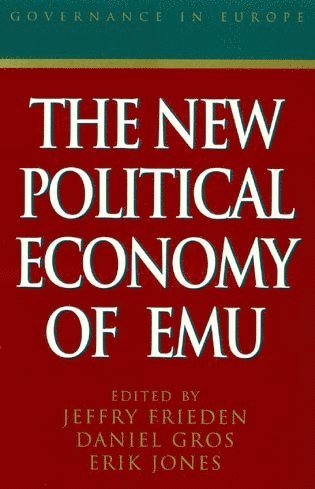
With euro banknotes and coins starting to circulate as of January 2002, this timely book comes at a crucial juncture for the European Union. Exploring the origins of and progress toward the introduction of the euro, the contributors focus on the importance of economic and monetary union (EMU) as part of the larger process of European integration. Thus, chapters consider the value and limits of a range of theoretical approaches for understanding economic and monetary integration, the pros and cons of EMU's institutional design, and country-specific experiences. With an international group of leading scholars representing a range of disciplines, this book offers a broad perspective on the dynamics of EMU.
1 824 kr
Skickas inom 5-8 vardagar
This definitive book offers the first full study of the development of the European Union's air-transport policy. Crucial to both globalization and regional integration, commercial aviation, along with other transport industries, provides the logistics for business activities, political life, and contact between cultures. Paradoxically, however, the airline industry was one of the last to be liberalized in the process of European integration, and the creation of a single market in air transport was attended by sharp political disputes, unreconstructed nationalism, and persistent foot-dragging.Exploring the long struggle to create a "Europe of the air" through both regulatory change and airline strategizing, Martin Staniland examines the political bargains that have shaped a highly fragmented industry and its regulation. He argues that, rather than focusing on directives and regulations issuing from Brussels, students of integration should examine the ways in which the contentious interaction between leaders of an industry and relevant politicians and officials creates distinctive "market orders." Such market orders enable firms to minimize the risks inherent in business, while allowing regulators to pursue the mandates of their organizations and to realize their notions of public interest. Economic integration is therefore an often-painful struggle to create a market order defined both by regulatory jurisdiction and by competition among firms. An invaluable case-study in industrial policy, this book will be essential reading for students of aviation, as well as for scholars interested in regulatory change and European integration.
665 kr
Skickas inom 5-8 vardagar
Considering the future of European integration, this clear and compelling study explores the interplay between collective action and democracy in the European Union and its member states. Richard Balme and Didier Chabanet analyze the influence of supranational governance on democratization through a wealth of case studies on a broad range of civil society interests, including regional policy, unemployment and poverty, women's rights, migration policy, and environmental protection. The authors trace the evolving relationship between citizens and European institutions over the past decades, especially as public support for deepening and widening integration has waned. This trend culminated in a deep institutional crisis precipitated by the rejection of the draft constitutional treaty in France and the Netherlands in 2005. At least two truisms were proven wrong during this tumultuous period: that European citizens have little interest in European integration and that citizens have little influence on EU politics. However, this power shift has left citizens with a deep distrust of integration and EU institutions with limited capacities to cope with issues the public considers priorities-primarily unemployment and social inequalities. The book shows how Europe-wide interest groups formed and protesters were able to mobilize around key issues of integration. The authors convincingly argue that the growth of contentious social movements has also been nourished by the EU policy process itself, which leaves more room for interest groups and protest politics than for political parties and representative democracy. An essential primer on European democracy, this study will be invaluable for scholars and students in European politics and public policy, globalization and democracy, and comparative social movements.
813 kr
Skickas inom 5-8 vardagar
This original work explores the increasingly important phenomenon of the formation of transnational identity. Considering the ongoing relevance of the European Union, the contributors ask a series of intriguing questions: Is a European identity possible? How are the various types of European identity formed and maintained? How are these identities linked to the process of European integration? Examining the psychological, institutional, and political mechanisms that encourage or impede identification with transnational groups, the book considers these theoretical questions in light of new evidence drawn from a rich body of primary research, including field experiments, in-depth interviews with elites, and public opinion surveys. Brought together for the first time, social psychologists, sociologists, political scientists, and ethnographers share their theoretical and methodological perspectives in tackling the common issues surrounding the emergence of 'European' as a political identity. Paying special attention to the role of the institutions of the EU, the authors investigate the impact of neo-functionalist strategies and find that the processes of identity formation are far more complicated than can be explained by material and institutional factors alone. The authors engage in a fruitful dialogue about how much a European identity exists and how much it matters as they delve into the sources of disagreement and their implications.
1 719 kr
Skickas inom 5-8 vardagar
This timely comparative analysis explores the evolution of governance in Central and Eastern Europe. The book considers post-communist leaders' key challenge: the development of central government institutions capable of coordinating, integrating, and steering the policymaking process. Building on a broad range of primary sources and extensive field research, the distinguished authors analyze the processes and outcomes of institution-building in Hungary, Poland, the Czech Republic, and Bulgaria since the late 1980s. They examine in detail the organization and inner workings of central executives; explain differences in executive trajectories across time and countries by considering the influence of institutional legacies, the impact of evolving party systems, and the role of crises in spurring institutional change; and show the effects of executive institutions on patterns of public policy, especially the budgetary process. Through a rigorous application of the core-executive framework, this study offers nuanced conceptual and analytical insights that will enhance understanding of both the evolving institutions of Central and Eastern Europe and the more stable West European systems. The in-depth analysis of the development of national executive institutions casts a distinctive new light on debates about EU enlargement, Europeanization, and patterns of governance.
867 kr
Skickas inom 5-8 vardagar
This timely comparative analysis explores the evolution of governance in Central and Eastern Europe. The book considers post-communist leaders' key challenge: the development of central government institutions capable of coordinating, integrating, and steering the policymaking process. Building on a broad range of primary sources and extensive field research, the distinguished authors analyze the processes and outcomes of institution-building in Hungary, Poland, the Czech Republic, and Bulgaria since the late 1980s. They examine in detail the organization and inner workings of central executives; explain differences in executive trajectories across time and countries by considering the influence of institutional legacies, the impact of evolving party systems, and the role of crises in spurring institutional change; and show the effects of executive institutions on patterns of public policy, especially the budgetary process. Through a rigorous application of the core-executive framework, this study offers nuanced conceptual and analytical insights that will enhance understanding of both the evolving institutions of Central and Eastern Europe and the more stable West European systems. The in-depth analysis of the development of national executive institutions casts a distinctive new light on debates about EU enlargement, Europeanization, and patterns of governance.
Europeanization and Multilevel Governance
Cohesion Policy in the European Union and Britain
Häftad, Engelska, 2007
789 kr
Skickas inom 5-8 vardagar
Europeanization has become a major theme within European studies in recent years, emphasizing the domestic effects of the EU on its member and applicant states. At the same time, multilevel governance has emerged as an important concept, highlighting shifts both in horizontal relations between state and society and in vertical links between actors at different territorial levels. In this state-of-the-art study, Ian Bache traces the relationship between these two key elements, considering the extent to which Europeanization advances multilevel governance within member states through the requirements of EU cohesion policy.Bache focuses especially on Britain, a member state whose political system has been increasingly characterized by multilevel governance since it became an EU member. Comparing Britain's case to that of ten other member states, the author distinguishes between the EU's effects in simple polities—in which voice, influence, and power are diffused through multiple levels and modes of governance—and in compound polities, where voice, influence, and power are more concentrated. Bringing together the conceptual tools of multilevel governance and policy networks and developing a framework for using these tools together in future research, this clearly written study will be valuable for scholars and students of EU and British politics.
675 kr
Skickas inom 10-15 vardagar
The creation of an economic and monetary union (EMU) in Europe is among the most important_and controversial_developments of the 1990s. This clear and balanced book brings together economists and political scientists to explain why the creation of a European monetary union is so contentious; how the debate has affected the political determination to construct a monetary union; and how it will influence the functioning of EMU into the next century. Focusing on how economics and politics interact both in the prelude to unification and in its aftermath, the authors provide an innovative analysis of a spectrum of related issues: how EMU relates to Europe's unemployment crisis, how it will affect the process of economic adjustment, what convergence means for the performance of the member states separately, and how the member states will decide both whether to participate themselves and whom else to admit to the monetary club.
1 572 kr
Skickas inom 10-15 vardagar
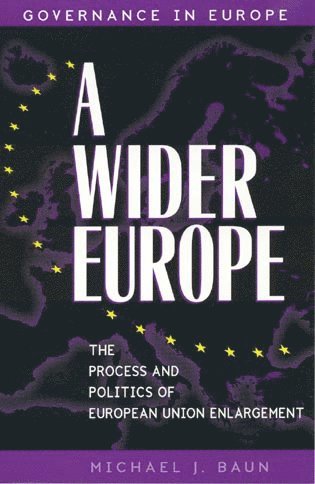
This clear and engaging text examines the process and politics of the European UnionOs OEasternO enlargement, beginning with its initial response to the 1989 revolution up through the Helsinki summit decisions of December 1999. Michael Baun explores such topics as the EUOs original decision to enlarge, the pre-accession strategy for prospective members, the key political decisions on launching and expanding the accession negotiations, and the actual progress of the negotiations. He also examines the EUOs efforts to reform its policies and institutions in advance of enlargement. Throughout, Baun weaves in understandable explanations of the complex multilevel process of EU decisionmaking. He concludes by considering the limits of enlargement and its consequences for the EUOs future development.
581 kr
Skickas inom 10-15 vardagar
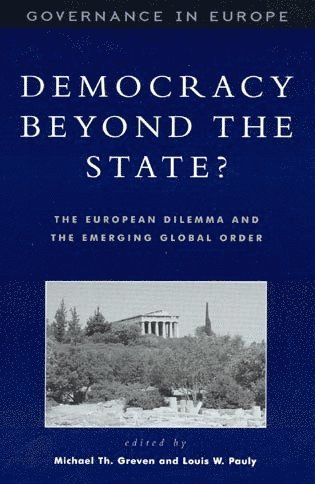
Political authority in today’s leading democracies rests on generally shared perceptions by a given people that their government is responsible to them and considers each individual citizen equal under the law. Yet since the dawn of the industrial age, democratic governments have presided over economies that function on the basis of an unequal distribution of real resources. As globalization opens these economies, the gap between legal, ideal and economic reality widens and boundaries separating “the people” of different democracies erode. This thought-provoking book explores the consequent challenge posed for the inherent legitimacy of democratic systems. When distinctive bonds between political power and social obligation break down, that erosion creates “democratic deficits.” Pressures build to reconstitute political authority beyond the state, and governance-in-practice grows ever more distant from democracy-in-principle.Nowhere is the deepening dilemma more evident than in the European Union. This book examines the contemporary breakdown and transformation of the democratic welfare state in Europe and draws fascinating contrasts with North America. In a cohesive and insightful collection of essays, a group of distinguished political scientists debates the implications of these trends both for theory and for policy.
515 kr
Skickas inom 10-15 vardagar
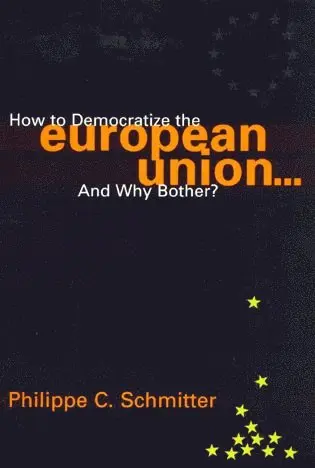
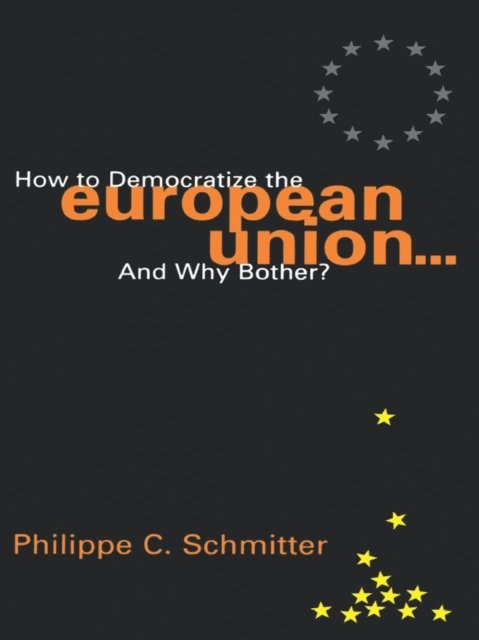
A contradictory creation indeed, the European Union has most of the institutions of a modern democracy, yet it does not function as one. Moreover, its growing scope of activity and supranational decision making processes are undermining the legitimacy of democracy in its member states. Much has been written about this double 'democratic deficit,' but surprisingly little thought has been given to what to do about it_short of drafting and ratifying a new federal constitution. In this provocative book, Philippe C. Schmitter explores both the possibility and the desirability of democratizing the EU. He argues that as a 'non-state' and a 'non nation' it will have to invent new forms of citizenship, representation, and decisionmaking if it is ever to democratize itself. The author also contends that the timing and political context work against a full-scale constitutionalization of the process. He proposes a number of modest (and some less modest) reforms that could improve the situation in the near future and eventually lead to a genuine Euro-democracy.