Higher Ed Leadership Essentials – serie
Visar alla böcker i serien Higher Ed Leadership Essentials. Handla med fri frakt och snabb leverans.
15 produkter
15 produkter
Häftad, Engelska, 2014
344 kr
Skickas inom 5-8 vardagar
Witty and insightful, How Universities Work is destined to be an essential handbook for anyone wanting to understand universities in the United States. John V. Lombardi gives readers an insider's view of the academy, describing the structure, logic, dynamics, and operational styles of both public and private institutions of higher education. Lombardi defines and describes all the bits and pieces that compose a university with remarkable economy - from budgeting systems to tenure, from the library to the athletic field. Although focused on research universities, much of the discussion applies to other types of post-secondary institutions. Ideal for students, this book will form a solid foundation for courses in higher education, but it will also be a welcome addition to faculty and administrators' personal libraries.
Häftad, Engelska, 2018
344 kr
Skickas inom 5-8 vardagar
How can colleges stay relevant in the twenty-first century?Residential colleges are the foundation on which US higher education is based. These institutions possess storied traditions fondly cherished by students, alumni, and faculty. There is no denying, however, that all colleges today struggle with changing consumer preferences, high sticker prices, and aging infrastructure. Technological and pedagogical alternatives—not to mention growing political pressure—present complex challenges. What can colleges and smaller universities do to stay relevant in today’s educational and economic climate? In their concise guide, How to Run a College, Brian C. Mitchell and W. Joseph King analyze how colleges operate. Widely experienced as trustees, administrators, and faculty, they understand that colleges must update their practices, monetize their assets, and focus on core educational strategies in order to build strong institutions.Mitchell and King offer a frank yet optimistic vision for how colleges can change without losing their fundamental strengths. To survive and become sustainable, they must be centers of dynamic learning, as well as economic engines able to power regional, state, and national economies. Rejecting the notion that American colleges are holdovers from a bygone time, How to Run a College shows instead that they are centers of experimentation and innovation that heavily influence higher education not only in the United States but also worldwide.
Häftad, Engelska, 2018
371 kr
Skickas inom 5-8 vardagar
An expert guide designed to help university trustees become effective leaders.Honorable Mention for Eric Hoffer Award (Business Category) by The Hoffer ProjectWe expect college and university trustees to hire the president, advise senior staff, manage investments and financial decisions, and oversee major strategic initiatives. Unfortunately, they sometimes come into this powerful role with little or no understanding of what they are meant to do or how their institutions work.How University Boards Work, by Robert A. Scott, is designed to help trustees understand how to fulfill their responsibilities. Written by a widely respected leader in American higher education and former university president, How University Boards Work is the product of personal experience and considerable research. This concise, straightforward guide includes:• an explanation of the difference between governance and management• tips on how best to prepare for board decisions and discussions• examples of positive and negative board behavior• guidance about board professional development• advice on managing transitions between chief executivesHow University Boards Work will prove an invaluable resource for those responsible for governing colleges and universities, whether privately financed or state funded. It will also be an illuminating read for board secretaries, campus executives and administrators, faculty leaders, alumni volunteers, and public officials, as well as anybody seeking to understand institutional governance in the light of past and current trends in higher education.
Häftad, Engelska, 2018
344 kr
Skickas inom 5-8 vardagar
A clear and cogent guide to how colleges and universities can investigate student misconduct.All colleges and universities grapple with the complexities of student misconduct. How can these institutions conduct efficient fact-finding investigations and disciplinary proceedings? What best practices should administrators and legal counsel follow when student behavior interferes with a university’s mission or poses a campus safety threat? Oren R. Griffin answers these questions and more in Investigating College Student Misconduct, an essential resource for student affairs professionals and university administrators. Misconduct investigations and disciplinary proceedings are as common in higher education as they are contested. Without the force of law, clear procedures, or even rules of evidence, these proceedings can leave both the accused and the accuser in danger of receiving unfair treatment, opening the university up to legal action. Emphasizing the importance of institutional compliance obligations and students’ rights, Griffin explores the fundamental steps that should guide the investigation process. He describes tactics that academic and student affairs administrators should consider and comments on the importance of managing privileged and confidential information—as well as communicating the results of and proposed remedies to student misconduct investigations.A law professor, scholar of higher education law, and associate dean who consults with other universities on legal compliance and litigation matters, Griffin brings a unique perspective to this topic. Touching on a range of issues, including academic dishonesty, sexual assault, freedom of speech, quasi-criminal activity, and other acts of misconduct, Investigating Student Misconduct is supported by a review of relevant judicial decisions from state and federal courts, along with a conceptual and pragmatic analysis of important statutory and constitutional provisions, including Title IX and FERPA.
Häftad, Engelska, 2019
389 kr
Skickas inom 5-8 vardagar
The essential guide to the hardest job in higher ed.A deanship in higher education is an exciting but complex job combining technical administration and academic leadership. On one hand, the dean is an institutional leader, standing up for the faculty, staff, and students. On the other, the dean is a middle manager, managing personnel, curriculum, and budgets and trying to live up to the expectations of the governing board, president, and provost. But what is it really like to be a dean?In How to Be a Dean, George Justice illuminates both of these leadership roles, which interact and even conflict with each other while deans do their best to help faculty members and students. Providing tested advice, Justice takes readers from the job search through the daily work of the dean and, ultimately, to the larger questions of leadership, excellence, and integrity the role provokes. He also explores the roles of "different" deanships in the broader context of academic leadership.Based on the author's experience as a dean at two large research universities, How to Be a Dean is clear, engaging, and opinionated. Current deans will use this book to reflect on the work they do in productive ways. Faculty members considering administrative work will find in this book some idea about the day-to-day work required of their institutional leaders. And finally, readers who are simply curious about what deans do will find pointed analysis about what works and what doesn't.
Häftad, Engelska, 2020
344 kr
Skickas inom 5-8 vardagar
An accessible handbook for anyone who needs to understand a university budget—perfect for the non-finance higher ed professional.To understand how universities function, it is critical to understand how their budgets work. In this useful volume, Dean O. Smith provides a concise explanation of university budgets—why they're important, how they are prepared, what information they provide, and how they are monitored.Translating technical jargon into layman's terms, How University Budgets Work emphasizes practical matters and best practices. Writing for a non-specialist audience, Smith covers major aspects of university budgets ranging from their preparation and alignment with strategic plans to their implementation at the departmental level. Offering time-tested advice from his many years in higher administration, he also touches on • expenditure monitoring• projections• allocations• revenue• incentives • financial reserves• end-of-year accounting The companion book to the more rigorous University Finances, also by Smith, How University Budgets Work is a unique introductory guide for the extended academic community. Ultimately, this logical, accessible book provides a working knowledge of how university budgets are produced and implemented, one that enables faculty members and administrators to become more effective in their roles within the university.
Häftad, Engelska, 2020
319 kr
Skickas inom 11-20 vardagar
It's not the "dark side" if you approach it with insight, wit, and compassion.Most new college and university administrators, especially if they come directly from the faculty ranks or from outside academia, receive little if any training. Rather, they try to succeed mostly by stumbling through the (semi-)dark with a combination of their own knowledge and experience as well as on-the-job learning. This can lead to costly (for the administrator and the institution) mistakes as well as professional failures and campus-wide miseries. In An Insider's Guide to University Administration, Daniel Grassian helps those currently in faculty positions or outside academia determine whether a career in college and university administration is right for them—and, if so, how to best position themselves for success. Applying theory to real, practical examples of university administration, Grassian provides both prospective and current administrators with an in-depth critical analysis of areas pertinent to college and university administration, including leadership, management, vision, diversity, ethics, and fund-raising. Drawing on his varied, extensive teaching and administrative career, Grassian leaves readers with a better understanding of what those in college and university administration do and the important practical, political, and ethical issues with which they engage.
Häftad, Engelska, 2021
332 kr
Skickas
How can universities implement strategic integrated marketing to effectively build and communicate their value?At a time of declining public support, a shrinking pipeline of traditional college-bound students, and a steady rise in tuition and discount rates, higher education leaders have never been under more pressure. How can they ensure steady or growing enrollments while cultivating greater philanthropic support, increasing research funding, and diversifying revenue streams? In How to Market a University, Teresa M. Flannery argues that institutions can meet all of these goals by implementing strategic integrated marketing in ways that are consistent with academic culture and university values. Flannery provides a road map for college leaders who want to learn how to build value—both in terms of revenue and reputation—by differentiating from competitors and developing personalized, supportive, and long-lasting relationships with stakeholders. Defining marketing while identifying its purposes in the context of higher education, Flannery draws on nonprofit marketing scholarship, the expertise of leading higher education marketing practitioners and administrators, and her own experiences over two decades at two different institutions. She teaches readers how to • set up their marketing leadership for success • find or build the necessary organizational capacity • set a firm foundation through market research• establish a differentiated value proposition and strong brand strategy• encourage enterprise-wide integration of marketing and communications• consider technical and resource requirements to succeed in digital marketing• develop appropriate and rigorous measurement• plan for appropriate investment• anticipate and prepare for future trendsThis practical guide reveals how to cultivate student, alumni, donor, and partner loyalty through strategic marketing. How to Market a University offers leaders and their CMOs the language, examples, and even questions they should discuss and answer in order to build or refine their marketing strategy.
Häftad, Engelska, 2022
344 kr
Skickas inom 5-8 vardagar
A new playbook for effective crisis management in higher education.Unlike other industries, in higher education an institution's most important asset is its reputation. Yet as fundamental as it is, many leaders continue to view managing reputation as dishonest and counterproductive, a suspect process that undermines the very idea of reputation as an organic outcome of reality. When leadership credibility is on the line, though, and an institution's reputation is facing potentially irreparable damage, the concept of reputational risk moves from being nebulous to all too tangible. In Preventing Crises at Your University, Simon Barker demonstrates how critical it is for colleges and universities to align strategy and values with decision-making during times of crisis. Arguing that leaders must stop considering the discussion of reputational risk as unseemly, he demonstrates that this discussion is in fact a strategic imperative for every leader. Significant reputational damage, Barker asserts, is not the inevitable outcome of a crisis but of a poor response. Defining a new crisis leadership playbook to deal with self-inflicted crises, he also• explains what typically goes wrong in a crisis;• describes how to prevent crises from escalating;• demonstrates how a stakeholder-centric model of communications can help mitigate reputational damage; and• introduces a number of original concepts, including a Reputational Risk Management Framework, a Reputational Risk Maturity Model, and a Culture and Capability matrix.Moving beyond the theoretical by presenting case studies of real crises involving sexual assault, freedom of speech, student protests, faculty misconduct, and a broad range of financial, social, and ethical issues, the book highlights and underscore key concepts around effective management of reputational risk. Ultimately, Preventing Crises at Your University serves as a wake-up call for all higher education leaders and board members.
Häftad, Engelska, 2023
323 kr
Skickas inom 5-8 vardagar
What does a culture of evidence really look like in higher education?The use of big data and the rapid acceleration of storage and analytics tools have led to a revolution of data use in higher education. Institutions have moved from relying largely on historical trends and descriptive data to the more widespread adoption of predictive and prescriptive analytics. Despite this rapid evolution of data technology and analytics tools, universities and colleges still face a number of obstacles in their data use. In How Colleges Use Data, Jonathan S. Gagliardi presents college and university leaders with an important resource to help cultivate, implement, and sustain a culture of evidence through the ethical and responsible use and adoption of data and analytics. Gagliardi provides a broad context for data use among colleges, including key concepts and use cases related to data and analytics. He also addresses the different dimensions of data use and highlights the promise and perils of the widespread adoption of data and analytics, in addition to important elements of implementing and scaling a culture of evidence.Demystifying data and analytics, the book helps faculty and administrators understand important topics, including:• How to define institutional aspirations using data• Equity and student success• Strategic finance and resource optimization• Academic quality and integrity• Data governance and utility• Implicit and explicit bias in data• Implementation and planning• How data will be used in the futureHow Colleges Use Data helps college and university leaders understand what a culture of evidence in higher education truly looks like.
Häftad, Engelska, 2022
323 kr
Skickas inom 5-8 vardagar
A practical, accessible handbook for chairing a department.Over the course of a typical academic career, most faculty will serve at least one term as chair of a department. It's a leadership and service role that's at the very heart of faculty satisfaction and student success, yet few receive any training on how to do the job. How to Chair a Department is a practical, accessible handbook for new and prospective chairs, providing both principles and practices for effective departmental leadership. Based on his dozen years of chairing departments, Kevin Dettmar provides invaluable advice on:• hiring tenure-track and visiting faculty• mentoring faculty colleagues at every stage of their careers• working with staff and other departmental administrators• managing department resources and budgets• meeting the needs of students• dealing with stress and conflict• connecting the department to the larger university or college as a whole• overseeing the department's curricula• maintaining a scholarly or creative profile• preparing for career moves after chairing a departmentHow to Chair a Department demystifies this important faculty position and argues that the role of chair, though sometimes seen as a burden, can prove to be a genuine opportunity for personal and professional growth.
Häftad, Engelska, 2025
312 kr
Skickas inom 5-8 vardagar
In the evolving landscape of academic freedom in America, this second edition addresses the latest challenges and developments in the field.Since the publication of the first edition of Understanding Academic Freedom, the never-ending struggle to defend academic freedom has entered a demonstrably new phase. Legislation determining what can and cannot be taught in schools in Florida, Texas, and other states has intensified governing board activism that impinges on widely accepted faculty prerogatives. Major donors in research, teaching, and institutional governance have grown bold in their interference. Highly polarizing controversies over antisemitism and the Israeli-Palestinian conflict, as well as debates over diversity, equity, and inclusion policies, continue to broil. Taken as a whole, these developments indicate that we have entered a new period in the history of American academic freedom. Academic freedom, long heralded as a core value of American higher education, may now be in as much danger as at any time since the 1950s. But what is academic freedom? Is it the right of faculty members to teach whatever they wish; a value upheld for supporters, but not opponents, amid polarizing controversy; or a narrow claim of privilege by a professorial elite, immune from public accountability? Henry Reichman, who chaired the American Association of University Professors' Committee A on Academic Freedom and Tenure for nearly a decade, mounts a rigorous defense of academic freedom and its principal means of protection: the system of academic tenure. Probing academic freedom's role in multiple contexts, Reichman draws on a wealth of historical and contemporary examples to offer a comprehensive introduction to the concept in all its manifestations. This second edition addresses the most recent and pressing issues in academic freedom, making it an indispensable resource for understanding the current controversial climate.
Häftad, Engelska, 2026
364 kr
Skickas
A completely updated guide to helping university trustees become effective stewards of their institutions.Boards of trustees hold immense responsibility in guiding the future of colleges and universities. They hire and fire presidents, approve and monitor strategy, oversee finances, and safeguard institutional missions and autonomy. Yet many trustees enter this role with limited understanding of the distinct culture, structure, and values of the academic institutions they are selected to govern. In this second edition of How University Boards Work, former university president Robert A. Scott offers a practical and candid guide for navigating the complexities of academic board service. Originally published in 2018 and widely adopted in board development programs, this updated edition incorporates insights gleaned from years of training sessions, executive coaching, and a radically altered higher education landscape. Elements unique to this edition include:• A new preface addressing the contemporary pressures affecting higher education governance, including political interference, enrollment challenges, changing public attitudes, tuition pricing, overall costs and ROI, and post-pandemic adaptations. • Expanded guidance on key topics such as consent agendas, indicators of institutional vitality and vulnerability, risk assessment, and succession planning. • Updated index entries and terminology reflecting evolving governance concerns such as cybersecurity and free speech. With illustrative examples of effective and problematic board behavior and actionable suggestions for trustee development, How University Boards Work remains the definitive primer for trustees of both public and private institutions.
Häftad, Engelska, 2026
338 kr
Kommande
The business and politics behind campus sports.In many states, the highest-paid public employee is not a governor or a university president, but a football coach. Yet most senior campus leaders rise through academic or administrative pathways that leave them with little preparation for overseeing athletics. In Understanding College Athletics, Karen Weaver offers a clear, practical account of how intercollegiate athletics functions as a complex enterprise with far-reaching implications for institutional reputation, finances, governance, and student experience. Weaver explains how athletics departments are structured, how budgets are built, where legal and compliance risks arise, and why athletics decisions reverberate across enrollment management, advancement, facilities planning, and alumni relations. Written for presidents, provosts, deans, financial officers, trustees, and other senior leaders, the book emphasizes oversight rather than operations. Weaver equips readers to ask informed questions, evaluate claims made in the name of competitive success, and understand how athletics aligns—or fails to align—with institutional mission and values. The book covers a wide range of topics, including financial partnerships and private equity, the student-athlete experience, donor influence, media and branding pressures, and the rapidly changing regulatory landscape shaped by NIL (Name, Image, and Likeness) policy, antitrust litigation, and NCAA restructuring.At a moment when college athletics faces unprecedented scrutiny and instability, Understanding College Athletics serves as a working handbook for campus leaders who can no longer afford to treat sports as someone else's responsibility.
Häftad, Engelska, 2019
266 kr
Tillfälligt slut
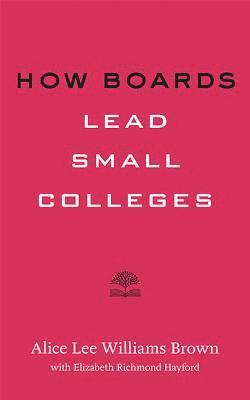
A college is only as strong as its board of trustees.While the media frequently report on threats facing colleges and universities, no sector of higher education is in more danger than private colleges with small endowments and low enrollments. Numerous small private liberal arts colleges could benefit from careful consideration of characteristics and practices of successful trusteeship. In How Boards Lead Small Colleges, Alice Lee Williams Brown and Elizabeth Richmond Hayford focus on small colleges—the kind that seldom attract the attention of researchers. Integrating case studies with theoretical analyses of college governance, they explain the basic responsibilities of boards while demonstrating how some develop practices that fulfill these responsibilities more effectively than others. The book emphasizes strategic planning and collaboration between the board and central administration—advice useful to those governing colleges and universities of all sizes and strengths.For decades, the authors led consortia of small colleges and served on boards of multiple nonprofit organizations. Here, they interview trustees and presidents at dozens of small colleges across multiple states to identify the role governing boards play in building strong private colleges. Encouraging presidents to consider new approaches for working with their boards based on mutual dedication to strengthening institutions, Brown and Hayford also urge trustees to challenge new thinking from their presidents without interfering in internal operations. How Boards Lead Small Colleges is designed to appeal to anyone with a special interest in the future of small private colleges, which play a critical role in the world of higher education.