• Fri frakt över 249 kr
  • •
  • Snabba leveranser
  • •
  • Billiga böcker
Kundservice

Du är på sajten för privatpersoner.

Företag, bibliotek eller offentlig verksamhet?

Du handlar på classic.bokus.com, där alla dina funktioner finns intakta.
Till classic.bokus.com
Bokus logotyp. Gå till startsidan.
  • Erbjudanden
  • Nyheter
  • Student
  • Topplistor
  • Barn & ungdom
  • Bokus Play
  • E-böcker
  • Pocketböcker
  • Spel & pussel

10% studentrabatt med kod TERM26

Sidfot

Mina sidor

    Hjälp

    • Kundservice
    • Vanliga frågor och svar
    • Frakt och leverans
    • Retur vid ångerrätt
    • Reklamera vara
    • Betalning
    • Köpvillkor
    • Allmänna villkor
    • Information om webbplatsens tillgänglighet

    Om Bokus

    • Om oss
    • Pressrum
    • För studenter
    • För företag
    • För bibliotek och offentlig verksamhet
    • För leverantörer
    • Hållbarhet

    Populärt

    • Aktuella erbjudanden
    • Presentkort
    • Studentlitteratur
    • Nya böcker
    • Topplistor
    • Signerade böcker
    • Engelska böcker

    Inspiration

    • Boktips
    • BookTok
    • Populära bokserier
    • Barnbokskaraktärer
    • Populära författare
    Logotyp för Bokus
    Följ oss på Facebook (extern länk)Följ oss på Instagram (extern länk)Följ oss på YouTube (extern länk)Följ oss på TikTok (extern länk)
    bokus @ CookiesAnpassa cookiesIntegritetspolicyKöpvillkor
    Till Citymail hemsida (extern länk)Till Budbee hemsida (extern länk)Till Postnord hemsida (extern länk)Till Schenker hemsida (extern länk)Till Early Bird hemsida (extern länk)Till Walleys hemsida (extern länk)
    1. Samhälle och politik
    2. Samhälle och kultur

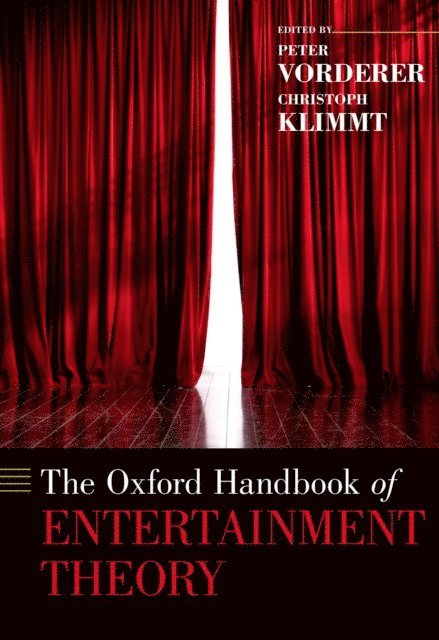
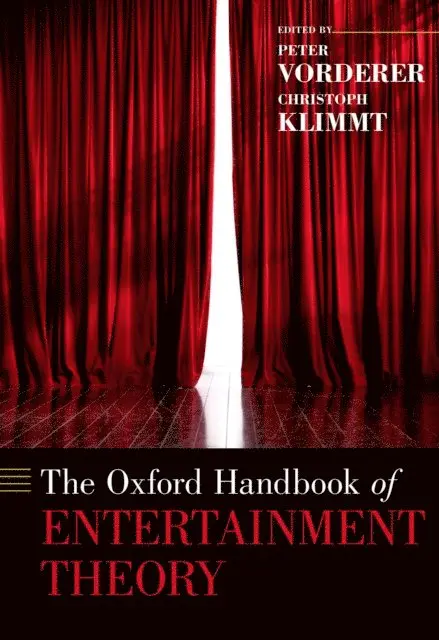
    The Oxford Handbook of Entertainment Theory

    AvPeter Vorderer,Peter Vorderer

    Inbunden, Engelska, 2021

    Del i serien Oxford Handbooks

    3 431 kr

    Beställningsvara. Skickas inom 3-6 vardagar. Fri frakt över 249 kr.

    Beskrivning

    The proliferation of new digital technologies has given rise to an entirely changed media landscape and revolutionized how we seek entertainment. Older entertainment media like novels, radio, and film have been joined by a host of digital media that smartphones allow us to carry almost anywhere and at all times, from video games and social media to video on demand services. This unprecedented ubiquity of entertainment media calls for new and more sophisticated theories that help us understand the fascination that different entertainment media exert on us and how they change the human experience.The Oxford Handbook of Entertainment Theory surveys and furthers the most influential psychology-driven research on media entertainment to illuminate how people are drawn into media experiences. The 41 chapters in this Handbook not only offer fresh perspectives on established theories but also introduce emerging models and highlight the importance of considering the diverse backgrounds of media users when conducting research. They also cover the motivations and reactions of media users in relationship to different types of media, the trend towards interactive media such as video games and virtual reality, and particularly popular media contents like sexuality, violence, sports, and the news. As the most comprehensive overview of psychology-based research on media entertainment available, this Handbook is an invaluable resource for seasoned researchers and those beginning to learn about the field alike.

    Produktinformation

    • Utgivningsdatum:2021-04-21
    • Mått:178 x 251 x 48 mm
    • Vikt:1 860 g
    • Format:Inbunden
    • Språk:Engelska
    • Serie:Oxford Handbooks
    • Antal sidor:890
    • Förlag:OUP USA
    • ISBN:9780190072216

    Utforska kategorier

    • Samhälle och kultur inom Samhälle och politik
    • Referensverk och tvärvetenskap inom Samhälle och politik
    • Television inom Kultur

    Mer om författaren

    Peter Vorderer is Professor of Media and Communication Science at the University of Mannheim, Germany. His research focuses on media-psychological questions, particularly the effects of entertainment media content, and the ubiquitous use of media in everyday life. He is a past president of the International Communication Association. Christoph Klimmt is Professor of Communication Science at Hanover University of Music, Drama, and Media. His research interests revolve around media entertainment, media effects, and digital media technologies. He serves as editor-in-chief of the Journal of Media Psychology.

    Innehållsförteckning

    • Preface Section I: General Theoretical Accounts of Media Entertainment Chapter 1: A Brief Analysis of the State of Entertainment Theory: Historical Achievements, Contemporary Challenges, and Future PossibilitiesPeter Vorderer, Christoph Klimmt, and Jennings Bryant Chapter 2: Entertainment Is a Journey, Not Just a Destination: Process Perspectives in Entertainment TheoriesAndreas Fahr and Hannah Früh Chapter 3: The Narrative Enjoyment and Appreciation RationaleRon Tamborini, Sara Grady, Joshua Baldwin, Nikki McClaran, and Robert Lewis Chapter 4: Life-Span Developmental Changes in Media Entertainment ExperiencesMarie-Louise Mares and James Alex Bonus Chapter 5: A Systematic Gender Perspective on Entertainment TheorySabine Reich Chapter 6: How Universal Is Media Entertainment, Really? On the Enriching Potential of Cross-Cultural Approaches for Existing Entertainment ScholarshipÖzen Odag Chapter 7: Entertainment and ResonancePeter Vorderer Chapter 8: Finding Elusive Resonance Across Cultures and TimeGerald C. Cupchik, Despina Stamatopoulou, and Siying Duan Section II: Models and Theories Dedicated to Specific Experiential Processes Chapter 9: Selection of Entertainment Media: From Mood Management Theory to the SESAM ModelKate T. Luong and Silvia Knobloch-Westerwick Chapter 10: Binge-Watching as a Case of Escapist Entertainment UseAnnabell Halfmann and Leonard Reinecke Chapter 11: Media Entertainment as Guilty Pleasure? The Appraisal of Media Use, Self-Control, and Entertainment (AMUSE) ModelLeonard Reinecke and Adrian Meier Chapter 12: Advances in Research on the Model of Intuitive Morality and Exemplars (MIME)Allison Eden, Ron Tamborini, Melinda Aley, and Henry Goble Chapter 13: Stories Enlarge the Experience of Self: Evidence for the Temporarily Expanded Boundaries of the Self (TEBOTS) ModelBenjamin K. Johnson, Michael D. Slater, Nathaniel A. Silver, and David R. Ewoldsen Chapter 14: Stepping In and Out of Media Characters: Identification and Dynamic Shifts in Users' Positioning towards Entertainment MessagesJonathan Cohen and Christoph Klimmt Chapter 15: Involvement with Media Personae and Entertainment ExperiencesWilliam J. Brown Chapter 16: Only Project: A Psychological Principle Explored in a NovelKeith Oatley Chapter 17: The Role of Narrative Cues in Shaping ADT: What Makes Audiences Think that Good Things Happen to Good People?Ron Tamborini, Matthew Grizzard, Lindsay Hahn, Kevin Kryston, and Ezgi Ulusoy Chapter 18: Media Entertainment, Flow Experiences, and the Synchronization of AudiencesJacob T. Fisher, Chelsea Lonergan, Frederic R. Hopp, and René Weber Chapter 19: Transcending Eudaimonic Entertainment: A Review and Expansion of Meaningful EntertainmentSophie H. Janicke-Bowles, Anne Bartsch, Mary Beth Oliver, and Arthur A. Raney Chapter 20: Biographic Resonance Theory of Eudaimonic Media EntertainmentChristoph Klimmt and Diana Rieger Chapter 21: Kama Muta as an Eudaimonic Entertainment ExperienceSophie H. Janicke-Bowles, Thomas Schubert, and Johanna K. Blomster Chapter 22: Entertained by Amazement and Wonder: The Role of the Emotion Awe in Media ReceptionDaniel Possler and Arthur A. Raney Section III: Models on Entertainment Phenomena Bound to Specific Media or Message Types Chapter 23: Humor and ComedyJeffrey Goldstein Chapter 24: Portrayals of Human Sexuality as EntertainmentFrancesca R. Dillman Carpentier and Farnosh Mazandarani Chapter 25: Cooling Down or Charging Up? Engagement with Aggressive Entertainment Contents as an Emotion Regulation Strategy of Boredom and AngerHeidi Vandebosch and Karolien Poels Chapter 26: Sports as (Digital) Media EntertainmentNicky Lewis Chapter 27: News as Entertainment Format: Applying Affective Disposition Theory and the Affective News Extended ModelMelissa J. Robinson and Silvia Knobloch-Westerwick Chapter 28: An Extended Dual-Process Model of Entertainment Effects on Political Information Processing and EngagementFrank M. Schneider, Anne Bartsch, and Larissa Leonhard Chapter 29: Cinematic Entertainment: Contemporary Adolescents' Uses-and-Gratifications of Going to the MoviesMaite Soto-Sanfiel Chapter 30: How Do People Evaluate Movies? Insights from the Associative-Propositional Evaluation ModelFrank M. Schneider, Ines C. Vogel, Uli Gleich, and Anne Bartsch Chapter 31: TV Series Fandom as Eudaimonic Consumption José Antonio Muñiz-Velázquez and Javier Lozano Delmar Chapter 32: A Synergistic Multi-Process Model of Video Game EntertainmentChristoph Klimmt and Daniel Possler Chapter 33: Interactivity as Demand: Implications for Interactive Media EntertainmentNicholas D. Bowman Chapter 34: Players' Moral Decisions in Virtual Worlds: Morality in Video GamesAndré Melzer and Elisabeth Holl Chapter 35: Player-Avatar Identification, Relationships, and Interaction: Entertainment through Asocial, Parasocial, and Fully Social ProcessesNicholas D. Bowman and Jaime Banks Chapter 36: Entertainment in Virtual Reality and Beyond: The Influence of Embodiment, Co-Location, and Cognitive Distancing on Users' Entertainment ExperienceTilo Hartmann and Jesse Fox Section IV: Models on Consequences or Correlates of Entertainment Phenomena Chapter 37: Retrospective Imaginative Involvement and Entertainment Narratives: Initial ForaysDavid R. Ewoldsen, Rick Busselle, Neha Sethi, and Michael D. Slater Chapter 38: Media Entertainment as a Self-Regulatory Resource: The Recovery and Resilience in Entertaining Media Use (R²EM) ModelLeonard Reinecke and Diana Rieger Chapter 39: Entertainment Media and Social ConsciousnessMeghan S. Sanders, Chun Yang, Anthony Ciaramella, Rachel Italiano, Stephanie L. Whitenack, and Hope M. Hickerson Chapter 40: Entertainment Theories and Media AddictionFelix Reer, Robin Janzik, Lars-Ole Wehden, and Thorsten Quandt Chapter 41: Theorizing Entertainment-Education: A Complementary Perspective to the Development of Entertainment TheoryHua Wang and Arvind Singhal