• Fri frakt över 249 kr
  • •
  • Snabba leveranser
  • •
  • Billiga böcker
Kundservice

Du är på sajten för privatpersoner.

Företag, bibliotek eller offentlig verksamhet?

Du handlar på classic.bokus.com, där alla dina funktioner finns intakta.
Till classic.bokus.com
Bokus logotyp. Gå till startsidan.
  • Erbjudanden
  • Nyheter
  • Student
  • Topplistor
  • Barn & ungdom
  • Bokus Play
  • E-böcker
  • Pocketböcker
  • Spel & pussel

Må bättre, för mindre! Upp till 50% rabatt på hälsoböcker

Sidfot

Mina sidor

    Hjälp

    • Kundservice
    • Vanliga frågor och svar
    • Frakt och leverans
    • Retur vid ångerrätt
    • Reklamera vara
    • Betalning
    • Köpvillkor
    • Allmänna villkor
    • Information om webbplatsens tillgänglighet

    Om Bokus

    • Om oss
    • Pressrum
    • För studenter
    • För företag
    • För bibliotek och offentlig verksamhet
    • För leverantörer
    • Hållbarhet

    Populärt

    • Aktuella erbjudanden
    • Presentkort
    • Studentlitteratur
    • Nya böcker
    • Topplistor
    • Signerade böcker
    • Engelska böcker

    Inspiration

    • Boktips
    • BookTok
    • Populära bokserier
    • Barnbokskaraktärer
    • Populära författare
    Logotyp för Bokus
    Följ oss på Facebook (extern länk)Följ oss på Instagram (extern länk)Följ oss på YouTube (extern länk)Följ oss på TikTok (extern länk)
    bokus @ CookiesAnpassa cookiesIntegritetspolicyKöpvillkor
    Till Citymail hemsida (extern länk)Till Budbee hemsida (extern länk)Till Postnord hemsida (extern länk)Till Schenker hemsida (extern länk)Till Early Bird hemsida (extern länk)Till Walleys hemsida (extern länk)
    1. Kultur
    2. Musikböcker
    3. Musik: stilar och genrer
    4. Opera

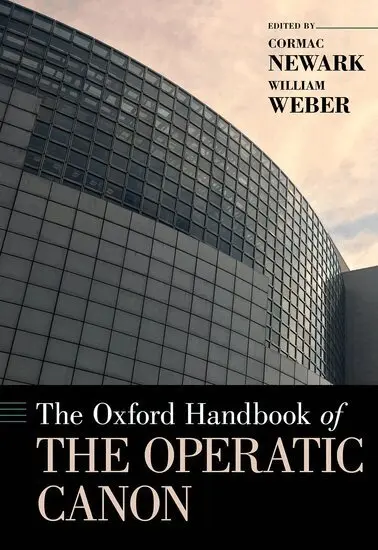
    The Oxford Handbook of the Operatic Canon

    AvCormac Newark,William Weber

    Inbunden, Engelska, 2020

    Del i serien Oxford Handbooks

    2 492 kr

    Beställningsvara. Skickas inom 5-8 vardagar. Fri frakt över 249 kr.

    Beskrivning

    Opera has always been a vital and complex mixture of commercial and aesthetic concerns, of bourgeois politics and elite privilege. In its long heyday in the eighteenth and nineteenth centuries, it came to occupy a special place not only among the arts but in urban planning, too — this is, perhaps surprisingly, often still the case. The Oxford Handbook of the Operatic Canon examines how opera has become the concrete edifice it was never meant to be, by tracing its evolution from a market entirely driven by novelty to one of the most canonic art forms still in existence.Throughout the book, a lively assembly of musicologists, historians, and industry professionals tackle key questions of opera's past, present, and future. Why did its canon evolve so differently from that of concert music? Why do its top ten titles, all more than a century old, now account for nearly a quarter of all performances worldwide? Why is this system of production becoming still more top-heavy, even while the repertory seemingly expands, notably to include early music?Topics range from the seventeenth century to the present day, from Russia to England and continental Europe to the Americas. To reflect the contested nature of many of them, each is addressed in paired chapters. These complement each other in different ways: by treating the same geographical location in different periods, by providing different national or regional perspectives on the same period, or by thinking through similar conceptual issues in contrasting or changing contexts. Posing its questions in fresh, provocative terms, The Oxford Handbook of the Operatic Canon challenges scholarly assumptions in music and cultural history, and reinvigorates the dialogue with an industry that is, despite everything, still growing.

    Produktinformation

    • Utgivningsdatum:2020-11-13
    • Mått:170 x 249 x 45 mm
    • Vikt:1 225 g
    • Format:Inbunden
    • Språk:Engelska
    • Serie:Oxford Handbooks
    • Antal sidor:640
    • Förlag:OUP USA
    • ISBN:9780190224202

    Utforska kategorier

    • Opera inom Kultur
    • Musikvetenskap inom Kultur

    Mer om författaren

    Cormac Newark is Head of Research at the Guildhall School of Music & Drama in London. He writes mainly on nineteenth-century French and Italian opera and literature, and is the author of Opera in the Novel from Balzac to Proust. He has published articles in journals including 19th-Century Music, the Cambridge Opera Journal, The Opera Quarterly, and the Journal of the Royal Musical Association.William Weber is Professor of History, Emeritus at California State University, Long Beach. He has contributed to the Oxford Handbook of the New Cultural History of Music (OUP, 2011) and is the author of several books, including The Rise of Musical Classics in 18th-Century England (OUP, 1992) and The Great Transformation of Musical Taste: Concert Programming from Haydn to Brahms.

    Recensioner i media

    Recommended. Upper-division undergraduates through faculty; general readers.

    Innehållsförteckning

    • Note to the readerContributors Acknowledgements General IntroductionIdiosyncrasies of the operatic canonCormac Newark and William Weber Part 1. History, geography Introduction to Chapters 1 and 2Foundations: France and Italy in the eighteenth centuryMichel Noiray and Franco Piperno Chapater 1. The practical and symbolic functions of pre-Rameau opera at the Paris Opéra before GluckMichel Noiray Chapter 2. Italian opera and the concept of "canon" in the late eighteenth centuryFranco Piperno Introduction to Chapters 3 and 4From royal authority to public taste in Berlin, 1740-1815John Mangum and Katherine Hambridge Chapter 3. The repertory of the Italian Court Opera in Berlin, 1740-1786John Mangum Chapter 4. Catching up and getting ahead: The opera house as temple of art in Berlin c. 1800Katherine Hambridge Introduction to Chapters 5 and 6Operatic practices at the London Opera: Pasticcio to repertory to canon?Michael Burden and Jennifer Hall-Witt Chapter 5. From recycled performances to repertoire at the King's Theatre in London, 1705-1820Michael Burden Chapter 6. Repertory opera and canonic sensibility at the London opera, 1820-1860Jennifer Hall-Witt Introduction to chapters 7 and 8From capital-city opera house to provincial theaters in FrancePatrick Taïeb, Sabine Teulon Lardic and Yannick Simon Chapter 7. The evolution of French opera repertories in provincial theaters: Three epochs, 1770-1900Patrick Taïeb and Sabine Teulon Lardic Chapter 8. The mingling of opera genres: Canonic opera at the Théâtre des Arts in Rouen, 1882-1897Yannick Simon Introduction to chapters 9 and 10The Italian opera world and its canonsCarlotta Sorba and Jutta Toelle Chapter 9. Theaters, markets, and canonic implications in the Italian opera system, 1820-1880Carlotta Sorba Chapter 10. Operatic canons and repertories in Italy around 1900Jutta Toelle Introduction to chapters 11 and 12Opera in the Western Hemisphere, 1811-1910: New York, Buenos Aires, and MontevideoKaren Ahlquist and Benjamin Walton Chapter 11. International opera in nineteenth-century New York: Core repertories and canonic valuesKaren Ahlquist Chapter 12. Canons of real and imagined opera: Buenos Aires and Montevideo, 1810-1860Benjamin Walton Introduction to chapters 13 and 14Tension between national and cosmopolitan canons in England and RussiaWilliam Weber and Rutger Helmers Chapter 13. The survival of English opera in nineteenth-century concert lifeWilliam Weber Chapter 14. National and international canons of opera in Tsarist RussiaRutger Helmers Part 2. Other views, other canons Introduction to chapters 15 and 16Singers and the operatic canonKimberley White and Hilary Poriss Chapter 15. Setting the standard: Singers, theater practices, and the operatic canon in nineteenth-century FranceKimberley White Chapter 16. Redefining the standard: Pauline Viardot and Gluck's OrphéeHilary Poriss Introduction to chapters 17 and 18Uses of the operatic canonCormac Newark and Mark Berry Chapter 17. Canons of the Risorgimento then and nowCormac Newark Chapter 18. "Blow the opera houses into the air": Wagner, Boulez, and modernist canonsMark Berry Introduction to chapters 19 and 20Re-writing the operatic canonFlora Willson and William Gibbons Chapter 19. Phantoms at the Opéra: Meyerbeer and de-canonizationFlora Willson Chapter 20. The uses and disadvantages of opera history: Unhistorical thinking in fin-de-siècle ParisWilliam Gibbons Introduction to chapters 21 and 22Contiguous genres: Operetta and American musicalsMicaela Baranello and Raymond Knapp Chapter 21. Viennese operetta canon formation and the journey to prestigeMicaela Baranello Chapter 22. Canons of the American musicalRaymond Knapp Introduction to chapters 23 and 24Twentieth-century reproductive technology and the operatic canonKaren Henson and Hugo Shirley Chapter 23. Sound recording and the operatic canon: Three "drops of the needle"Karen Henson Chapter 24. Opera on film and the canonHugo Shirley Introduction to chapters 25 and 26Views of the operatic canon from the industryJohn Rockwell and Kasper Holten Chapter 25. Critical reflections on the operatic canonJohn Rockwell Chapter 26. Inside and outside the operatic canon, on stage and in the boardroomKasper Holten Bibliography