• Fri frakt över 249 kr
  • •
  • Snabba leveranser
  • •
  • Billiga böcker
Kundservice

Du är på sajten för privatpersoner.

Företag, bibliotek eller offentlig verksamhet?

Du handlar på classic.bokus.com, där alla dina funktioner finns intakta.
Till classic.bokus.com
Bokus logotyp. Gå till startsidan.
  • Erbjudanden
  • Nyheter
  • Student
  • Topplistor
  • Barn & ungdom
  • Bokus Play
  • E-böcker
  • Pocketböcker
  • Spel & pussel

Må bättre, för mindre! Upp till 50% rabatt på hälsoböcker

Sidfot

Mina sidor

    Hjälp

    • Kundservice
    • Vanliga frågor och svar
    • Frakt och leverans
    • Retur vid ångerrätt
    • Reklamera vara
    • Betalning
    • Köpvillkor
    • Allmänna villkor
    • Information om webbplatsens tillgänglighet

    Om Bokus

    • Om oss
    • Pressrum
    • För studenter
    • För företag
    • För bibliotek och offentlig verksamhet
    • För leverantörer
    • Hållbarhet

    Populärt

    • Aktuella erbjudanden
    • Presentkort
    • Studentlitteratur
    • Nya böcker
    • Topplistor
    • Signerade böcker
    • Engelska böcker

    Inspiration

    • Boktips
    • BookTok
    • Populära bokserier
    • Barnbokskaraktärer
    • Populära författare
    Logotyp för Bokus
    Följ oss på Facebook (extern länk)Följ oss på Instagram (extern länk)Följ oss på YouTube (extern länk)Följ oss på TikTok (extern länk)
    bokus @ CookiesAnpassa cookiesIntegritetspolicyKöpvillkor
    Till Citymail hemsida (extern länk)Till Budbee hemsida (extern länk)Till Postnord hemsida (extern länk)Till Schenker hemsida (extern länk)Till Early Bird hemsida (extern länk)Till Walleys hemsida (extern länk)
    1. Samhälle och politik
    2. Politik och statsskick
    3. Politisk aktivism

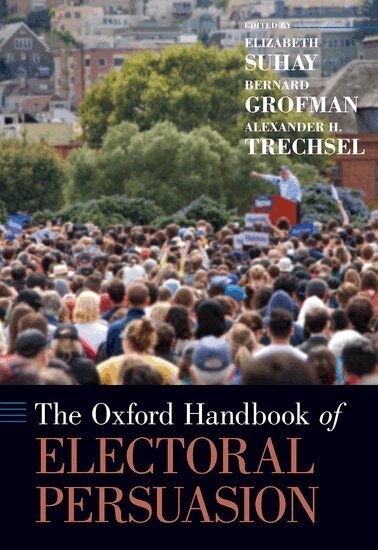
    The Oxford Handbook of Electoral Persuasion

    AvElizabeth Suhay,Bernard Grofman

    Inbunden, Engelska, 2020

    Del i serien Oxford Handbooks

    3 281 kr

    Beställningsvara. Skickas inom 7-10 vardagar. Fri frakt över 249 kr.

    Beskrivning

    Elections are the means by which democratic nations determine their leaders, and communication in the context of elections has the potential to shape people's beliefs, attitudes, and actions. Thus, electoral persuasion is one of the most important political processes in any nation that regularly holds elections. Moreover, electoral persuasion encompasses not only what happens in an election but also what happens before and after, involving candidates, parties, interest groups, the media, and the voters themselves.This volume surveys the vast political science literature on this subject, emphasizing contemporary research and topics and encouraging cross-fertilization among research strands. A global roster of authors provides a broad examination of electoral persuasion, with international perspectives complementing deep coverage of U.S. politics. Major areas of coverage include: general models of political persuasion; persuasion by parties, candidates, and outside groups; media influence; interpersonal influence; electoral persuasion across contexts; and empirical methodologies for understanding electoral persuasion.

    Produktinformation

    • Utgivningsdatum:2020-07-01
    • Mått:251 x 180 x 66 mm
    • Vikt:2 018 g
    • Format:Inbunden
    • Språk:Engelska
    • Serie:Oxford Handbooks
    • Antal sidor:1 128
    • Förlag:OUP USA
    • ISBN:9780190860806

    Utforska kategorier

    • Politisk aktivism inom Samhälle och politik
    • Val och folkomröstningar inom Samhälle och politik
    • Media och underhållning inom Ekonomi och Ledarskap

    Mer om författaren

    Elizabeth Suhay is Associate Professor and Graduate Program Director in the Department of Government at American University's School of Public Affairs. Bernard Grofman is the Jack W. Peltason Chair of Democracy Studies and Distinguished Professor of Political Science at the University of California, Irvine.Alexander H. Trechsel is Professor and Chair of Political Science and Vice Rector for Research at the University of Lucerne.

    Recensioner i media

    This hefty volume takes a multidisciplinary look at the machinations involved in electoral persuasion... Highly recommended. Lower- and upper-division undergraduates. Graduate students and faculty.

    Innehållsförteckning

    • 1. A Framework for the Study of Electoral PersuasionElizabeth Suhay, Bernard Grofman, and Alexander H. Trechsel Part I. General Models of Political Persuasion2. Classic Models of PersuasionRichard R. Lau3. When, How, and Why Persuasion Fails: A Motivated Reasoning AccountRyan G. Cotter, Milton Lodge, and Robert Vidigal4. The Boundary Conditions of Motivated ReasoningRyan G. Cotter, Milton Lodge, and Robert Vidigal5. Reasoned PersuasionBernard Grofman6. Persuasion and Issue VotingBernard Grofman7. Party CuesJohn G. Bullock8. How the News Media Persuades: Framing Effects and BeyondThomas J. Leeper and Rune Slothuus9. The Emotional Aspects of Political PersuasionBethany Albertson, Lindsay Dun, and Shana Kushner Gadarian10. Do Election Campaigns Matter? A Comparative Perspective and OverviewJ. Alexander Branham and Christopher Wlezien Part II. Persuasion by Parties, Candidates, and Outside Groups11. The Utility and Content of Traditional AdsMichael Franz12. The Persuasion Effects of Political EndorsementsCheryl Boudreau13. Mobilization Strategies and Get Out the VoteMelissa R. Michelson14. Appealing to Diverse Electorates in the United StatesDavid M. Searle and Marisa Abrajano15. Race and Racism in U.S. CampaignsChristopher Sebastian Parker, Christopher C. Towler, Loren Collingwood, and Kassra AR Oskooii16. Gendered Aspects of Political Persuasion in CampaignsKelly Dittmar17. Persuasion and Non-Party Groups in the Digital AgeDeana A. Rohlinger18. Interest Groups and ElectionsJeffrey M. Berry19. How Electoral Spending Relates to Political PersuasionDavid B. Magleby20. Low-Resource Candidates and Fundraising AppealsRichard Johnson Part III. Media Influence21. Campaigns and Elections in a Changing Media LandscapeMichael X. Delli Carpini and Bruce A. Williams22. Sowing Distrust of the News Media as an Electoral StrategyJonathan M. Ladd and Alexander R. Podkul23. Beyond Infotainment: Political-Entertainment Media and Electoral PersuasionGeoffrey Baym and R. Lance Holbert24. Horse-Race and Game-Framed Journalism's Effects on Turnout, Vote Choice, and Attitudes toward PoliticsBenjamin Toff25. Misinformation, Fake News, and Dueling Fact Perceptions in Public Opinion and ElectionsDavid C. Barker and Morgan Marietta26. Conspiracy TheoriesJoseph E. Uscinski27. Polarization and Media Usage: Disentangling CausalityJustin de Benedictis-Kessner, Matthew A. Baum, and Adam J. Berinsky28. National and Cross-National Perspectives on Political Media BiasYphtach Lelkes29. The Incentives and Effects of Independent and Government-Controlled Media in the Developing WorldHoracio Larreguy and John Marshall Part IV. Interpersonal Influence30. Persuasion in Interpersonal NetworksAnand Edward Sokhey and Carey Stapleton31. Social Network Effects in Developing CountriesCesi Cruz, Horacio Larreguy, and John Marshall32. Voter Mobilization in Intimate NetworksFlorian Foos and Eline A. de Rooij33. Citizen Deliberation OnlinePatrícia Rossini and Jennifer Stromer-Galley34. Networks and Media InfluenceDavid A. Siegel35. Bandwagon Effects, Information Cascades, and the Power in NumbersSusanne Lohmann36. Lobbying NetworksJennifer Nicoll Victor Part V. Electoral Persuasion across Contexts37. Electoral Persuasion in the New Democracies: Challenges and OpportunitiesRosario Aguilar and Jeffrey Conroy-Krutz38. A Menu of Clientelist Methods to Buy and Coerce Voters: The Dark Side of Electoral PersuasionGilles Serra39. How and Why the Populist Radical Right Persuades CitizensElisabeth Ivarsflaten, Scott Blinder, and Lise Bjånesøy40. The Strategic Adaptation of the Populist Radical Right in Western Europe: Shifting the Party Message Elie Michel41. Party Nominations and Electoral PersuasionJ. Andrew Sinclair42. Persuasion and Ballot PropositionsShaun Bowler and Stephen P. Nicholson43. Online versus Offline Strategies in Comparative PerspectiveTiago Silva44. Voting Advice Applications: The Power of Self-PersuasionAlexander H. Trechsel and Diego Garzia45. How Voters Distort Their Perceptions and Why This MattersAndrea De Angelis Part VI. Empirical Methodologies for Understanding Electoral Persuasion46. Accounting for Complex Survey Designs: Strategies for Post-stratification and Weighting of Internet SurveysErin Hartman and Ines Levin47. Debating How to Measure Media Exposure in SurveysSeth K. Goldman and Stephen M. Warren48. Studying Electoral Persuasion Using Online ExperimentsThomas J. Leeper49. Citizens, Elites, and Social Media: Methodological Challenges and Opportunities in the Study of Persuasion and MobilizationPhilip Habel and Yannis Theocharis