• Fri frakt över 249 kr
  • •
  • Snabba leveranser
  • •
  • Billiga böcker
Kundservice

Du är på sajten för privatpersoner.

Företag, bibliotek eller offentlig verksamhet?

Du handlar på classic.bokus.com, där alla dina funktioner finns intakta.
Till classic.bokus.com
Bokus logotyp. Gå till startsidan.
  • Erbjudanden
  • Nyheter
  • Student
  • Topplistor
  • Barn & ungdom
  • Bokus Play
  • E-böcker
  • Pocketböcker
  • Spel & pussel

10% rabatt på allt med kod: NYSTART10 →

Sidfot

Mina sidor

    Hjälp

    • Kundservice
    • Vanliga frågor och svar
    • Frakt och leverans
    • Retur vid ångerrätt
    • Reklamera vara
    • Betalning
    • Köpvillkor
    • Allmänna villkor
    • Information om webbplatsens tillgänglighet

    Om Bokus

    • Om oss
    • Pressrum
    • För studenter
    • För företag
    • För bibliotek och offentlig verksamhet
    • För leverantörer
    • Hållbarhet

    Populärt

    • Aktuella erbjudanden
    • Presentkort
    • Studentlitteratur
    • Nya böcker
    • Topplistor
    • Signerade böcker
    • Engelska böcker

    Inspiration

    • Boktips
    • BookTok
    • Populära bokserier
    • Barnbokskaraktärer
    • Populära författare
    Logotyp för Bokus
    Följ oss på Facebook (extern länk)Följ oss på Instagram (extern länk)Följ oss på YouTube (extern länk)Följ oss på TikTok (extern länk)
    bokus @ CookiesAnpassa cookiesIntegritetspolicyKöpvillkor
    Till Citymail hemsida (extern länk)Till Budbee hemsida (extern länk)Till Postnord hemsida (extern länk)Till Schenker hemsida (extern länk)Till Early Bird hemsida (extern länk)Till Walleys hemsida (extern länk)
    1. Historia och arkeologi
    2. Historia
    3. Historia: särskilda händelser och ämnen
    4. Folkmord och etnisk rensning

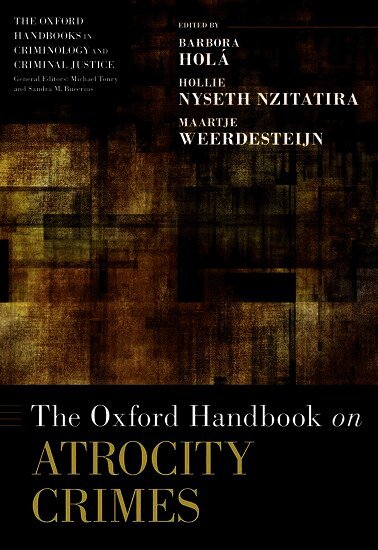
    The Oxford Handbook on Atrocity Crimes

    AvBarbora Holá,Hollie Nyseth Nzitatira

    Inbunden, Engelska, 2022

    Del i serien Oxford Handbooks

    2 810 kr

    Beställningsvara. Skickas inom 5-8 vardagar. Fri frakt över 249 kr.

    Beskrivning

    Social scientific research focusing on mass atrocities, which include widespread or systematic crimes such as genocide, crimes against humanity, and war crimes, expanded after the end of the Cold War. Mass violence in the former Yugoslavia, as well as the genocide in Rwanda, sparked new research initiatives in numerous disciplines. Scholars working in various academic fields such as international (criminal) law, political science, psychology, sociology, history, anthropology, and demography began to focus on the causes and consequences of atrocity crimes. Yet knowledge generated by these various disciplines remains scattered and has not been integrated into a single edited volume.The Oxford Handbook on Atrocity Crimes surveys and further develops the evolving field of atrocity crimes studies by combining major mono-, inter-, and multi-disciplinary research on atrocity crimes in one comprehensive volume. With contributions of leading scholars, this handbook will be an essential source and reference tool. Unique in its thematic focus (atrocity crimes as an overarching phenomenon, including crimes of genocide, crimes against humanity, and war crimes) as well as in its comprehensive scope, the book covers the etiology, the actors involved, the harm caused, the reactions to atrocity crimes, and in-depth analyses of understudied situations of war crimes, crimes against humanity, and genocide.

    Produktinformation

    • Utgivningsdatum:2022-06-14
    • Mått:183 x 241 x 61 mm
    • Vikt:1 771 g
    • Format:Inbunden
    • Språk:Engelska
    • Serie:Oxford Handbooks
    • Antal sidor:980
    • Förlag:OUP USA
    • ISBN:9780190915629

    Utforska kategorier

    • Folkmord och etnisk rensning inom Historia och arkeologi
    • Folkrätt inom Juridik
    • Straffrätt: lagar inom Juridik

    Mer om författaren

    Barbora Holá works as Senior Researcher at the NSCR and as Associate Professor at the Department of Criminal Law and Criminology at Vrije Universiteit Amsterdam, the Netherlands. She has an interdisciplinary focus and studies transitional justice after atrocities, in particular (international) criminal trials, sentencing of international crimes, enforcement of international sentences, rehabilitation of war criminals and life after trial at international criminal tribunals.Hollie Nyseth Nzitatira is an Associate Professor of Sociology at The Ohio State University. Her research addresses the causes of genocide and mass violence, as well as how countries rebuild in the aftermath. Her two current projects funded by the U.S. National Science foundation examine Rwanda's gacaca courts and peoples' reentry and reintegration following incarceration for genocide in Rwanda.Maartje Weerdesteijn works as Assistant Professor at the Department of Criminal law and Criminology at Vrije UniversiteitAmsterdam. She is an interdisciplinary scholar who focusses on the role of the dictator in orchestrating mass atrocities and the responsibility of the international community to mitigate these crimes.

    Recensioner i media

    This extremely comprehensive handbook seeks to overcome this separation and approaches 'serious, large scale, collective, and organized acts of violence' against civilians under the umbrella term 'atrocity crimes'. This concept includes genocide, crimes against humanity, war crimes, ethnic cleansing and the crime of aggression. The editors explain the focus on 'crime' by highlighting that criminology's interdisciplinary approach can unite the scattered field of atrocity studies.

    Innehållsförteckning

    • Introduction: Atrocity Crimes and Atrocity Studies: Barbora Holá, Hollie Nyseth Nzitatira, and Maartje Weerdesteijn PART I: Atrocity Crimes 1. Genealogy and Etymology of Atrocity Crimes: Jeremy Kuperberg and John Hagan 2. On the Empirical Study of Atrocity Crimes: Catrien Bijleveld 3. Atrocity Crimes as a Different Type of Crime?: Mark A. Drumbl PART II: Etiology and Causes of Atrocity Crimes 4. Origins of Predicting Genocide and Politicide: Risk Assessments and Early Warnings: Barbara Harff 5. Human Rights and Atrocities: Melanie O'Brien 6. Armed Conflict and Atrocities: Understanding Power Dynamics: Jolle Demmers 7. Natural Resources and Atrocities: Kieran Mitton 8. Democracies, Dictatorial Regimes, and Atrocities: Maartje Weerdesteijn 9. Ideologies, Identities, and Speech in Atrocities: Jonathan Leader Maynard 10. Meso-level Dynamics of Atrocities: Rachel Jacobs and Scott Straus 11. Detention, Torture, Disappearance: The Crimes of Atrocious Organizations: Susanne Karstedt PART III: Actors in Atrocity Crimes 12. Individuals as Perpetrators of Atrocity Crimes: Alette Smeulers 13. Individuals as Bystanders to Atrocity Crimes: Roland Moerland 14. On the Margins: Role Shifting in Atrocity Crimes: Erin Jessee 15. Child Soldiers: Myriam Denov and Anaïs Cadieux Van Vliet 16. Non-State Actors and Atrocity Crimes: Ugur Ümit Üngör 17. The Involvement of Corporations in Atrocity Crimes: Wim Huisman, Susanne Karstedt, and Annika van Baar 18. The Role of the State in Atrocity Crimes: Christopher W. Mullins 19. The International Community and Atrocity Crimes: The Responsibility to Protect: Alex J. Bellamy PART IV: Harm and Victims of Atrocity Crimes 20. Victimology of Atrocity Crimes: Antony Pemberton and Rianne Letschert 21. How Can Mortality due to Atrocity Crimes be Estimated? Methods and Data Sources: Helge Brunborg 22. Atrocity Crimes and Harm to the Environment: Interrelations between Armed Conflict, Violence, and Ecocide: Daan P. van Uhm 23. Forced Migrants and Atrocity Crimes: Victoria Colvin and Phil Orchard 24. In the Aftermath of Atrocities: Research on the Intergenerational Transmission of Trauma and Violence: Lidewyde Berckmoes PART V: Reactions to Atrocity Crimes 25. Transitional Justice in the 21st Century: History, Effectiveness, and Challenges: David Tolbert and Marcela Prieto Rudolphy 26. International Criminal Justice: Nancy Amoury Combs 27. Sexual Violence as a Practice of War: Implications for the Investigation and Prosecution of Atrocity Crimes: Kim Thuy Seelinger and Elisabeth Jean Wood 28. Amnesties and Truth Commissions: Jeremy Sarkin 29. Customary Responses: Joanna R. Quinn 30. Reparations and the Role of Apologies: Stephanie Wolfe 31. Memory and Memorialization After Atrocities: Nicole Fox PART VI - Case Studies A. War Crimes 32. War Crimes in Angola: Joris van Wijk 33. War Crimes, Atrocities, and Resistance in Colombia: Oliver Kaplan B. Crimes Against Humanity 34. Crimes against Humanity in Indonesia (1965-1966): Jess Melvin and Annie Pohlman 35. Crimes against Humanity and Transitional Justice in Ethiopia (1935-2020): Thijs B. Bouwknegt and Tadesse Simie Metekia C. Genocide 36. Guatemala: Genocide and its Aftermath: Naomi Roht-Arriaza 37. Genocide Against the Êzidîs in Iraq: The Sinjar Massacre and its Aftermath: Kjell Anderson